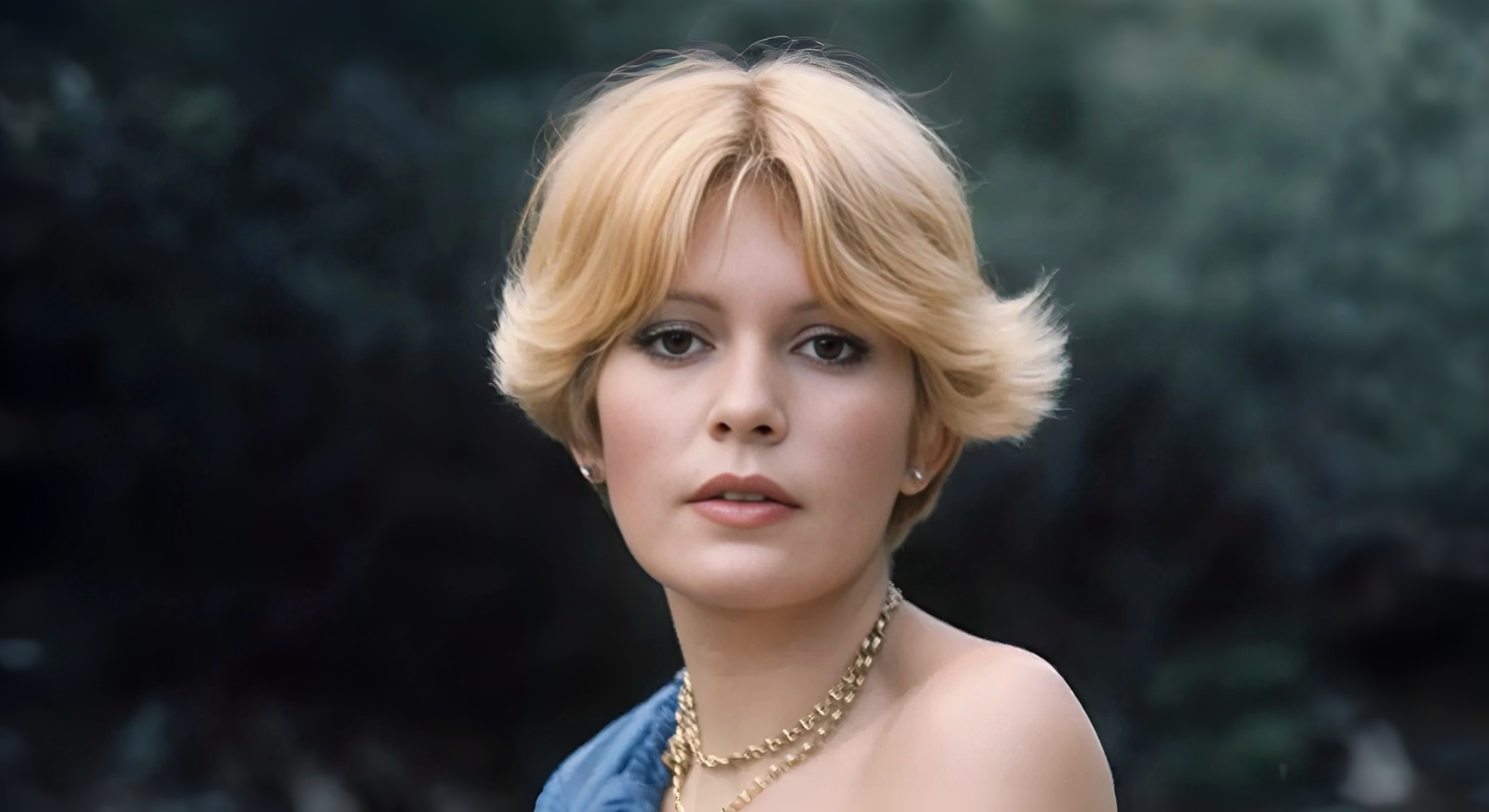


Seven centuries after royal officers across France arrested the Knights Templar in a single coordinated sweep, the order still stalks Spanish cinema, eyeless and robed, acting out the crimes its historical members were tortured into confessing. Those revenants belong to Amando de Ossorio, and an actress who shared the screen with them in 1974 now receives a career honor from the 59th Sitges International Fantastic Film Festival of Catalonia.
The Nosferatu Award to Bárbara Rey is no nostalgic courtesy; it is the anniversary act of Brigadoon, the section founded in 1986 to recover exactly the popular, disreputable cinema her genre work belongs to, and a statement about which lineage Sitges considers its own.
Brigadoon Turns Forty
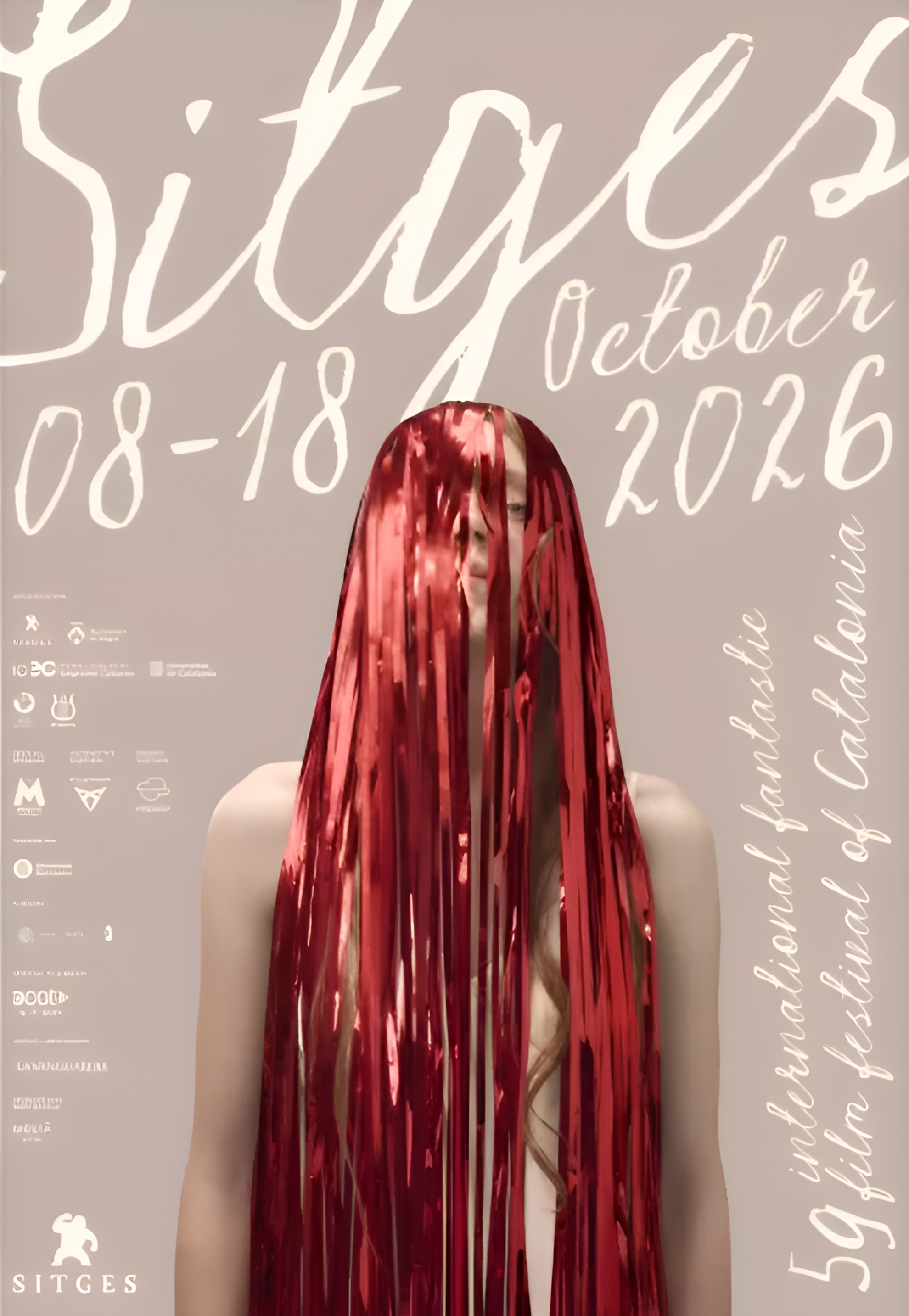
Sitges enters its 59th edition, running October 8th–18th, 2026, as the European anchor of FIAPF’s competitive specialized category for fantastic film, the designation Fantastic Fest has shared since 2023. Its line-up makes the circuit link between the two unusually legible: Óscar Martín’s ‘Upiro,’ whose Austin world premiere in September this publication covered, now competes in the Official Fantàstic In-Competition Selection, while Dara Van Dusen’s ‘A Prayer for the Dying,’ which this publication followed to its North American premiere there, continues its Berlinale-to-genre route in the Noves Visions strand. From this year, a three-member FIPRESCI jury also awards a prize among the competition titles.
The festival’s honorary structure keeps a separate ledger for the past. Sitges defines the Nosferatu Award as a retrospective honorary distinction reserved for national and European film personalities, distinct from the Time Machine Award, which recognizes careers bound to the festival and to the genre at large. The juxtaposition is pointed. Robert Eggers, whose ‘Nosferatu’ this publication reviewed after its December 2024 release, receives a Time Machine Award; the prize carrying the vampire’s name goes instead to a Spanish actress whose genre credits date from the 1970s.
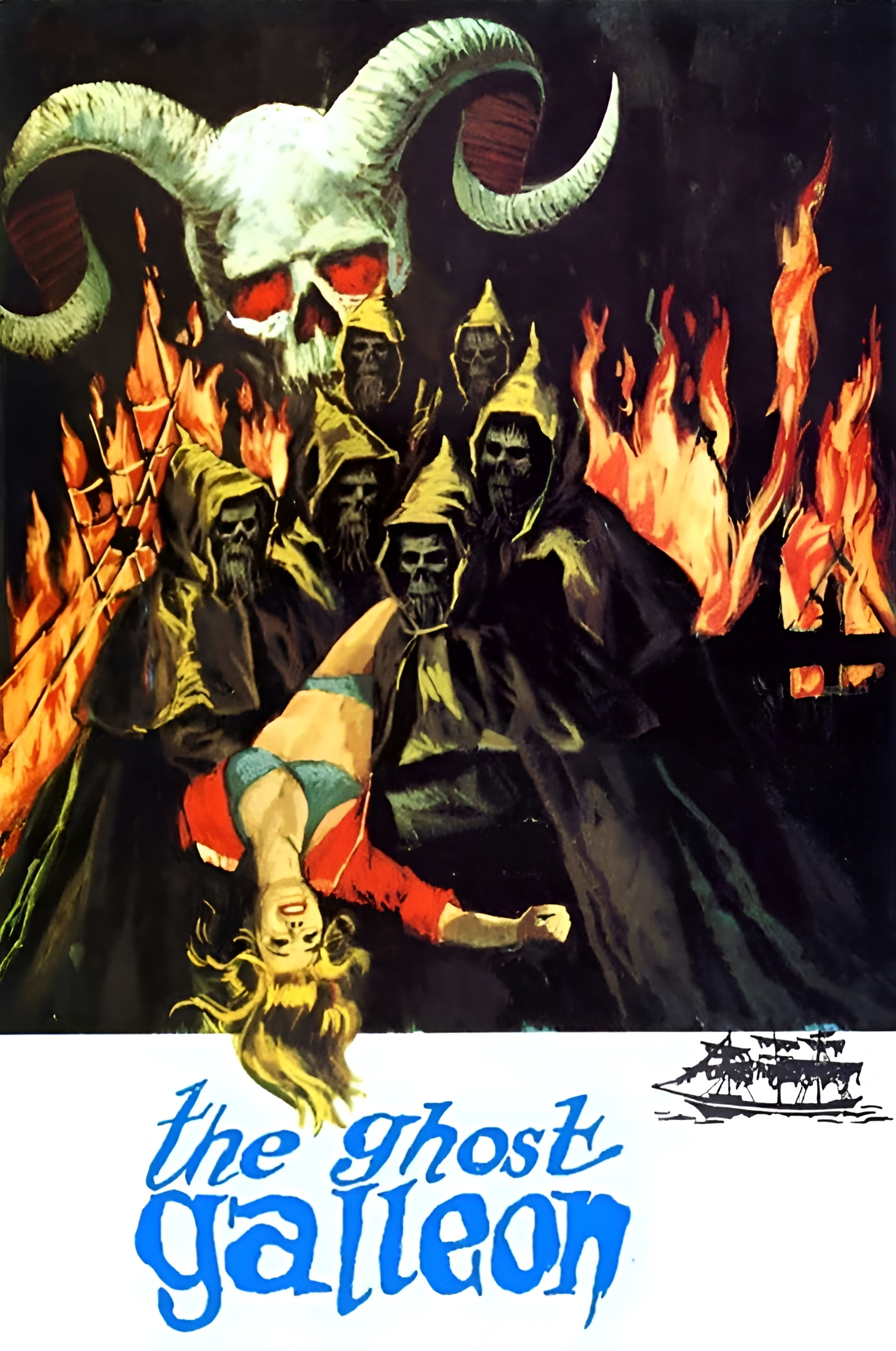
The festival confirmed the honor on September 4th, 2026, as part of Brigadoon’s 40th anniversary, citing Rey’s work in ‘The Ghost Galleon’ and ‘The Night of the Sorcerers,’ both directed by de Ossorio in 1974, alongside Ramón Fernández’s ‘Death Stalks Monica’ and Javier Aguirre’s ‘Battered Flesh.’ An award named after the silent-era vampire, routed through a section devoted to films that traveled along the genre’s fringes, positions Spanish popular horror as a legitimate branch of the European fantastic tradition that Murnau’s 1922 film opened.
A Charge Sheet Turned Mythology
The historical Templars were arrested across France on October 13th, 1307, on the orders of Philip IV, and Pope Clement V suppressed their order in 1312. Malcolm Barber’s study of the proceedings documents how the accusations of spitting on the cross, idol worship, and obscene initiation rites were secured largely through confessions obtained under torture, many of them later retracted by the accused.1 The prosecution’s charge sheet, in other words, outlived the order it condemned.
Spanish letters absorbed that afterlife in the nineteenth century. Gustavo Adolfo Bécquer’s Romantic legend ‘El monte de las ánimas’ sets its haunting on a mountain outside Soria, where Templars and local nobles once slaughtered one another and where, on the Night of the Dead, the fallen are said to rise and hunt across the slopes. The Templar ghost already had a Spanish mountain and a feast day before de Ossorio gave it a camera.
‘Tombs of the Blind Dead’ (1972) made the substitution that defines the cycle. Its Templars are not martyrs of a rigged tribunal but blood-drinking occultists executed for their rites, their hanged corpses left to the birds that took their eyes, rising again to feed. De Ossorio’s quartet treats the fourteenth-century accusations as literal truth, converting a prosecution historians now largely distrust into a monster mythology.
Andy Willis situates the four films within the cultural politics of Spanish horror production of the period;2 the Blind Dead are what a popular cinema produces when it adopts the accuser’s account of history wholesale.
Antonio Lázaro-Reboll dates the Spanish horror boom to 1968–1975,3 and Rey’s genre work sits squarely in its closing stretch. ‘The Ghost Galleon,’ the third Blind Dead film, reached Spanish screens in September 1974, moving the Templars onto a mist-bound ship; ‘Death Stalks Monica’ followed in 1976, and ‘Battered Flesh,’ shot in 1977, reached theaters in 1978, both after the boom had ended.
The Galleon Back on Screen
The award is tied to a screening of de Ossorio’s film under its original title, ‘El buque maldito,’ in Sitges Clàssics, the festival’s heritage strand, where it shares space with a 4K ‘Carrie,’ a restored ‘Tesis,’ Jesús Franco’s ‘Bloody Moon,’ and Eggers’ own ‘The Witch,’ while Aguirre’s ‘Carne apaleada’ appears in the Seven Chances rediscovery section. Two of Rey’s films therefore screen in the same edition, turning a career honor into an argument an audience can test in the auditorium.
The edition’s central anniversary pairing is ‘Carrie’ with Narciso Ibáñez Serrador’s ‘Who Can Kill a Child?,’ both released in 1976 and both turning 50 this year. Placing a Spanish film released the year after the boom’s closing date beside Brian De Palma’s American canon asserts parity; the Nosferatu Award extends that assertion downward, into the popular end of the same national cinema.
Its Spanish Archives strand continues the ‘In Glorious VHS’ series with Jacinto Molina’s ‘Operación Mantis’ and Julio Pérez Tabernero’s ‘Sexy Cat,’ while its documentary slate turns to Dario Argento, Francesco Barilli, Sergio Martino, and Ruggero Deodato. Molina, better known as Paul Naschy, already lends his name to Brigadoon’s short-film prize. The section maintains a working archive of the Southern European popular fantastic, with Spain and Italy treated as a single circuit.
A Programmer Who Wrote the History
Àngel Sala, born in Barcelona in 1964, has directed the festival since 2001. He has written, co-written, or edited some 30 books on fantastic and horror cinema, among them a study of German fantastic film from 1913 to 1927 and ‘Profanando el sueño de los muertos’ (2010), a history of the Spanish fantastic. The festival’s canon and his scholarship share one body of research.
Speaking in an interview published June 16th, 2025, Sala observed that Spanish horror of the Fantaterror period could rarely set its werewolves and vampires on Spanish ground, since the country was treated as off-limits to such monsters, even as the films sold well abroad. The Blind Dead films bear that out in their geography: the first placed its abandoned town on the frontier between Spain and Portugal, and ‘The Ghost Galleon’ moved its Templars onto open water.
Seen that way, the Nosferatu Award is more precise than a tribute: honoring an actress from a cinema that had to displace its monsters in order to exist allows Spain’s leading fantastic festival to relocate them, at last, onto its own program.
Seats at the Meliá Auditori
The 59th edition runs from October 8th to 18th, 2026, opening with Carlota Pereda’s ‘Found Alive’ and closing with ‘Wicker,’ starring Olivia Colman and Alexander Skarsgård. Its principal venue is the Auditori at the Hotel Meliá Sitges, home to the galas and competition, with further screenings at the Sala Tramuntana in the same hotel, the Cinema Prado, and the Cinema El Retiro, all in Sitges, Spain.
Pre-sale for pass and pack holders runs from September 28th at noon CEST, with general sale following on September 29th. General admission for the Auditori costs €12.50 (approx. COP 46,000) and standard general admission €11.50 (approx. COP 42,000); the opening gala is priced at €27 (approx. COP 100,000) and the closing gala at €20 (approx. COP 74,000).11 All season passes and multi-ticket packs had sold out at the time of writing, and film submissions for this edition are closed.
The Vampire’s Name, Reassigned
Murnau’s count gives the prize its name, and Eggers’ remake returned that name to wide circulation two years ago. Sitges keeps the two honors apart with evident intent: the American filmmaker is recognized for renewing the genre, while the Nosferatu name stays with a retrospective lineage running from a fourteenth-century tribunal through a Romantic legend in Soria to a mist-bound galleon of 1974.
In Brigadoon’s 40th year, Sitges is asserting that the Fantaterror cycle was not an embarrassing prologue to the Spanish genre renaissance it later championed. The cycle was the inheritance, and an actress whose genre career spanned only a handful of years is the person the festival has chosen to hand it back to.
Which performer from the European popular horror of the 1970s would you put forward for the kind of recognition Sitges is extending to Rey, and which single film would you screen beside the presentation?
References
- Malcolm Barber, ‘The Trial of the Templars,’ 2nd ed. (Cambridge: Cambridge University Press, 2006). ↩︎
- Andy Willis, ‘Amando de Ossorio’s ‘Blind Dead’ Quartet and the Cultural Politics of Spanish Horror,’ in ‘Screening the Undead: Vampires and Zombies in Film and Television,’ ed. Leon Hunt, Sharon Lockyer, and Milly Williamson (London: I.B. Tauris, 2013), 233–248. ↩︎
- Antonio Lázaro-Reboll, ‘Spanish Horror Film’ (Edinburgh: Edinburgh University Press, 2012), chap. ‘The Spanish Horror Boom: 1968–75.’ ↩︎

Leave a Reply