


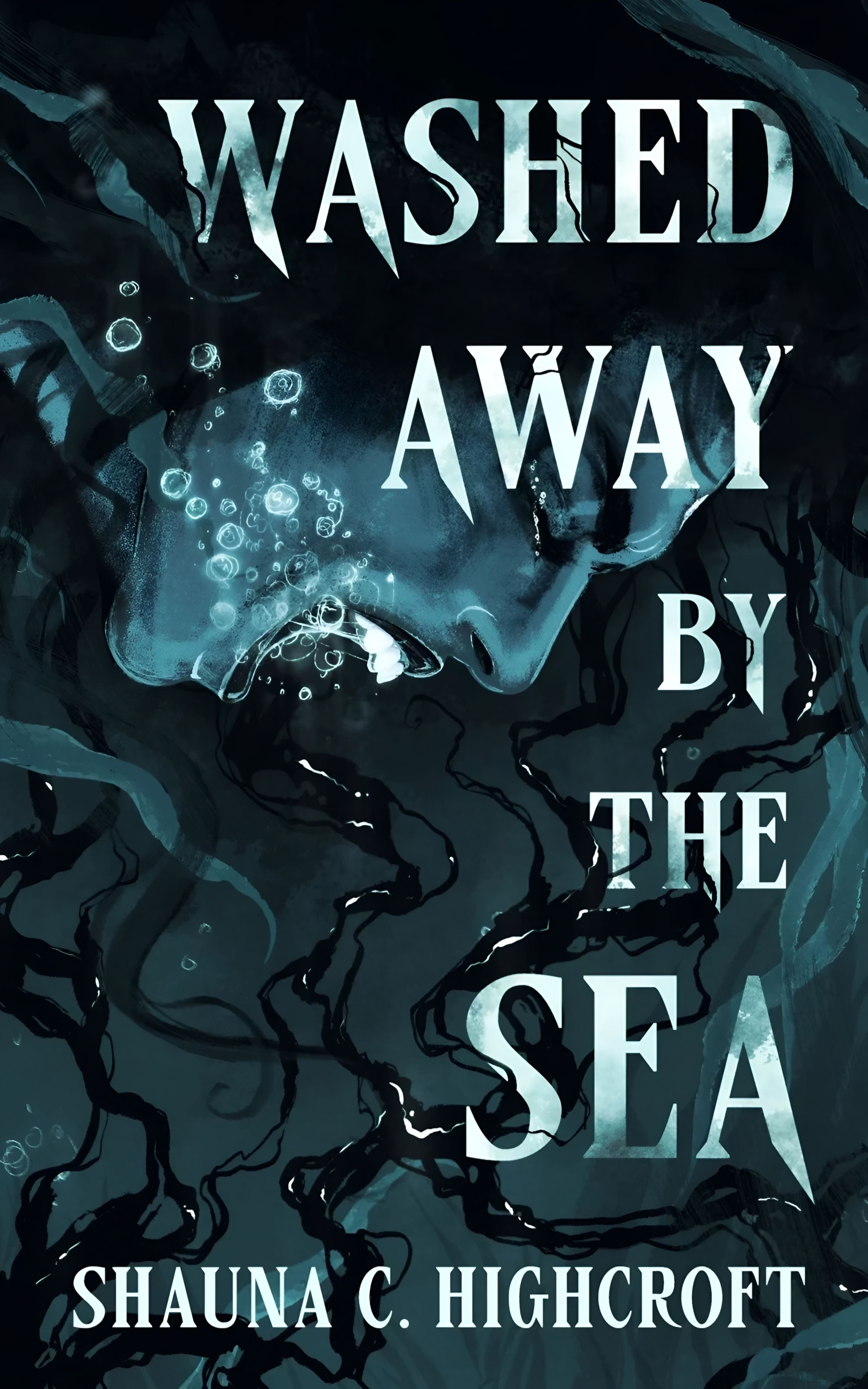
A funeral is the only reason Samantha Passmore has for going back. The village sits beside the cove on Hoal Beach where, 10 years earlier, something tore her apart and left her alive, and she has spent the decade insisting that the thing could not have been real. Her grandfather’s death ends that arrangement, because mourning requires her presence in the one place where the denial cannot stay private.
The premise asks less whether the creature exists than what becomes of a witness who has organized her adult life around the verdict that her own memory was mistaken, and who must now defend that verdict at the edge of the water that contradicts it.
Quill & Crow Publishing House publishes that return as ‘Washed Away by the Sea’ on November 5th, 2026, the debut novel of Shauna C. Highcroft. The paperback carries ISBN 978-1-967911-28-8. The press’s own storefront lists hardcover and ebook editions beside it.
A Survivor Goes Home
The publisher’s synopsis fixes the starting condition with precision. The attack lies in the past, the protagonist has survived it, and she has already performed the one act her survival required: she has decided the creature was impossible and pushed the memory into the corners of her mind. Her grandfather’s funeral supplies the occasion for return, and proximity to the cove shakes loose what she has tried to keep lost at sea.
That order of events departs from the sea-edge horror it descends from. In ‘The Shadow over Innsmouth,’ written by H. P. Lovecraft in November and December 1931 and issued in April 1936 as the only story of his to appear in book form during his lifetime, a student on an antiquarian tour reaches a decaying seaport, flees it, and learns that the place is also his ancestry. The pattern runs from stranger to insider. Highcroft’s protagonist already belongs to the place.
Where the ‘Innsmouth’ pattern ends in recognition, this novel begins in refusal, and the tagline on the publisher’s storefront compresses the consequence into a reversal: “Sometimes healing is its own horror.” Recovery, in that formulation, is not the relief that follows the dread but the shape the dread takes.
A Debut With a Long Lead
‘Washed Away by the Sea’ is Highcroft’s first novel, so no earlier book conditions how it is read; the nearest context is the sale that placed it.
Its acquisition was reported in July 2025, when Cassandra Thompson of Quill & Crow bought it through Ciara Smith and Marisa Corvisiero of Corvisiero Literary Agency, in a report that described the book as “a psychological eldritch horror for survivors.”
The agency’s profile of Highcroft is consistent with that description, crediting her with a lean toward horror and mystery, a pleasure in blending genres, and stories driven by visual imagery and by characters who will not be forgotten.
The agency’s profile of Highcroft is consistent with that description, crediting her with a lean toward horror and mystery, a pleasure in blending genres, and stories driven by visual imagery and by characters who will not be forgotten.
Her publisher’s biography describes dark, lyrical fiction about the unsettling edges of human experience and the thin line between reality and the uncanny, written by an author drawn to stillness and moody weather.
The Eldritch Inheritance
The label attached to the sale has two parts, and each has a documented history. Cosmic horror takes its name and its first critical definition from Lovecraft’s survey ‘Supernatural Horror in Literature,’ researched and written between November 1925 and May 1927, published in the one-issue magazine The Recluse in August 1927, and revised and expanded in 1933 and 1934.
Its central claim is that the oldest and strongest kind of fear is “fear of the unknown,” and that a literature of cosmic fear is a different thing from tales that rest on bodily peril or gore.
The survey also fixes a genealogy: it names Horace Walpole’s ‘The Castle of Otranto’ (1764) as the founding form of the horror story as a literary type, which places the Gothic inheritance of a haunted place at the root of the tradition Lovecraft later pushed toward the cosmic.
The second half of the label has an older and more local history. Eldritch belongs to the Older Scots record, where it meant the uncanny or otherworldly; Robert Burns gave it its best-known English appearance in ‘Tam o’ Shanter,’ where the pursuing witches raise an eldritch screech, and Lovecraft carried it into American pulp in stories such as ‘The Dunwich Horror’ (1929).
Its derivation is contested. The traditional account traces it to an Old English compound meaning elf-realm, while a 2007 article in Scottish Language argues instead for a first element meaning “foreign” and a whole meaning other world.1 Highcroft’s publisher places her in Scotland, where she has lived most of her life, so a novelist from the word’s home country writes under a label that American weird fiction made familiar.
After the Encounter
‘Washed Away by the Sea’ locates its horror in the long afterward of a witness who survived contact and spent years denying it. The tradition Lovecraft surveyed prized the unknown; Highcroft’s protagonist has been handed the unknown and has chosen to call it impossible, and a debut that stakes its structure on that choice joins the ‘Innsmouth’ line by reversing it.
In a catalog committed to the Gothic and the macabre, the reversal reads as continuation: the oldest Gothic question, what an inherited place will not let its heirs forget, asked once more at the edge of the sea.
Which novels have you read in which the encounter with the monstrous is already over when the book begins, leaving the survivor to live beside it, and how did that arrangement change where the dread sat for you?
Reference
- Alaric Hall, ‘The Etymology and Meanings of Eldritch,’ Scottish Language 26 (2007): 16–22. ↩︎



Leave a Reply