

Scholarly surveys of Scandinavian crime writing begin with the ten novels Maj Sjöwall and Per Wahlöö published between 1965 and 1975, which read the welfare state through its crimes, and they extend as far as a vampire novel, John Ajvide Lindqvist’s ‘Låt den rätte komma in’ (2004).1 ‘Alva in the Dark’ Vol. 1 joins that line from the side of comics.
The Danish writer Aksel Studsgarth and the Swedish artist Daniel Hansen send a small burglary crew into a snowbound night, and the supernatural enters the book through the crime.
The premise is a thief’s. Alva, an orphan living on the margins, runs break-ins with a small crew, and one burglary turns up an ancient witch imprisoned behind a steel door. She flees across the frozen north with her friend Mini, hunted by the Craftsmen, a secretive order obsessed with the magical Aldinn tribes.
She carries the blood of the Fell, a near-extinct people whose abilities the order will do anything to control. The argument of the book, on the evidence of its opening pages, is that the order is the monster, and Hansen makes that case before the order appears.
Opening on Appetite
The book does not open on the witch. Page 3 is a six-panel grid of close-ups: a hand crosshatched in black reaching into a paper bag, a takeout box, a mouth crammed with fries, a straw, a burger. Only the final wide panel pulls back to reveal two men eating in a parked car while snow crosses the windshield, one telling the other, addressed as Mini, to look at something outside the frame.
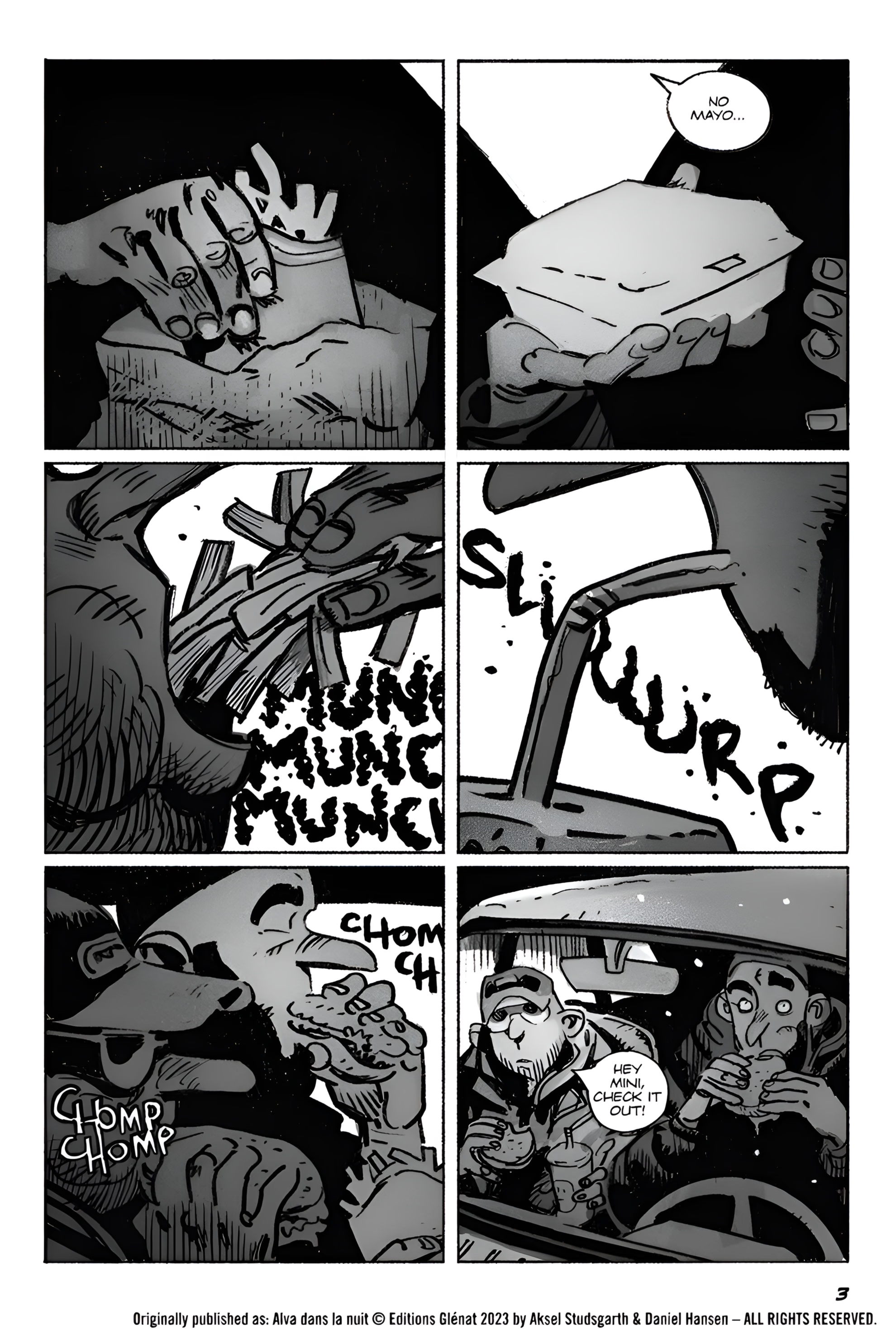
Hansen withholds the establishing shot until the last cell, so the reader meets the crew as hands and mouths before faces, and the chewing and slurping sound effects, lettered in thick brush strokes that the panel borders slice off, take up as much room as the bodies.
The register is ordinary appetite, set down before anything uncanny, and it supplies a measure for the hunger the Craftsmen are said to bring to Alva’s bloodline.
A Fall Staged for Spectators
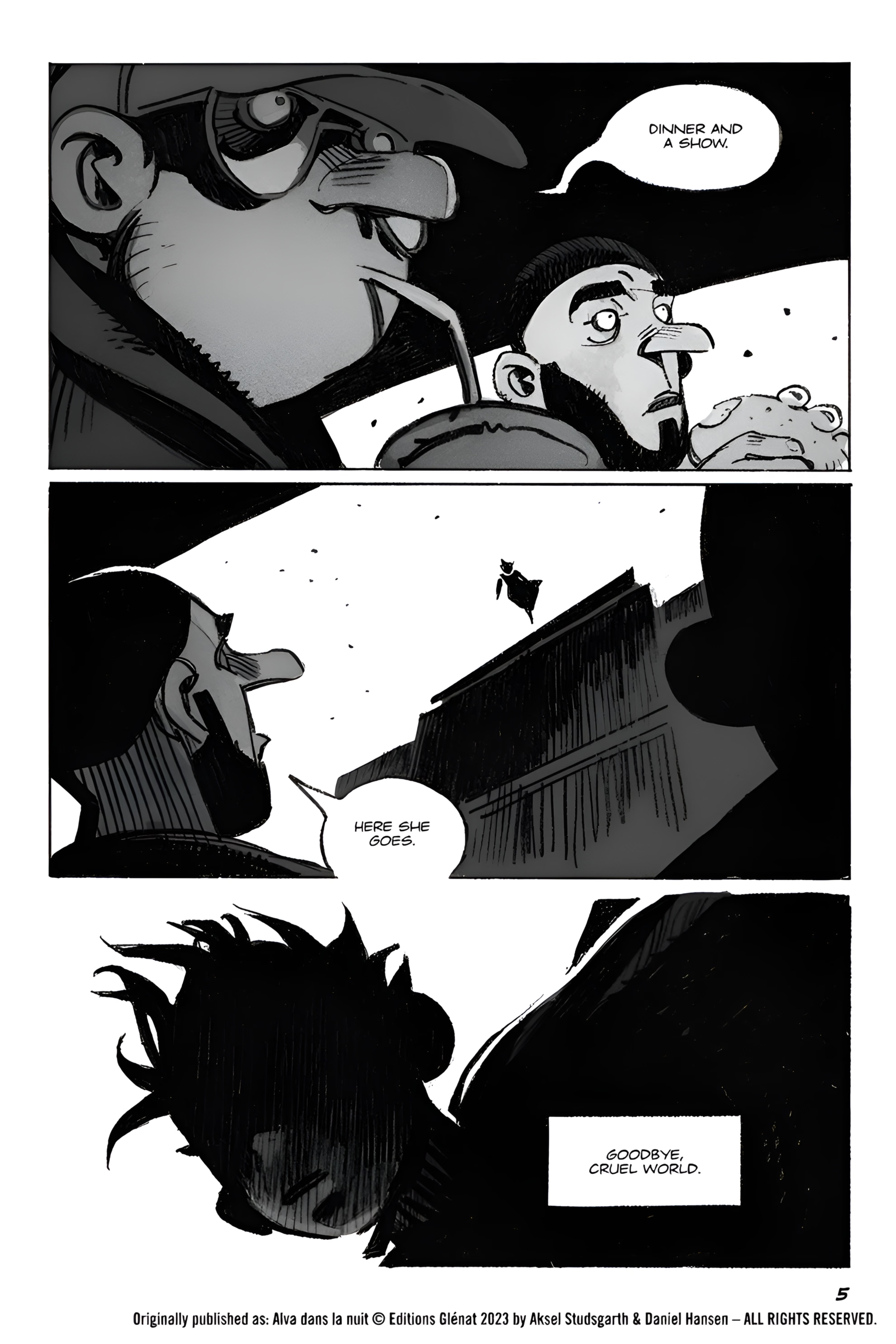
Pages 5 and 7 turn the car into a theater box. On page 5 a close-up of a man with a straw in his teeth delivers the line “Dinner and a show.”
The next panel, a low-angle shot from inside the car, crops a bearded head into the foreground and sets a tiny figure in the black air above a tower’s roofline, falling while snow dots the sky. The third panel cuts to a silhouette of spiky hair seen from behind, beside a bare caption box reciting a melodramatic farewell. The page offers the cliché of a suicide and a picnicker’s commentary in the same breath.
Page 7 resolves the joke. The figure lands in a snowbank lit by headlights, one of the men remarks with a deadpan gesture that the stunt gets to him every time, and a close-up of a young woman’s face, calm and narrow-eyed, closes the page.
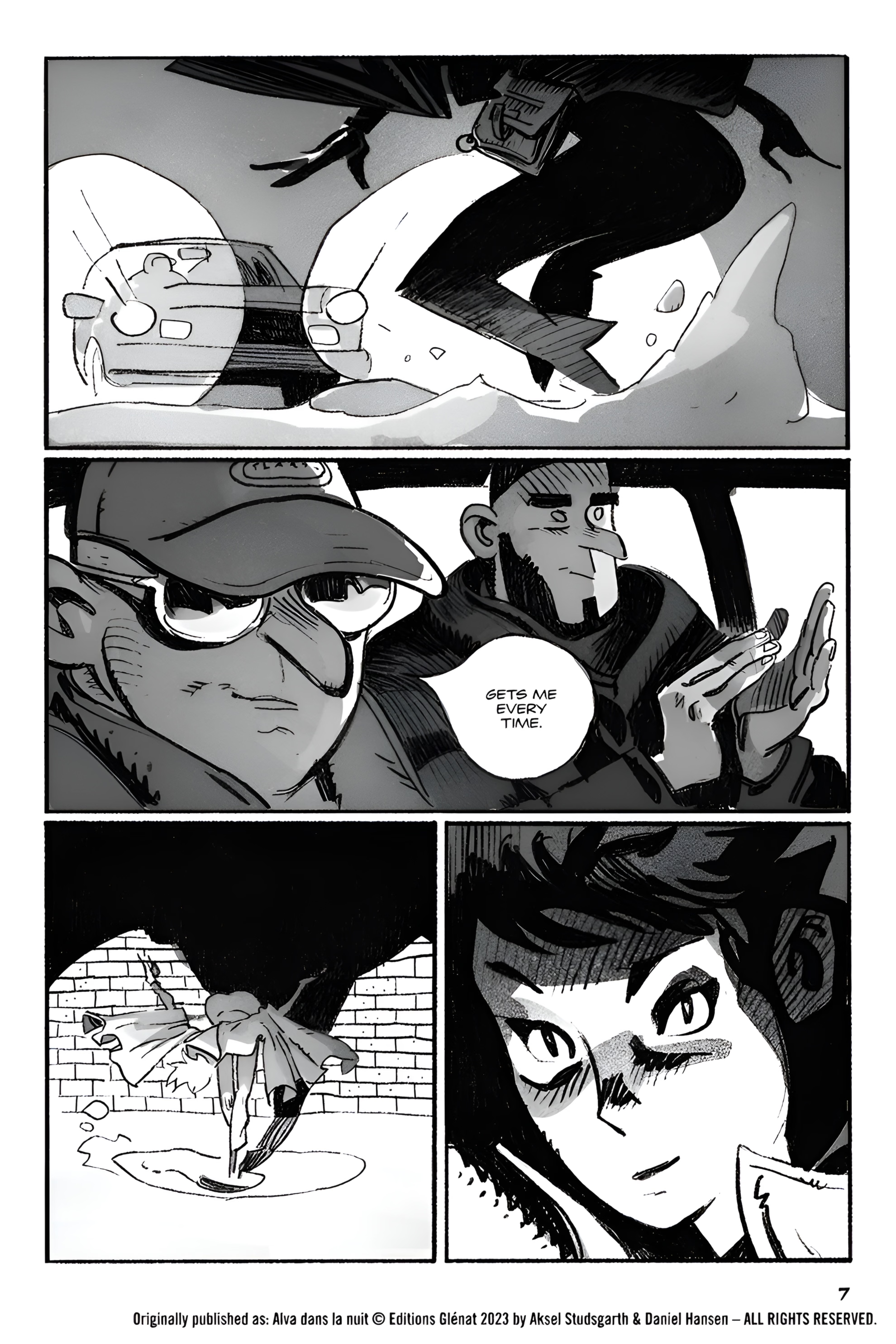
The sequence makes her fall a trade skill and a spectacle at once. The men watch it warm and fed, and the camera sits with them, which places the reader in the same seat: Alva is first seen as something to be watched. The crew exploits her talent with a shrug; the order, as the publisher describes it, will do so with doctrine.
Grain, Ink, and Gray
Hansen’s line alternates between the thick black of a brush and a fine hatching that textures hands, paper bags, pavement, and brick, while the faces are caricatured, with long beaked noses and round glasses, a looseness that makes the crew’s talk feel lived-in.
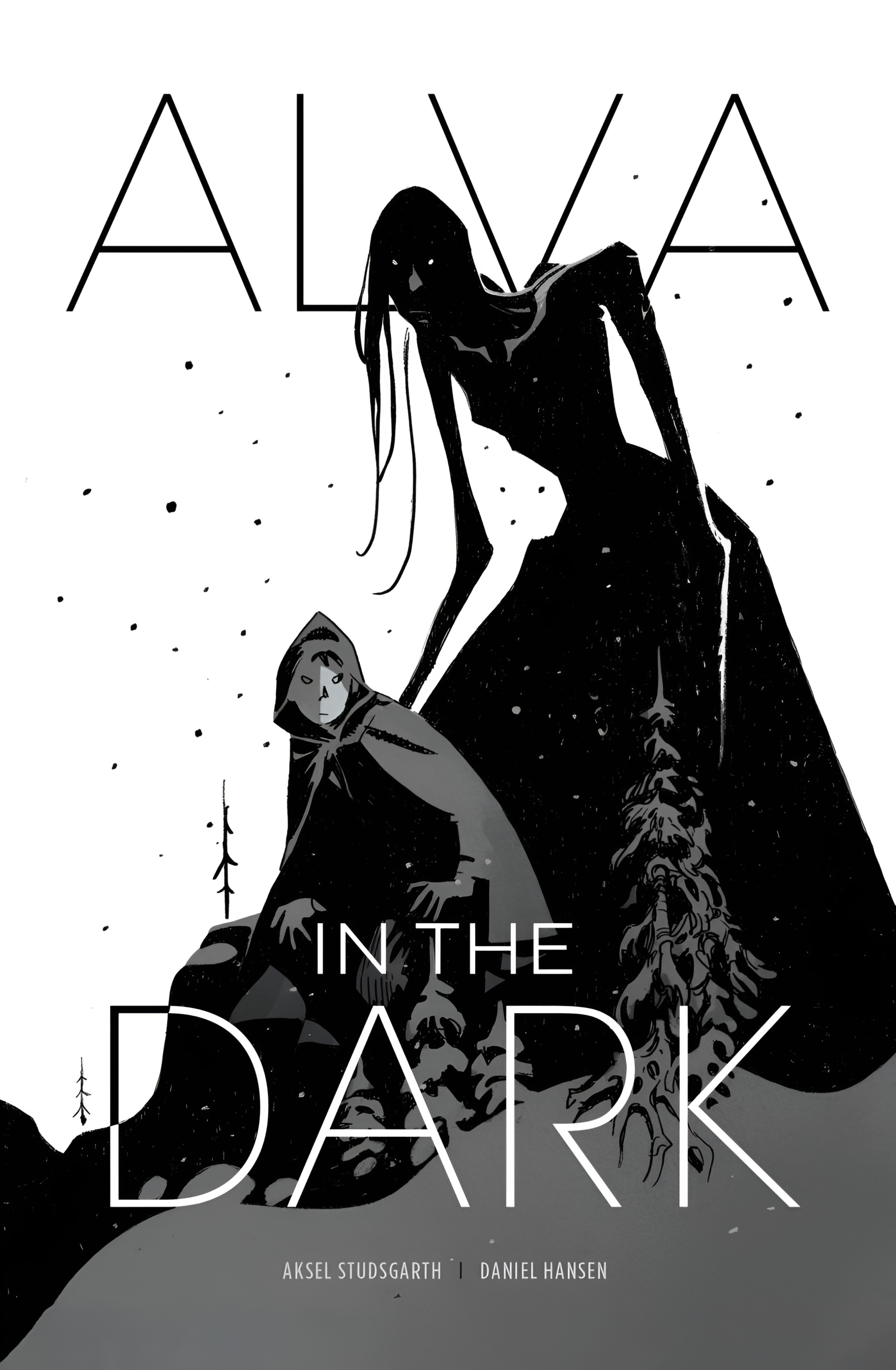
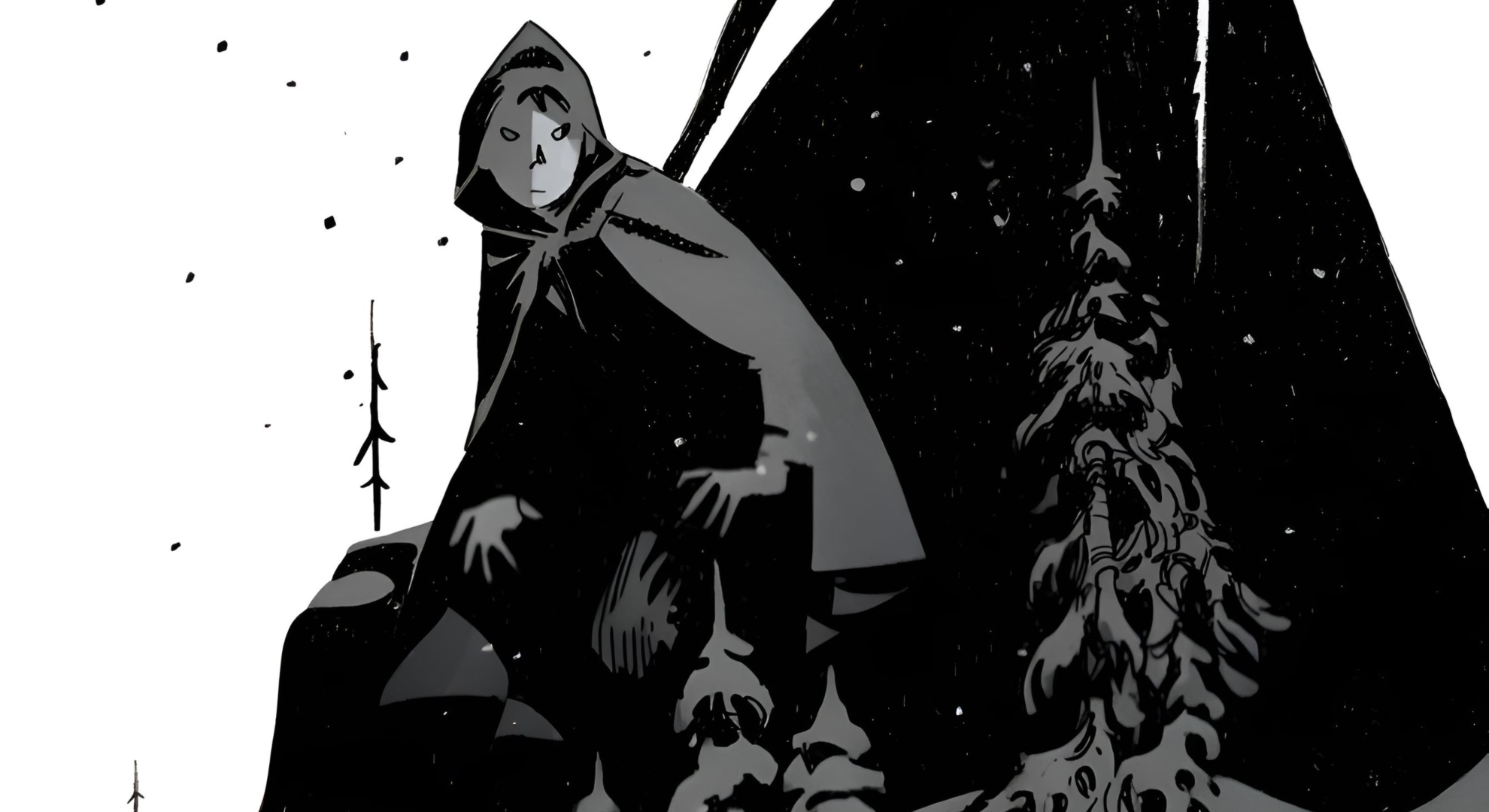
The interior pages supplied for this feature are rendered in black, white, and a graded gray wash under a fine grain, a palette that holds snow, headlight, and skin on one tonal scale, so that the white of a balloon or a caption box becomes the loudest thing on the page. The cover compresses the same palette into one contrast: a tall black-gowned figure bending over a small hooded one beside a spruce, on white ground.
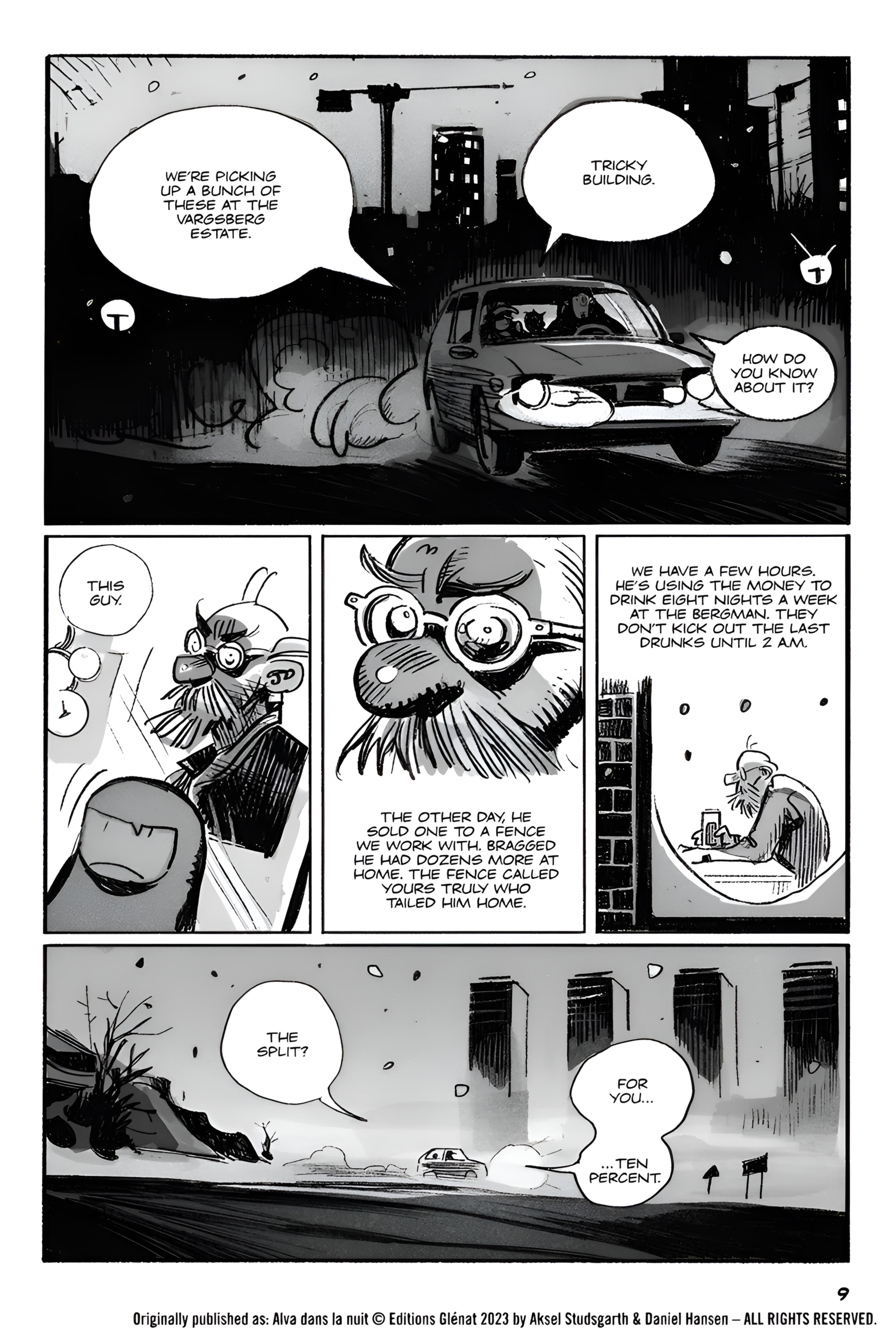
Panel shapes follow the scene’s attention. Page 9 sets a wide shot of a car crossing a dark road beneath a crane and apartment towers above three small panels of exposition about an old man’s hoard, then closes on a wide strip where the car shrinks to a dot while the dialogue turns to the split.
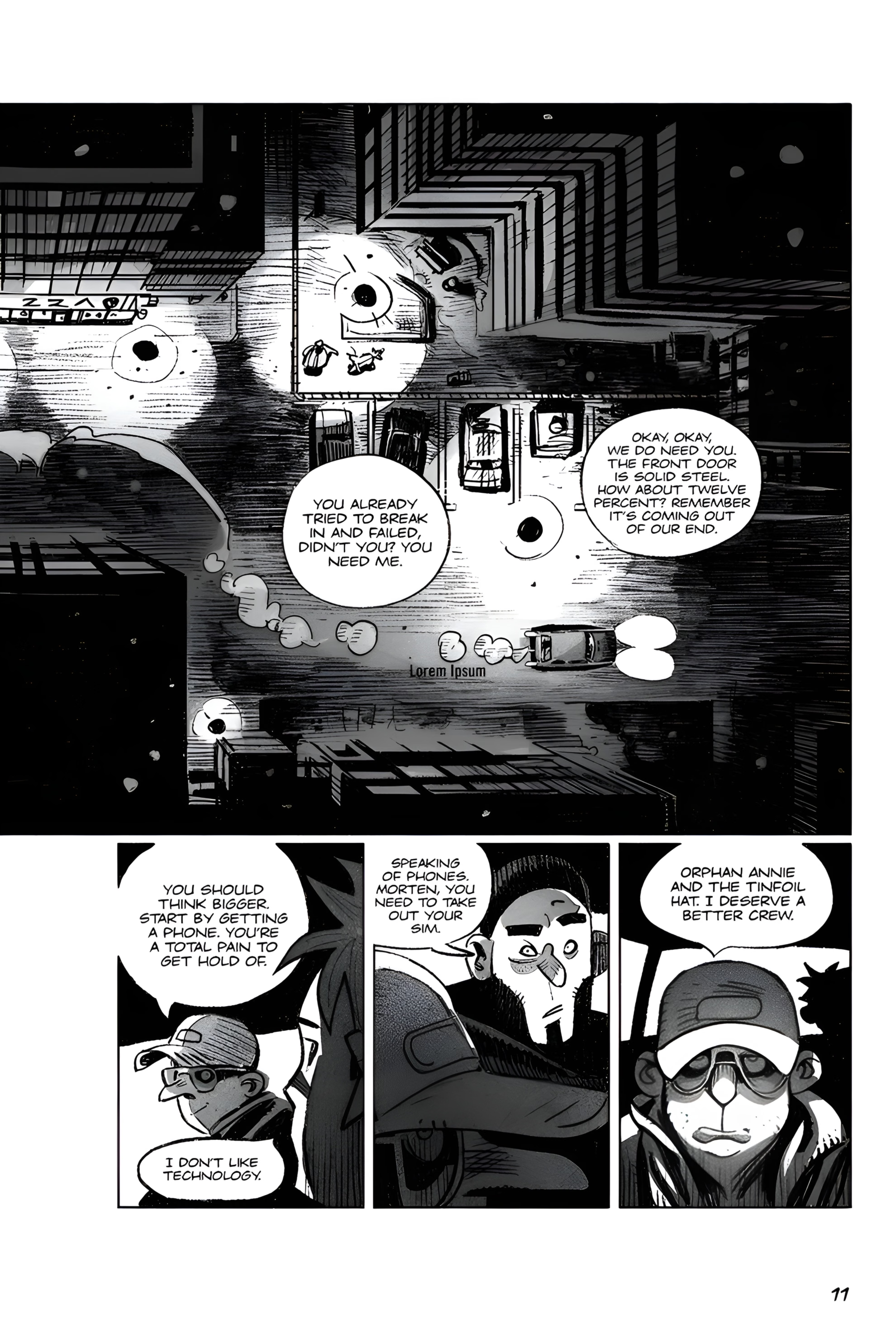
Page 11 goes further: a full-width overhead shot reduces the car to a small shape trailing puffs of exhaust through a grid of snowbound streets, and the tails of two balloons dissolve into those same puffs, so the talk of a failed earlier attempt and a raised offer travels with the exhaust. Below it, three narrow panels return to faces in close, bickering about phones and crew.
The Order Behind the Witch
Before the Craftsmen begin their hunt, Hansen has taught the reader to watch Alva the way her crew does: from a warm car, at a distance, as a performance with a payout. The figure bent over the small hooded one on the cover reads as the threat only if the reader forgets that, on the page, the first people to treat Alva as a resource are the ones sitting nearest to her.
What the order adds to that habit is a system, a name, and a doctrine of control, and that addition is where the book locates its horror. The monster of ‘Alva in the Dark’ is not a creature at the end of the road but the practice of looking at a person and seeing what can be taken from her.
If the crew’s casual treatment of Alva as an asset in the opening pages already contains the order’s logic, does the Craftsmen’s pursuit frighten more because it is familiar, or does it lose force by repeating what the crew has already shown?
Reference
- Jakob Stougaard-Nielsen, ‘Scandinavian Crime Fiction’ (London: Bloomsbury Academic, 2017), 39–61, 130–34. ↩︎

Leave a Reply