

In April of 1933, a Minnesota pulp writer named Carl Jacobi placed a short story in the pages of Weird Tales, the magazine that gave American horror its first regular home. The tale turned on a black-bound book, a vampiric presence, and a dreamer who could no longer tell where his nightmares ended and his waking hours began. Nearly a century later, that obscure piece of weird fiction supplies both the title and one of the governing images for a record made in Athens.
Vampire stories have always traveled well, precisely because they carry a culture’s private fears in portable form. The figure that unsettled a Depression-era American readership is the same one a Greek extreme metal band now summons on a record finished in a California studio. That circulation — of images, of dread, of inherited literature — is the real subject beneath the music.
A Third Statement From Athens
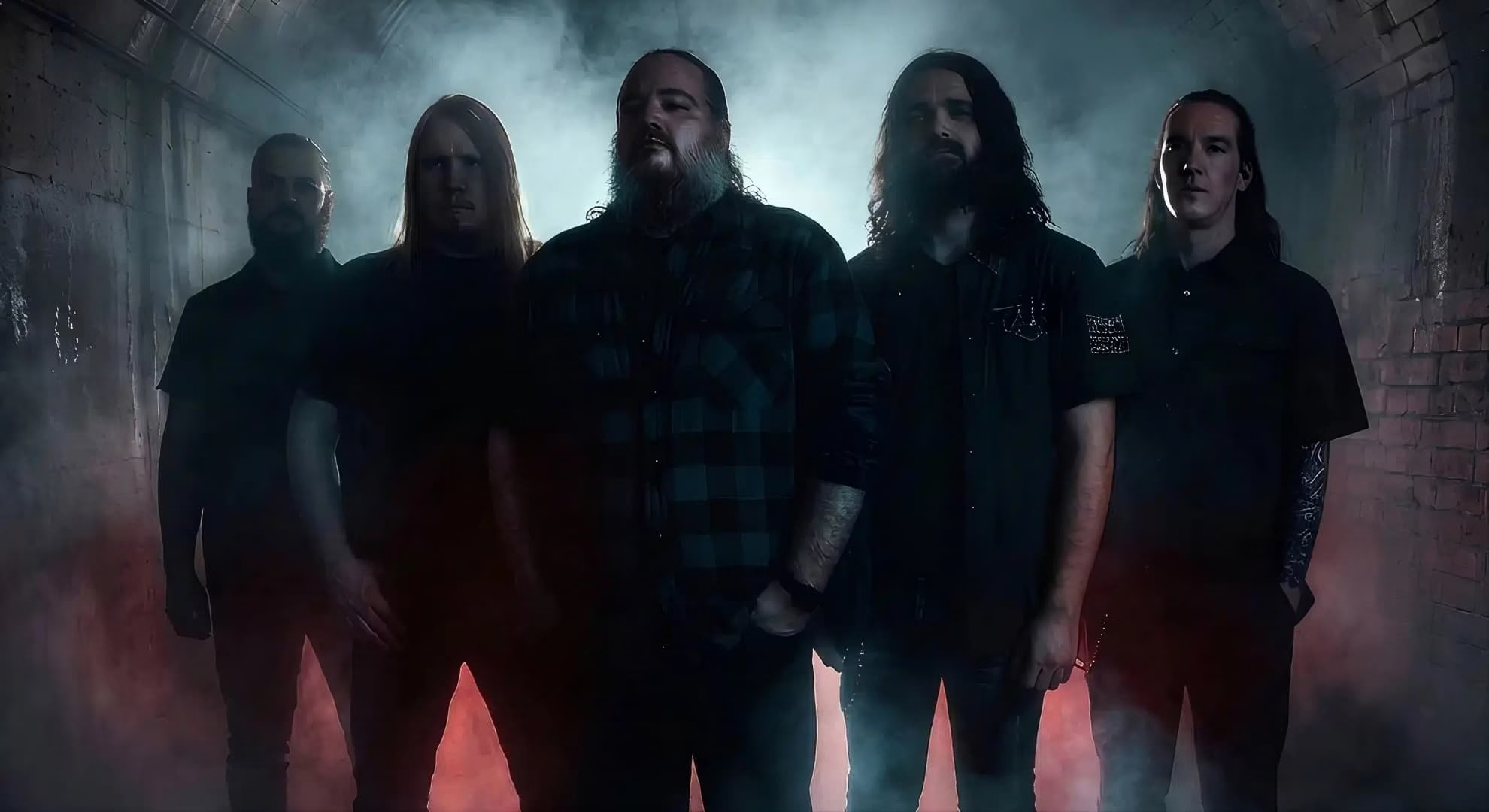
Caelestia formed in Athens in 2013 and have moved, across more than a decade, from a conventional melodic death metal outfit into something harder to file.
Their 2015 debut ‘Beneath Abyss’ on Inverse Records set the melodic template; a second full-length and the 2025 ‘Infernalia’ EP on Wormholedeath Records tracked a steady turn toward severity. ‘Revelations In Black,’ their third full-length, reaches listeners on July 24th, 2026, through Eclipse Records.
Guitarist Bill Thomas has described the change as a matter of necessity rather than ambition. After the pandemic hiatus, several members departed, and the songwriting responsibility settled on him — a composer whose instincts run guitar-first rather than orchestral. Vocalist Pantelis Daskalelos, who writes under the name Lordwinter, found his darker preoccupations easier to place inside that more aggressive frame.
Thomas has also framed the refusal of a single genre label as a longstanding trait rather than a new pose. The band have always reached across melodic black metal, technical death metal, and atmospheric passages, and he regards the widening of that range as a healthy tendency across the wider scene. ‘Revelations In Black’ is the record on which that breadth is meant to cohere into a signature instead of a scattering.
The group did not reach this point in isolation. Years of touring across Europe and the United Kingdom, shared stages with Arch Enemy and Katatonia, and studio contributions from figures such as Björn Strid and Jason Bittner placed Caelestia inside a working international circuit well before this signing. What the new record proposes is a consolidation of that position under a single, guitar-driven identity.
The German Hands Behind the Kit
The most telling addition to that identity sits behind the drum kit. Marc Reign, born Markus Reincke, is a German player whose history runs through two distinct chapters of his country’s extreme music. He held the drum chair in the thrash institution Destruction from 2001 to 2010, then joined the reunited death metal pioneers Morgoth in 2011.
His recruitment ties a Greek band to a German heritage that predates the Gothenburg sound Caelestia otherwise draw upon. Destruction belonged to the first wave of European thrash; Morgoth was among the earliest German death metal acts on Century Media. A rhythm section anchored by that experience gives the record a direct connection to the continental extreme tradition, rather than a borrowed one.
Ohren and the Bay Area Precision
The other decisive hand belongs to Zack Ohren, who produced, mixed, and mastered the record at Castle Ultimate Studios in Oakland, California.
Ohren has spent two decades as one of the Bay Area’s most sought engineers for technically demanding metal, with credits that include Machine Head, Suffocation, Immolation, Fallujah, and Cattle Decapitation. His signature is clarity under pressure — the capacity to hold a dense, fast arrangement legible without smoothing away its aggression.
That specialization matters for a band pursuing the seam between Gothenburg melody and American death metal precision. A hybrid of that kind collapses into noise without an engineer who can keep every layer distinct, and the recorded document is where such balances are settled.1 Ohren’s involvement is therefore a structural statement about the sound Caelestia want, not an incidental hire.
The Vampire That Keeps Returning
The title track adapts Jacobi’s weird fiction directly, while the album’s opening piece, ‘La Morte Amoureuse,’ borrows its name from Théophile Gautier’s 1836 tale of a priest seduced by a vampiric revenant. Two centuries of vampire literature, French and American, thus frame the record before its historical material even begins. The choice is deliberate on a band that has staked its renewal on literary and historical depth.
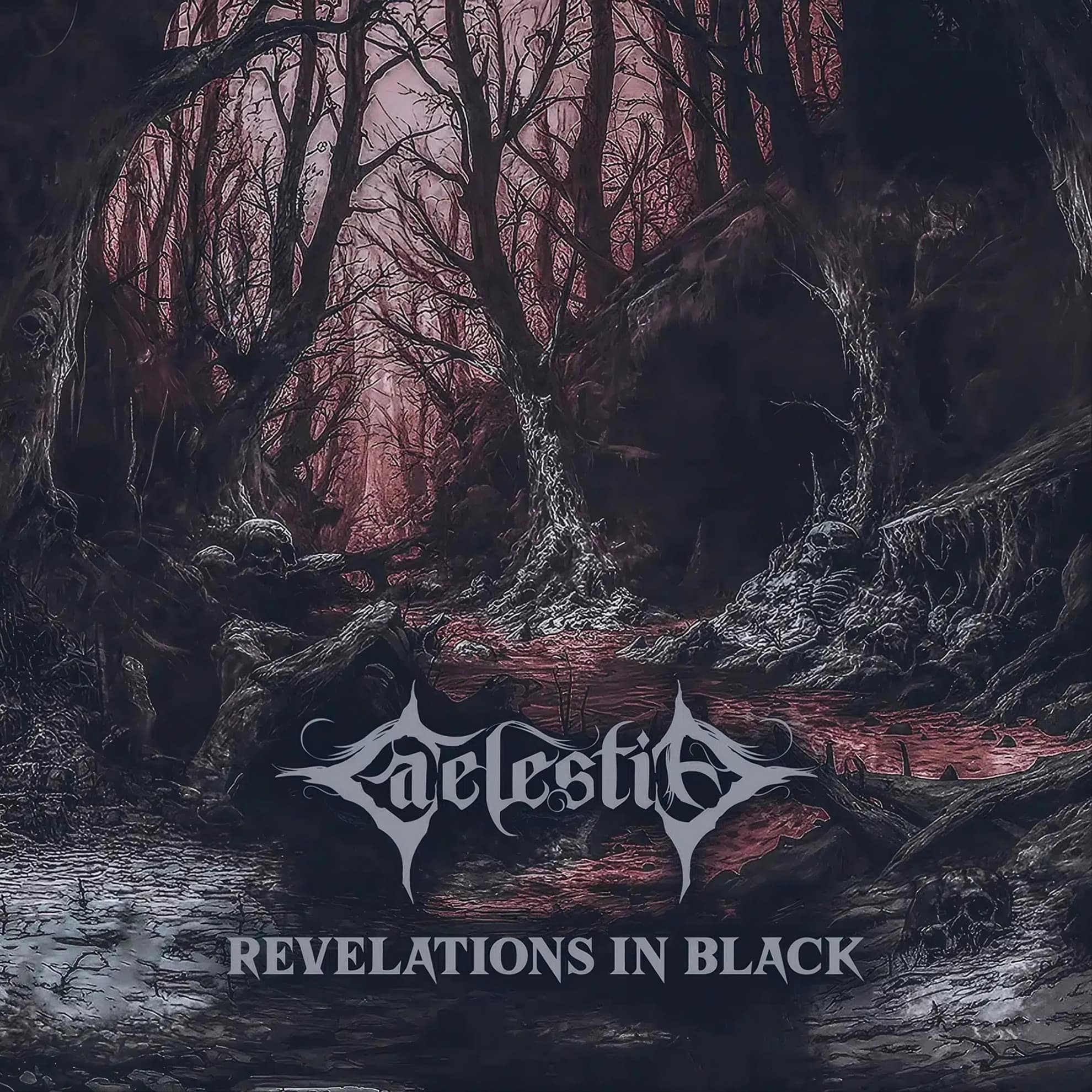
The album folds that same book into its own structure. Its seventh track, ‘Five Unicorns and A Pearl,’ takes its name from the black-velvet, ivory-skull volume within Jacobi’s story — the cursed book whose reading draws the narrator toward the vampire — and stands as a prelude to the title track.
The vampire endures in fiction because it is endlessly rewritten, each era refashioning the figure to carry its own anxieties.2 Jacobi’s Depression-era dreamer and Gautier’s tormented cleric are not the same creature, and a modern metal band reading both performs that same act of reinvention. What Caelestia take from the tradition is less a monster than a method: the past returning in altered form to speak to the present.
A Letter From the Dead
Two pieces of the record have reached the public ahead of its release. ‘Dead Eternal,’ released with a video in June of 2026 as the album’s first visual chapter, was directed by Sergios Vafiadis, whose prior work includes videos for Rotting Christ and Cirith Ungol, and filmed in Northern Attica and the First Cemetery of Athens.
The track is a tribute to Per Yngve Ohlin, the Swedish vocalist known as Dead, who fronted the Norwegian band Mayhem until his death in 1991.
The lyric grew out of a published collection of Ohlin’s correspondence, ‘Letters from the Dead.’ Reading them, Thomas has said, revealed a figure very different from the myth; behind the projected image was, in his words, “a young dreamer.” The song sets that private person against the legend that consumed him.
Heard on its own, ‘Dead Eternal’ moves between melodic tremolo lines and a heavier, mid-paced churn, its clean-to-harsh vocal contrast carrying the song’s grief. The wish to memorialize the dead in formal, public art is among the most durable impulses in European culture, and a tribute of this kind belongs to that long practice of commemoration.3 Caelestia frame the piece not as morbid fascination but as an argument for life, urging viewers to choose living over the myth of a beautiful death.
The Forest and the Propaganda
‘Wolves’ turns from black metal’s own history to a darker chapter of the twentieth century. Its subject is the Werwolf organization, an SS-directed guerrilla program activated in the final months of the Second World War to conduct sabotage behind Allied lines. The scheme failed militarily, yet its myth — of indoctrinated youth vanishing into the German forest — outlived the regime that produced it.4
The track reached the public as the album’s second single and video, its harder, guitar-driven attack making audible the direction the band describe.
Caelestia treat that myth as tragedy rather than emblem. Their stated concern is the manipulation of the young by propaganda during the collapse of the Third Reich — the machinery that turned children into instruments of a lost cause. The song’s value lies in that framing: it observes how radicalization is engineered, without granting the fantasy of occult persistence any glamour.
The Weight the Record Carries
‘Revelations In Black’ reaches its audience as a record about return — the vampire rewritten, the dead musician reconsidered, the wartime myth reopened for judgment. Each of its confirmed subjects is a piece of the past summoned back to be examined under present light, and the method is that summoning rather than nostalgia. Whether the full sequence sustains the seriousness of its singles and its stated themes is a question only July 24th can settle.
What is already clear is the shape of the ambition. A band from Athens has bound German rhythmic heritage, French and American Gothic literature, and Norwegian black metal history to a sound finished in California, then offered the result to an underground that recognizes no border. That reach, more than any single track, is what gives the moment its weight.
If a record earns its authority by reopening the past — a Depression-era vampire tale, a lost black metal voice, a wartime program of engineered radicalization — which of those returns speaks most directly to your own reasons for seeking out music that refuses to look away from history?
References
- Susan Schmidt Horning, ‘Chasing Sound: Technology, Culture, and the Art of Studio Recording from Edison to the LP’ (Baltimore: Johns Hopkins University Press, 2013), 201–206. ↩︎
- Nina Auerbach, ‘Our Vampires, Ourselves’ (Chicago: University of Chicago Press, 1995), 3–9. ↩︎
- Jay Winter, ‘Sites of Memory, Sites of Mourning: The Great War in European Cultural History’ (Cambridge: Cambridge University Press, 1995), 78–83. ↩︎
- Perry Biddiscombe, ‘Werwolf!: The History of the National Socialist Guerrilla Movement, 1944–1946’ (Toronto: University of Toronto Press, 1998), 264–270. ↩︎


Leave a Reply