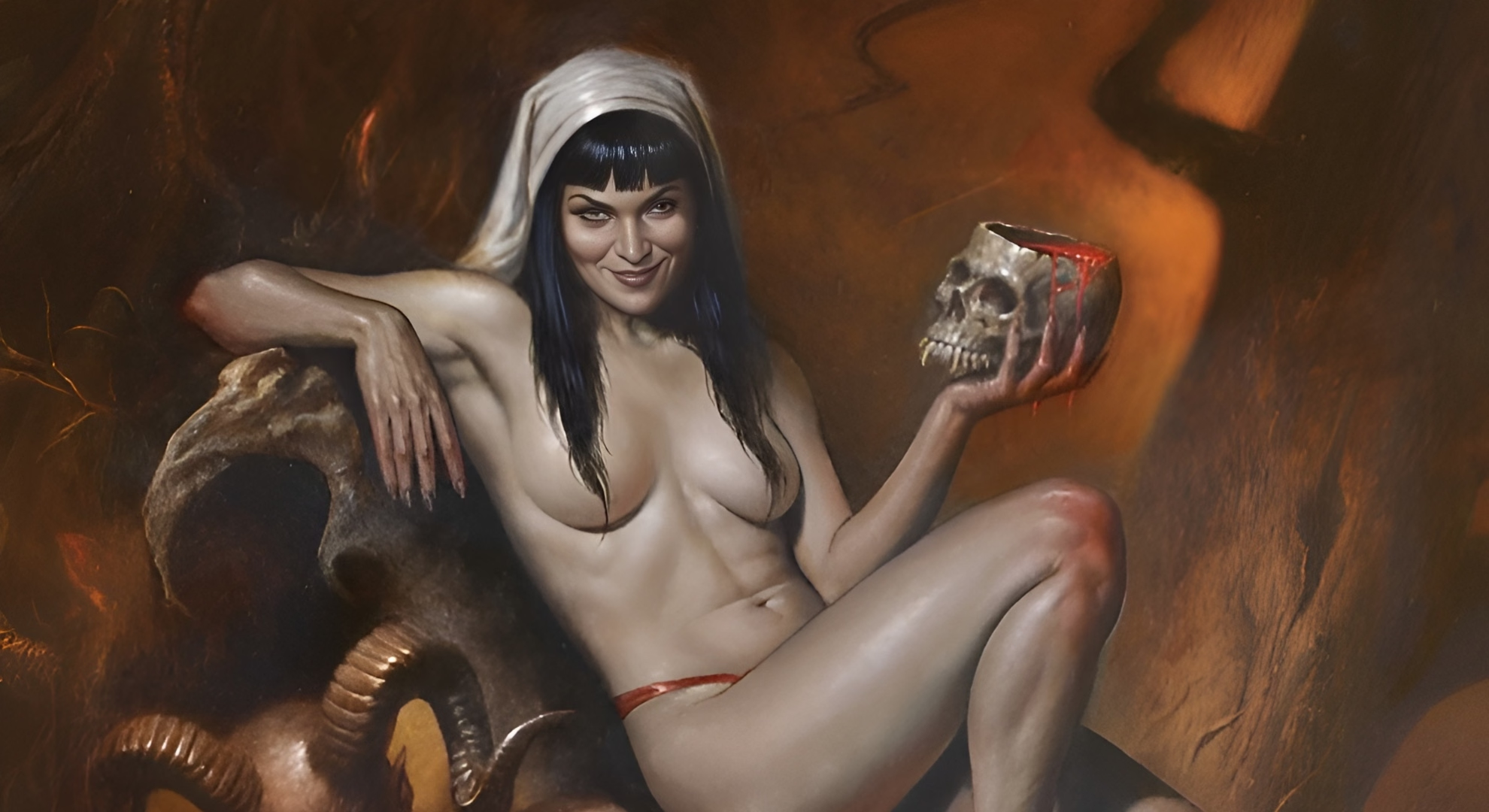


Vampirella is a vampire by species rather than by curse. She is an extraterrestrial from Drakulon, a world where blood runs in rivers and seas, and her need for it is biology, not damnation. That origin separates her from the human victims of the genre’s older monsters and made her, from the first page, a hunter of the dark rather than its prey.
She was also an erotic figure by design. Her costume, a narrow red cut that leaves most of the body bare, was the character’s defining image, and Warren presented her as a sensual hostess who introduced the horror stories in each issue. The sensuality was the premise of the character, not an ornament added to it, and it is the quality any later treatment must either keep or consciously set aside.
Her place in comics rests on that combination. She has passed through three publishers, Warren, Harris Publications, and Dynamite Entertainment, and each new treatment has been measured against the monochrome horror magazine in which she began. That continuity is what gives a single manga-style issue its stakes: the format asks whether a character this fixed in one image can carry an entirely different grammar of the page.
A book that opens from its back cover tells its reader that the habits of the medium have been suspended before a single panel is read. ‘Vampirella’ #8, scheduled for release by Dynamite Entertainment on November 18th, 2026, applies that instruction to a heroine whose own history began in a black-and-white magazine in September 1969. The issue runs 32 pages at $4.99, approximately COP 16,160. Dynamite lists it as a special manga-style issue within the current Vol. 8 series.
A Book Entered From the Back
Christopher Priest writes the issue and Ziyan Qiu, a newcomer to the series, draws it. The art runs in black and white with color accents. Lucio Parrillo supplies Cover A. Letterer and editor credits could not be confirmed at the time of publication.
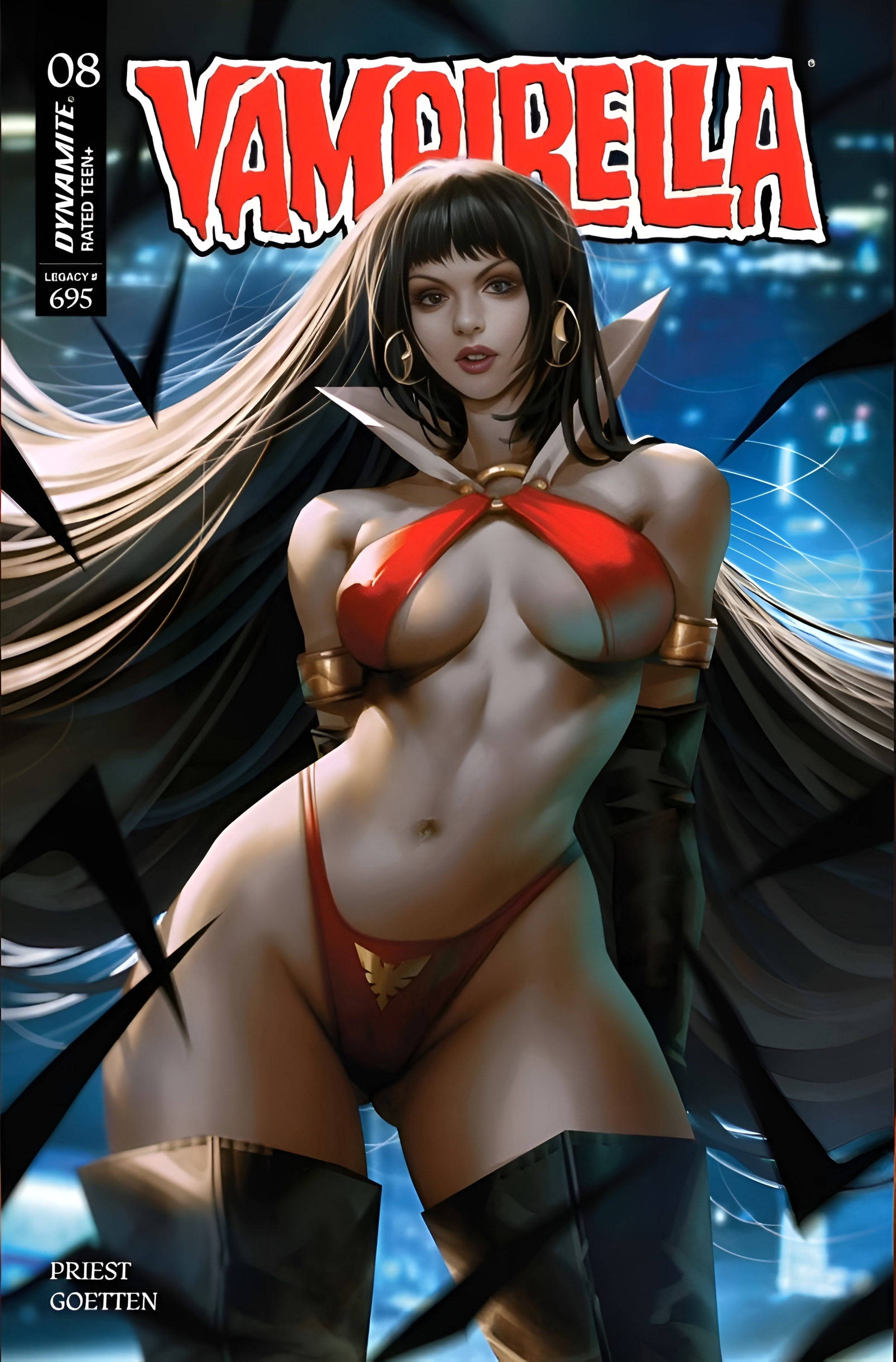
That back cover matters more here than in a conventional issue. Dynamite presents the book in the manga tradition, reading from back to front, with panels flowing from right to left, and a book made that way is entered through what Western shelves call its back.
Comics scholarship describes manga’s conventions as a learned visual language with a grammar of its own.1 Reversing the page order therefore changes more than direction. It changes what the reader must learn before the story can be followed at all.
The reversal gives Priest a formal counterpart to his premise. Dynamite describes a Vampirella reeling from her therapist’s prescription medication and entering a world of her own creation. A reader forced to navigate an unfamiliar page order shares that displacement without a caption to announce it; the disorientation belongs to the book rather than to the dialogue.
The interior pages remained unseen at the time of publication, so this argument rests on the format Dynamite has confirmed rather than on any single sequence, and only the pages themselves can show if the panel layouts exploit the reversal or merely accommodate it.
Monochrome as Homecoming
The black-and-white choice returns Vampirella to her first form. She debuted in ‘Vampirella’ #1 from Warren Publishing, cover-dated September 1969, a black-and-white horror magazine in which Forrest J Ackerman conceived and named the character, Trina Robbins designed her costume, and Tom Sutton illustrated the debut story, with early covers by Frank Frazetta.
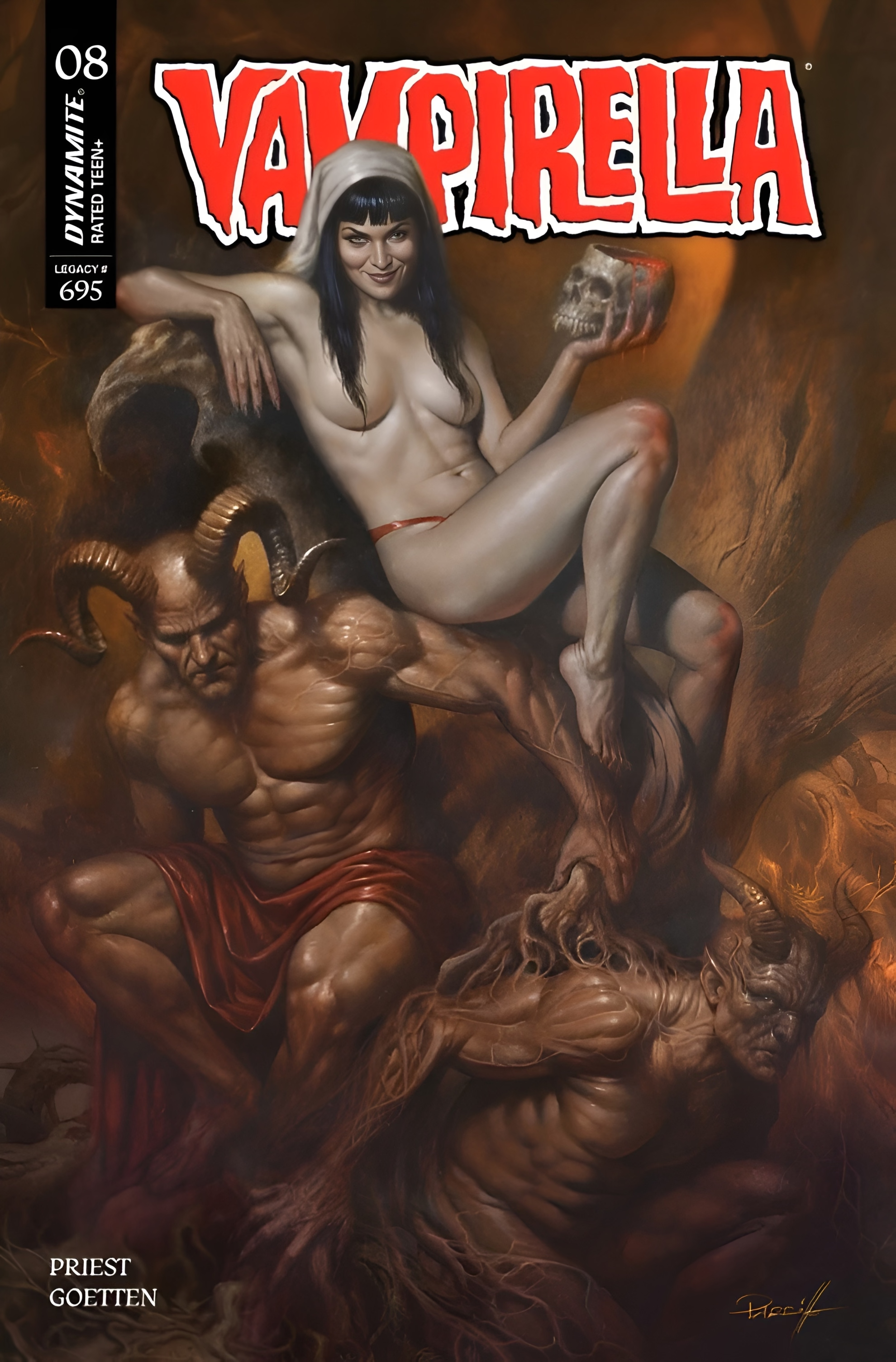
Dynamite’s earlier monthlies for the character ran in full color, so a monochrome issue reads as a deliberate return to the Warren page rather than a stylistic whim.
Dynamite also describes the art as following the traditional black and white of Eastern comics, with special spot color, and as a tribute to manga, manhwa, and manhua, the Japanese, Korean, and Chinese comics traditions.
The pairing is exact: Warren’s Vampirella was black and white by format, and Qiu’s pages are black and white by tradition, so the issue reaches the same palette from two directions. With color rationed, any accent carries a pressure it never has in a full-color monthly, because it is the only place the page permits warmth.
Wude and the Hunter’s Burden
The plot turns on an obligation rather than an appetite. When the benevolent king of the mystical realm of Escala is murdered, Vampirella must honor the tradition of wude, which Dynamite renders as “martial virtue,” and take responsibility for the crime, even though it means hunting down the man she loves. The story is set in a realm that joins ancient custom to a futuristic society.
Wude is a real term from Chinese martial culture, and scholarship describes it as a code of conduct with two linked dimensions, an outward ethics of behavior and an inward ethics of the mind. The structure matters for Vampirella.
A code that governs the mind as well as the deed explains how a character can accept responsibility for a killing as a point of honor: the virtue lies in the acceptance itself, and the hunt for the man she loves becomes an exercise of inner discipline rather than a punishment imposed from outside.
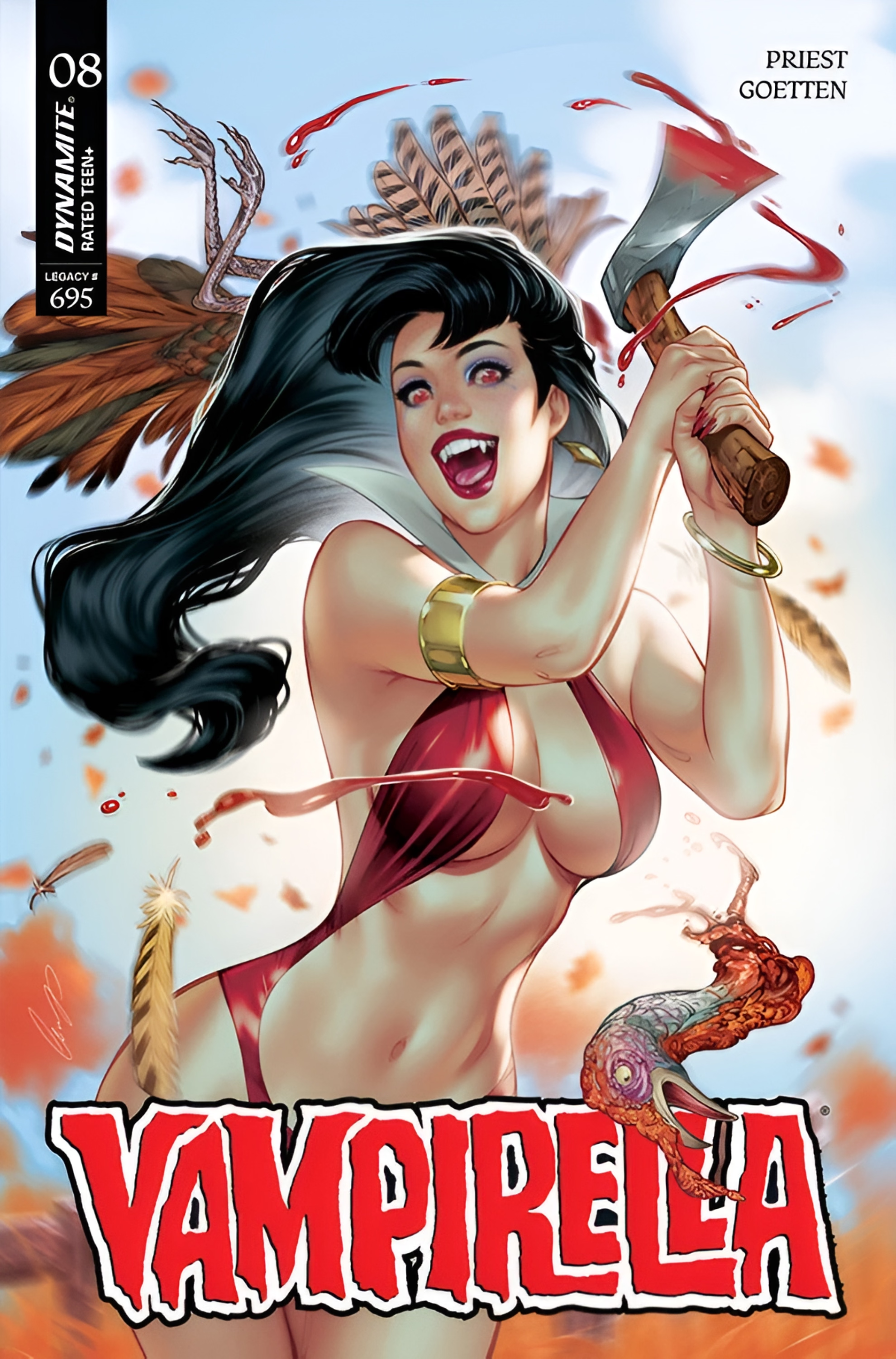
The tragedy this produces is specific to the character. Her hunger has long defined her. Priest’s issue places her under a different compulsion, one that asks her to hunt out of honor instead of need.
A Hunter Bound by Honor
The most telling reversal in the issue is moral rather than directional. A character defined across 57 years by appetite is asked to carry blame as an act of virtue, and the book asks its reader to carry an unfamiliar page order in the same spirit, accepting a burden before being told why.
If the format holds, the reading direction and the code of honor press on the same point: that obedience to a form, whether a page order or a moral discipline, can feel like loss before it feels like meaning. That is the argument the 32 pages must earn, and it is a sharper test for Vampirella than any new costume or enemy would be.
When a character defined by appetite is made to carry blame as an act of martial virtue, does the right-to-left page order sharpen that reversal for the reader, or does the format risk reading as costume rather than conviction?
References
- Neil Cohn, ‘Japanese Visual Language: The Structure of Manga,’ in ‘Manga: An Anthology of Global and Cultural Perspectives,’ ed. Toni Johnson-Woods (New York: Continuum, 2010), 187–203. ↩︎


Leave a Reply