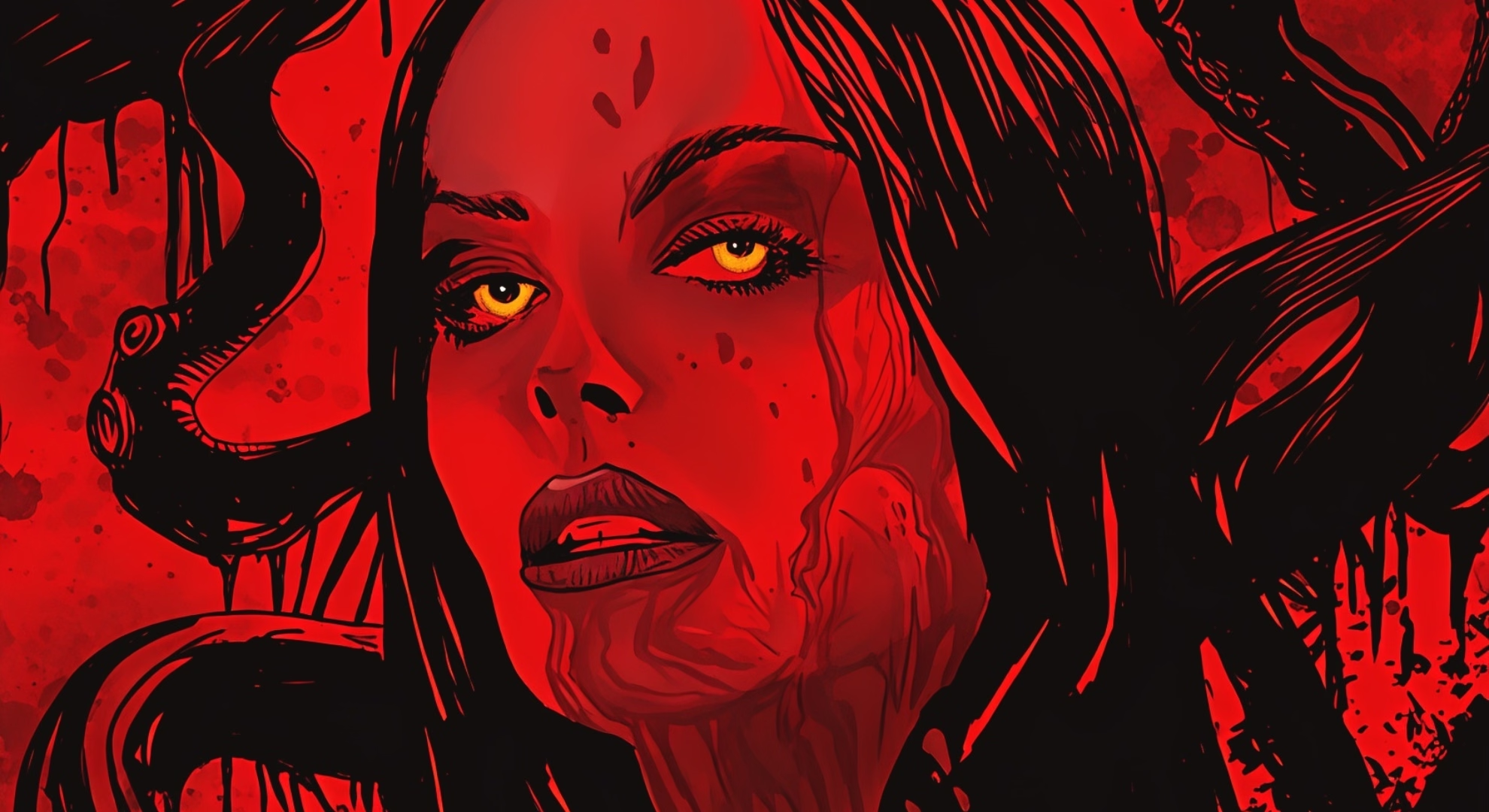


The accounts of Ragnarök that survive come from a few Icelandic manuscripts, among them the ‘Konungsbók’ (‘Codex Regius’) of about 1270, and from Snorri Sturluson’s ‘Prose Edda,’ composed around 1220. Scholars still debate how far Christian copyists shaped the vision of the end that these texts preserve.1 A story that treats the end of the gods as a staged lie therefore stands on firmer textual ground than its premise suggests, and ‘Immortal Coil’ #1 rests its Norse horror on exactly that ground.
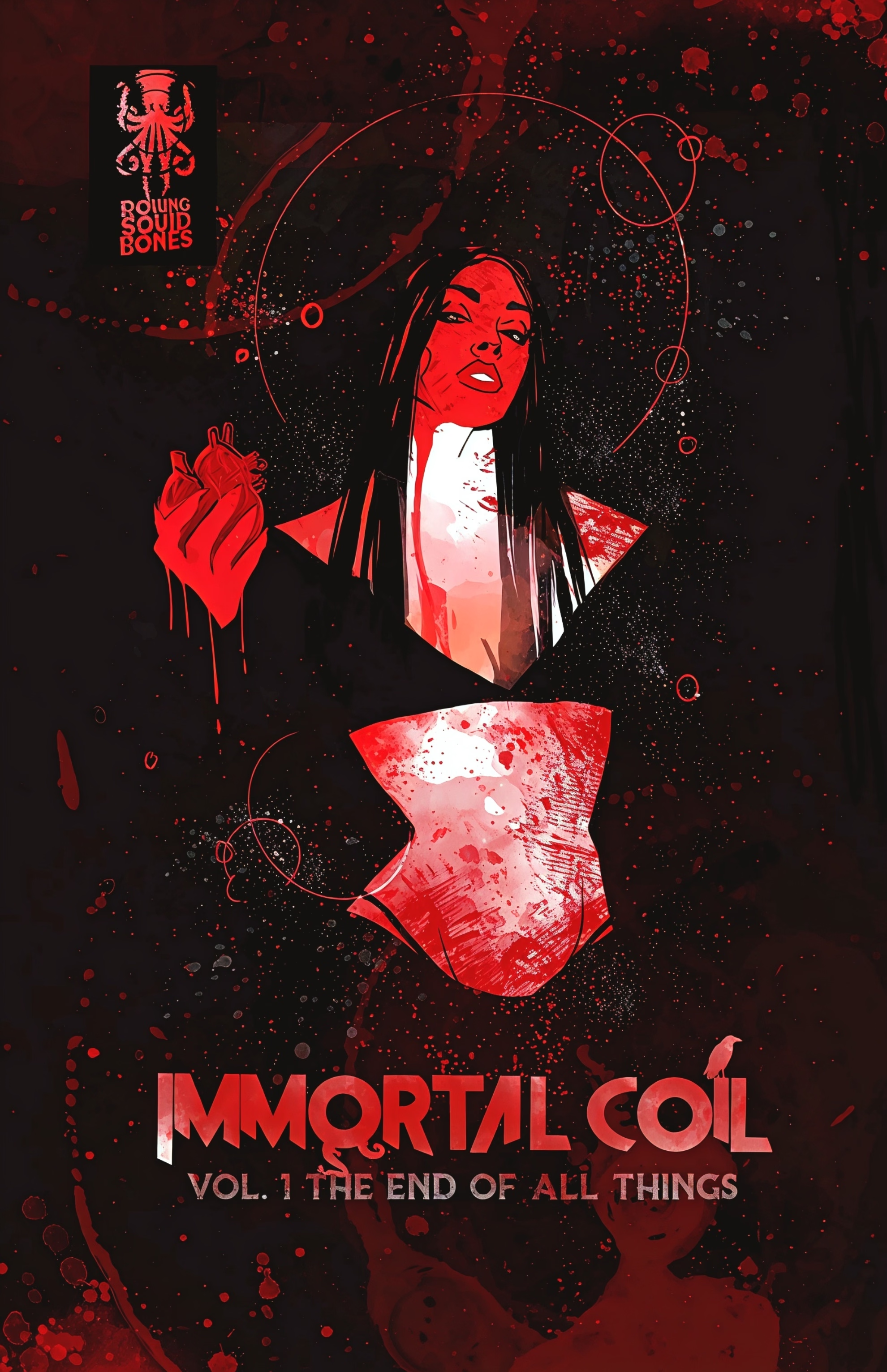
Third Contact Comics released the issue on November 4th, 2026, at $4.99 across 32 pages, as the first of five planned issues. Frank Martin and Gerald von Stoddard write, von Stoddard and Dave Fowler draw, and von Stoddard supplies Cover A.
The 2024 crowdfunded edition credited von Stoddard alone as writer, while Martin’s co-writing credit appears on the November 2026 retail release. The cover prints the surnames Von Stoddard, Mendes, and Jones, but Mendes’s role, the retail colorist, and the editor could not be confirmed at the time of publication, although the 2024 crowdfunded edition credited Guilherme Lindemberg with colors and Rob Jones with letters.
The issue is a serialized chapter, not an original graphic novel or a collected edition; its first pages were crowdfunded in 2024, and a digital edition followed on August 31st, 2024.
A Hoax With Textual Roots
The premise holds that Ragnarök was a conspiracy of illusion, staged to banish Loki forever and to make Earth the gods’ final home. Loki, awakened and set on revenge, seeks a sliver of Nyarlathotep, the Crawling Chaos, to serve as his avatar, with his daughter Hel at his side, while Odin’s dormant grandchildren live among mortals without knowing their birthright.
The invention is sharper than it first looks. The sources describe the end of the gods as a catastrophe followed by renewal, with a few gods surviving and Baldr returning to a new earth, so the finality that the comic denies was never complete.2 Where the texts leave survivors, the comic installs a fraud, and it converts a gap in the myth’s certainty into a motive.
The Whistleblower’s Motive
The solicitation presents Loki as the figure who returns to expose the gods’ greatest deception, which makes him the series’ whistleblower. The creators withhold the usual dignity of that role. Speaking in an interview published February 2nd, 2026, Martin described this Loki as angry, vengeful, and uninterested in mischief, and von Stoddard said he has no redemption.
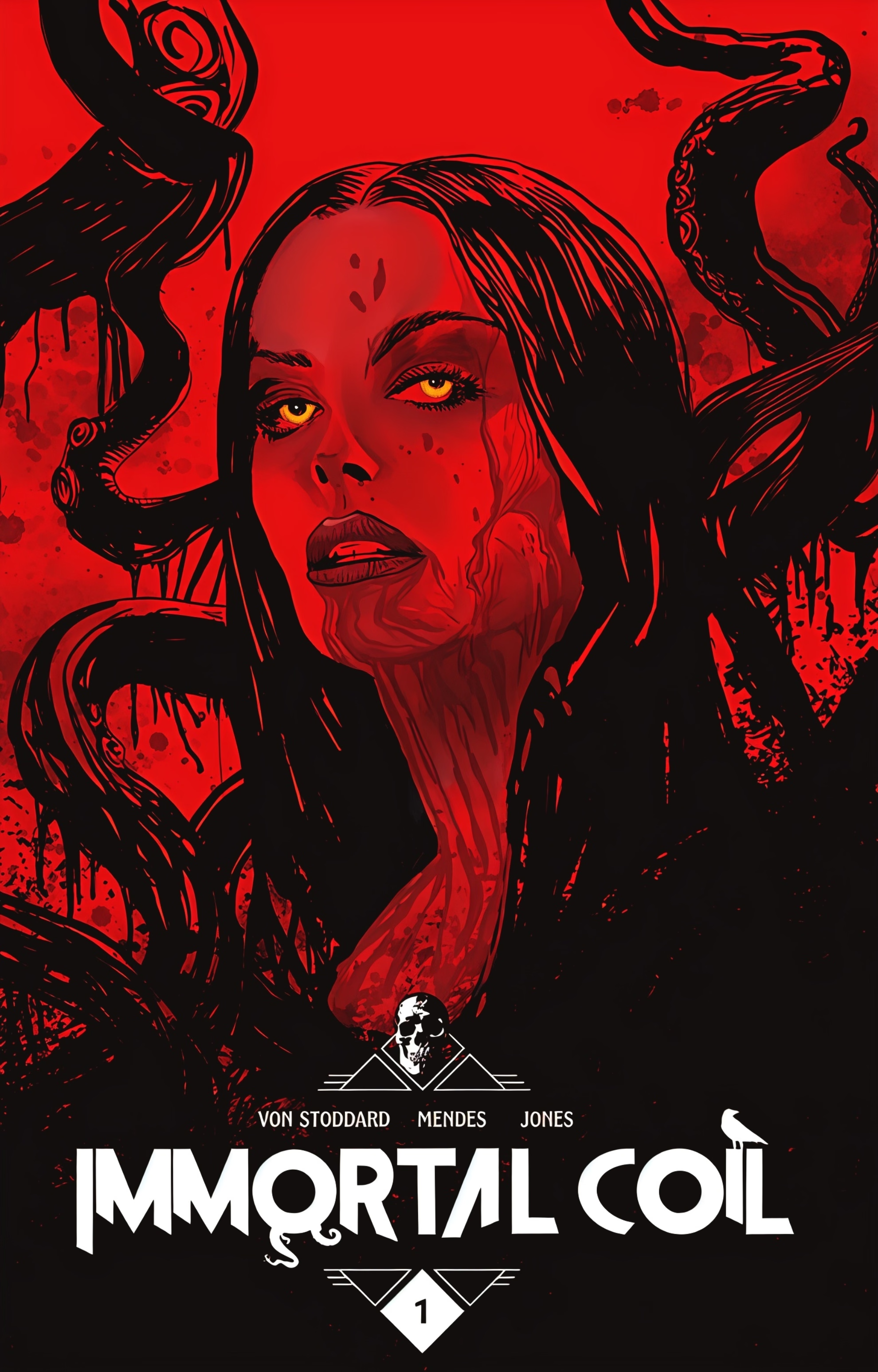
That pairing is the book’s central tension. A revelation delivered by an avenger comes tainted, because the reader cannot separate the truth of the lie from the appetite of the god who tells it. The hoax is real inside the story, yet every page that advances it also advances a plan to end the mortal and Immortal worlds alike.
A Coil of Family Lies
Von Stoddard said the title plays on Shakespeare’s phrasing, and he put its logic plainly: for gods there is “no shuffling off.” Eternal life turns family secrets into a sentence without term. Martin said his main contribution was reminding von Stoddard that the battle rests on a very broken family. The grandchildren who must awaken to godhood carry that inheritance: they receive a mythology, and a quarrel, that they did not start.
The Page as Performance
Von Stoddard writes and draws, and his background gives the page a stage-minded discipline, since he has a past in theater and his paintings have been shown in New York and Los Angeles galleries. Martin, who came to comics from prose, said that von Stoddard approaches every page by asking how to give the reader the best artistic treat, which pushed Martin to plan every beat rather than only the arc.
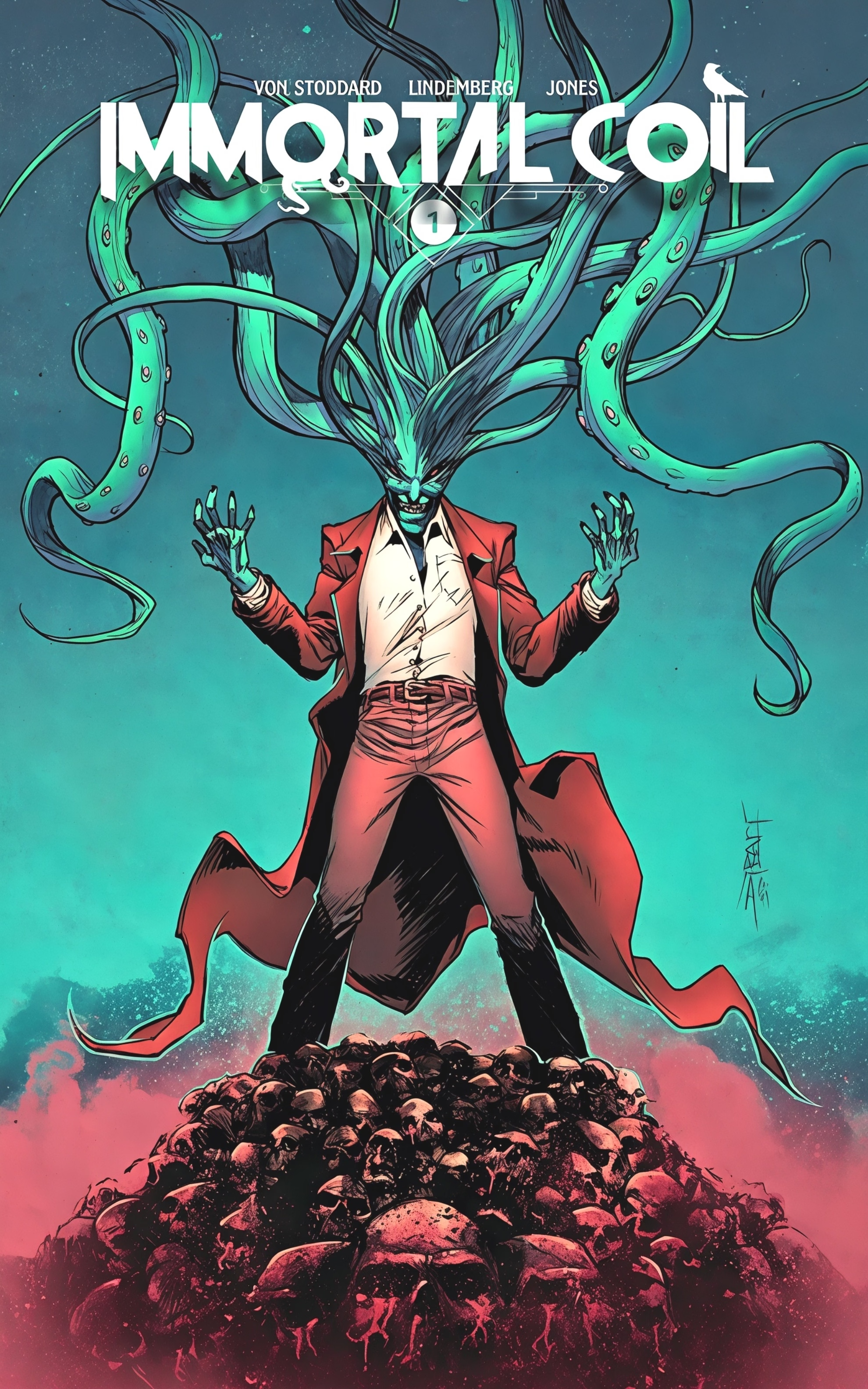
The clearest documented image is Loki himself. Von Stoddard said he first saw him dressed as a Halloween DJ, casual in manner while bringing on Ragnarök, with his resentments in full display. That design carries the argument visually. A god who plays the end of the world like a party set makes the revenge feel intimate and sets a mundane surface against cosmic stakes.
Lightning on the Armchair
The preview pages show how von Stoddard stages that tension. The opening page sets a raven on a bare branch against an orange dusk, a lit manor below it, and an inset clock whose ticking steps down a staircase in lettered beats. The palette runs on violet and ember, and a single acid green marks Loki, first as a hood at a bookshelf and then as the vial in the closing panel, so that color binds the thief to the thing he takes.
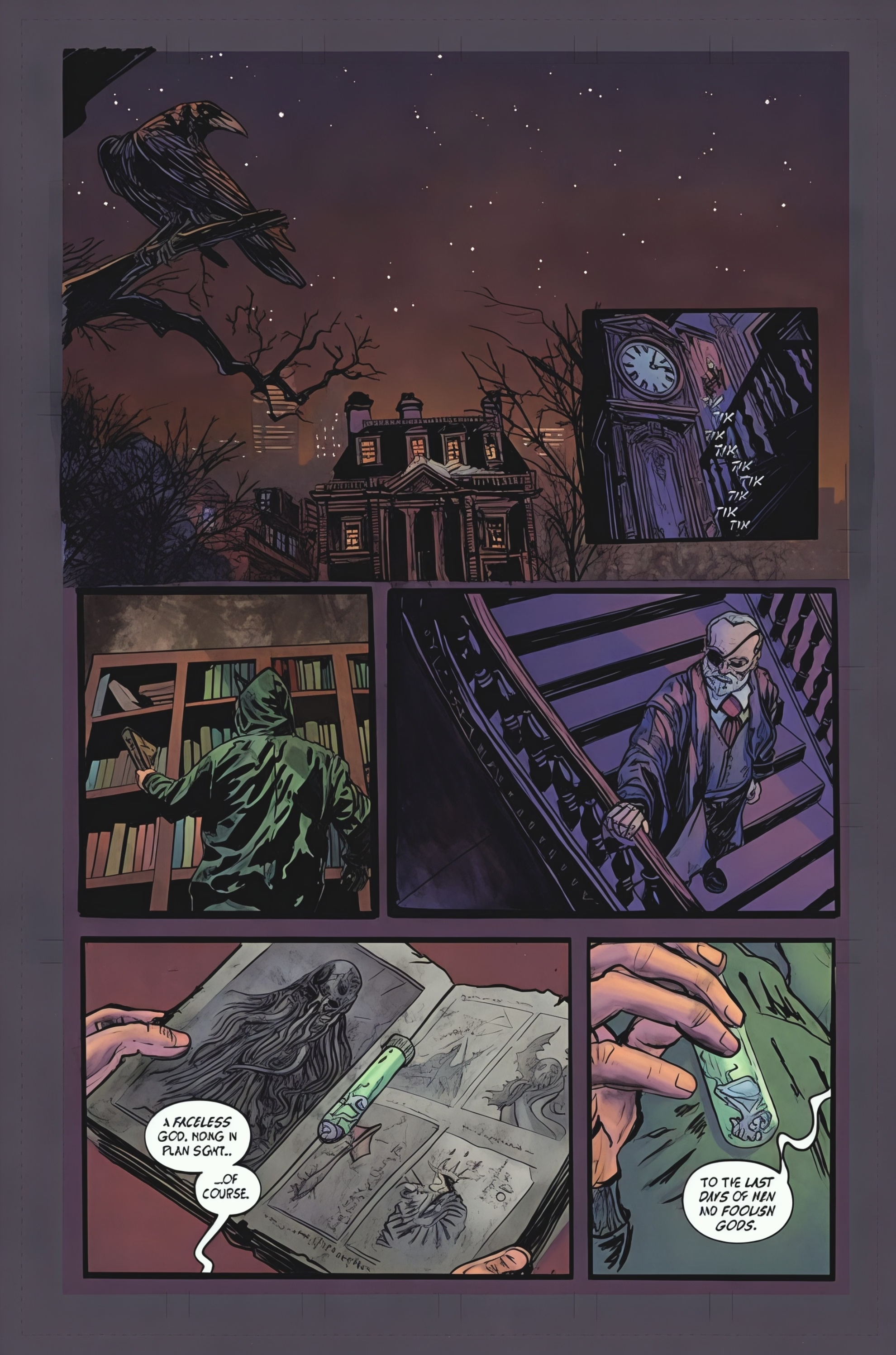
The confrontation turns on a trick of layout. Loki sits with his back to the reader before a fire, calls Odin “father,” and concedes that the deception wounded his pride more than anything, since he is “so easily deceived.”
Odin answers with a close-up in which lightning splits the panel borders, and the strike lands on the armchair under a sound effect that cuts the frame on a diagonal.
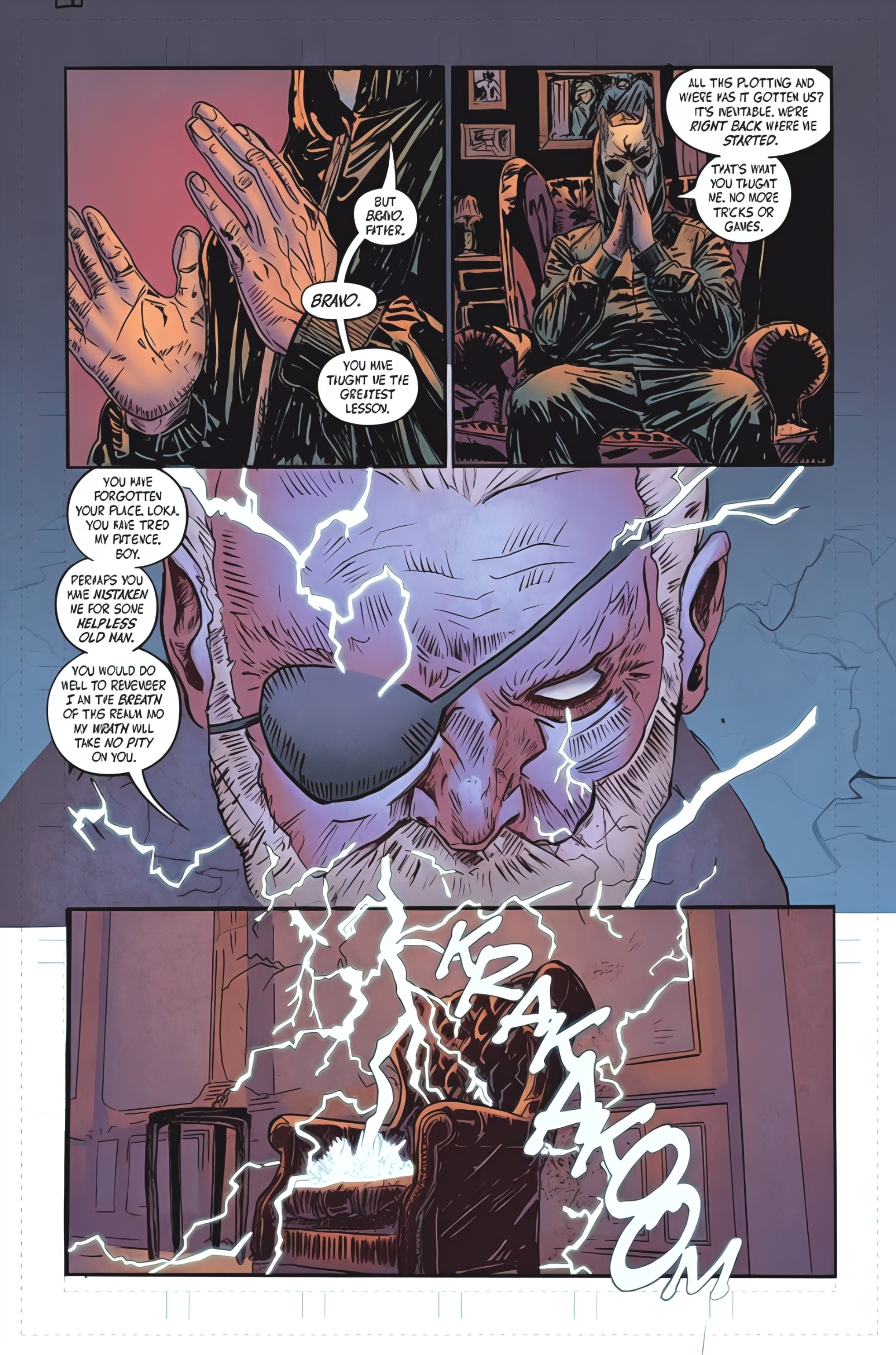
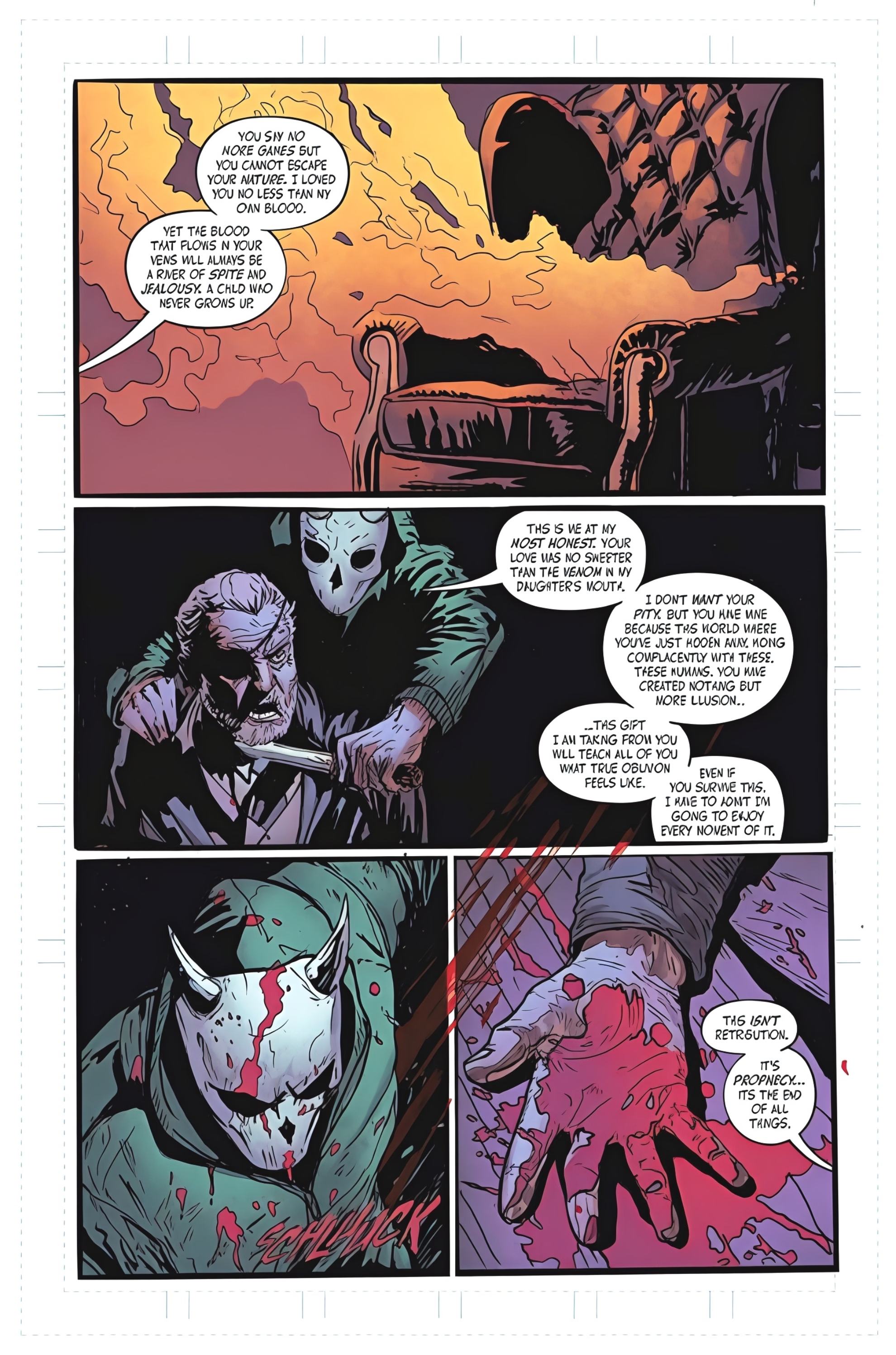
The next page finds Loki behind Odin with a knife, in a panel where the two finally share a frame, and the closing panels tighten to a bloodied mask and a bloodied hand while Loki denies retribution and names the act “prophecy.” The pride speech and the prophecy speech cannot both be his motive, which is the tainted-witness problem in two pages.
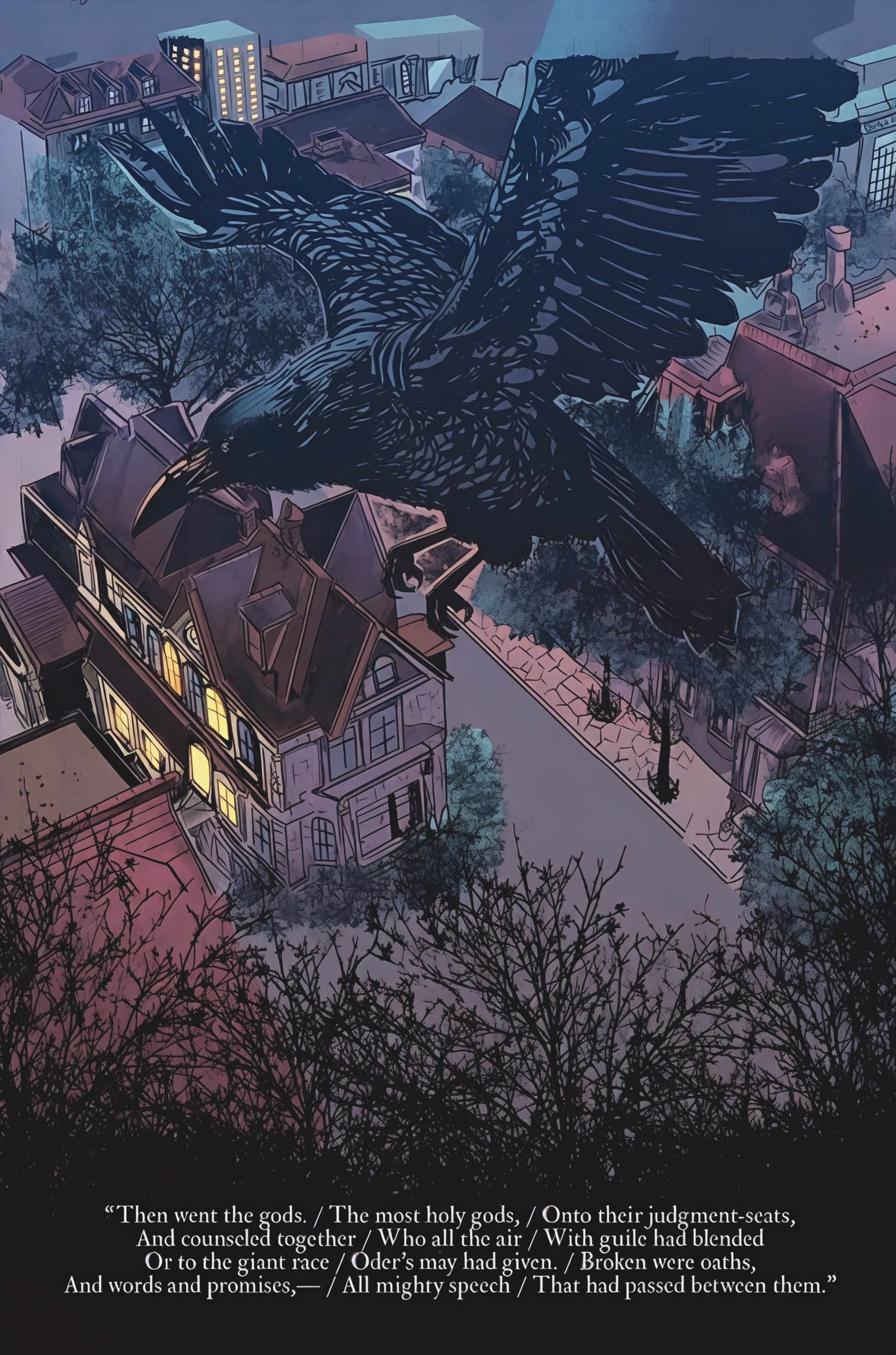
A separate aerial page sets an oversized raven above the same house, beneath a quoted passage on broken oaths among the gods in white serif type on black, the one place in these pages where the lettering gives way to the source text.
Von Stoddard named his inspirations as Neil Gaiman’s cosmic horror, the novel ‘American Gods,’ and Gaiman’s retelling of the Prose Edda in ‘Norse Mythology,’ which he picked up at an airport.
The solicitation extends the lineage to ‘The Sandman,’ ‘Hellblazer,’ and ‘Lucifer.’ Those titles share an interest in the supernatural inside the modern world, and ‘Immortal Coil’ locates its difference in agency: its gods hide by their own design, after a lie they authored, so the modern setting becomes an alibi rather than an exile.
Myth Used or Borrowed
The Lovecraftian element carries the risk. Norse myth already supplies its own forces of dissolution in the wolf Fenrir, the world serpent, and the fire giant Surtr, so a sliver of Nyarlathotep has to do work that they cannot.
The premise suggests the answer: Loki needs an external chaos because the gods’ own end was fabricated, and the borrowed entity supplies the apocalypse the myth was denied. If the book keeps that logic, the crossover is a repair to the hoax rather than a mashup. If Nyarlathotep only escalates the violence, the myth becomes a costume.
A Series Joined Midway
Because the retail edition reintroduces an issue first released in 2024, readers enter a five-issue series whose later chapters already exist: the second issue circulated digitally on March 31st, 2025, and a third was crowdfunded in February 2026.
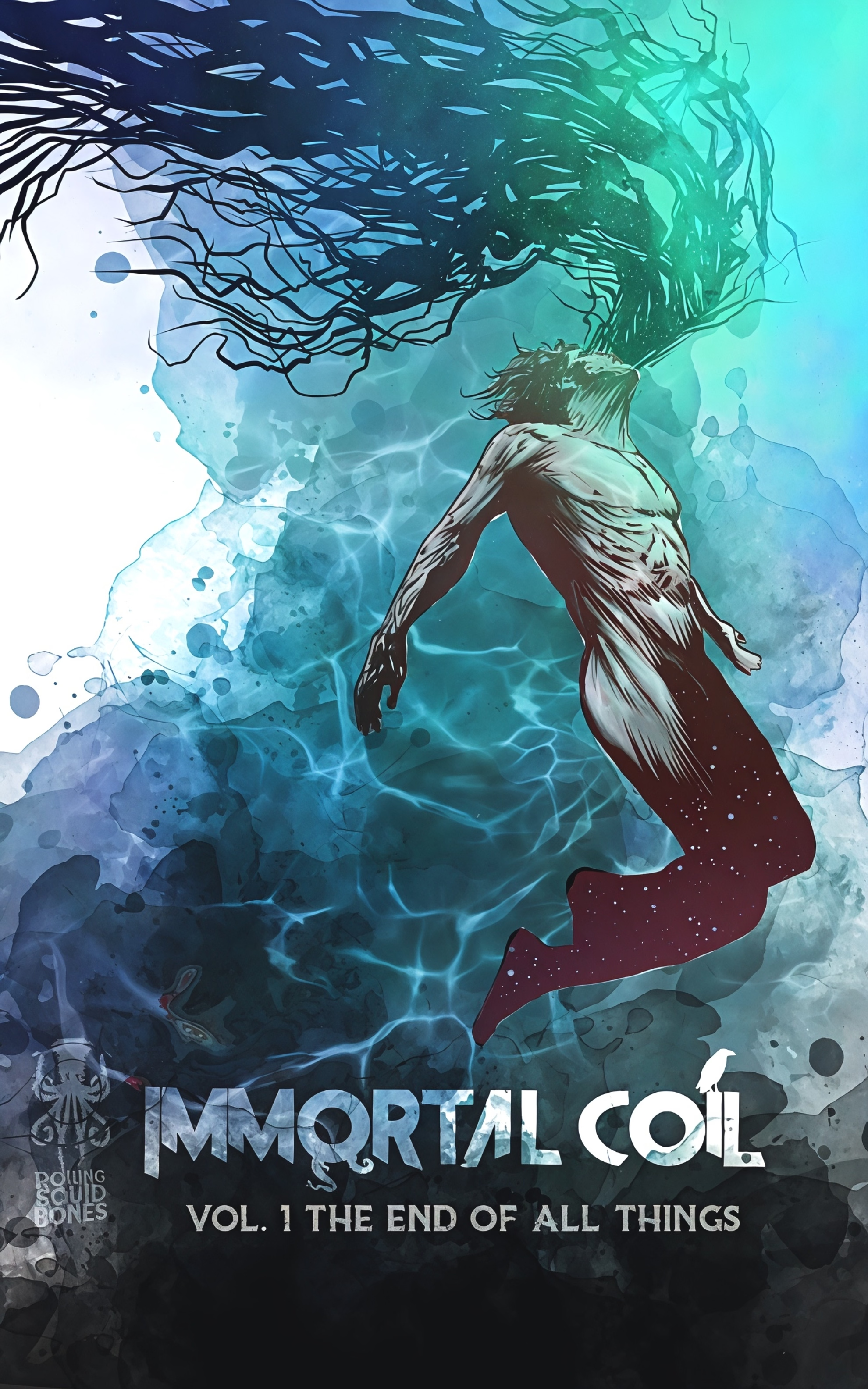
A preview of issue 2 sits on the crowdfunding page for the first volume. Martin said in the 2026 interview that he joined the book halfway through the second issue, so the first issue carries von Stoddard’s decade of daydreaming before it carries the collaboration.
Third Contact Comics
Third Contact is a small independent banner founded by von Stoddard and Martin, two New York creators who work under it as a shared imprint.
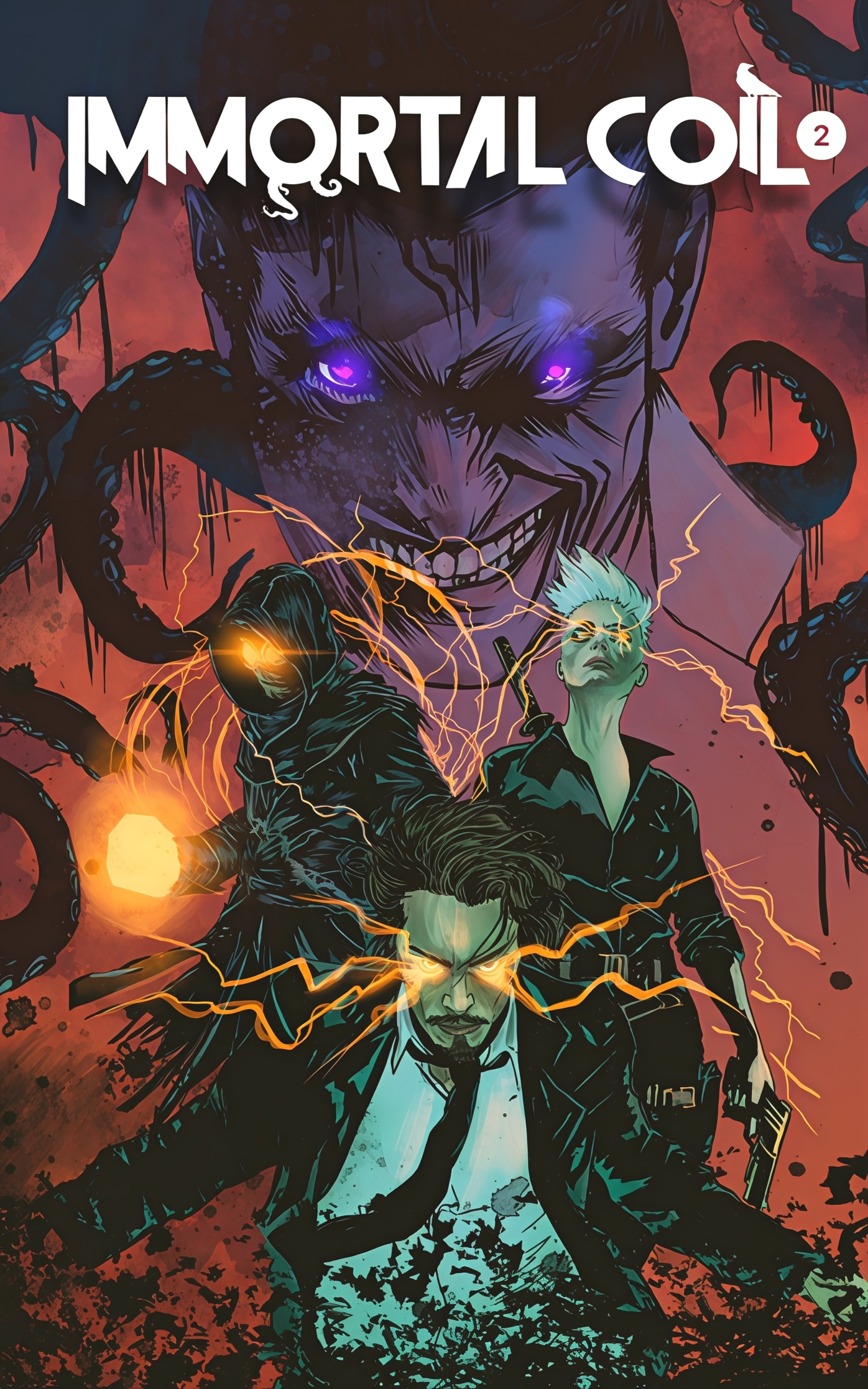
In November 2026 it entered comic shops through Lunar Distribution and Prana Direct Market Services, with Prana Publishers listed on the retail catalog. ‘Immortal Coil’ is the lead title of that move, and its origin is the most personal in the catalog: a story von Stoddard carried for about a decade before Martin joined to structure it.
The Liar Who Tells the Truth
Loki is the series’ one witness to the gods’ fraud, and the only witness it offers is a god who wants the world ended. That arrangement gives the hoax its edge. The surviving tellings of Ragnarök passed through hands with interests of their own, so a book that makes its truth-teller a vengeful partisan is faithful to that history in a way a righteous whistleblower would not be. The issue succeeds if a reader leaves unable to choose between the lie and the liar.
If the gods’ Ragnarök was a lie, does Loki’s revenge strengthen the series as a story about betrayal, or does it make the truth too tainted for readers to trust?
References
- Anders Hultgård, ‘The End of the World in Scandinavian Mythology: A Comparative Perspective on Ragnarök’ (Oxford: Oxford University Press, 2022), 52–102. ↩︎
- John Lindow, ‘Handbook of Norse Mythology’ (Santa Barbara: ABC-CLIO, 2001), 254–257. ↩︎


Leave a Reply