

When Fredric Wertham published ‘Seduction of the Innocent’ in 1954, a psychiatrist’s case against comic books became a matter of Senate testimony, and that testimony sparked the creation of the Comics Code.1 Three decades later the accusers had turned to heavy metal records and tabletop role-playing games, and the form that once stood accused tells the story of that second trial from the side of the defendants.
Mad Cave Studios publishes ‘Satanic Panic’ #1 on October 28th, 2026, with Cover A priced at $4.99 USD, approximately COP 15,900, across 32 pages (ISBN 978-1545830574).
It opens a four-issue limited series written by Matt Miner and drawn by Clayton McCormack, with colors by Oliver Mertz and letters by Matt Krotzer. McCormack also supplies Cover A, and Justin Coffee draws the Cover B variant, which Mad Cave also offers in foil (Cover C) and glow-in-the-dark (Cover D) editions. Editor credit could not be confirmed at the time of publication.
A Medium Once Accused
The satanic panic of the nineteen-eighties has its own scholarly record. The sociologist Jeffrey S. Victor read the scare as a contemporary legend, a rumor that hardened into accepted fact, and concluded that nothing supported the existence of the organized satanic cults the rumor described.2
His chapters on the search for satanism in schools, books, music, and games name the same targets that fill this series: the record collection and the game manual treated as exhibits.
A comic about that panic therefore inherits a double position. Its medium was an early defendant, and its subject matter is a later one. The premise, a masked killer loose in a town that has already decided who the culprits are, treats the accusation as a plot engine rather than as period dressing.
The Suspects Are the Heroes
The three leads are Naz, Sal, and Terry, ‘Dungeons & Dragons’ players and devoted listeners of Ozzy Osbourne who become the prime suspects in a string of murders. Their task, as the publisher describes it, is to clear their names and unmask the real killer before suspicion costs more lives.
The structure inverts the usual allegiance of a whodunit. As the publisher frames it, the three are innocent from the first page, and the story watches a community decline to accept that.
Miner has tied the premise to his own history. In the series announcement of July 2026, Miner recalled that his mother was caught up in the religious hysteria around heavy metal and role-playing games, and that “she burned my Ozzy tapes, my gaming stuff, all of it.”
The anecdote places the author with the accused, and it fixes the series’ moral geometry: the objects confiscated in a kitchen become, in the book, the exhibits a town reads as proof.
The Page as Accusation
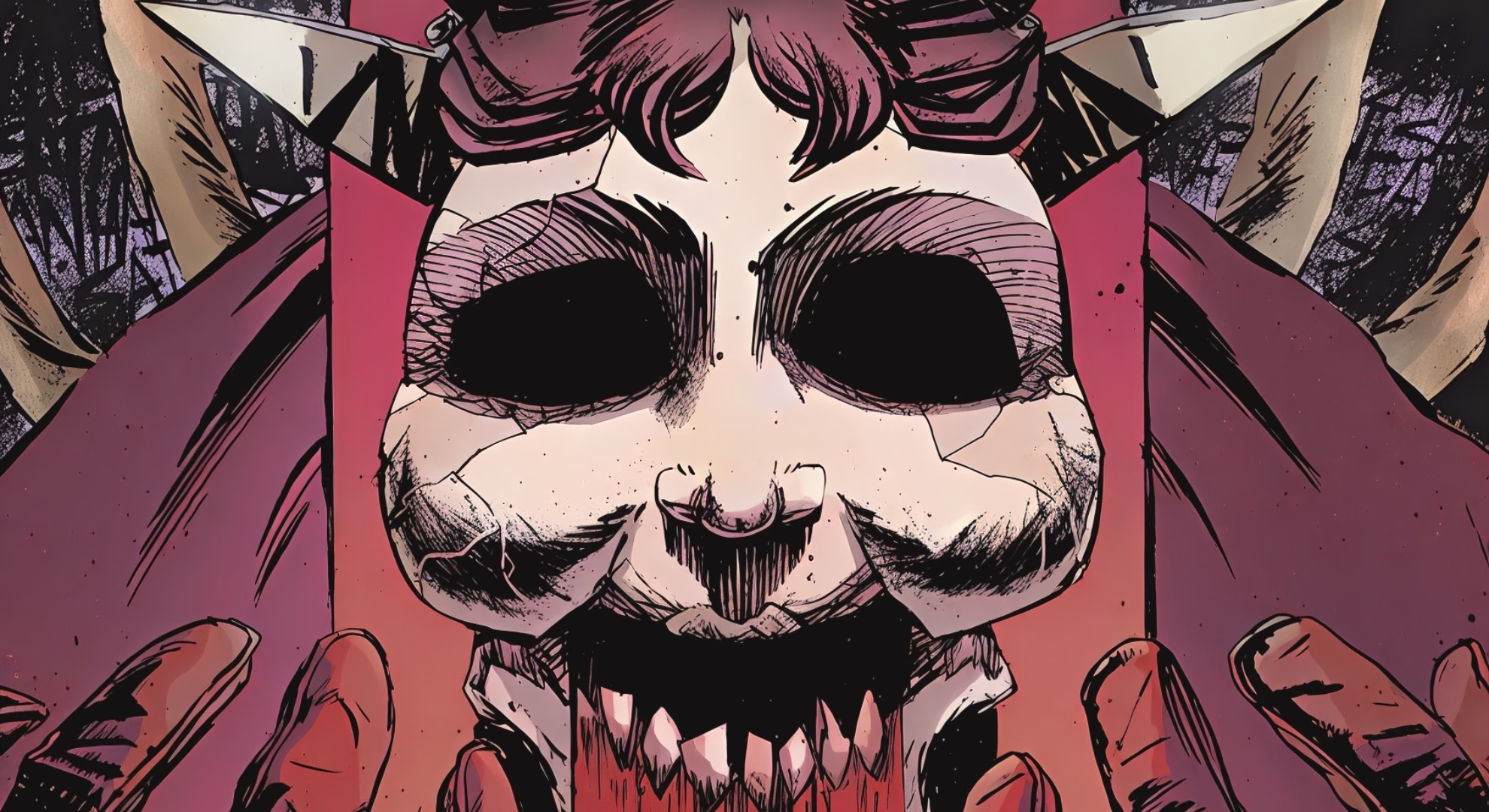
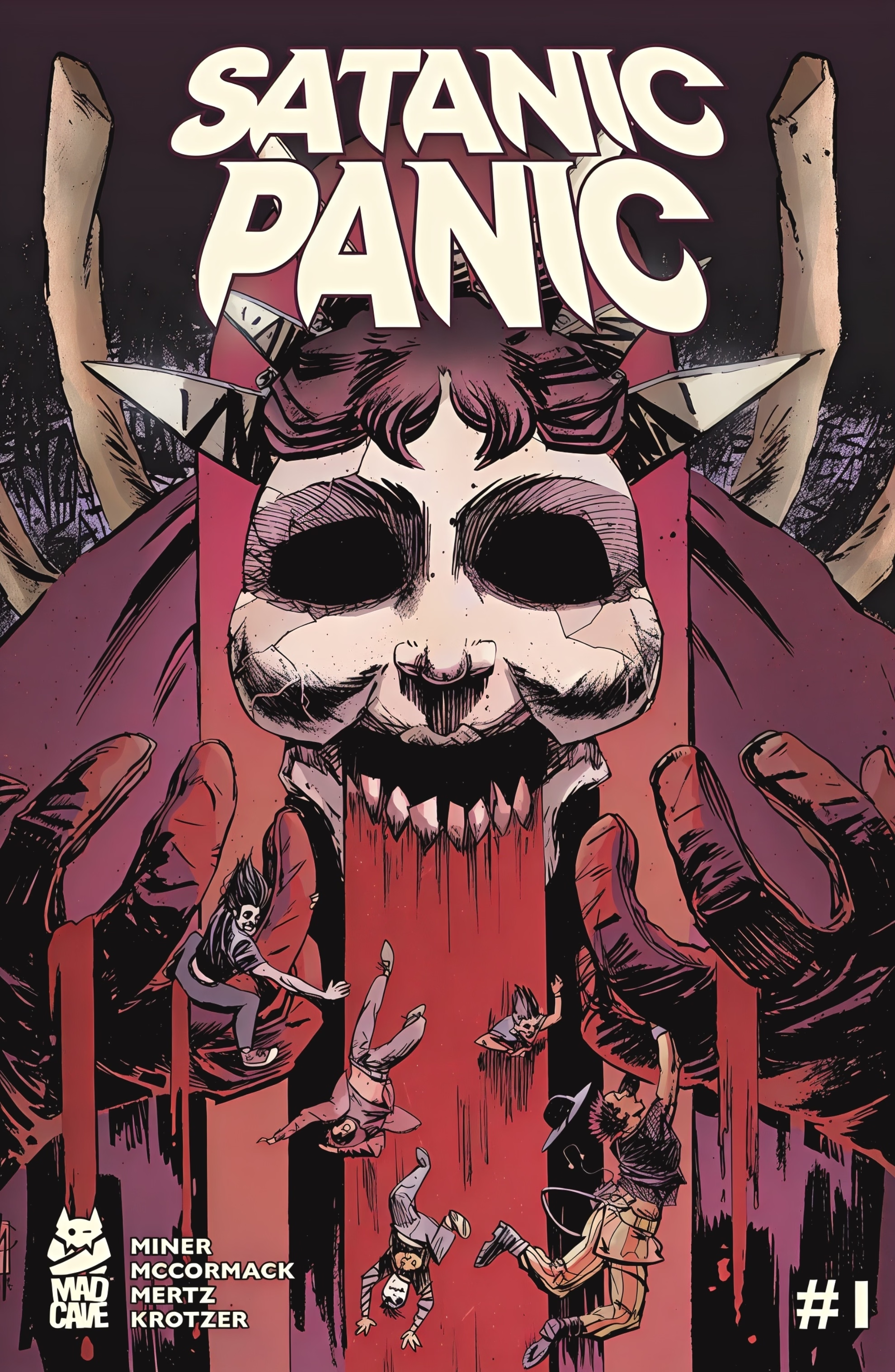
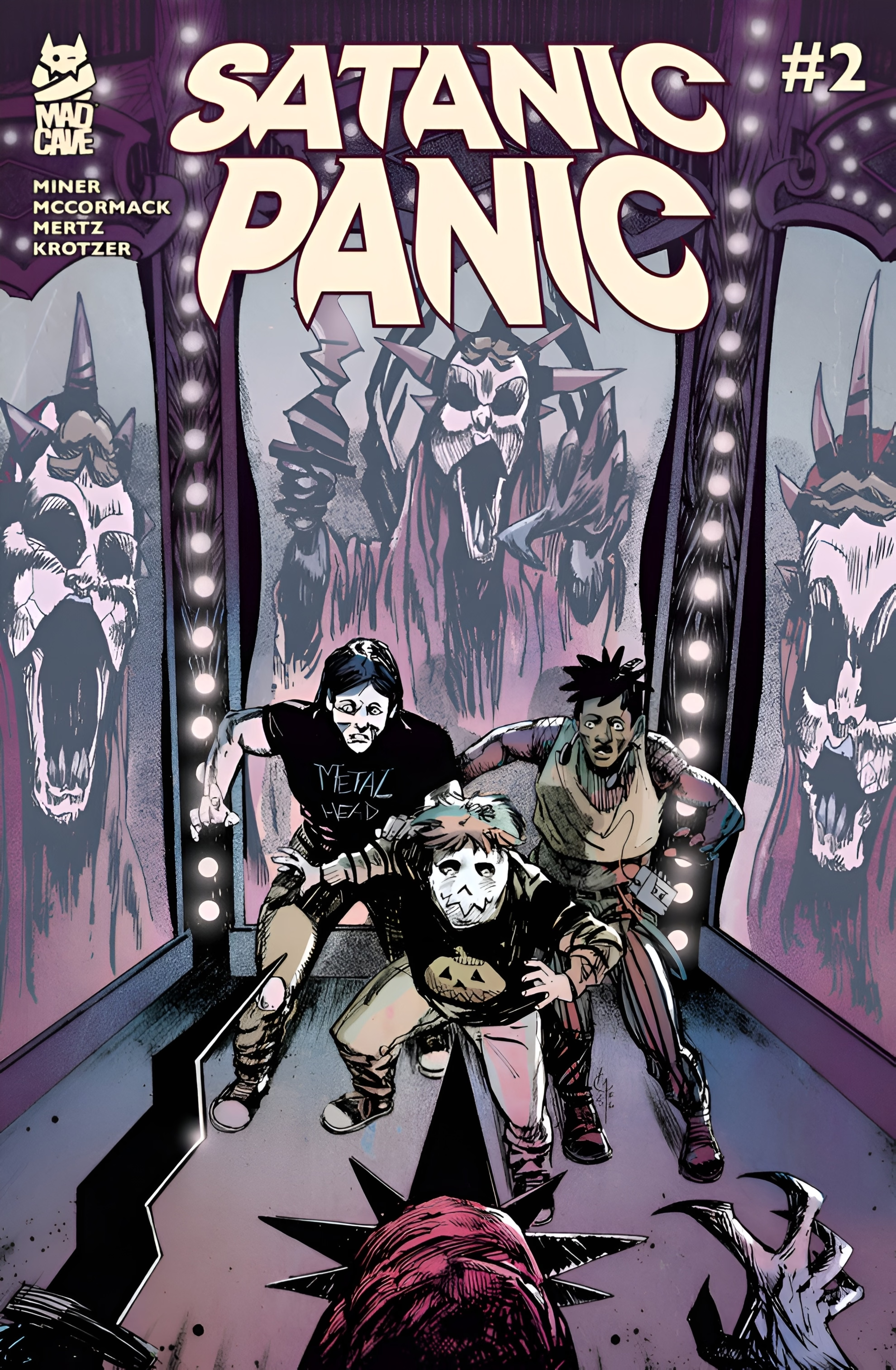
The two covers supplied with this feature divide the book’s horror between two sources. McCormack’s Cover A draws a looming cracked white mask with a spiked crown and empty black sockets, with a single red stream pouring from its mouth while teenagers tumble down it, small enough to read as debris. The linework is ragged brushed ink over dense hatching, and plum, maroon, and cream hold nearly everything in one register until the red cuts across it.
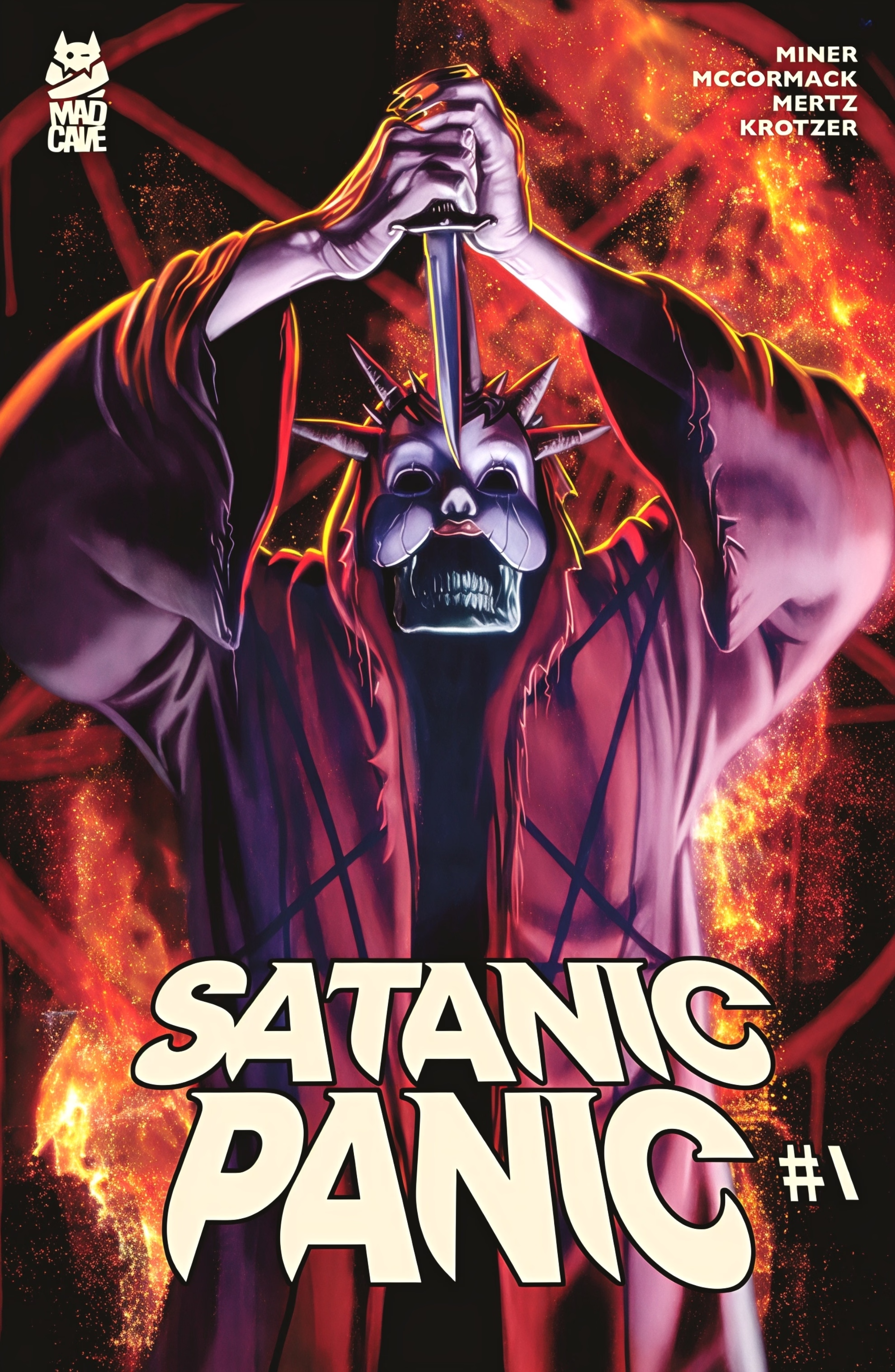
Justin Coffee’s variant paints the same mask in an airbrushed glow and surrounds it with a burning pentagram and a raised ritual dagger, the symbols the panic claimed to find in every bedroom. Where Cover A shows what threatens the teenagers, the variant shows what the town imagines they are.
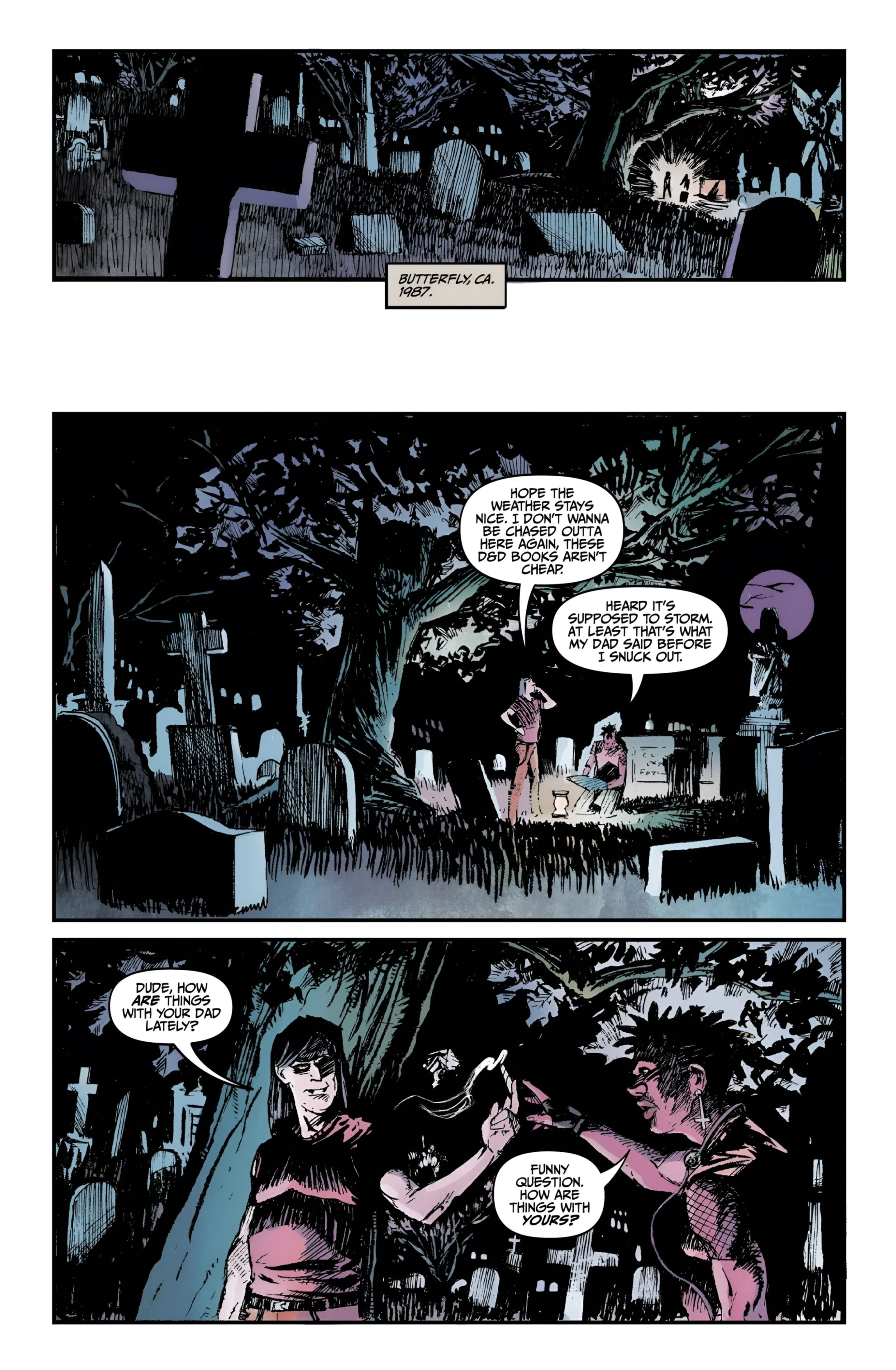
The interior pages place the story in Butterfly, California, in 1987, through a caption set against a wide panel of a cemetery drawn in cold blue and lavender. McCormack stacks the first page in horizontal tiers, and Mertz warms only the pocket of candlelight around a tomb where a group of teenagers sets up a tabletop role-playing game.
The opening dialogue already carries the panic, as one player worries about being chased out of the cemetery again because the game books are expensive. Over the next pages the panels tighten around faces, and the game master’s narration of a prison corridor cuts against the sound of an approaching car, so that the fantasy the players are describing is overtaken by a group of bullies in letterman jackets.
The page that settles the argument is the last of those supplied. The bullies’ threats run across level, conversational panels while the outnumbered players plead for calm, so that the page reads as a standoff. One bully begins to promise that the group will be missed at school, and the line breaks off at “We’ll sure miss y—” as a jagged balloon cuts in with a choked sound effect.
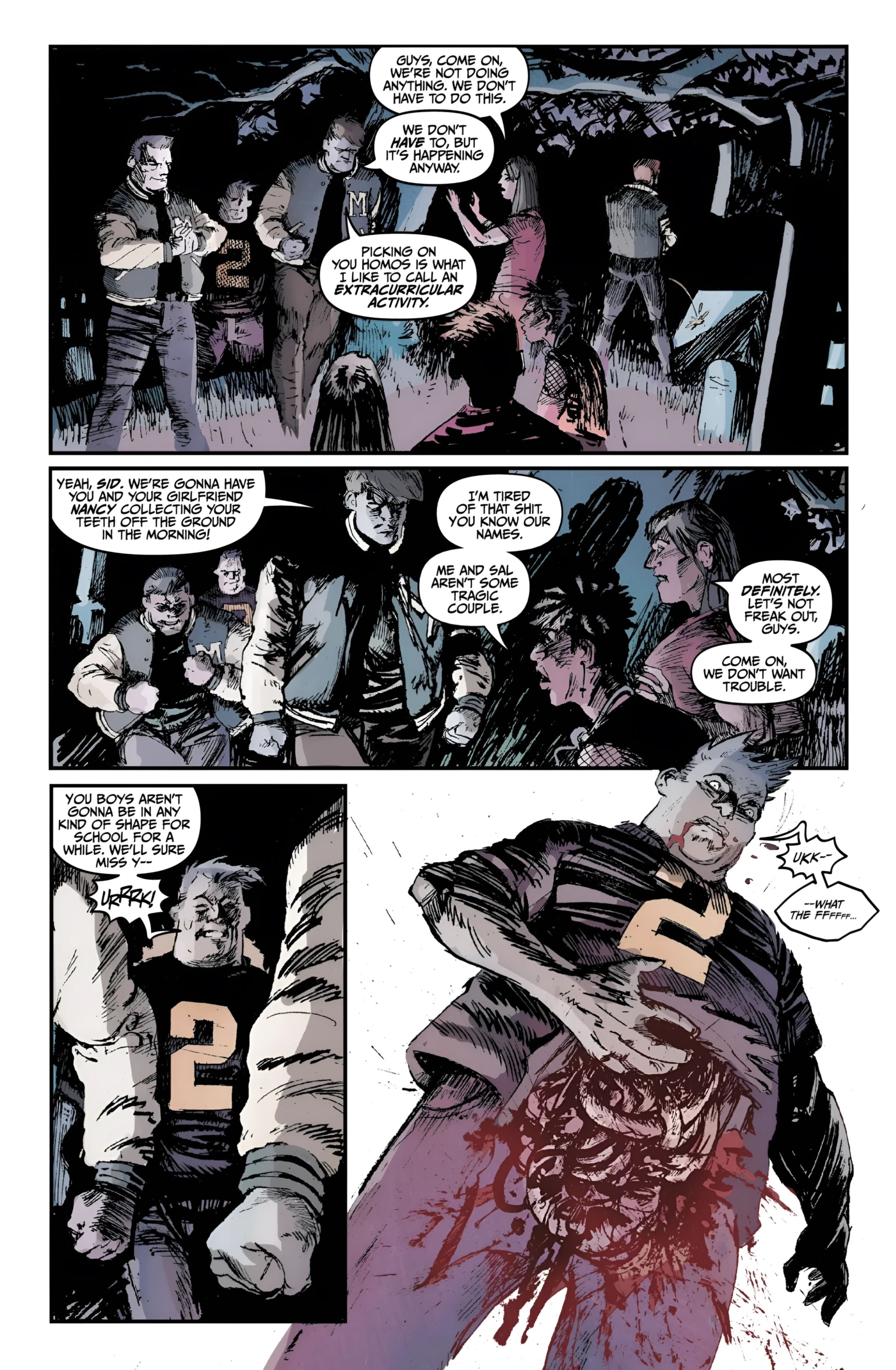
In the panel beside it, the artwork drops its black border and bleeds into white paper, and red takes over the palette for the first time in the supplied pages: a torn torso, a mouth open on half a curse. The killer is not drawn. The reader sees the bully who was performing the town’s cruelty become a casualty of the murders, and the white of the page does the work the dark palette has withheld until that moment.
Krotzer keeps the speech balloons plain and white and saves oversized, jagged lettering for sound effects, so the engine noise that interrupts the game and the choked cry that ends the page are the clearest moments in which the lettering raises its voice. The restraint of the earlier pages is what lets that red panel read as a sentence rather than a spectacle.
Serialized Suspicion
Issue one of four is neither an original graphic novel nor a collected edition, and the distinction matters to how it works. An original graphic novel can be read straight through to its verdict. A monthly installment of 32 pages ends before the verdict by design, and for a story about a town that convicts early, the interval is an asset.
Readers carry the same incomplete case file the characters do, and the pause between issues lets suspicion harden the way the book says it hardens in a community. A later collected volume would reward rereading and clue-checking, but it would remove the one condition under which the reader shares the town’s impatience. For this premise, the serial form is a gain.
The Town in the Mask
A slasher wears a mask so that no face can be held responsible, and the series asks what a town is wearing when it does the same. The title names the principal antagonist. The killer supplies the bodies, but the accusation supplies the conditions in which three teenagers can be blamed for them.
If the next three issues keep that accusation at the center, the book completes an arc that began in a Senate hearing room in the nineteen-fifties, with the medium moving from the dock to the witness stand.
When a town’s suspicion does more damage than the masked killer, what work is left for the slasher to do in a story about the satanic panic?
References
- Bart Beaty, ‘Fredric Wertham and the Critique of Mass Culture’ (Jackson: University Press of Mississippi, 2005). ↩︎
- Jeffrey S. Victor, ‘Satanic Panic: The Creation of a Contemporary Legend’ (Chicago: Open Court, 1993). ↩︎



Leave a Reply