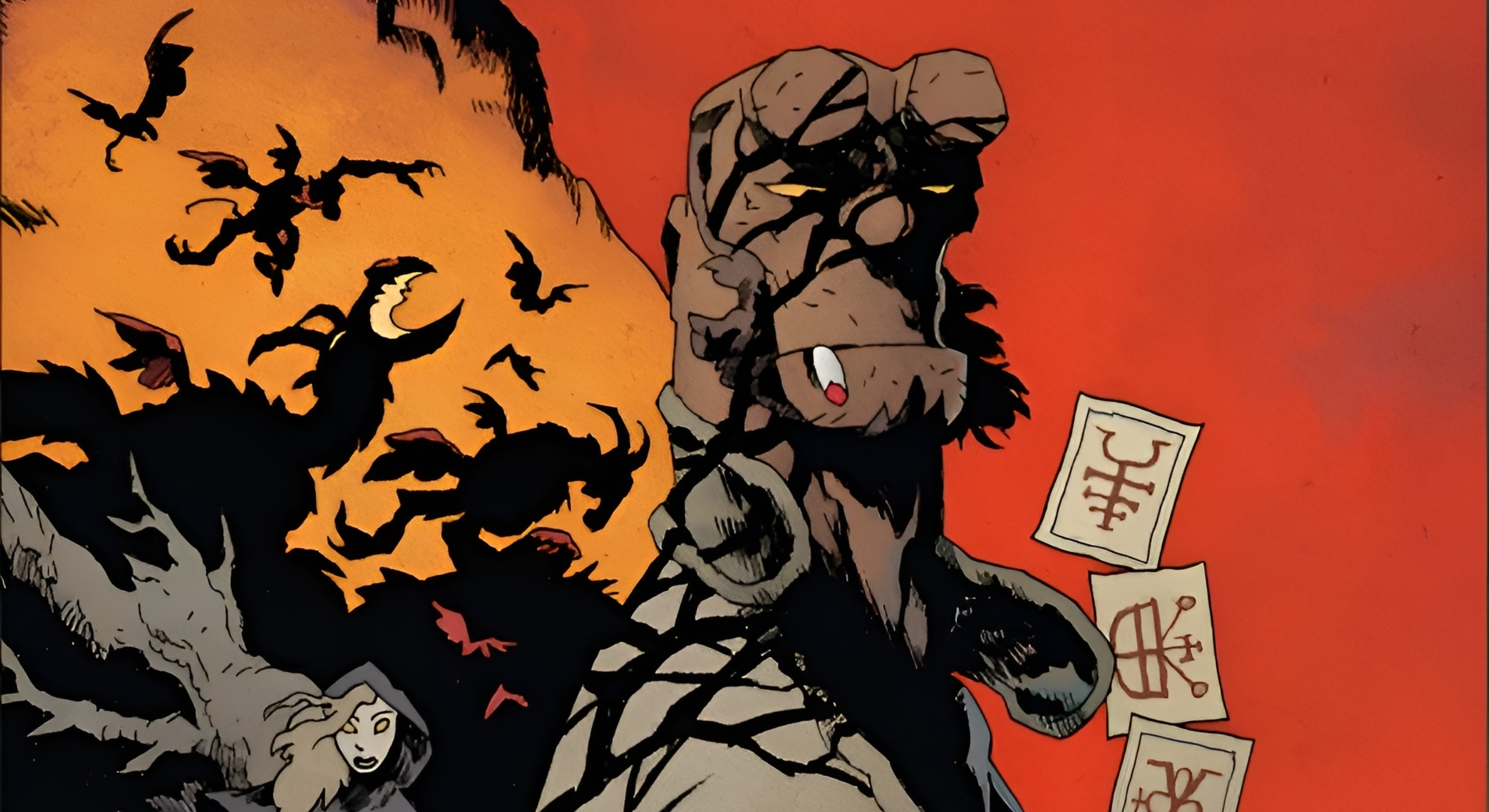


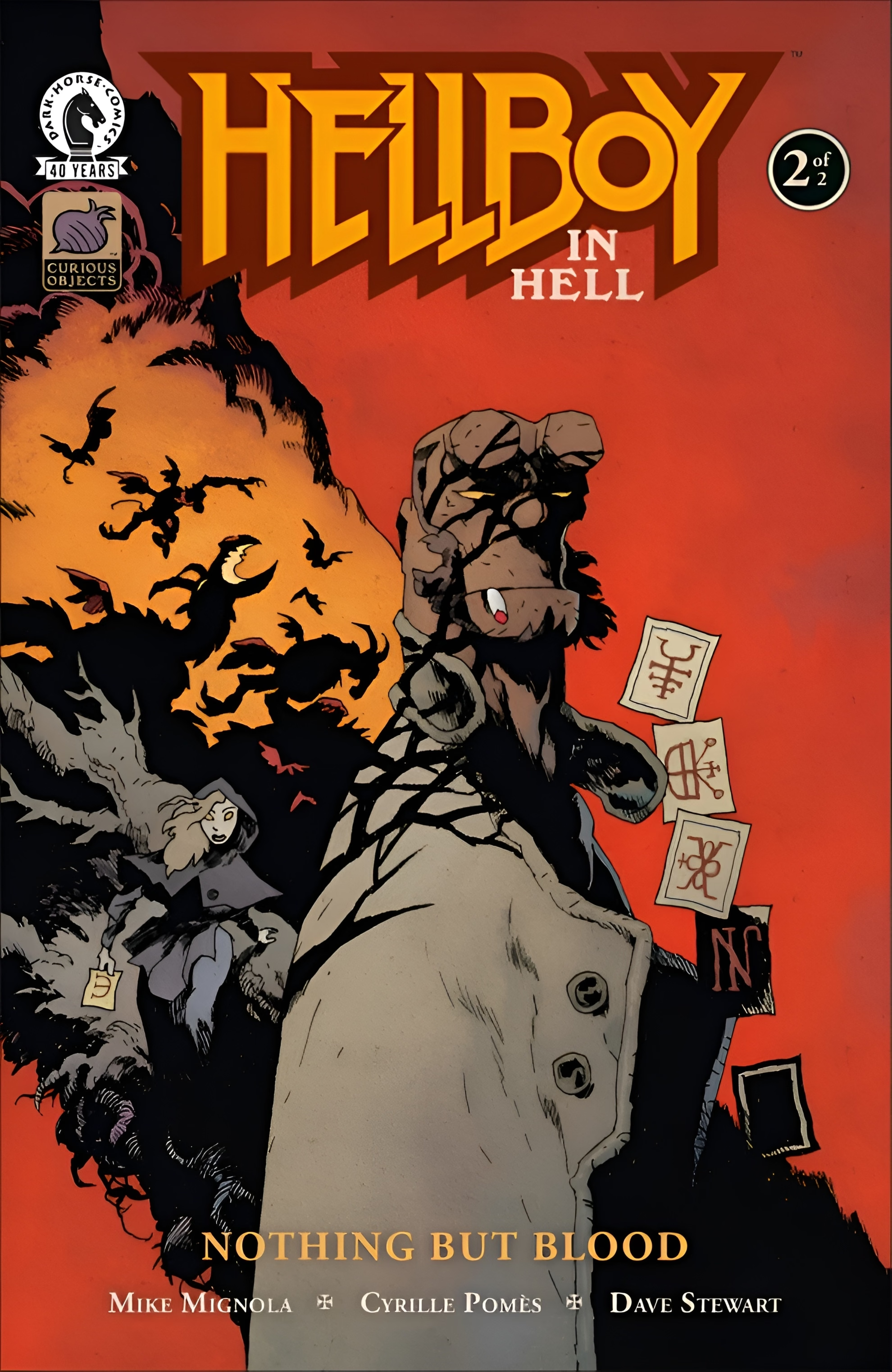
A kingdom that loses its king usually receives a succession story. Hell, in the poems that gave the Christian underworld its geography, receives something odder: the administration stays in place. Dante’s Satan sits frozen at the bottom of the ‘Inferno’ while the circles above him run on assigned punishments, and Milton’s ‘Paradise Lost’ gives the fallen a capital, Pandemonium, with a palace and a council. Both poems imagine Hell as a place with institutions. ‘Hellboy in Hell: Nothing But Blood’ #2 inherits that idea and tests it against a vacancy.
Dark Horse Comics publishes the issue on November 18th, 2026, at $4.99 USD, approximately COP 16,157, across 32 full-color pages. It closes a two-issue miniseries written by Mike Mignola, drawn by Cyrille Pomès, colored by Dave Stewart, and lettered by Clem Robins, with a Cover A by Pomès. The solicitation places the story after ‘Hellboy in Hell’ #8, in the aftermath of Satan’s murder.
A Hell With Its Offices Open
Earlier issues of the series put Hellboy in a Pandemonium whose dead waited for him to claim a throne. That throne is now vacant by murder, and the solicitation frames the issue around fallout rather than conquest: Hellboy finds himself at the center of Hell while the consequences of the killing play out around him.
The choice of fallout over succession is the formal wager of the premise. A story about who inherits the throne would be a story about one person. A story about what Hell does in the weeks after its ruler is gone is a story about a system, and it can be told only through what the system does to the people inside it.
Issue One in Retrospect
The miniseries opened on October 7th, 2026, with a Cover B variant by Mignola, and the primary cover states the premise before a page is read. Pomès draws Hellboy hanging from a blackened branch against a slate-gray sky, his silhouette cut from the same black as the tree so that the body reads as another limb of the dead wood. Beside him a slight, dark-haired young woman with a curled tail gazes off the edge of the frame, and small red winged shapes circle in the open air behind them.
The palette holds to gray-blue, black, and rust, and the one saturated note is the orange of the title, which places the heat of Hell in the lettering and leaves the picture cold.
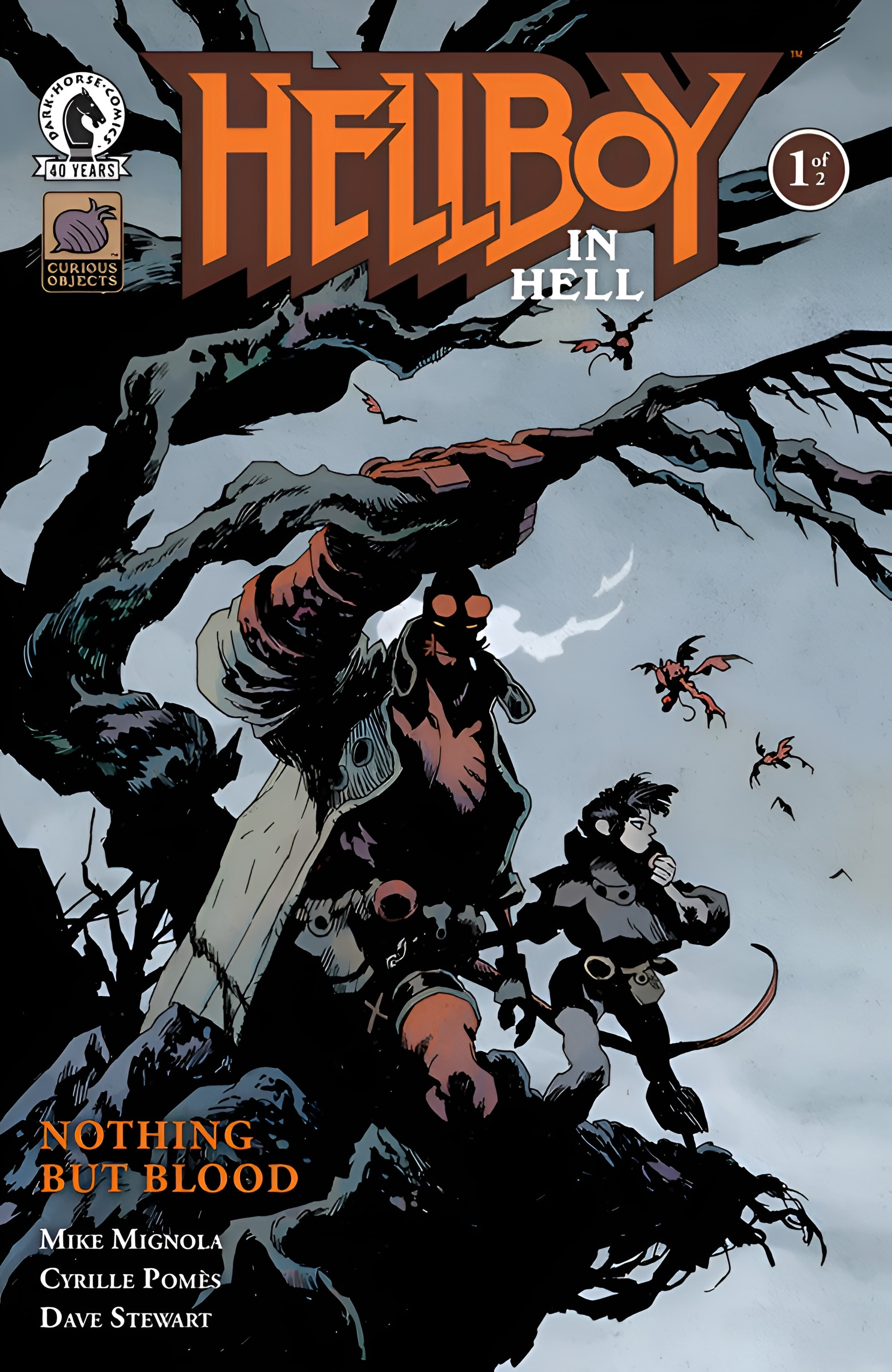
That cover makes a quiet argument about stillness. Scott Bukatman reads Mignola’s pages as an aesthetics of stasis, in which the drawing slows the eye instead of driving it from panel to panel.1 The first cover keeps to that principle even though a different hand drew it: Hellboy is held mid-climb, and nothing in the image moves toward the viewer.
The story inside is a rescue. Hellboy pulls a young woman out of reach of winged beasts during an uprising against Hell’s most powerful demons, in a Hell where Pandemonium has already fallen, and the publisher warns that nothing and no one in it is what it seems. The warning gives the cover’s second figure a different reading: her raised hand at her chin and her gaze fixed outside the frame suggest appraisal more than panic.
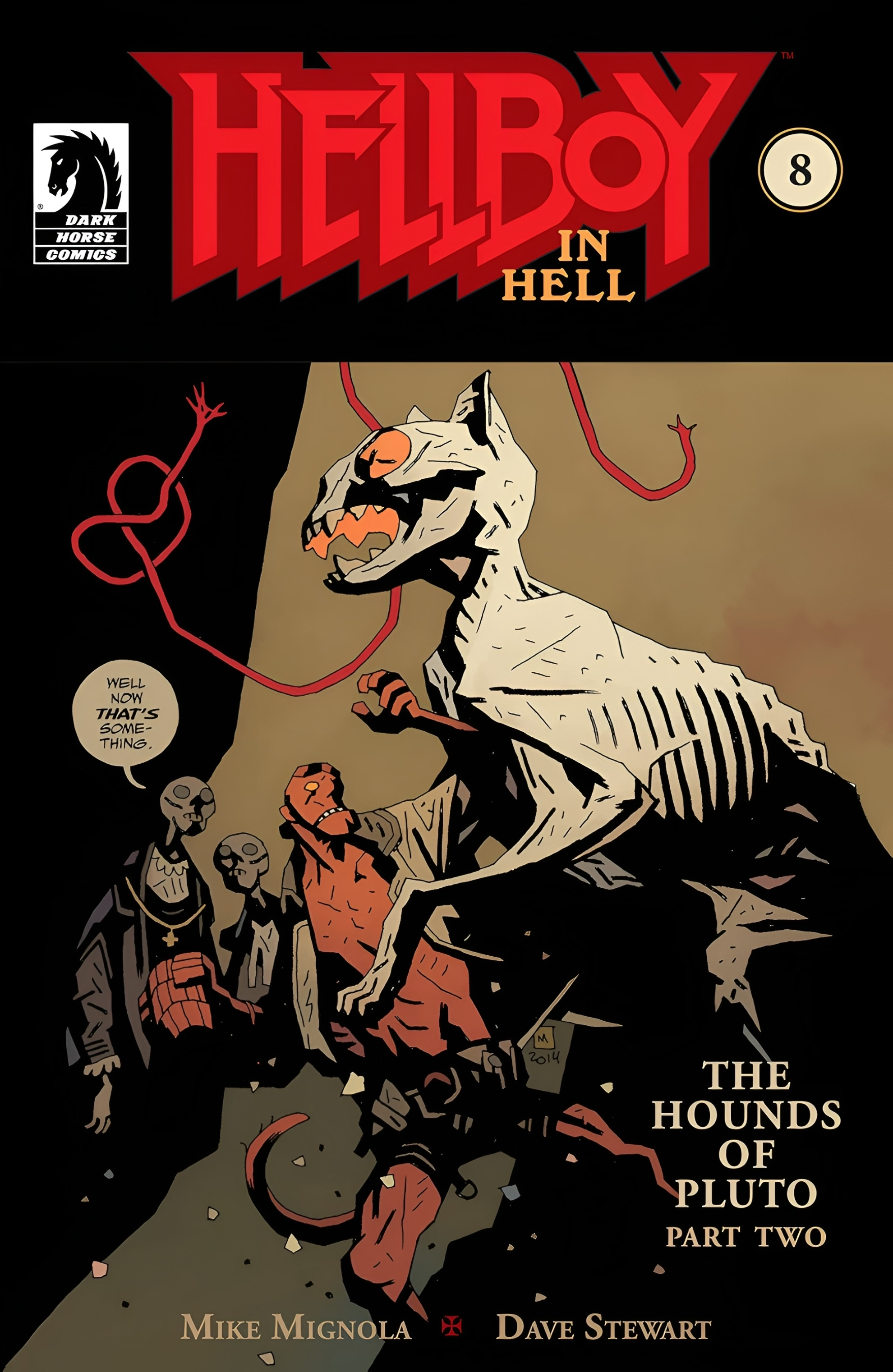
The vacancy the story occupies has a documented origin. Dark Horse published ‘Hellboy in Hell’ from 2012 to 2016, and Satan dies in issue #2, released in 2013, when Hellboy kills him in Pandemonium. Issue #8, released September 23rd, 2015, supplies the visual baseline, and Mignola drew its cover himself: Hellboy looks up at a gigantic skeletal cat while two skull-faced figures stand beside him, all of it composed of hard black shapes and flat planes of red, tan, and bone.
Set against it, the first Pomès cover trades the flat planes for a thin, feathered line and a mottled sky, and the heavy black survives only in the tree.
A New Hand in Hell
The original ten-issue ‘Hellboy in Hell’ run was written and drawn by Mignola himself, which makes Hell one of the few settings in the Hellboy Universe tied to a single hand. Pomès makes his Hellboy Universe debut with this miniseries. Speaking in the announcement of June 2026, Mignola said he “too thought Hellboy in Hell was a closed book” until he discovered Pomès’s work and the two met.
Pomès is a French cartoonist whose credits include ‘Moon’ and ‘6,000 Miles to Freedom.’ Around his line, the collaborators stay close to home: Stewart is a longtime Mignola colorist, and Robins supplies the lettering.
The arrangement poses a precise formal question about a mythology built on heavy blacks and flat color planes, namely how much of Mignola’s Hell lives in the drawing and how much in the color and the lettering.
A Finale Before the Funeral
The solicitation calls the issue a series finale, and it is one only for the miniseries. Dark Horse sets the story after ‘Hellboy in Hell’ #8, ‘The Hounds of Pluto’ Part Two, and the original run still had two issues to go from that point. The ending is a pause in a larger sequence rather than a closing door.
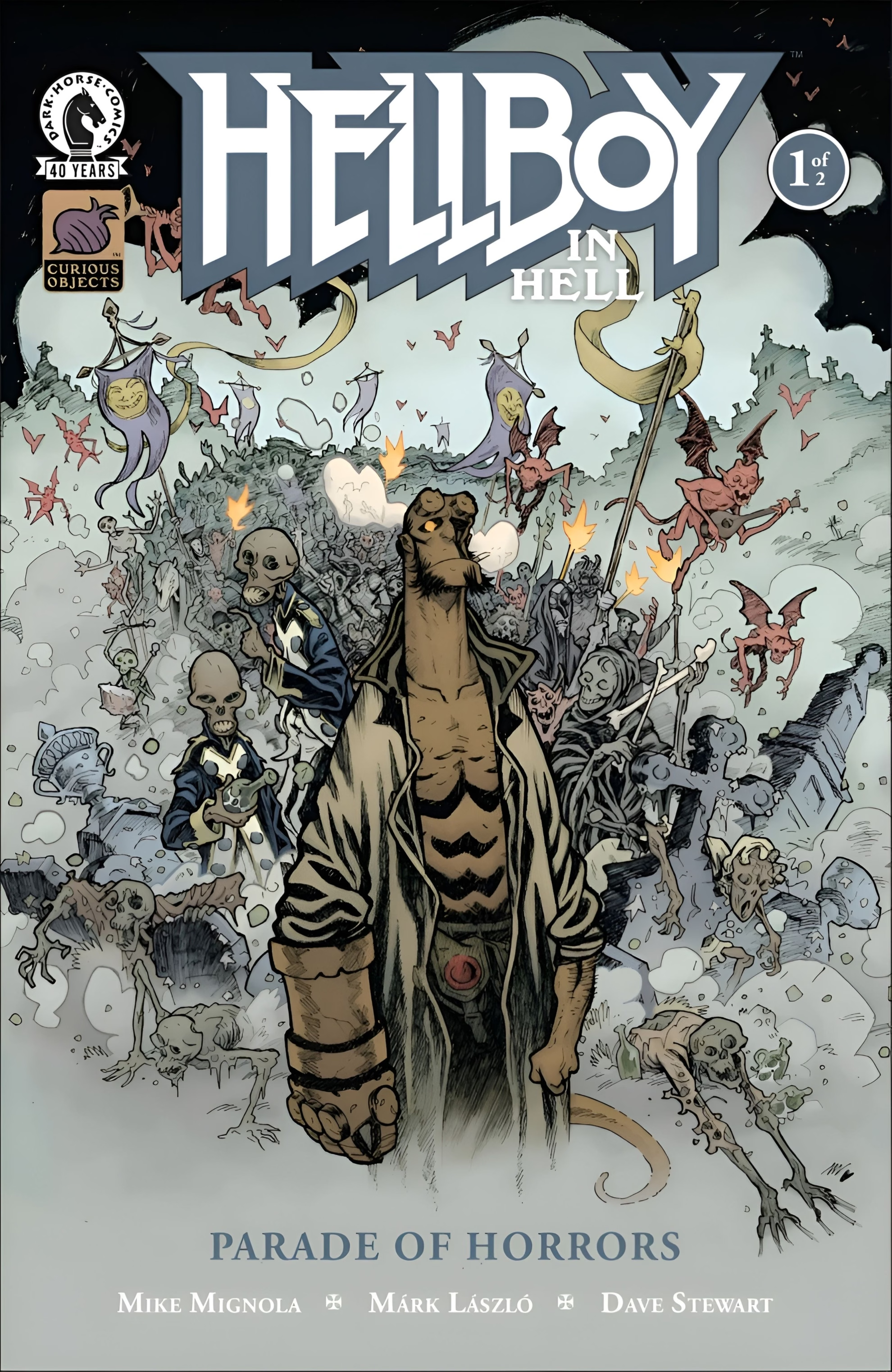
The follow-up, ‘Hellboy in Hell: Parade of Horrors,’ reaches shops on December 16th, 2026, reuniting Mignola with artist Márk László.
According to the publisher, it begins right after this miniseries, with Hellboy heading out for a drink and ending up at the Devil’s funeral. The order is telling: the Devil is murdered before the first issue opens and buried in the next book, so the rites trail behind the event. Institutions behave that way, and Mignola’s Hell is arranging itself as one.
A Throne Left Empty
Dante left Satan frozen in place while the circles kept their rules, and Milton gave him a palace to preside from. Mignola’s Hell removes the ruler and keeps the furniture. If the solicitation’s outline holds, the series ends its Hell by arguing that evil in this mythology never depended on one figure: it lives in the offices, the errands, the factions, and the rites that continue after the throne is empty, and it is Hellboy’s misfortune to be the one who wanders through them.
Mignola has spent three decades arranging the Hellboy mythology around a reluctant heir to a throne. Removing the throne’s occupant does not release him from that inheritance; it leaves him standing in an inheritance with no one left to refuse.
If Hell keeps running after the Devil is murdered, does that make evil in Mignola’s cosmology more frightening, or does it shrink the Devil’s death into a smaller event than the series once treated it as?
Reference
- Scott Bukatman, ‘Hellboy’s World: Comics and Monsters on the Margins’ (Oakland: University of California Press, 2016), 149–196. ↩︎


Leave a Reply