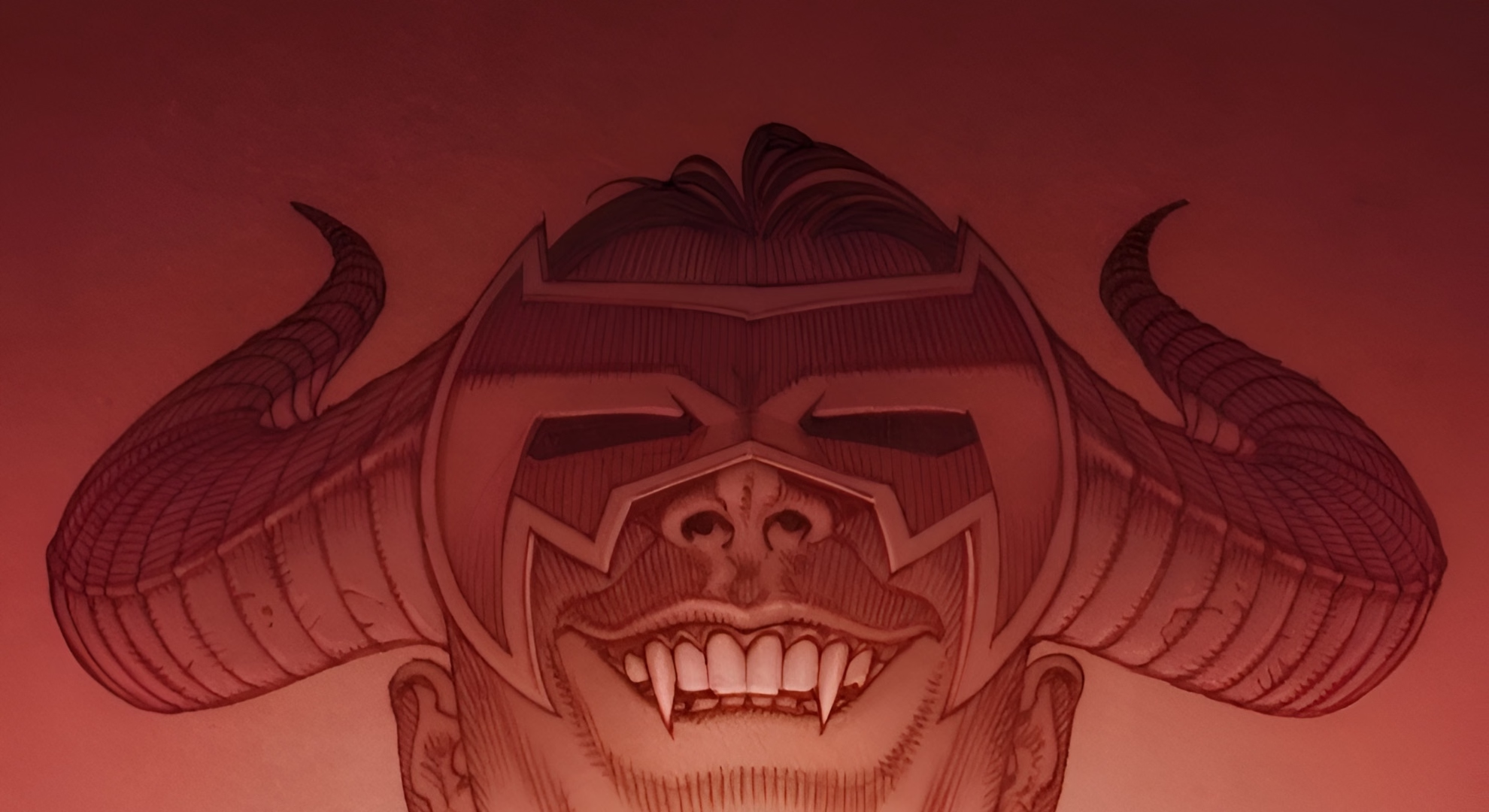


Tzvetan Todorov observed that every detective story contains two stories, the crime and the investigation, and that the detective stands apart from the first while learning from it: he cannot be harmed by the crime he reconstructs, and the reader follows him because he is immune.1 A comic page can hold both stories at once, one in the picture and one in the caption box, and a mystery drawn that way has to settle which channel is permitted to deceive.
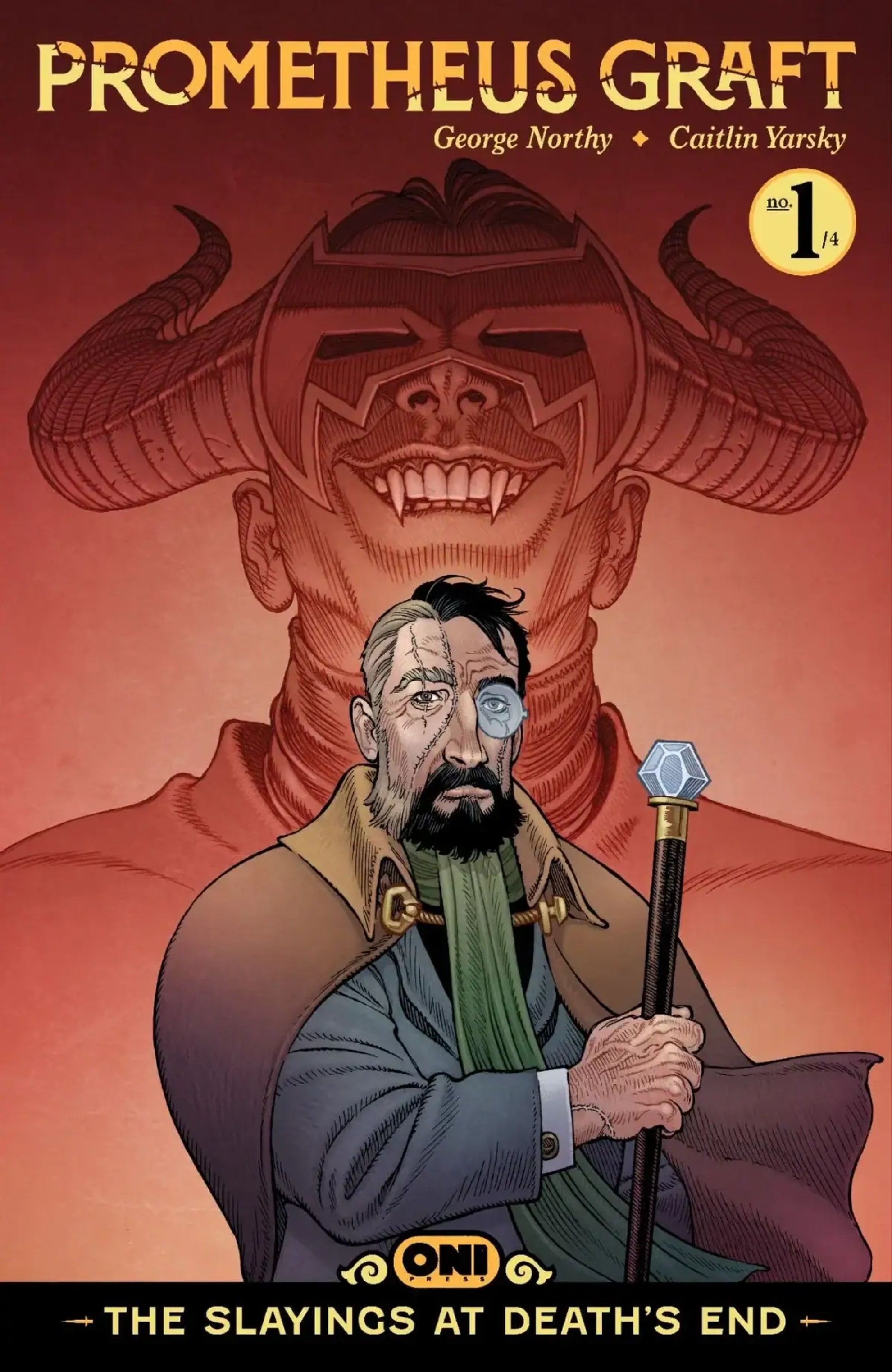
‘Prometheus Graft: The Slayings at Death’s End’ #1 stages that problem with a detective who cannot claim immunity, because he is himself a body assembled from other bodies.
Oni Press releases the issue on December 9th, 2026, at $4.99 (approximately COP 16,200) for 32 pages, the first of four, with the second due January 20th, 2027. George Northy writes; Caitlin Yarsky draws the interiors and the main cover; Eric Powell, Gabriel Rodriguez, and Patricia Martín supply variant covers, the last of them a 1:20 retailer incentive.
Rodriguez and Powell also supply textless full-art variants at 1:10 and 1:50, and a blank sketch cover completes the lineup. Matt Dryer edits, a credit Northy named in an interview published October 29th, 2026. Colorist and letterer credit could not be confirmed at the time of publication.
The Puzzle on the Page
The opening pages establish the method in the relation between caption and panel. The Creature’s narration runs in boxes, and its own account of the work is exact: “I then connect them, fasten them.” One verb serves the surgeon’s suture and the detective’s inference, and the layout enacts it, since each caption has to be fastened to the panel beside it before either makes sense.
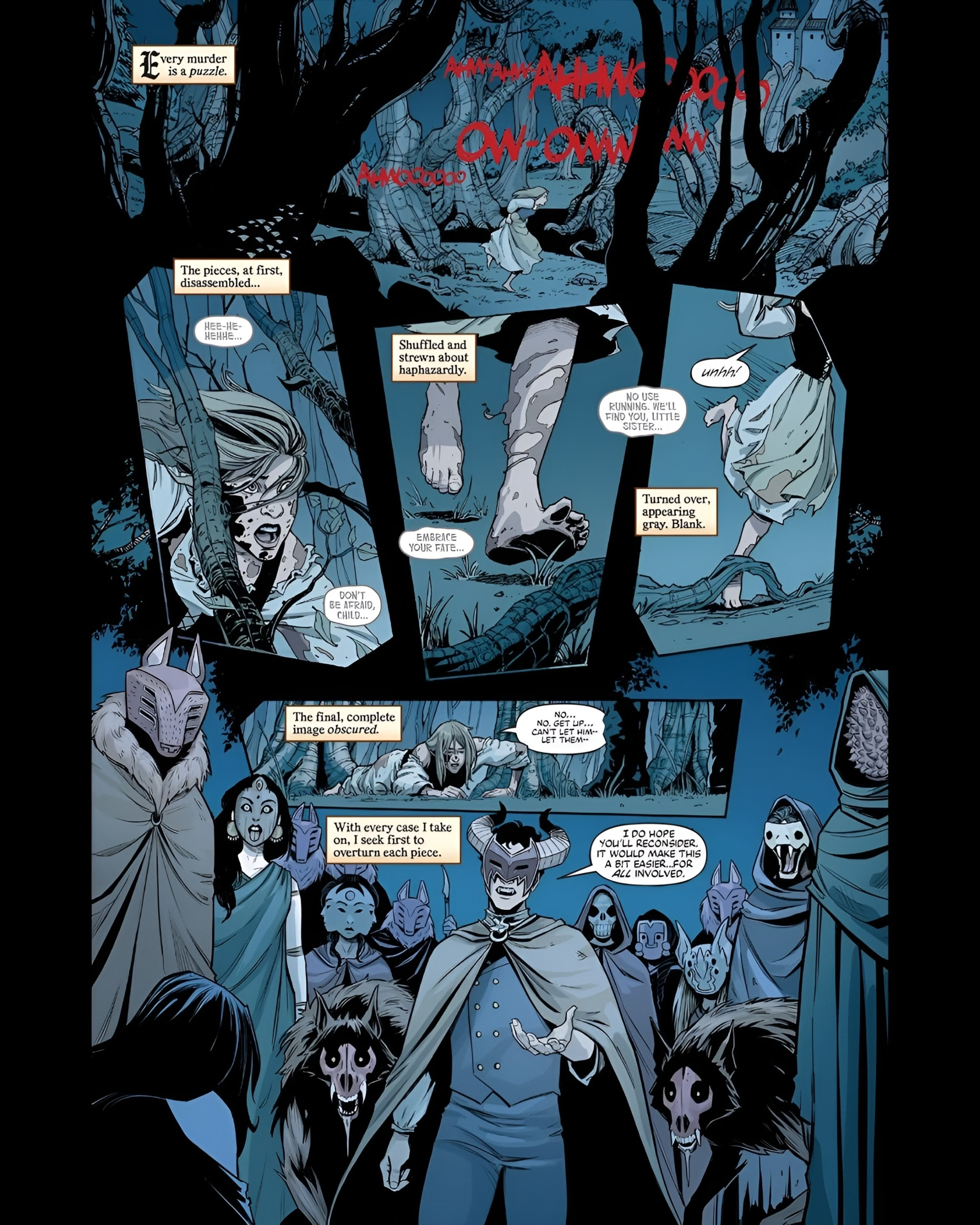
Crimson floods the page at the moment of violence, and the narration continues around it in the same measured box, so that color and voice disagree about how alarming the scene is.
Yarsky’s line favors firm contour and cross-hatching, which gives each figure a silhouette that can be identified at a glance; Northy noted in the October 29th interview that identifiable silhouettes mattered in a story with a cast of suspects.
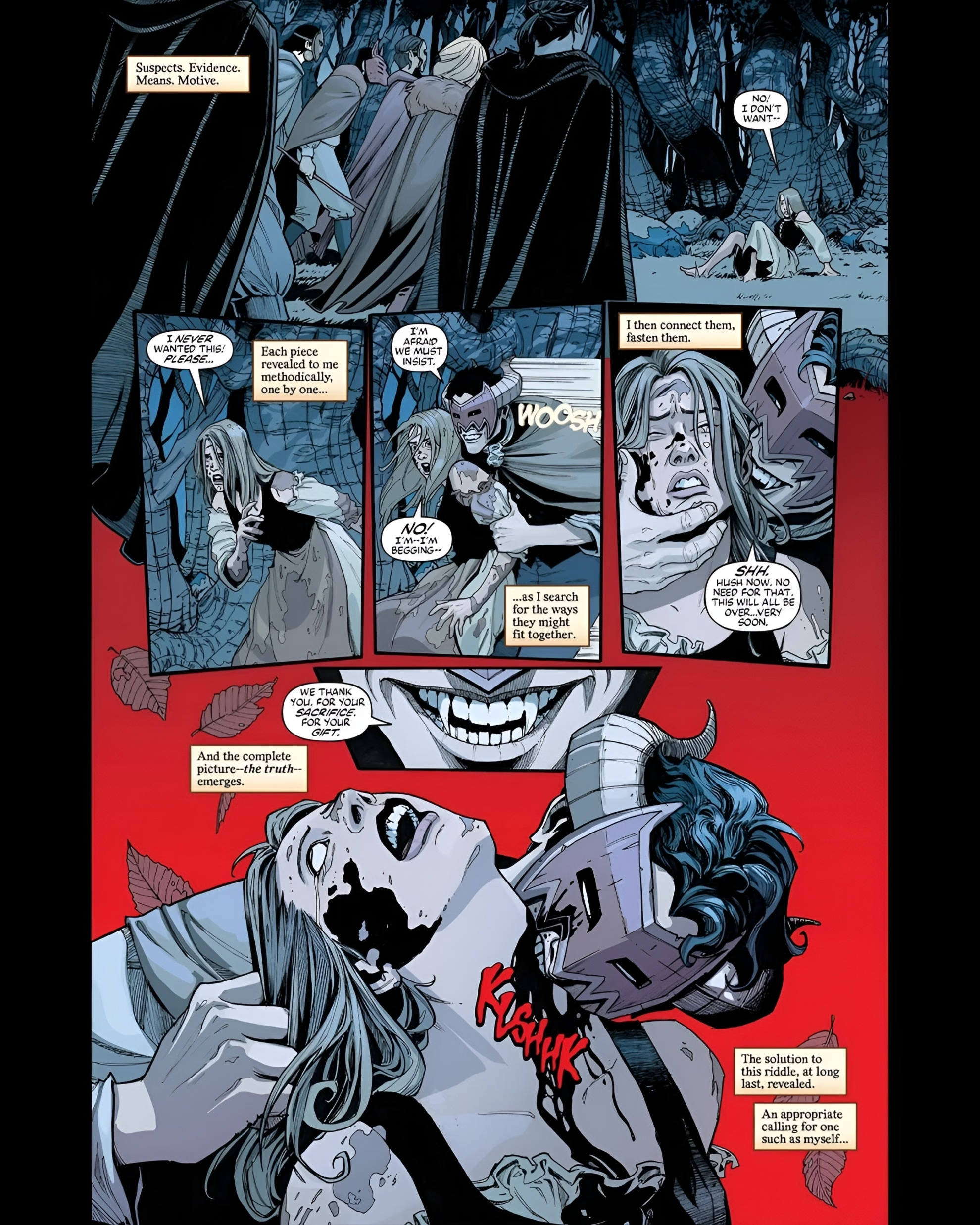
Color assigns each space its own key: teal and black for the crime, mauve and cream for the Creature’s interior life, and coral, gold, and burgundy for the castle. The scheme works as a fair-play device, because a reader can tell by hue which of the two stories a panel belongs to.
A Mirror in Three Panels
Page 3 gives the Creature’s reflection three consecutive panels. Repeating the frame slows time to three beats on one face, and each beat is a look of the kind a detective gives a witness. The face is the first piece of evidence the book asks the reader to weigh, and the sequence argues that the investigator belongs among the exhibits.
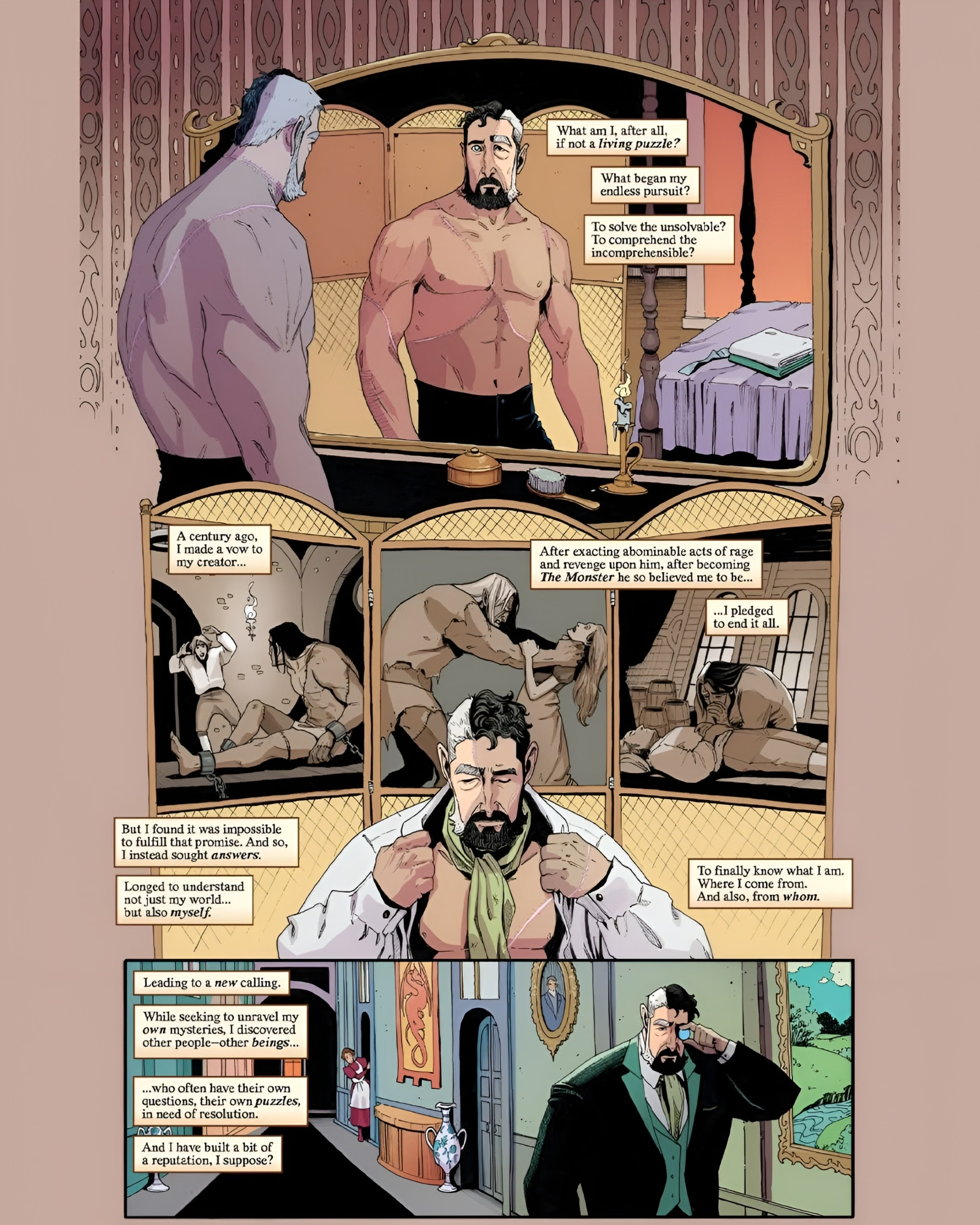
Northy described the Creature in the announcement of September 15th, 2026, as a “living puzzle.” The title carries the same double meaning. Anne K. Mellor observed that Mary Shelley’s subtitle, ‘The Modern Prometheus,’ names Victor Frankenstein, who combines the Prometheus who shapes humans from clay with the one who steals fire.2
Northy’s comic hands that name to the Creature, and “Graft” serves as a surgical term and as the caption method at once. Northy said in material released October 27th, 2026, that the events of Shelley’s novel remain canon, which means the detective carries Victor’s laboratory as history, not as metaphor.
Fair Play With Fangs
Northy explained in an interview published October 27th, 2026, that he wrote the series as fair play, with clues planted earlier than the reader expects them to matter. The setting is arranged to test that promise: a murder committed by day, after the guests have retired, and a hunt for werewolves where an English house party would have a pheasant shoot. The weapons name the victim’s species. Silver, stakes, fire, and sunlight each point at who the dead person was, so the cause of death doubles as an identification clue.
The closest precedent in comics is ‘Fables’ #1–5 (Vertigo, July to November 2002), in which Bill Willingham and Lan Medina set Bigby Wolf to investigate the murder of Rose Red, and whose fifth issue, ‘The Famous Parlor Room Scene (Sans Parlor),’ announced its debt to the genre’s drawing-room reveal in its title. ‘Fables’ treated its monsters as residents of a community with a sheriff. Northy’s book makes the investigator the one monster the others will not trust.
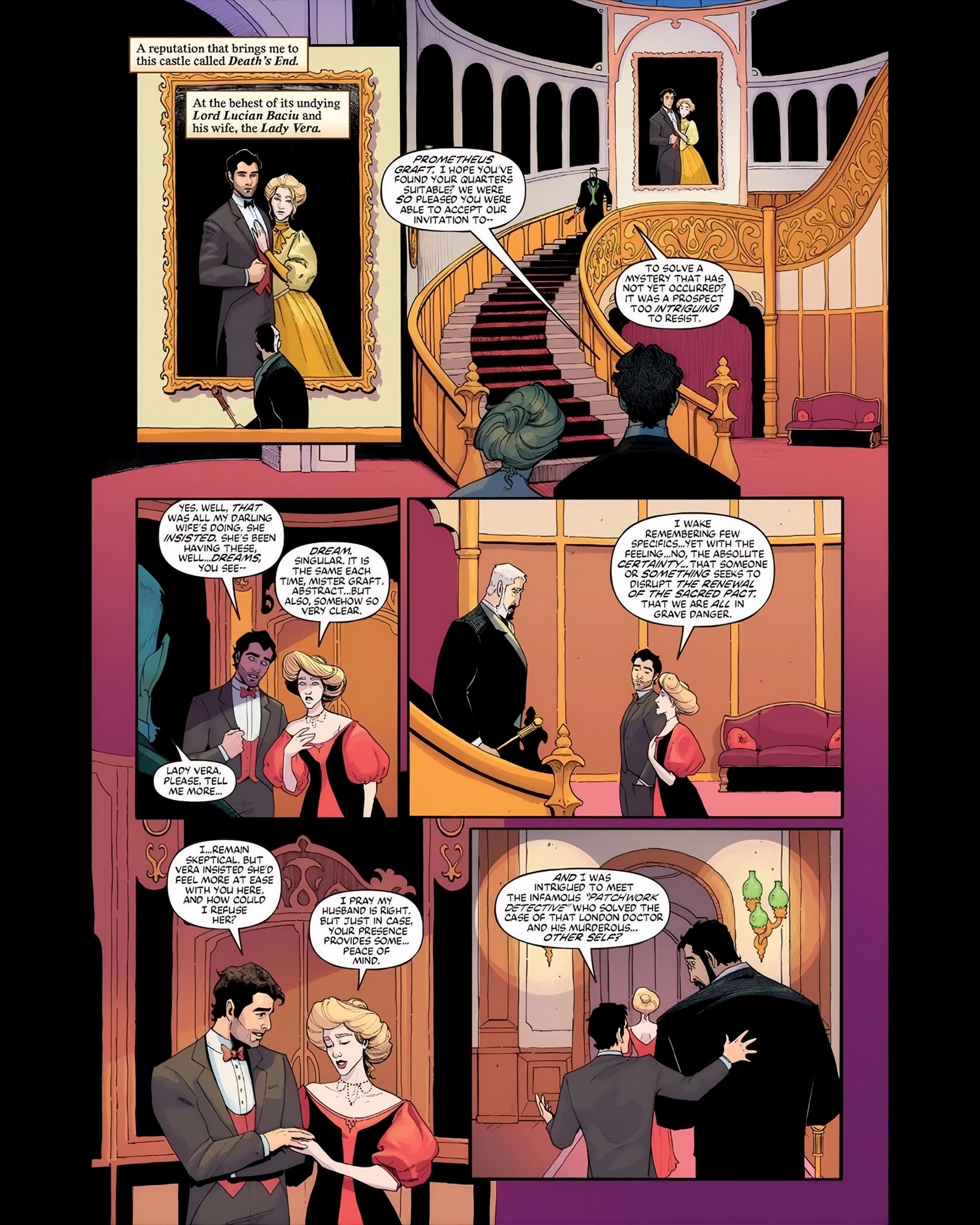
Page 4 inverts the order Todorov described. Lord Lucian Baciu and the Lady Vera dream of the pact being disrupted, so the investigation story begins before the crime story: a mystery that has not yet occurred is already pressing on the characters who will have to solve it.
A Month Between Clues
The series is neither an original graphic novel nor a collected edition, and the distinction still matters, because its form is designed for installments. Northy said that page-turn reveals serve as act breaks and that each issue ends on a cliffhanger. The case is to be solved within four issues, and an earlier Jekyll and Hyde matter in the Creature’s career is mentioned in this first one.
A reader of the monthly issues spends weeks suspicious of everyone the first issue introduces, with no way to flip back and cross-check. Should a collected volume follow, it will allow one-sitting clue checking, a more efficient and less anxious reading. For this book the monthly reading is stronger, because suspicion is the pleasure of the genre and a month is how long suspicion takes to ripen.
Solver and Solved
The case itself remains to be seen; the method is already on the page. The Creature was made by connecting and fastening, and that is the only way he knows to read anything, which is why he cannot stand outside the pieces the way Todorov’s detective stands outside the crime. He is assembled from them. The remaining three issues will show if working out other people’s deaths alters what he concludes about the making of his own body.
If the Creature reads evidence the way he was made, by connecting and fastening, does that make him a more reliable detective or a less reliable one?
References
- Tzvetan Todorov, ‘The Poetics of Prose’ (Ithaca: Cornell University Press, 1977), 42–52. ↩︎
- Anne K. Mellor, ‘Mary Shelley: Her Life, Her Fiction, Her Monsters’ (New York: Methuen, 1988), 70–71, 77–78. ↩︎



Leave a Reply