

Of the principal creatures Universal Pictures assembled across the nineteen-thirties and forties, three carry no novel or play behind them. The Mummy, the Creature from the Black Lagoon, and the man who turns wolf under an autumn sky were invented for the screen rather than adapted to it, which leaves any later interpreter free of an authoritative source text to honor or betray.
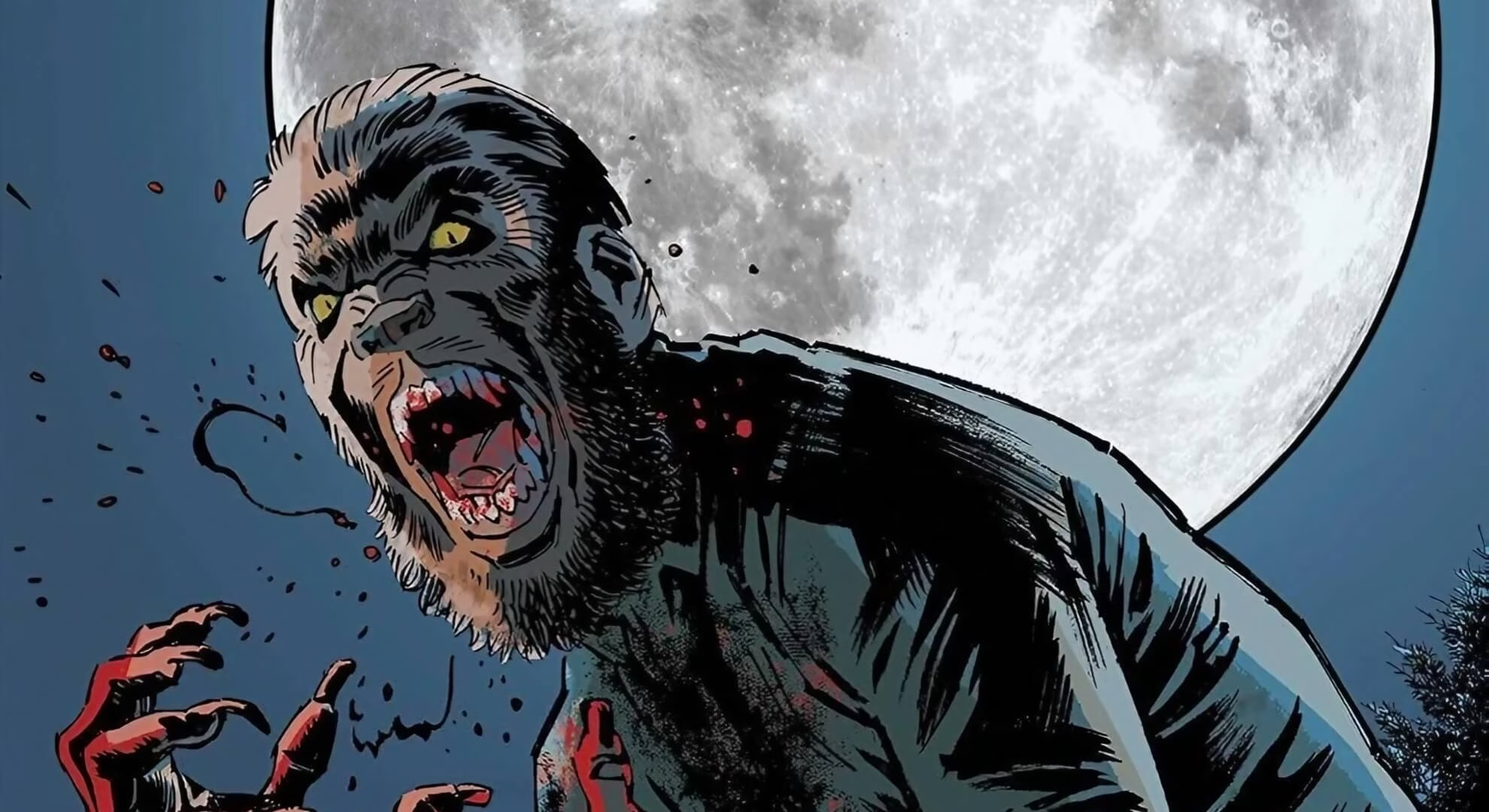
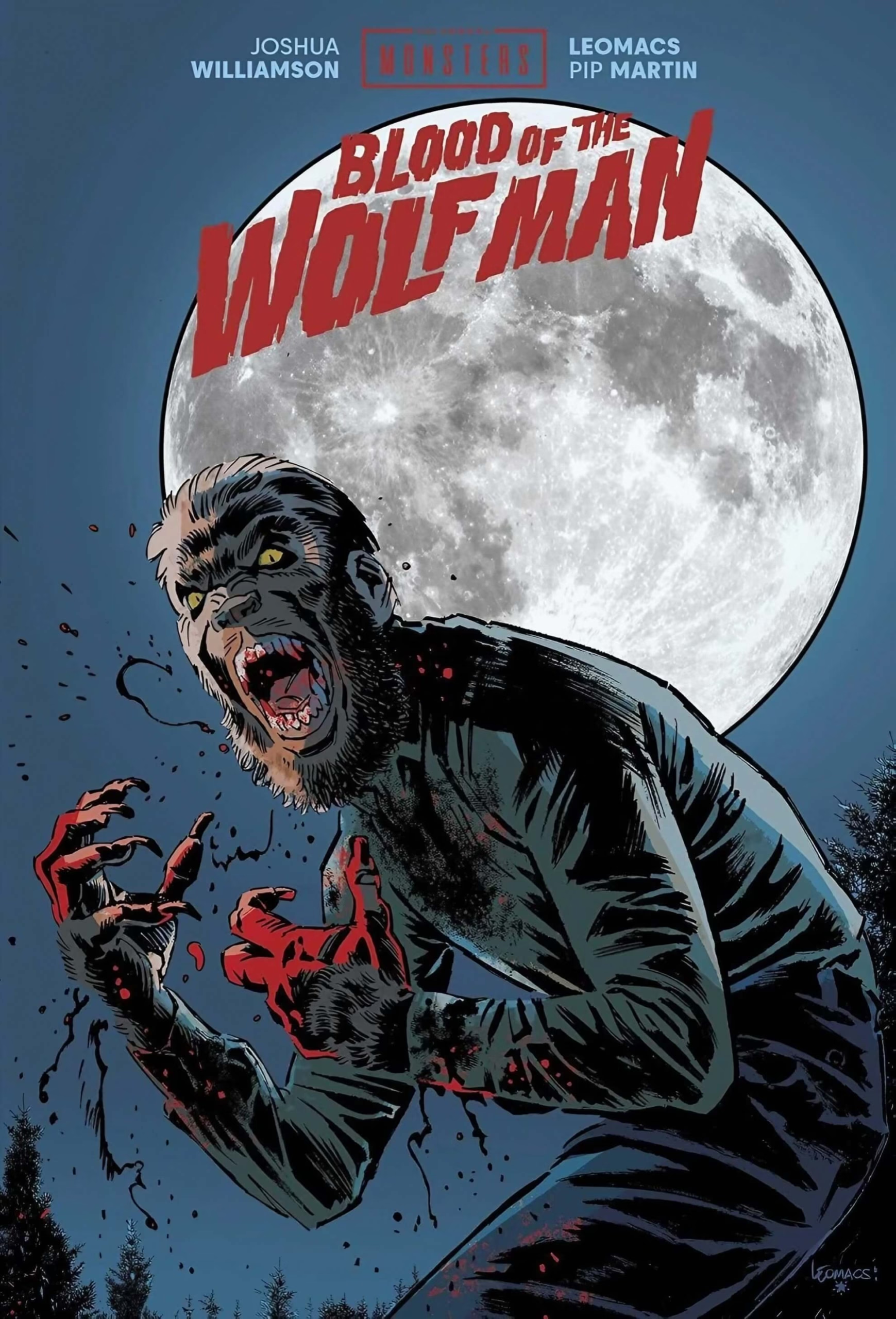
That freedom is the most useful fact to keep in view as Skybound Entertainment, the Image Comics imprint working in partnership with Universal Products & Experiences, releases ‘Universal Monsters: Blood of the Wolf Man’ #1 on June 24th, 2026, at $4.99 USD across 32 full-color pages.
The four-issue limited series reunites writer Joshua Williamson and artist Leomacs, with colorist Pip Martin and letterer D.C. Hopkins completing the team and a Cover A by Leomacs and Pip Martin.
The Wolf With No Book
A werewolf in comics inherits very little that is fixed. The 1941 film, ‘The Wolf Man,’ written by Curt Siodmak and directed by George Waggner did most of the codifying that audiences now treat as ancient lore.
Siodmak invented the rhyme about the man pure in heart who becomes a wolf when the wolfsbane blooms, and his original screenplay left it ambiguous whether Larry Talbot physically changed at all or merely believed he did. The full moon as trigger arrived only with the 1943 sequel; the first film tied the curse to the autumn bloom.
What endures from that picture is not a monster so much as a predicament. Talbot is bitten, survives, and is told he will kill whether he consents or not, and the film grants him no escape that does not also destroy him. Skybound’s series keeps the predicament and discards nearly everything else around it.
A Massacre and a Suspect
The lead is Adam Jaeger, a college student who arrived on campus expecting to remake himself and instead wakes as one of the few survivors of a massacre.
The solicitation withholds the obvious confirmation: Adam may be the one responsible, and as the thing inside him strains to break out, he sets himself against his own becoming.
Williamson has described the result as the most tragic work of his career, a story about family and inherited damage that earns the blood in its title through both violence and lineage. The premise quietly rewrites the Talbot situation: where the 1941 victim was a grown man returning to an ancestral estate, Adam is young, displaced, and uncertain, the curse arriving before he has settled into any self at all.
Leomacs and the Grimy Decade
The 1970s setting is the series’ most deliberate formal choice, and it falls to Leomacs and Pip Martin to make that decade legible on the page rather than merely stated in a caption.
Williamson has noted that the book does not look like what readers expect from a Wolf Man comic, crediting Leomacs and Martin with delivering a grimy period texture rather than gothic fog.
This is the partnership that drove the DC Comics series ‘Rogues,’ where Leomacs paired ground-level human faces with sudden eruptions of menace. That same contrast is the engine a Wolf Man story needs: a protagonist relatable enough that his transformation reads as loss, and a beast rendered with enough weight that the loss costs something.
Color as the Carrier of Dread
Color, not line, is likely to do the heaviest lifting in a werewolf comic, because the genre lives or dies on the threshold between the ordinary and the monstrous. A 1970s palette of sodium light, nicotine interiors, and asphalt offers Martin a muted register to hold for pages before blood forces a violent shift in key.
The effect a single page can produce is the contrast between a panel governed by that dull domestic range and the first panel in which red is permitted to dominate. When the restraint breaks, the eye registers the change as the transformation itself, before any figure has fully turned. That managed withholding is the formal mechanism that separates a werewolf sequence that lands from one that merely depicts.
Seventh in the Pack
Skybound’s Universal line has moved through its roster at a steady clip, and ‘Blood of the Wolf Man’ is the seventh series to launch under it.
It follows James Tynion IV and Martin Simmonds’s ‘Dracula’, the ‘Creature from the Black Lagoon Lives!’ by Ram V, Dan Watters, and Matthew Roberts, Michael Walsh’s ‘Frankenstein’, Faith Erin Hicks’s ‘The Mummy’, ‘The Invisible Man’ by Tynion IV and DANI, and Tyler Boss and Simmonds’s ‘Phantom of the Opera’, whose run concluded in May 2026.
A pattern is visible in that sequence: the line has favored period settings drawn close to the source films and literary register. ‘The Wolf Man’ book breaks from it by uprooting its monster to the recent past and trading gothic atmosphere for something closer to grindhouse grime.
The character also supplies the line its first genuinely source-free lead, since the prior entries adapted Stoker, Leroux, Shelley, and Wells, or carried decades of literary accretion. With no canonical text to answer to, Williamson and Leomacs are bound only by what the 1941 film established and the broader werewolf inheritance.
The Curse Before the Movies
Lycanthropy reaches the Universal cycle already ancient. Ovid’s Metamorphoses turns the tyrant Lycaon into a wolf as punishment, and Germanic and Slavic folklore carried the man-beast long before any studio claimed him.
In the Germanic north the wolf-shape was a martial honor rather than an affliction. The úlfhéðnar, the “wolf-coats” named in the Sagas and the ninth-century skaldic poem ‘Haraldskvæði,’ were warriors of Odin who fought wrapped in wolf pelts and were said to share the animal’s frenzy.
The ‘Völsunga’ saga sharpens the idea into narrative: Sigmundr and his son Sinfjötli pull on enchanted wolfskins and cannot shed them at will, and the Old Norse word “vargr” names both the wolf and the outlaw, binding the animal form to banishment from the human order.
Slavic tradition kept the transformation but recast its cause. The figure named across the languages as volkolak or vlkodlak, “the one with wolf-like fur,” usually owed its shape to sorcery, a curse, or punishment for sin rather than a bite.
The belief runs deep enough that Herodotus recorded the Neuri, a people of the lands that became Ukraine and Belarus, turning into wolves once each year, an early account of a change that reverses on its own. In the South Slavic strain the wolf-shifter and the vampire blur into a single returning dead, a reminder that the curse Skybound hands its college student descends from a tangle older and stranger than any single film.
What the comic inherits, then, is double: a folkloric figure thousands of years deep, and a specific cinematic shape that froze a slice of it into the tragic, conscience-ridden Talbot mold. Setting the new story in the 1970s places it within a particular American moment for the werewolf in print and on screen, the years just before the prosthetic showcases of the following decade.
Inheritance Made Monstrous
The most telling decision in ‘Blood of the Wolf Man’ is the reframing of the curse as something handed down rather than merely contracted. Siodmak’s Talbot caught his affliction from a stranger’s bite; Williamson’s framing of family and generational damage relocates the horror inside the bloodline, where a young man inherits a violence he never chose and cannot return.
For readers tracking Skybound’s Universal project, this is the moment the line stops adapting and starts inventing, taking the one top-tier monster without a book and treating that absence as license rather than limitation. Whether the 1970s relocation deepens the Talbot tragedy or simply redresses it is the question the four issues exist to answer.
Does relocating the Wolf Man to a nineteen-seventies college town and recasting his curse as inherited family damage strengthen the tragedy Curt Siodmak built into the 1941 film, or does it trade away the very thing that made Larry Talbot’s story endure?



Leave a Reply