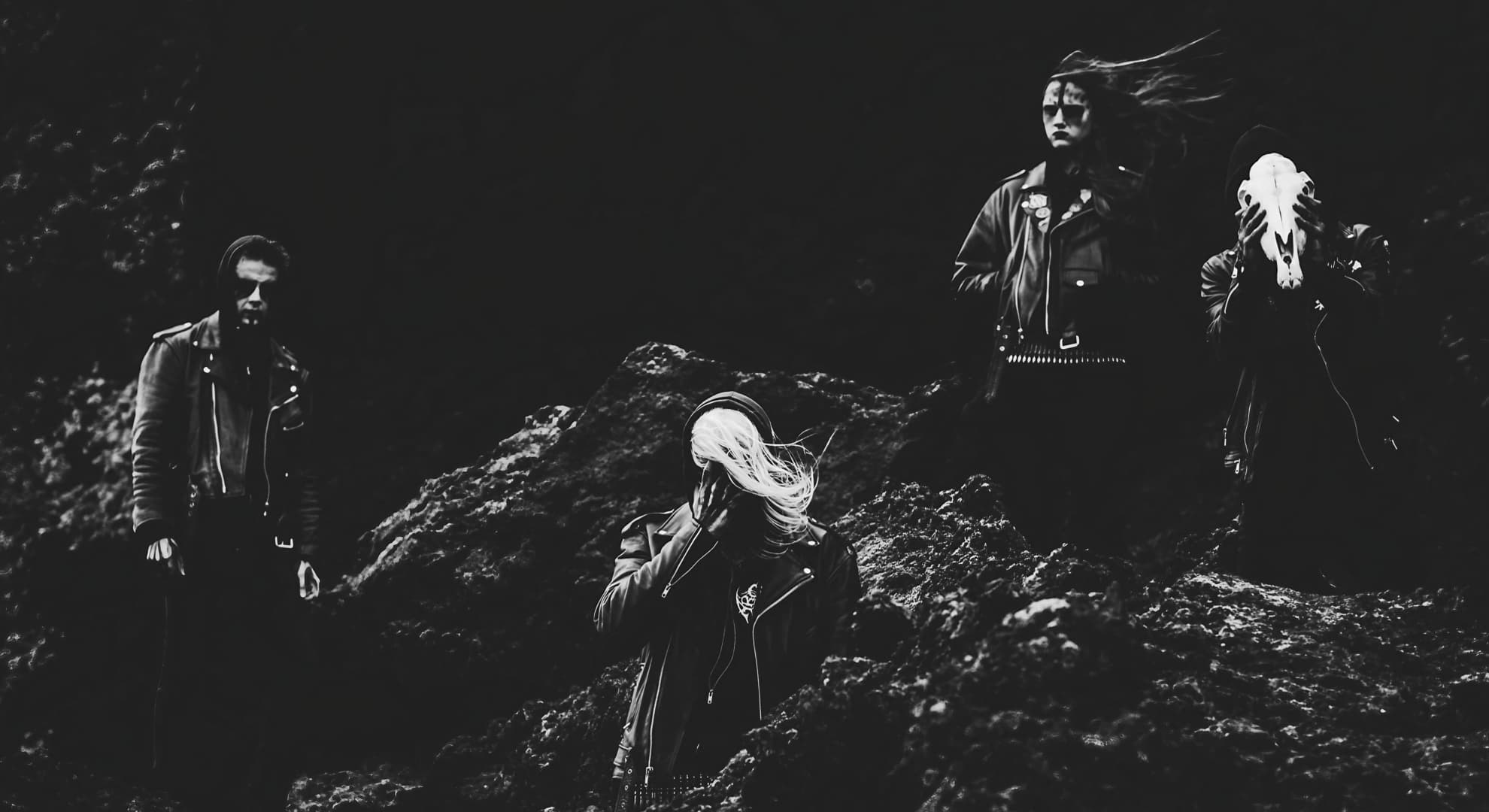


Iceland keeps almost no one in its interior. The island’s volcanic heart — black sand, fissured rock, ground that still shifts underfoot — was never tamed into pasture or town, and the first settlers read that emptiness as inhabited. In the medieval imagination set down in the Eddas, terrain was never neutral.
Spirits held particular stretches of coast and mountain, a seeress could be called to speak the fate of the world, and that world was promised an ending in fire and water.
A generation of musicians from the country’s margins has spent the past decade treating that inheritance as method rather than costume. A quartet from a Reykjavík suburb now steps into it with unusual composure.
The country has no deep forests to hide its myths and no cities old enough to bury them. Its oldest stories survive where they were first set down — on lava fields, along fjord edges, beneath skies that withhold the sun for months. That exposure is the condition the music inherits.
Cosmology Written in Volcanic Ground
The Eddic account of Ragnarök — the burning and drowning of the ordered world — is not a marginal tale but the horizon toward which gods and mortals alike move.1
Iceland kept those texts when much of the continent let them lapse. The land-spirits were bound to actual ground rather than to any temple, which turned the country’s geography itself into a sacred record.
The seeress of the old poems was summoned to speak what was coming, and what she foretold was rarely deliverance. A worldview organized around an appointed catastrophe leaves a particular residue — not despair, but a calm familiarity with endings. That temperament, more than any single lyric, is what the island’s severe music carries outward.
A New Voice in the Cold Current
Forsmán formed in Kópavogur, a town folded into the southern edge of the Reykjavík area, and the four musicians who make up the band remain in their early twenties. They take their place within the modern Icelandic current associated with Svartidauði, Sinmara, and Misþyrming.
Scholarship on Nordic metal has shown how thoroughly Norse themes work there as a means of shaping cultural identity rather than mere decoration.2
What sets the Icelandic strain apart is that its ground is not a remembered homeland but a present and largely empty fact. The current those three bands set running favors dissonance and ceremony over the raw minimalism of the Norwegian second wave that preceded it — chaos shaped into something deliberate.
Svartidauði opened the modern current with a chaos that felt theological rather than merely violent; Sinmara refined its dissonance into something close to liturgy; Misþyrming gave it scale and a national audience. Forsmán arrive after all three, fluent in a grammar that took the previous decade to assemble.
Out of Kópavogur, Onto Metal Blade
The band’s only earlier release was the 2021 EP ‘Dönsum í logans ljóma,’ tracked at Studio Emissary, the Reykjavík facility whose work with Svartidauði, Sinmara, and the wider scene has made it the central production house of Icelandic black metal. Five years separate that session from the debut full-length.
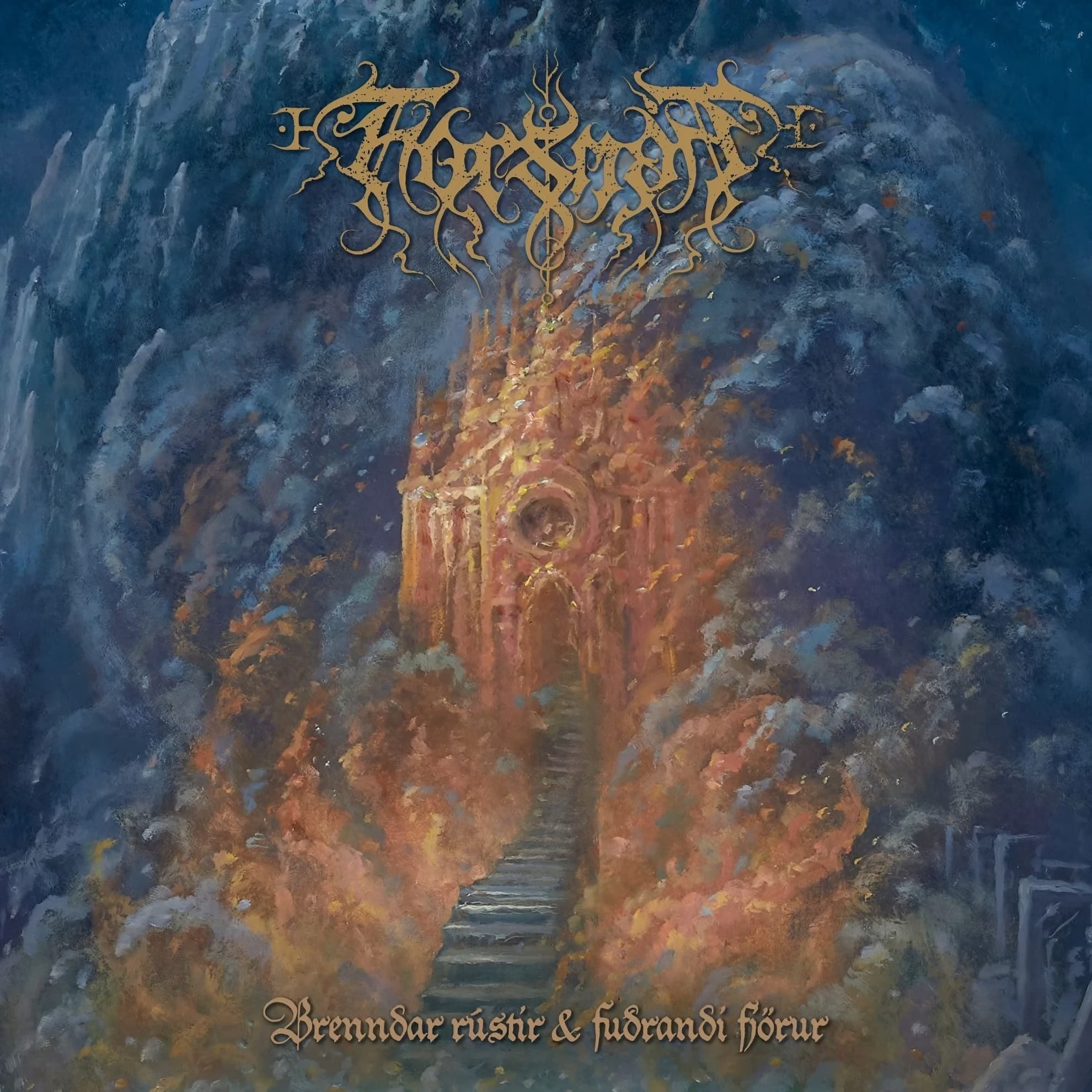
‘Brenndar Rústir & Fuðrandi Fjörur’ arrives on June 26th, 2026, through the German label Vesperian World and distributed by Metal Blade Records worldwide — a reach the EP never had. The production credits for the album itself had not been confirmed through official sources at the time of publication.
The move from a self-released EP to a debut pressed on splatter vinyl, compact disc, and a limited gatefold edition marks a change in scale rather than intent. Vesperian handling the release while Metal Blade carries it outward gives a band barely past its first decade a path to listeners its earlier work could never reach.
Severity as a First Utterance
The track issued ahead of the album, ‘Drottinn Fyrirgefur Allt,’ or ‘The Lord Forgives All,’ opens the record and appeared on May 13th, 2026, with a visualizer. In its audible form it moves through intricate, fast riff figures that shift rather than settle, holding a cold density while keeping the separate lines beneath it legible.
That restraint — detail kept clear inside speed — positions the forthcoming record toward precision rather than the blurred murk the genre often accepts as atmosphere. The album’s title reads roughly as scorched ruins and blazing shores, a pairing of fire and coastline that the cover painting by Paolo Girardi, whose work includes Sulphur Aeon and Revocation, renders in churning apocalyptic detail.
The titles that follow the opener read as a catalog of ruin and water — black swans, the stillborn, graves brimming at the shore — a vocabulary that matches the album’s name rather than illustrating it. The full record stays out of reach for now, but the opener already declares a preference for precision over brute weight.
The Cold Carried Far from Home
Carried out of the North Atlantic and into scenes that never shared its ground, that severity does not arrive intact. Imported culture travels by reworking, taking on meanings far from those it left with.3
In much of the global underground, extreme metal reached listeners not as entertainment but as a language for endurance. Scholars of the music in Latin America have traced how it took shape under repression and came to code identity and survival in sound rather than mere defiance.4
Forsmán’s fated, burning world meets audiences with their own reasons to take catastrophe seriously. The image of an island promised to fire and flood needs no translation where history has already supplied the feeling.
Access shapes the encounter. A limited vinyl pressing carried across an ocean, or a premium streaming tier weighed against a modest wage, makes attention to a record like this one a deliberate act rather than an idle stream.
After the Burning, the Shore
A debut rarely carries the weight of a tradition this fully formed, and ‘Brenndar Rústir & Fuðrandi Fjörur’ enters the Icelandic current without the apprenticeship its makers’ ages might suggest. On June 26th, 2026, it reaches a public far wider than the one its 2021 EP could find.
What that public receives is not a finished verdict but an argument carried in cold detail — a young band’s wager that the island’s old promise of fire and flood still has something to say, and a listenership elsewhere prepared, by its own past, to hear it. The record’s full shape waits on its release; the terms of the encounter are already set.
For a debut, that is an unusual position to hold — neither announcing itself through novelty nor leaning on a borrowed pedigree, but stepping into an existing severity as though it had always belonged there. Whether the rest of the record honors that poise is the one question the opener leaves open.
For a listener far from the North Atlantic meeting Forsmán through a single track and a painted cover, does an Icelandic vision of a burning, fated world become something personally meaningful, or does the distance between that island’s ground and one’s own surroundings change what the music is able to mean?
References
- John Lindow, ‘Norse Mythology: A Guide to the Gods, Heroes, Rituals, and Beliefs’ (Oxford: Oxford University Press, 2001), 254–256. ↩︎
- Imke von Helden, ‘Norwegian Native Art: Cultural Identity in Norwegian Metal Music’ (Münster: LIT Verlag, 2017), 44–48. ↩︎
- Néstor García Canclini, ‘Hybrid Cultures: Strategies for Entering and Leaving Modernity,’ trans. Christopher L. Chiappari and Silvia L. López (Minneapolis: University of Minnesota Press, 1995), 206–211. ↩︎
- Idelber Avelar, ‘Heavy Metal Music in Postdictatorial Brazil: Sepultura and the Coding of Nationality in Sound,’ Journal of Latin American Cultural Studies 12, no. 3 (2003): 332–335. ↩︎

Leave a Reply