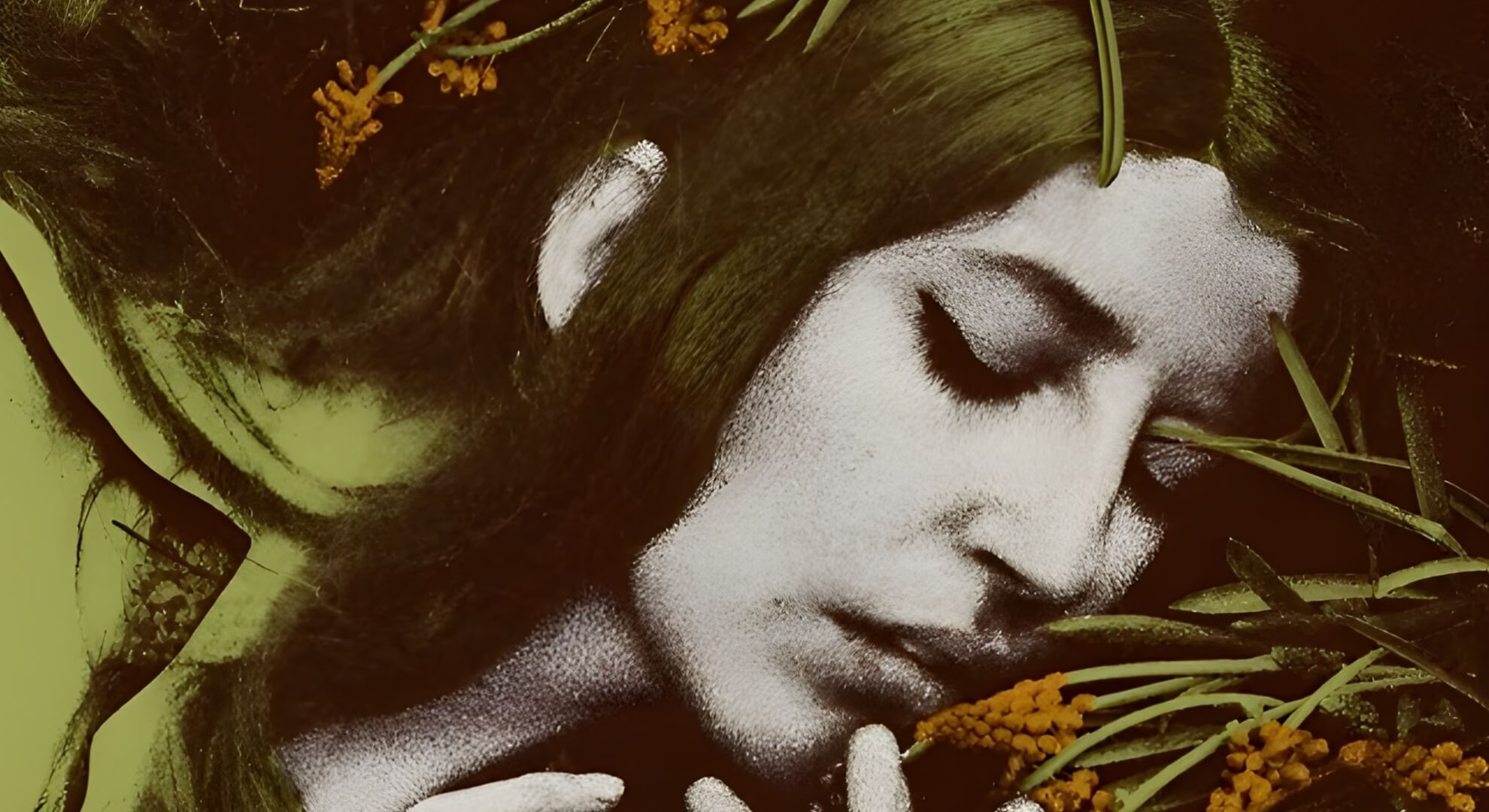


The Green Man carved into the stonework of medieval English churches was named in 1939. Before Lady Raglan gave the foliate head its contemporary title in the journal Folklore, there was no single “Green Man” — only stone carvings and May Day customs and forest legends that did not know they were related.
The naming created the deity, or rather created the scholarly debate about whether a deity had ever existed. That debate is now 87 years old, and Hellebore Magazine, the United Kingdom’s leading small-press magazine devoted to folk horror, folklore, magic and the occult in Britain, has built its fifteenth issue around it.
Where the Scholarly Line Holds
Since its founding issue in October 2019, Hellebore has occupied a precise critical position: rigorous enough for scholars, accessible enough for readers with no academic affiliation.
Ronald Hutton — historian of modern Paganism and author of ‘The Triumph of the Moon,’ ‘Pagan Britain,’ and ‘The Witch’ — described it as “the most erudite journal on the current scene to deal with Paganism, magic and folklore in the realms of modern history, fiction and popular culture,” one that “effortlessly straddles the spheres of academic and independent scholarship to unite the two in an ever-exciting and always accessible cocktail of new research.”
That endorsement names a structural achievement, not a stylistic one: a single publication doing work that two separate types of institution usually divide between themselves.
The magazine carries no advertising — an editorial position that removes commercial pressure on its line. Founded by writer and editor Maria J. Pérez Cuervo, it publishes twice yearly at the Beltane Fire Festival in May and the Samhuinn Fire Festival, in October. Hellebore was a World Fantasy Awards finalist in 2022 and a British Fantasy Awards finalist in 2024.
The Green Man’s Contested Ground
Green in British folklore is not a single tradition. The foliate heads carved into medieval church stonework, the Jack-in-the-Green processionals of eighteenth-century London May Day celebrations, the Wild Man of the medieval forest, the Green Knight of the Arthurian cycle, and Pan in his British manifestations are distinct historical phenomena that the twentieth century repeatedly attempted to unify into a single pagan fertility tradition.
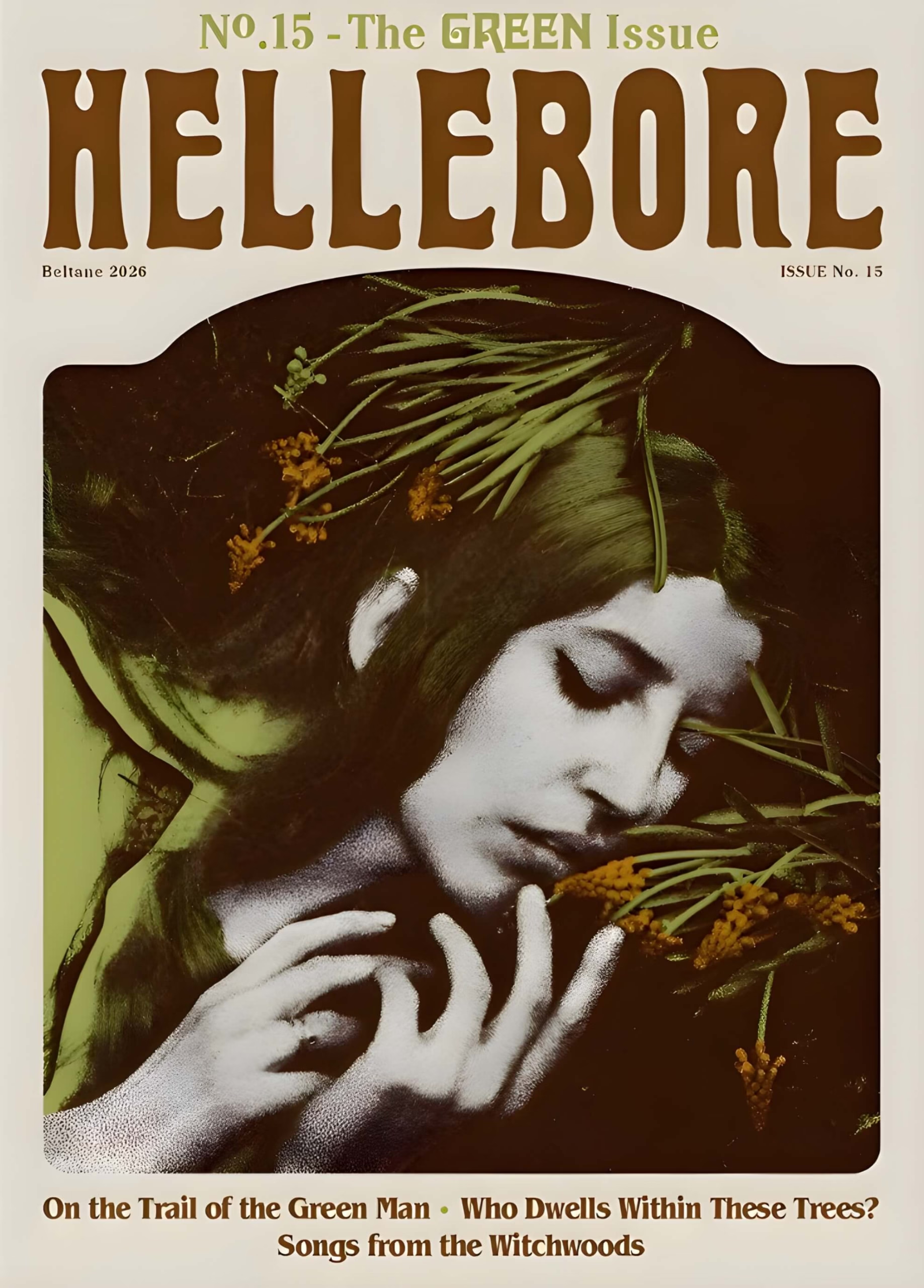
Lady Raglan’s 1939 naming of the “Green Man” was the most influential of those unifications; Robert Graves’s ‘The White Goddess’ (1948) provided the syncretic vegetation mythology that would shape three generations of pagan practice. What Hellebore #15, ‘The Green Issue,’ examines is whether that unified mythology survives contact with the documented histories of its component figures.
The Beltane timing is not incidental. Releasing a 92-page examination of green mythology at Beltane Fire Festival is a statement about the calendar this tradition actually follows: the Jack-in-the-Green processions, the maypole, the opening of the summer half of the year. Hellebore has published its spring issues at this festival throughout its run, and the decision to devote Issue #15 to green mythology on that schedule argues that the tradition is still alive enough to time your publishing around it.
A Roster That Argues Its Own Case
Paul Robichaud — Professor and Chair of English at Albertus Magnus College and author of ‘Pan: The Great God’s Modern Return’ (Reaktion Books, 2021) — contributes to an issue whose editorial argument runs directly from the Green Man to Peter Pan, described as the figure who “with the sound of his pipes will lead us to the Arcadian god with whom he shares his name.” That framing connects to Robichaud’s documented scholarly work on Pan’s twentieth-century cultural return.
Dr. Katy Soar of the University of Winchester — who has contributed to Hellebore since Issue #1 and wrote ‘The Great Pan in Albion’ for Issue #2 — anchors the specifically British dimension of that argument.
Francis Young — Fellow of the Royal Historical Society, tutor at Oxford University’s Department for Continuing Education, and author of 25 books on the history of religion and supernatural belief, most recently ‘Silence of the Gods’ (2025) — addresses the material on holy and unholy trees in the issue.
Nick Freeman, Reader in English at Loughborough University and a member of the Friends of Arthur Machen, brings the Victorian-literary thread that connects the issue’s historical ground to its late-nineteenth-century expression. Novelists Verity Holloway and Ally Wilkes — Wilkes is the author of the Antarctic horror novel ‘All the White Spaces’ (2022) — contribute fiction alongside the essays. Art is by Lorenza Daprà and Sam Freeman, who also handles graphic design.
The Editor and Her Own Contribution
Pérez Cuervo is not only Hellebore’s editor but one of its consistent writers, and in Issue #15 she contributes ‘The Folklore of Flowers,’ a piece on plant magic and botanical lore that sits squarely within the issue’s thematic argument.

As a freelance writer she has produced criticism for Fortean Times across film history, folklore, and mythology, and has written liner essays for Radiance Films, Severin Films, and Indicator. She has been a guest speaker at Tate Britain, the British Library, and Watkins Books — a range of invitations that places her work in both popular and institutional contexts without fixing her to either.
Rick Poynor, writing for Eye Magazine, called Hellebore the most impressive fusion of editorial vision and interpretative magazine design he had encountered in years. That description captures the same dual positioning that makes Hellebore what it is.
In Print, in Your Hands
Hellebore #15, ‘The Green Issue,’ is available from helleborezine.com at £7.75 GBP (approx. COP 38,800 at May 2026 rates) and through independent stockists worldwide. The magazine ships internationally from the United Kingdom. The issue runs approximately 92 pages, printed on silk paper with perfect binding, in A5 print format — consistent with the format Hellebore has maintained throughout its 15-issue run. There is no digital edition for individual issues. The publication carries no advertising. Back issues from #1 through #14 remain available through the same channels, with bundled collections also listed on the site.
Beltane Fire Festival 2026
The 2026 Beltane Fire Festival took place on April 30th on Edinburgh’s Calton Hill, organized by the Beltane Fire Society — a community arts performance charity that has staged the revivalist celebration of the ancient Gaelic festival each year since 1988.
More than 9,500 people attended the 2026 edition, which centered its procession on the May Queen and the Green Man, the two mythic figures whose seasonal drama the Society has performed for nearly four decades. The festival runs from 7:30pm until the early hours of May 1st, with several hundred volunteer performers — drummers, fire players, acrobats, and costumed characters — processing from the National Monument around the hill.
Adult tickets for the 2026 edition were priced at £15.00 in advance and £20.00 on the night through Citizen Ticket, with under-18 tickets at £8.00 in advance and a low-income rate of £9.99. That the 2026 festival placed the Green Man at the center of its narrative, arriving in the same week as Hellebore #15 with its own sustained treatment of the figure, illustrates the currency of the tradition both are drawing from.
Samhuinn at the Dark End of the Year
Edinburgh’s Samhuinn Fire Festival, organized by the Beltane Fire Society, takes place each October 31st — the date it shares with Halloween, which derives from the Celtic celebration it reimagines.
The modern festival has been held in Edinburgh since 1995, staging the overthrow of the Summer King by the Winter King, overseen by the Cailleach — the Celtic figure of the divine hag — through fire performance, drumming, and immersive theatre on Calton Hill.
The festival is expected on October 31st, 2026, consistent with its established annual date. Announcements and tickets, when released, will be available through beltane.org.
What the Wood Still Holds
Hellebore #15 arrives at a moment when green spirituality is moving through a particularly visible commercial cycle — in garden ornaments, folklore-branded goods, and mainstream gothic aesthetics drawn from the Midsommar template. What distinguishes a rigorous examination from that cycle is not hostility to the figures themselves but precision about what they are: documented history, scholarly debate, genuine folk custom, and the creative additions of each intervening century.
With Robichaud, Soar, Young, and Freeman among its contributors, Issue #15 brings that precision to an independent press context where it is rarely available at this level.

Leave a Reply