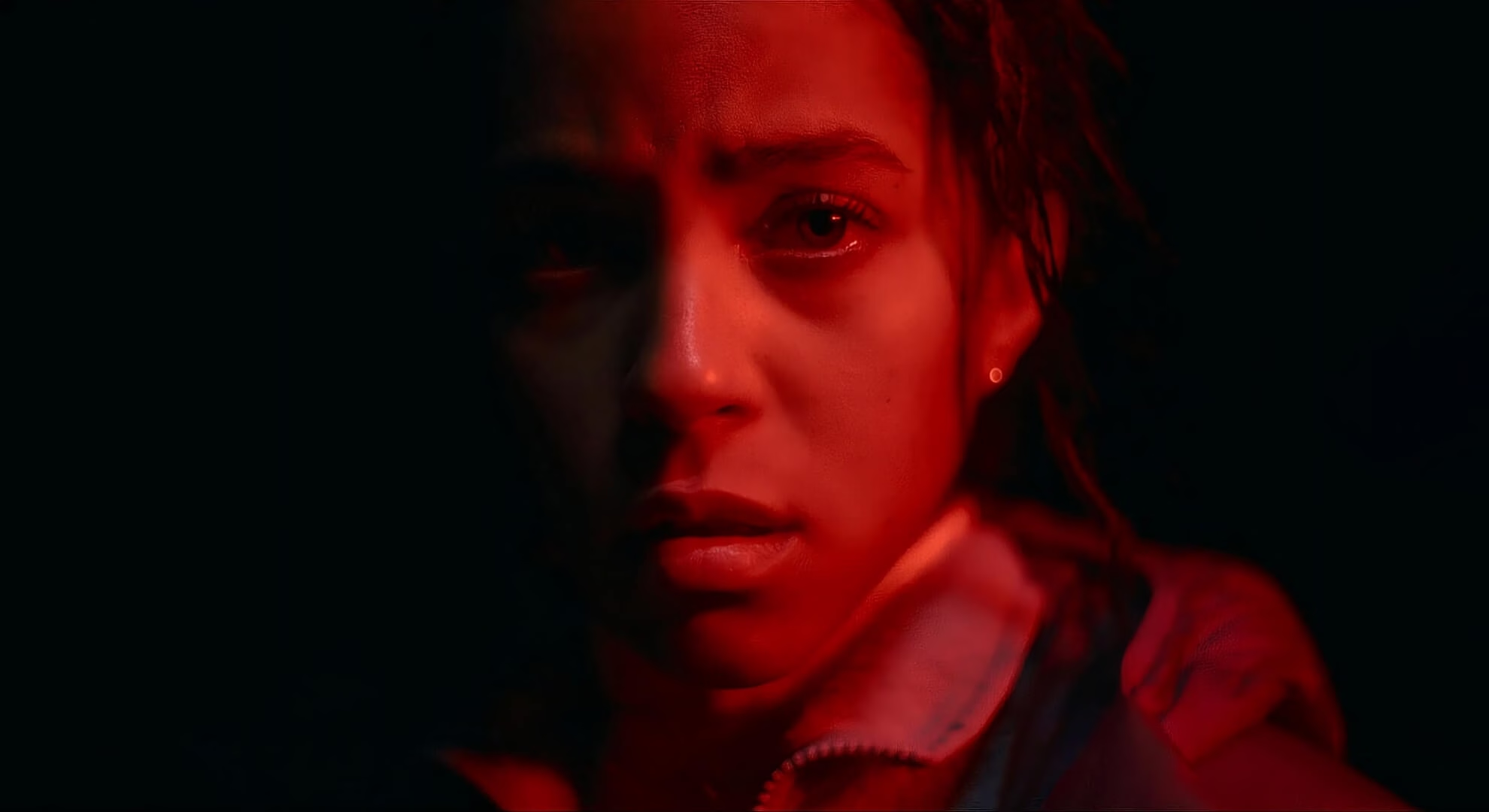


The road that refuses to let you leave is one of horror cinema’s most durable premises. From Steven Spielberg’s ‘Duel’ (1971) to Victor Salva’s ‘Jeepers Creepers’ (2001), American road horror has located its threat not in any particular destination but in the geometry of transit itself — the liminal space between inhabited places where the social rules that govern legible interaction cease to apply.
André Øvredal’s ‘Passenger,’ opening in wide theatrical release today via Paramount Pictures, extends that tradition by reaching into a folkloric substrate older than the internal combustion engine.
Written by T.W. Burgess and Zachary Donohue, rated R for strong violent content, some gore, and language, and running 94 minutes, the film follows Tyler (Jacob Scipio) and Maddie (Lou Llobell), a couple several weeks into a van-life road trip who witness a fatal highway accident and discover they did not leave the crash scene alone. A demonic entity — played by Joseph Lopez and identified simply as the Passenger — pursues them across state lines with an apparent inability to be outrun.
Before the Highway Existed
The archetype that ‘Passenger’ inherits has documented scholarly lineage. Richard Beardsley and Rosalie Hankey published the first systematic study of the vanishing hitchhiker in the inaugural issue of California Folklore Quarterly in October 1942, documenting eighty distinct American variants of a supernatural figure encountered on a dark road who proves not to be what it initially appeared.
Their subsequent 1943 study identified analogues in far older European traditions — spirits of those who died on roads attempting to return home — connecting what seemed like an automobile-age phenomenon to ghost-lore predating the internal combustion engine by centuries.
The Japanese roadside yūrei, the Central European crossroads phantom, the English revenant who returns along the road where she died — these traditions share a structural premise that Burgess and Donohue’s screenplay applies with formal precision: the supernatural entity is not an invader from elsewhere. It is a condition of the road itself, activated by the specific violence that roads produce, latent in the accident that witnessed it into existence.
Øvredal’s Method of Grounded Superstition
Øvredal has described ‘Passenger’ as “a road movie, which is what I really fell in love with” — and as “totally unique for me as a horror movie,” in that it bridges the road-movie tradition with what he characterizes as “a haunting, essentially, on the road.”1 The statement is consistent with his documented directorial method: a persistent interest in making supernatural threat native to its geographic environment rather than imported into it.
In ‘Trollhunter’ (2010), his found-footage debut, the trolls were not fantasy intrusions on the Norwegian landscape; they were geological facts the state had been suppressing, as native to the fjords and mountains as the rock formations that concealed them. In ‘The Autopsy of Jane Doe’ (2016) — the film that established his international standing — the supernatural invaded through a body already delivered into the most rationalized of professional spaces: the morgue.
‘The Last Voyage of the Demeter’ (2023) extended that approach to nineteenth-century maritime history, placing a creature of genuine antiquity onto a voyage whose historical specificity grounded the supernatural stakes in material reality. ‘Passenger’ applies the same logic to the American interstate system: the highway — the most ordinary, most infrastructurally legible environment in contemporary American life — becomes the site of a supernatural encounter whose terms are as old as the road itself.
Hamada, Dauberman, and the Production’s Lineage
The production infrastructure behind ‘Passenger’ situates the film within the dominant commercial current of American studio horror. Walter Hamada, producing through his 18Hz Productions banner, oversaw the ‘Conjuring’ and DC franchises at Warner Bros. before launching independently; Gary Dauberman, producing through Coin Operated, wrote the ‘Annabelle’ trilogy, co-wrote ‘It’ (2017) with Chase Palmer and Cary Fukunaga, wrote ‘It Chapter Two’ (2019), and ‘The Nun’ (2018), making him the primary screenwriter of the ‘Conjuring’ extended universe.
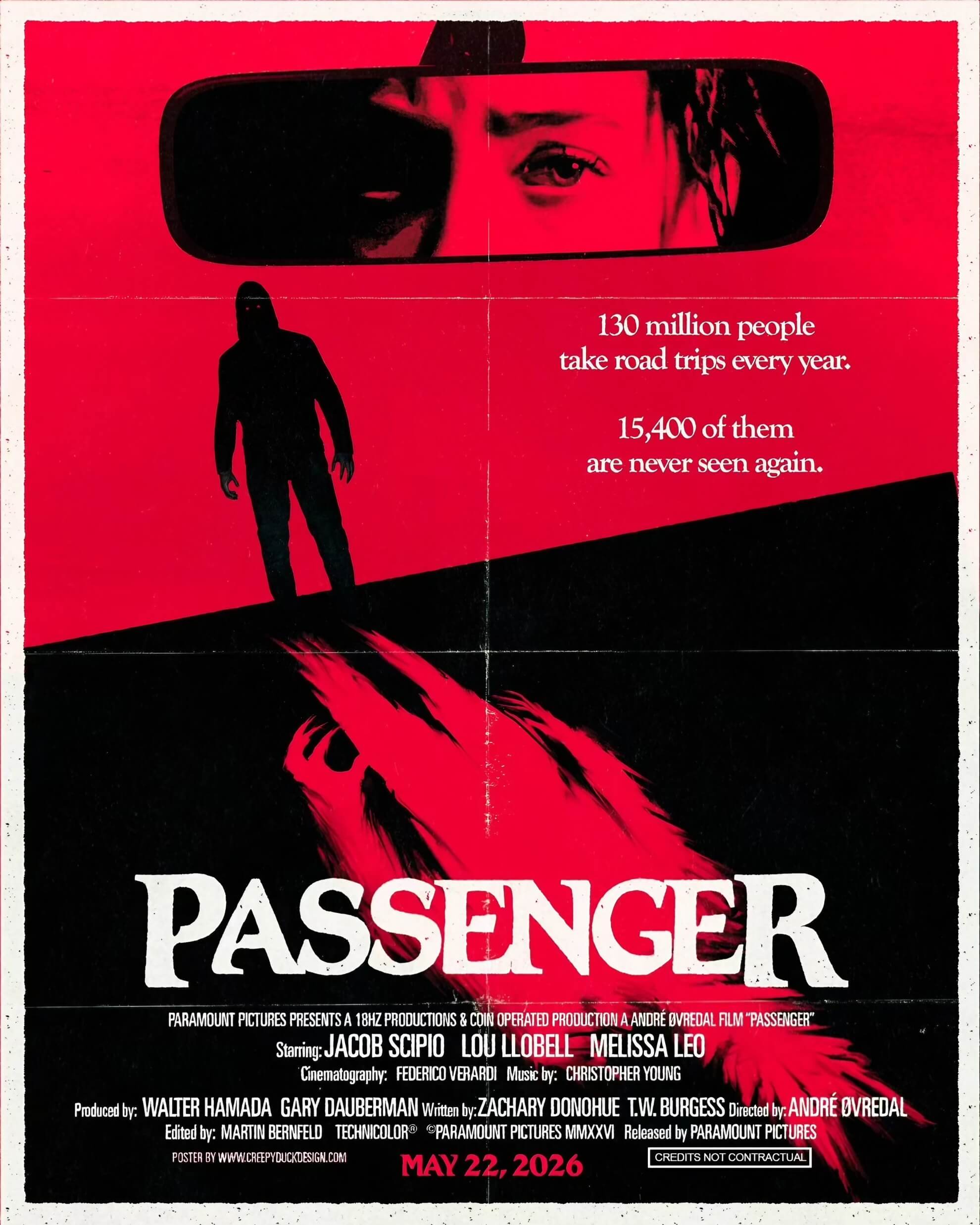
Together, with Domain Entertainment also attached, they bring to ‘Passenger’ the production infrastructure of the most commercially dominant American horror cycle of the past decade, now directed toward an original property. The collaboration with Paramount Pictures represents Øvredal’s second major-studio horror production after ‘Scary Stories to Tell in the Dark’ (2019), which Guillermo del Toro produced.
The film’s deliberately sparse mythology — centered on the demonic entity’s transmission rules rather than its origins — does not discourage reading the production as the intended foundation for a continuing franchise.
Burgess, Donohue, and the Screenplay’s Terrain
Zachary Donohue’s prior directorial credit is instructive context for the screenplay he and T.W. Burgess have written. ‘The Den’ (2013), which Donohue wrote and directed, placed its protagonist before a screen through which a murder becomes visible and then inescapable — a film organized around the horror of witnessed violence and the impossibility of extracting oneself from the network of observation through which that violence circulates.
The structural logic Donohue applied to screen-mediated horror in ‘The Den’ translates into ‘Passenger’ as a logic of physical witness: the couple becomes implicated in the demonic entity’s existence through the act of watching a death, and cannot undo that watching. The screenplay reportedly approaches the Passenger’s mythology with deliberate minimalism — withholding origin explanation in favor of a “what you need to know” economy that keeps the entity’s dread properly generalized rather than rationally contained.
Verardi’s Nocturnal Precision
Federico Verardi’s cinematography addresses the specific formal problem of night-road horror: how to shoot predominantly in darkness without losing the spatial legibility on which suspense depends.
The film is set and shot largely at night in Washington State’s Pacific Northwest terrain, and advance material confirms that Verardi maintains clear geography within dark frames — a discipline that separates ‘Passenger’ from the murky digital aesthetic that renders many contemporary horror films spatially illegible at precisely the moments their suspense requires the audience to track exactly where each character is.
Øvredal has described the cinematographic approach in terms of sustained spatial continuity: “My job is to find a visual language that sustains a certain continuity throughout all these various situations.” The results, as documented in advance screenings, include circling long takes that generate enclosure within open-space settings — a technique that converts the roadside parking lot, among the most visually banal environments in American commercial geography, into a space of concentrated dread through camera movement and controlled shadow rather than through darkness alone.
Young’s Score in the ‘Hellraiser’ Tradition
Christopher Young’s score situates ‘Passenger’ within a specific sonic lineage. Young composed Clive Barker’s ‘Hellraiser’ (1987), a film whose treatment of supernatural threat as enormous and patient rather than merely loud established a template for how horror scoring could refuse the cheap economy of jump-cut stingers in favor of low-register timbral weight sustained across the film’s full duration.
His subsequent work on ‘Drag Me to Hell’ (2009) and ‘Sinister’ (2012) applied comparable discipline: orchestral restraint organized around dread before and after the shock moment, rather than substituting score for it.
The formal choice to pair Øvredal’s direction with Young’s scoring intelligence frames ‘Passenger’ as a production more interested in accumulated dread than mechanical shock delivery. Press descriptions of the score emphasize its use of silence and ambient road noise as active expressive elements — an economy consistent with Young’s documented approach and with Øvredal’s stated commitment to visual and spatial continuity over conventional horror escalation.
The Entity That Was Always on This Road
The formal argument of ‘Passenger’ — readable from its premise, its screenwriters’ documented prior work, and the folkloric tradition it inhabits — is not that a demonic entity invades an ordinary American road. It is that the entity is a condition of that road, latent in the accidents and isolation that highway geography produces, activated by witnessing rather than summoned from elsewhere.
The vanishing hitchhiker traditions that Beardsley and Hankey catalogued in 1942 did not describe figures arriving from outside the road; they described figures who were properties of the road environment itself.
‘Passenger’ operates within that logic and extends it into the specific supernatural-horror tradition Øvredal has been developing across four features: a tradition in which the monster does not come to the geography but emerges from it. That the film opens through Paramount’s widest commercial infrastructure, distributed by the studio that distributed the original ‘Friday the 13th’ (1980) and its seven Paramount sequels, places this folkloric argument in front of the broadest possible American theatrical audience — the audience most likely to have driven the highways the film is claiming were never empty.
Given that Øvredal has consistently made supernatural threats feel native to their geographic environment — geological in ‘Trollhunter’, pathological in ‘The Autopsy of Jane Doe’, maritime in ‘The Last Voyage of the Demeter’ — how do you read his placement of this demonic figure within the American interstate highway system as a development in that ongoing formal project?
Reference
- California Folklore Quarterly — Richard K. Beardsley and Rosalie Hankey, ‘The Vanishing Hitchhiker,’ California Folklore Quarterly 1, no. 4 (October 1942): 303–335; and ‘A History of the Vanishing Hitchhiker,’ California Folklore Quarterly 2, no. 1 (January 1943): 13–25. ↩︎
Leave a Reply