

In February 1985, Quorthon recorded ‘The Return of the Darkness and Evil’ at Electra Studios in Stockholm with his father, Boss Forsberg, producing — a session conducted in a facility not designed for extreme music, on equipment that strained against what the band was attempting. The result became a template for an entire underground tradition — not because it was refined, but because it was uncompromising in its fidelity to its own logic.
That same year, in Gdańsk, a city whose shipyards had just become the hinge on which the Cold War began to swing, a generation of Polish teenagers was absorbing the import cassettes, the photocopied fanzines, and the particular fury that extreme music carried into a society still navigating state censorship and collective exhaustion.
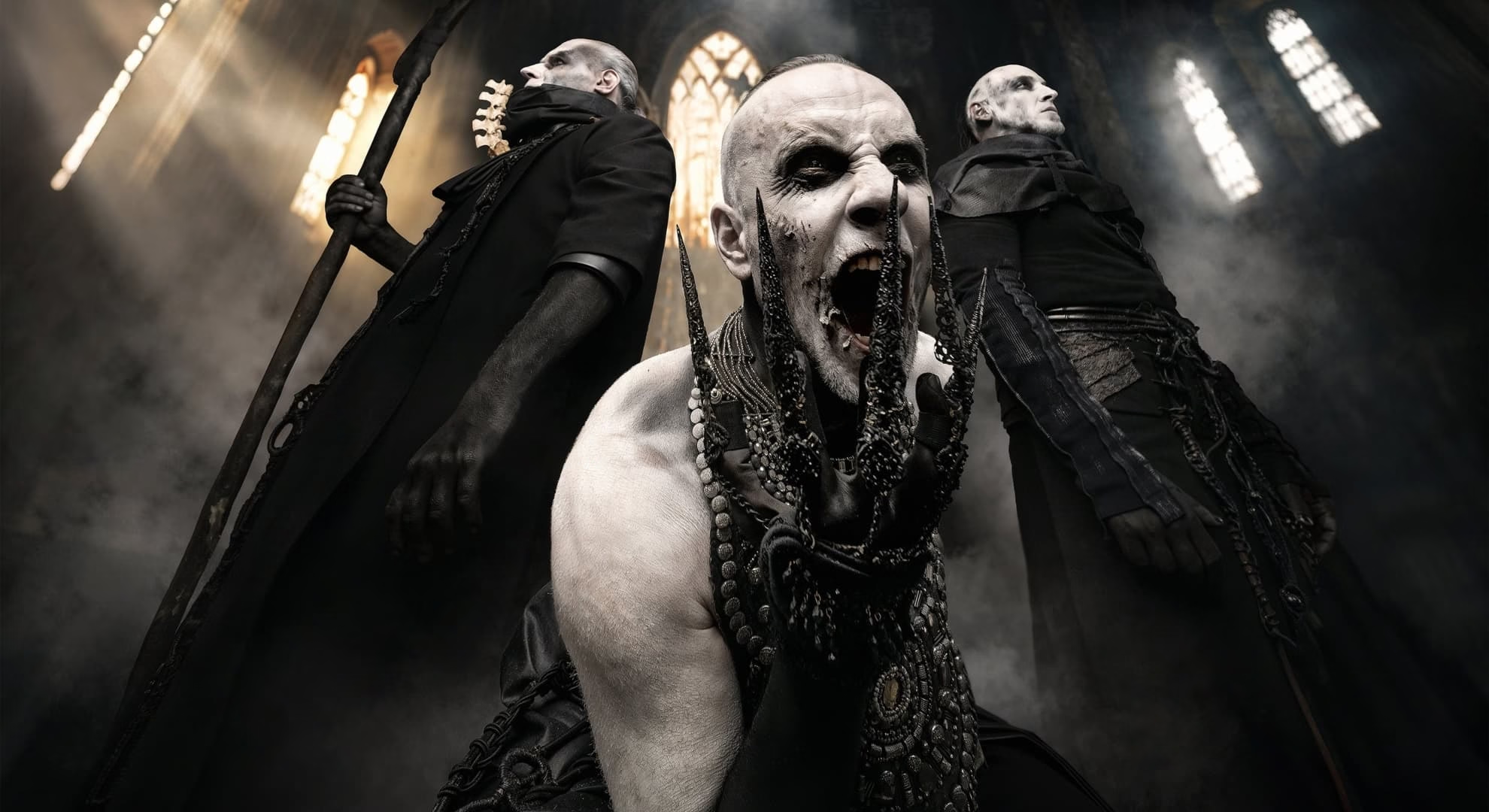
Out of that formation emerged Behemoth — founded by Adam “Nergal” Darski in 1991, initially rooted in the raw black metal of early Bathory and Venom, and subsequently transformed, across more than three decades and thirteen studio albums, into one of the most visually and sonically ambitious forces the genre has produced.
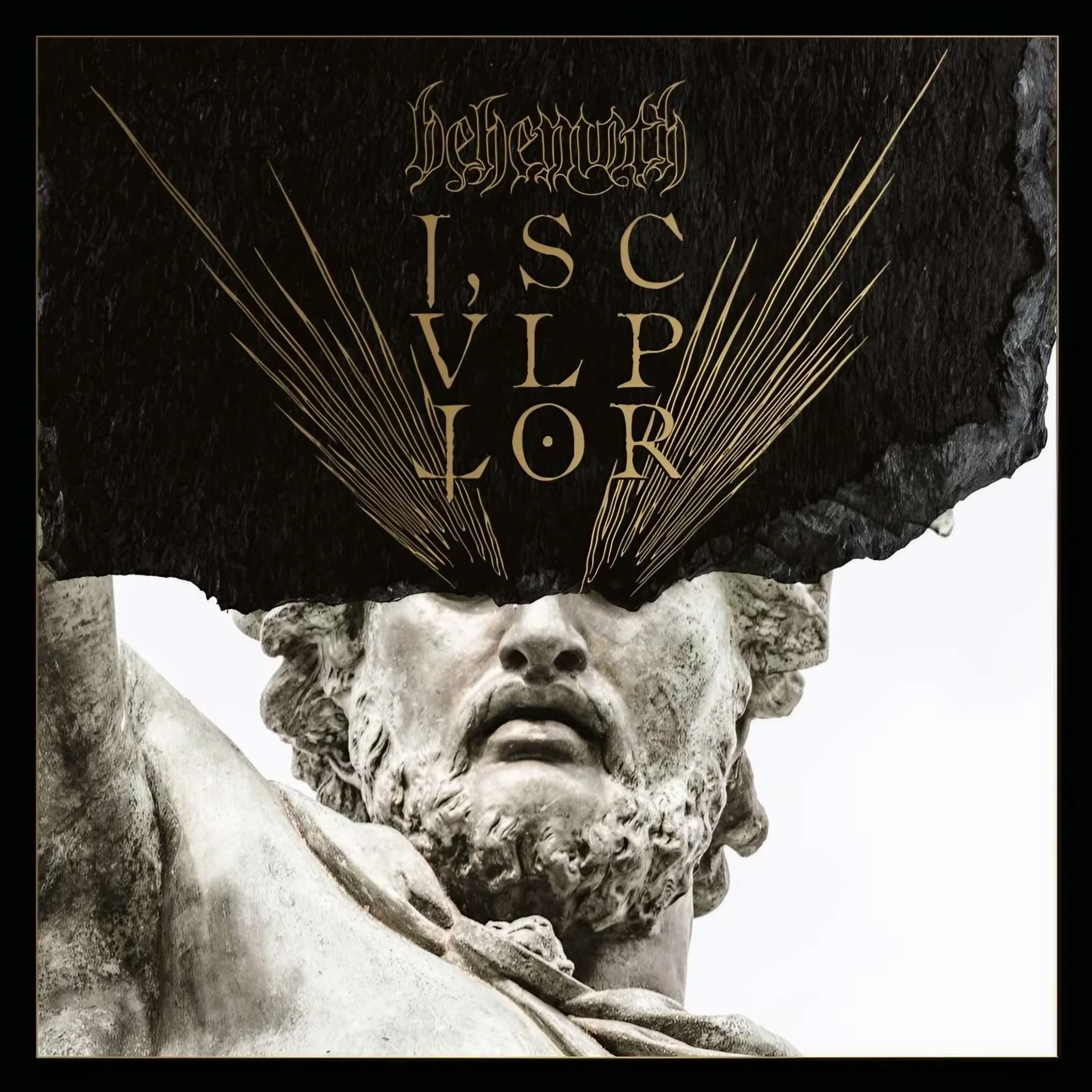
On September 4th, 2026, the band release ‘I, Scvlptor’ — eight tracks — seven new studio recordings and one live performance issued through Massacre Records, the German independent label, in a move that marks a departure from the multinational infrastructure of Nuclear Blast Records, with whom Behemoth recorded their previous two studio albums.
What the Title Already Argues
The title ‘I, Scvlptor’ is not incidental. The Latin orthographic affectation — the “v” for “u,” the same substitution the band has used across decades of album titles and press materials — announces the record as a self-defining act.1 To sculpt is to cut away what is not the form, to reveal what was already present inside the material.
Darski described the record as “an autonomous work that bridges our past with what is new and fresh,” adding that the band “revisited our earliest material, reshaping it with a modern edge while preserving its ancient spirit.” These are the words of an artist who has decided that his own archive is not a liability but a resource — and that the act of returning to it constitutes creation, not nostalgia.
That framing carries particular weight given the sequence that precedes this release. ‘Opvs Contra Natvram’ (2022, Nuclear Blast) and ‘The Shit Ov God’ (May 9th, 2025, Nuclear Blast) completed a phase of Behemoth’s output that, for a portion of their dedicated listenership, had entered the territory of formula — the stagecraft elaborating while the compositional premises remained static.
The movement to Massacre Records and the decision to release a record built explicitly around unreleased material and reformulated early work suggests a calculated break from that pattern.
Gdańsk, Bathory, and the Debt Declared
The Bathory connection in ‘I, Scvlptor’ is not speculative. Behemoth have already released a cover of Bathory‘s ‘The Return of Darkness and Evil’ in 2026, reimagined as the anthem for Mystic Festival. That act of public homage — performed under their own name, at a major European extreme metal gathering — signals the same impulse Darski describes in his statement about the record: a wish to make audible the line of descent that runs from Quorthon’s Electra Studios sessions in Stockholm to the Gdańsk underground that formed Behemoth.2
The confirmed tracklist makes the tribute impulse explicit and specific. Two early Behemoth compositions are re-recorded: ‘Rise of the Blackstorm of Evil,’ written in 1992 as a tribute to Samael, Celtic Frost, and Hellhammer, and ‘In Thy Pandemaeternum’ from ‘Pandemonic Incantations’ (1998), a track Darski felt had been compromised by its original mix.
Two covers complete the tribute arc: Venom’s ‘In League With Satan,’ recorded on seven-string guitars with Shagrath of Dimmu Borgir as guest vocalist, and Bathory’s ‘The Return of Darkness and Evil,’ released as the live Athens performance with Sakis Tolis of Rotting Christ. Producer credits and recording studio had not been confirmed via official sources at the time of publication.
Massacre Records and the Independent Turn
The choice of Massacre Records is a structural statement about distribution and autonomy as much as it is a commercial arrangement. Founded in Abstatt, Baden-Württemberg, in 1991, Massacre Records built its catalog across extreme metal subgenres, operating through independent distribution channels that reach dedicated underground audiences across Europe and beyond.3
The label’s infrastructure is substantially smaller than Nuclear Blast’s, and its international distribution network reaches audiences through independent channels rather than the integrated promotional machinery of major metal labels.
For Behemoth, whose prior decade was built on Nuclear Blast’s capacity to reach mainstream rock audiences through elaborate visual campaigns and wide digital placement, the move to Massacre represents a deliberate narrowing of scope — or, read another way, a return to a relationship between artist and audience that does not require the intermediation of scale.
Thomas Hertler, the label’s director, described the signing as “a landmark moment for our label,” which, in the economics of independent metal, it plainly is. What it means for the music is an open question that September 4th will begin to answer.
What ‘I, Scvlptor’ Points Toward
The tracklist and artwork were revealed on June 1st, 2026, simultaneous with pre-orders opening via Massacre Records and Mystic Production. Eight tracks are confirmed across approximately 40 minutes: the new title track and ‘Lord Ov the Horizons,’ both original compositions; re-recordings of ‘Rise of the Blackstorm of Evil’ (1992) and ‘In Thy Pandemaeternum’ (1998); ‘Begotten,’ a new wave-inflected track held from ‘The Shit Ov God’; covers of Venom and Bathory; and the Athens live recording. The record is available on CD, LP, cassette, and a limited-edition box set including a digibook, T-shirt, and art print signed by the band.
What Darski’s own track-by-track commentary makes clear is that ‘I, Scvlptor’ is not a retrospective release but an argument conducted in parallel registers. The title track, he noted, sits in the tradition of the band’s most monumental compositions — ‘O Father O Satan O Sun!’ and ‘Lucifer’ among them — while taking an unexpected formal turn; ‘Begotten,’ by contrast, carries a post-gothic new wave character that he acknowledged sat outside the tonal logic of ‘The Shit Ov God.’
The two registers held within the same release — ceremonial weight and stylistic restlessness — are not in conflict. They are the record’s formal proposition: that a band three decades into its own mythology retains the capacity to surprise itself.
The Form That Refuses to Close
Three decades is enough time for a band’s formation to become doctrine. Behemoth have built a public persona of such coherence — Darski’s corpse paint, the antichristian staging, the Latin orthography of every title — that the risk of calcification has always been implicit in the success. ‘I, Scvlptor’ is a record that, if it delivers on what its announced structure implies, will refuse that calcification — not by abandoning the persona but by reexamining the raw materials beneath it.
Massacre Records gives the release an infrastructure that does not require massive mainstream reach to succeed on its own terms. September 4th, 2026, arrives as a moment in which one of extreme metal’s most studied bands reasserts authorship over its own origin — not with nostalgia, but with the deliberate act of the sculptor returning to see what the stone still contains.
For those who have followed Behemoth through the precision of ‘The Satanist’ and the theatrical scale of ‘I Loved You at Your Darkest’: does a record that consciously renegotiates the band’s own formative influences represent a meaningful reorientation, or does the sheer weight of three decades of persona make any such return impossible to receive without the lens of mythology?
References
- Michael Witzel, “The Origins of the World’s Mythologies” (Oxford: Oxford University Press, 2012), 44–49. On the symbolic function of naming and self-designation in ritual and artistic contexts. ↩︎
- Ian Christe, “Sound of the Beast: The Complete Headbanging History of Heavy Metal” (New York: HarperCollins, 2003), 201–207. On the formation of the Scandinavian extreme metal tradition and its global transmission. ↩︎
- Steve Waksman, “This Ain’t the Summer of Love: Conflict and Crossover in Heavy Metal and Punk” (Berkeley: University of California Press, 2009), 88–94. On independent label infrastructure and its relationship to underground metal distribution. ↩︎


Leave a Reply