


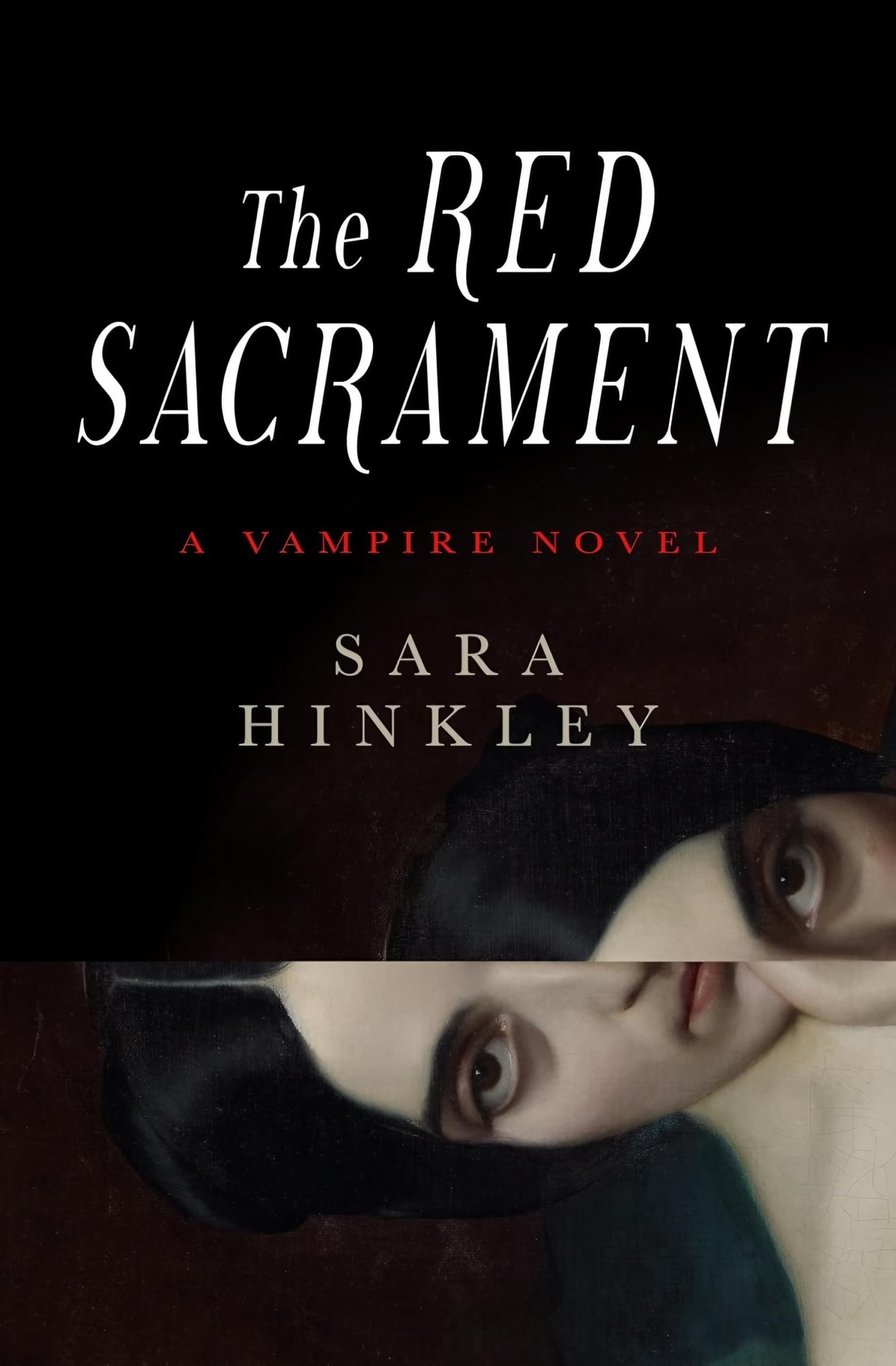
A theatre that performs only after midnight, doors held by scraps of black paper that function as invitations rather than tickets, actors who are never glimpsed by daylight — this is the room Sara Hinkley builds at the center of ‘The Red Sacrament,’ her debut novel from Titan Books, reaching American and British readers on July 7th, 2026, in a 512-page trade paperback.
The book arrives inside a crowded season for vampire fiction, crowded enough that Hinkley herself, in an interview given ahead of publication, described the creature as a durable metaphor that resurfaces “in times of heightened class antagonism,” a monster built to be read against whatever crisis currently grips its readers.
What that same interview does not dwell on, and what the title insists on regardless, is the specific vocabulary Hinkley chose to house that argument: not curse, not affliction, not gift, but sacrament — a word with a fixed theological meaning long before it acquired a horror-fiction one.
An Argument the Title Makes
Vampire fiction has staged its confrontation with Christian ritual since the form first cohered. John William Polidori wrote ‘The Vampyre’ during the same 1816 gathering at the Villa Diodati that produced Mary Shelley’s ‘Frankenstein,’ and the genre he helped found has returned to consecration, communion, and the cross as reliably as it has returned to blood itself.
Nina Auerbach has argued that literary vampires function as close personifications of the specific anxieties belonging to the moment that produces them, absorbing whatever a given culture fears into one recurring body.1 Susannah Clements has traced that absorption specifically into Christian symbolism, reading the vampire’s relationship to blood, consecration, and transformation as a documented strand of the tradition rather than an incidental borrowing.2
Read against that strand, ‘The Red Sacrament’ does not gesture at ritual through mood alone; it names the thing directly in its title, and asks the reader to carry that word — sacrament, not curse — through five hundred pages of a theatre that runs on secrecy, admission, and repetition.
Hinkley’s own account of the title leans toward class rather than creed: a vampire aristocracy, in her telling, is an image for extraction and inherited privilege more than for damnation. That reading is legitimate, and it belongs to the author. It does not, on its own, exhaust what the word she chose is doing on the page.
A Nightly Rite for Paying Guests
The Théâtre Saint-Siméon, by Titan’s own account of the book, admits only those holding one of its black slips of paper, issued to select persons and to no one else. Its performers appear solely after dark and vanish from view by daylight, restaging the same nocturnal event on a fixed schedule for an audience that receives, without fully knowing it, blood offered in place of bread.
That arrangement — closed membership, fixed timing, a substance offered under one name that functions as another — repeats the form of a rite, whether Hinkley reaches for the word deliberately in every scene or not. A theatre that restages itself nightly for the initiated is not simply an image of a Mass; inside the novel’s own vocabulary, it operates as one, performed by predators for prey who applaud.
The Siege Behind the Curtain
The novel’s political register is, unlike its theological one, fully documented by its author. Hinkley has described building the book’s two engines of suspense — Arnault’s private drift toward the vampire Victor de Rouvray, and the city’s collective slide toward the Siege of Paris — around the historical fact of the Franco-Prussian War, working through improvised pacing tools, index cards among them, to keep both threads active across the manuscript.
That siege, which closed around Paris in the autumn of 1870 and reduced the city to eating its zoo animals and its household pets before the following spring, gives the novel’s second half a documented historical floor beneath its supernatural plot. Hinkley has said the vampires of the Théâtre Saint-Siméon do not meet that starvation with any particular solemnity, an intentional refusal she has traced to decades of backstage theater complaint rather than to gothic convention.
The arrival of Victor and his sister Françoise, vampires from a plantation aristocracy in pre-revolutionary Haiti, gives the novel’s class argument a second axis beyond Paris itself, setting the inherited ease of colonial wealth against the working conditions of a troupe that survives on nightly ticket sales, in blood and otherwise.
A Costume Designer’s First Chapter
Hinkley worked for years as a costume designer on productions including ‘Law & Order: SVU’ and ‘Monsterland’ before writing any fiction at all, and has said the pandemic-era shutdown of television production supplied the block of unstructured time in which ‘The Red Sacrament’ was written.
Her account of the book’s craft returns repeatedly to that professional background: character built from material circumstance, the texture of collaborative and hierarchical workplaces, the specific social behavior of people who spend more waking hours with coworkers than with anyone else.
That background also shaped the novel’s refusal of a familiar vampire convention. Hinkley has said she was uninterested in rendering her vampires as people made simply grander by immortality, preferring instead a company of performers with the smallness, venality, and professional exhaustion of any long-running production — a choice that keeps the theater at the center of the book a workplace first and a temple second, even as the title insists otherwise.
The Mass Ends at Curtain
‘The Red Sacrament’ arrives able to sustain two separate readings without either one canceling the other: Hinkley’s own, in which the vampire stands for capital and inherited advantage, and the one built into her title, in which a closed nightly rite trades blood for bread under a word borrowed directly from the tradition vampire fiction has argued with since Polidori. Titan Books, publishing Hinkley’s first novel as a full debut rather than an established name’s genre turn, is betting on a book willing to hold both arguments at once.
Which vocabulary does ‘The Red Sacrament’ ultimately serve more fully — the political register Hinkley describes in her own account of the book, or the theological one her title borrows outright — and can a single novel sustain both without one eventually becoming decoration for the other?
References
- Nina Auerbach, ‘Our Vampires, Ourselves’ (Chicago: University of Chicago Press, 1995). ↩︎
- Susannah Clements, ‘The Vampire Defanged: How the Embodiment of Evil Became a Romantic Hero’ (Grand Rapids: Brazos Press, 2011). ↩︎


Leave a Reply