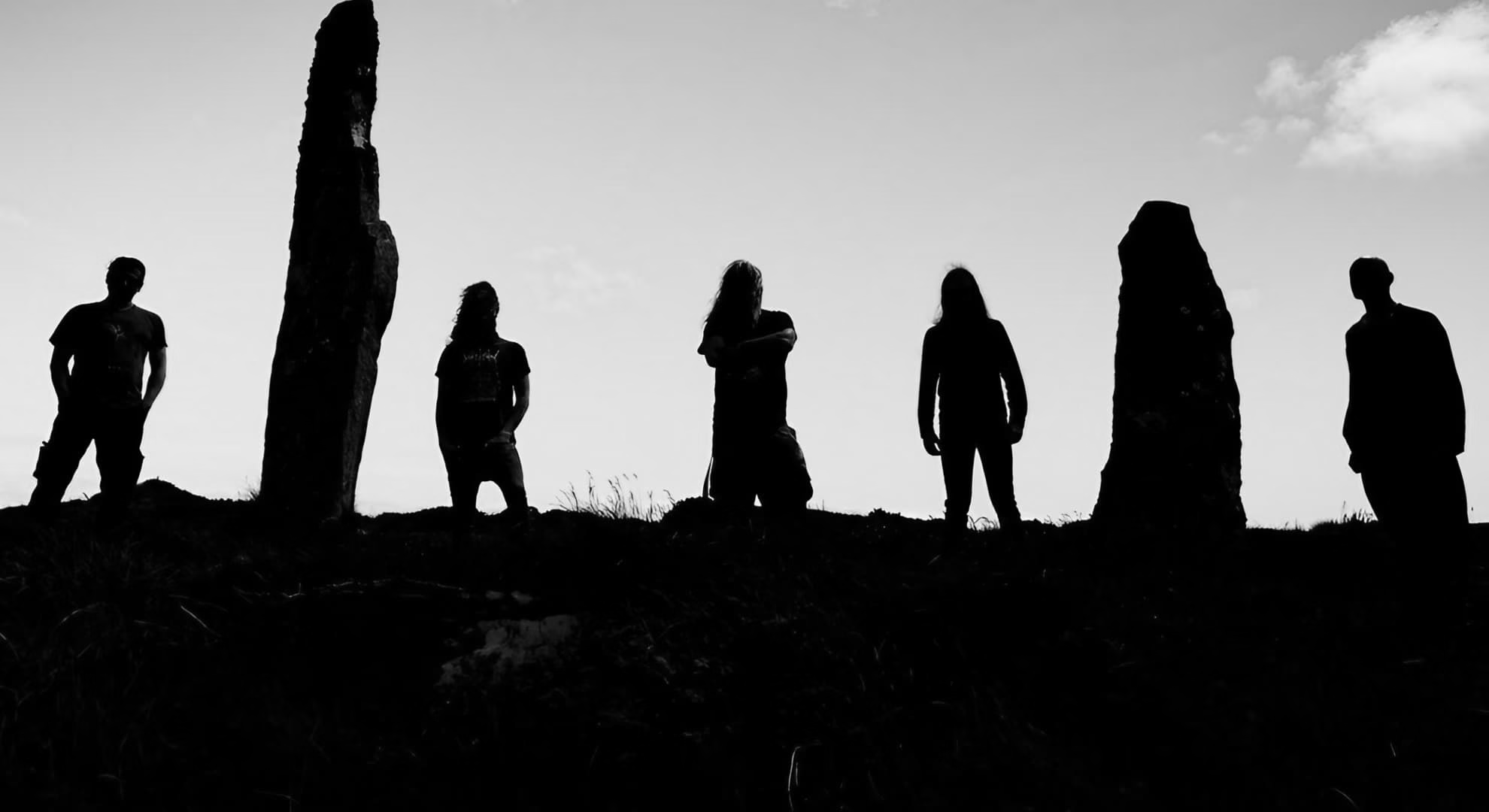


Off the coast of County Kerry, six hundred feet above the Atlantic, a cluster of dry-stone beehive huts has clung to the rock of Skellig Michael since the sixth century. The monks who built those cells rowed out to the island to leave the world behind, treating isolation not as punishment but as the precondition for a deeper kind of attention.
The wish to abandon the ordered world in search of what it cannot provide runs deep in the Irish imagination. It surfaces again, in a far darker register, on a doom record from County Cork.
‘The Unbinding,’ the second full-length from Soothsayer, arrives July 3rd, 2026, on Apocalyptic Witchcraft Recordings, and it traces exactly that arc: a single figure deliberately unbinding from collective life, moving toward a calling the collective cannot name.
A Sparse and Deliberate Catalog
Soothsayer formed in Cork in 2013 and have issued only a handful of records in the thirteen years since. Pace, for this band, has always been a form of severity.
The work before this amounts to two extended plays, ‘The Soothsayer’ and ‘At This Great Depth’, a live album cut in Malta, and a split shared with fellow Cork act Partholón.
The work before this amounts to two extended plays, ‘The Soothsayer’ and ‘At This Great Depth,’ a live album cut in Malta, and a split shared with fellow Cork act Partholón.
The full-length debut, ‘Echoes of the Earth,’ arrived only in 2021, eight years after the band came together, joining doom, sludge, and death metal into a single heavy idiom.
That patience extended to the stage. Soothsayer have played Bloodstock Open Air in England and Gothoom in Slovakia, and shared bills with Alcest and Bell Witch, carrying a Cork underground sound into rooms well beyond Ireland.
‘The Unbinding’ is the first Soothsayer record for Apocalyptic Witchcraft Recordings, the English independent founded in 2015 whose roster favors the obscure and the uncompromising. The signing places the band inside an apparatus that asks the listener to come looking, rather than the other way around.
The Self Unbound From the World
The album follows a loose narrative. A figure turns away from collective life, sheds the weights of the system, and moves toward something further down and further out.
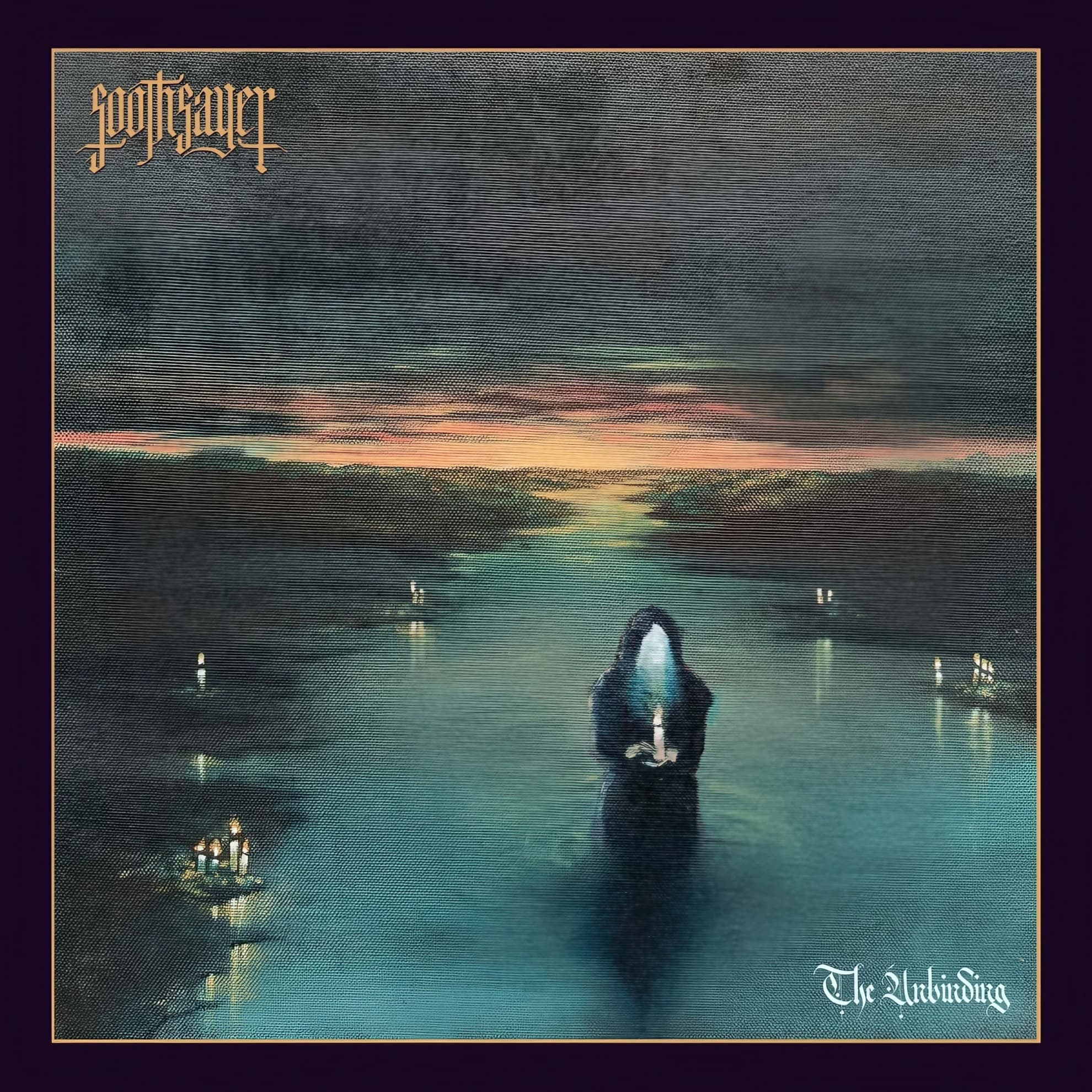
The cover, painted by the band’s drummer, Ger O’Callaghan, fixes that image in a single frame: a hooded figure wading through water away from the land, clutching one candle flame as the sun goes down. By the band’s account, two members had independently painted a figure walking into the water before either had seen the other’s canvas.
Vocalist Liam Hughes has located the opening track in a plain personal admission, describing a desire to “go to a faraway place that operates on different rules.” The sentiment is not rhetorical posture; it is the record’s organizing premise.
What that premise describes is withdrawal as descent rather than escape — a downward search pursued as discipline. The dark-music audience tends to register that distinction immediately, because it has heard the difference between flight and renunciation before.
The Single at the Threshold
One piece stands at the album’s threshold and is the only one publicly streaming: ‘Eroding the Sky,’ released as the album’s advance single, its official visualiser posted on April 21st, 2026. No second single had been issued at the time of publication.
‘Eroding the Sky’ runs 7:56. It opens on a hovering, detuned overture before a fierce main riff arrives, then slows into growled, heaving weight — a study in how a long doom track accumulates rather than climaxes.
That accumulation is the genre’s defining gesture. Drone and doom build meaning through duration and repetition, asking the listener to inhabit a passage of time rather than follow a hook to its resolution.1
What lies beyond that single is known only through the band’s own account and the confirmed running order, not through music made public. The second track, ‘Sooner Acceptance,’ is described by the band as a piece drawn from personal loss rather than spectacle.
On the evidence of that single alone, ‘The Unbinding’ leans toward accumulation rather than quick release. No track on the album runs short: the closer, ‘A Vague Shimmer,’ extends to 12:54.
Grief Older Than the Church
The grief that drives ‘Sooner Acceptance’ has a specifically Irish ancestor. The caoinneadh, the keen sung over the dead, was a formalized lament older than Irish Christianity itself.2
Keening was women’s work: improvised, sustained, public mourning performed at the graveside. The Church condemned it as pagan excess, yet it persisted across rural Ireland into the twentieth century.
Hughes wrote ‘Sooner Acceptance’ shortly after the death of his grandmother. He described a strong, hard-working woman whose dignity slipped only at the end, her “final years to be greatly lacking in any sense of peace and dignity.”
Recast as song, that private loss takes a ceremonial, public form. This is the work the keen once performed, transposed from the graveside to the amplifier.
Lament of this kind is not Ireland’s alone. The ritualized mourning song is among the most durable and portable forms in human culture, carried intact across languages and centuries, which is precisely why a record built on it can travel so far from where it was made.3
Cadogan and the Dublin Room
‘The Unbinding’ was recorded with engineer Shaun Cadogan at Last Light Recordings in Dublin, the room that has handled recent work by Coscradh, Diocletian, and Dread Sovereign.
That body of work favors a raw, cavernous heaviness over polish — murk held in place by enough definition that nothing dissolves. It is a particular kind of clarity, one that keeps density legible.
For a band whose tracks routinely run past seven minutes and pivot between hush and avalanche, an engineer fluent in that register is a structural choice rather than an incidental hire. The producer’s documented preference for legible weight positions the record’s heaviness as something a listener can move through, though the full result remains unheard until July 3rd.
The Serpent and the Mudra
The album’s frame is not only Irish. ‘Endless Shesha’ takes its title from Shesha, the world-bearing serpent of Hindu cosmology on whom Vishnu rests between the cycles of creation.
The closing ‘A Vague Shimmer’ reaches further east still, drawing on the names of mudras, the ritual hand gestures of Hindu and Buddhist practice, invoked here as small spells of hope against the surrounding dread.
Hughes has framed the band’s outlook as a nihilism shot through with broken shards of hope — the faint shimmer that keeps the descent from closing over entirely.
A Cork doom band routing Irish grief through Sanskrit cosmology is itself a quiet argument about how this music moves. It absorbs what it passes through, and arrives somewhere that belongs wholly to neither tradition.
The Underground That Comes Looking
‘The Unbinding’ arrives on limited-edition vinyl, digipak compact disc, cassette, and digital download, sold mainly through the label’s Bandcamp page rather than pushed outward by recommendation engines.
That distribution favors an audience that arrives on purpose. A record of this weight is found by listeners already searching for it, not served to passive ears. The underground’s circuits run on exactly this logic: small labels, direct sales, and scenes that cohere around deliberate discovery instead of scale.4
For listeners far from Ireland, the draw is not the specific geography of Cork. It is the transferable register the record offers — grief made formal, retreat made audible — which lands without translation. Access still carries a cost. A physical import or a paid download can represent a real outlay in many markets, and that friction tends to produce a more committed listener, not a more casual one.
Toward the Faraway Place
Thirteen years and one full-length into a deliberately slow career, Soothsayer reach a second record that turns withdrawal into method: a figure wading from the shore toward a place that runs on other rules.
Across its five long tracks, ‘The Unbinding’ proposes that grief and retreat are not endpoints but disciplines — the same wager the island hermits and the keening women each made in their own form, centuries apart, and whether the full sequence sustains the momentum its lead single suggests is a question only July 3rd answers. For the patient underground that will go looking for it, the answer was never going to come from anywhere else.
When a record routes a specifically Irish inheritance of mourning and withdrawal through Sanskrit cosmology, and reaches its audience by deliberate discovery rather than algorithm, what is it that a listener with no tie to Cork actually recognizes — the particular tradition, or the shape of grief the tradition gives form to?
References
- Owen Coggins, ‘Mysticism, Ritual and Religion in Drone Metal’ (London: Bloomsbury Academic, 2018), 41—47. ↩︎
- Angela Bourke, ‘More in Anger than in Sorrow: Irish Women’s Lament Poetry,’ in ‘Feminist Messages: Coding in Women’s Folk Culture,’ ed. Joan Newlon Radner (Urbana: University of Illinois Press, 1993), 160—171. ↩︎
- Margaret Alexiou, ‘The Ritual Lament in Greek Tradition,’ 2nd ed., rev. Dimitrios Yatromanolakis and Panagiotis Roilos (Lanham: Rowman & Littlefield, 2002), 131—136. ↩︎
- Stephen Graham, ‘Sounds of the Underground: A Cultural, Political and Aesthetic Mapping of Underground and Fringe Music’ (Ann Arbor: University of Michigan Press, 2016), 54—60. ↩︎


Leave a Reply