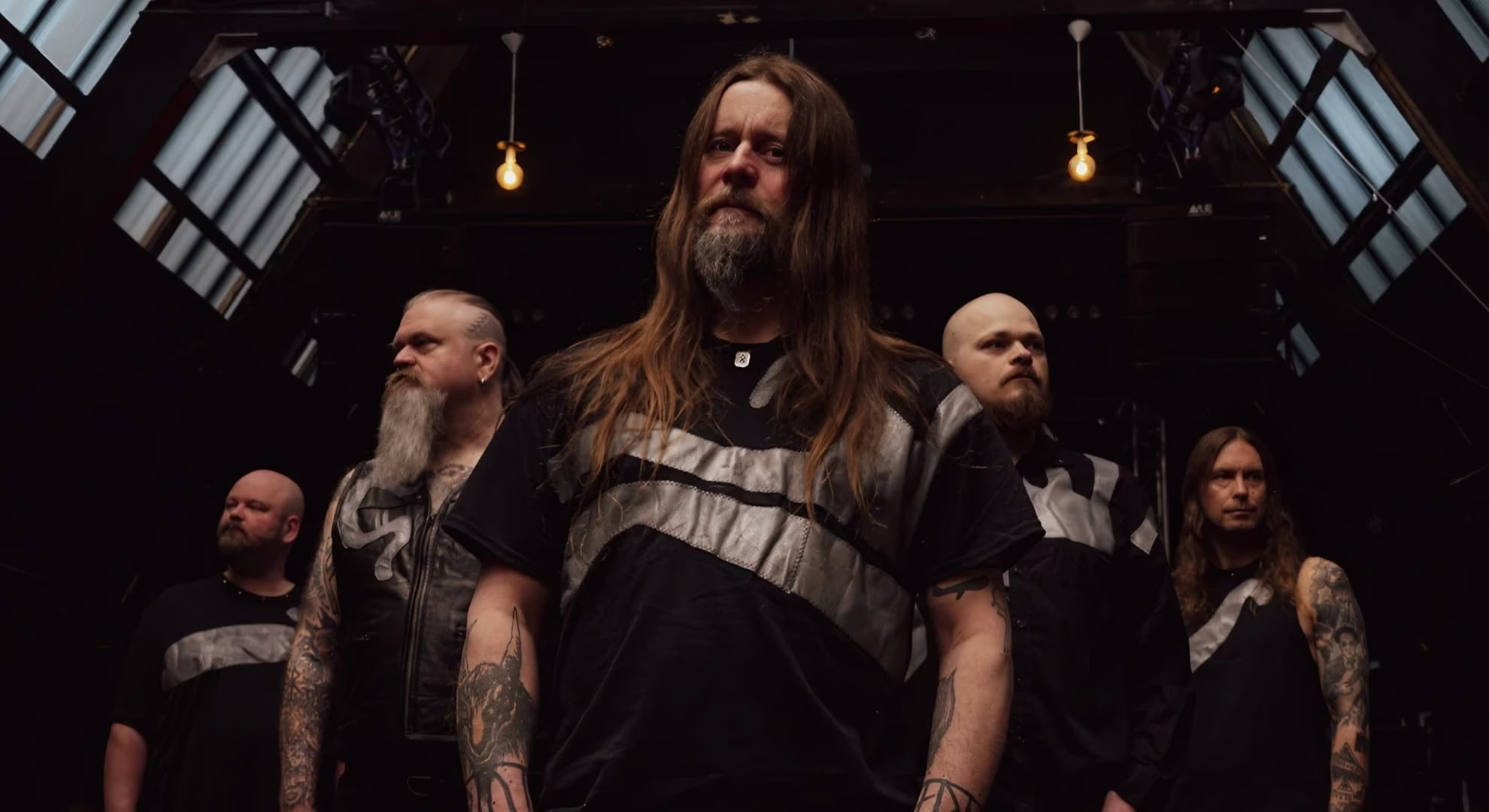


Sun worship is among the oldest documented human instincts, older than the runic alphabets that Norse cultures eventually used to record it. Every society that has watched daylight shorten toward winter has needed some account of why the sun returns each spring, and Norse cosmology answered the question with a chase rather than a triumph—a sun goddess pursued endlessly across the sky by a wolf, her survival never resolved but never yet lost. That kind of precarious continuity, rather than conquest, sits at the center of the record Enslaved release on October 30th through Nuclear Blast Records.
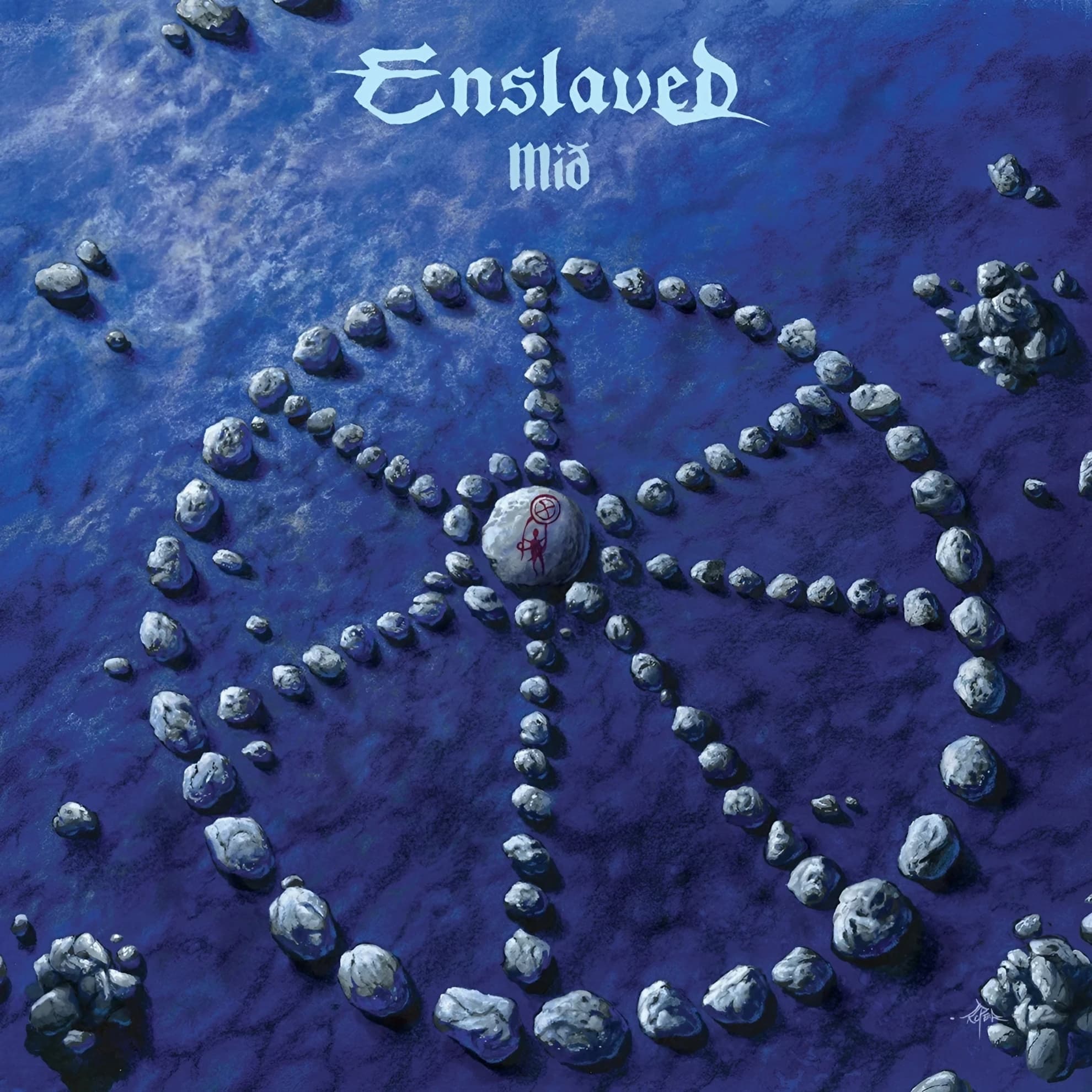
‘Mið’ is the Norwegian progressive black metal band’s seventeenth studio album, and its title is Old Norse for center, or middle. Where the band’s two previous full-lengths took their names from specific figures and places within Norse mythology, ‘Mið’ names a position instead.
Guitarist Ivar Bjørnson and vocalist and bassist Grutle Kjellson, the band’s two constant members since its 1991 formation in Haugesund, built the record around what they have described as the axis, the middle point from which past, present, and myth radiate outward with equal reach. The album’s closing track, ‘I Miðju,’ translates directly as in the middle, closing the circle the title opens.
Where Heimdal Left Off
The record ‘Mið’ answers is 2023’s ‘Heimdal,’ Enslaved’s sixteenth album and the most recent full-length before this one. ‘Heimdal’ took its name from the Norse god charged with guarding the rainbow bridge between worlds, a figure the band had returned to in its lyrics since a 1992 demo tape, and it used that guardianship as a structural principle as much as a lyrical one.
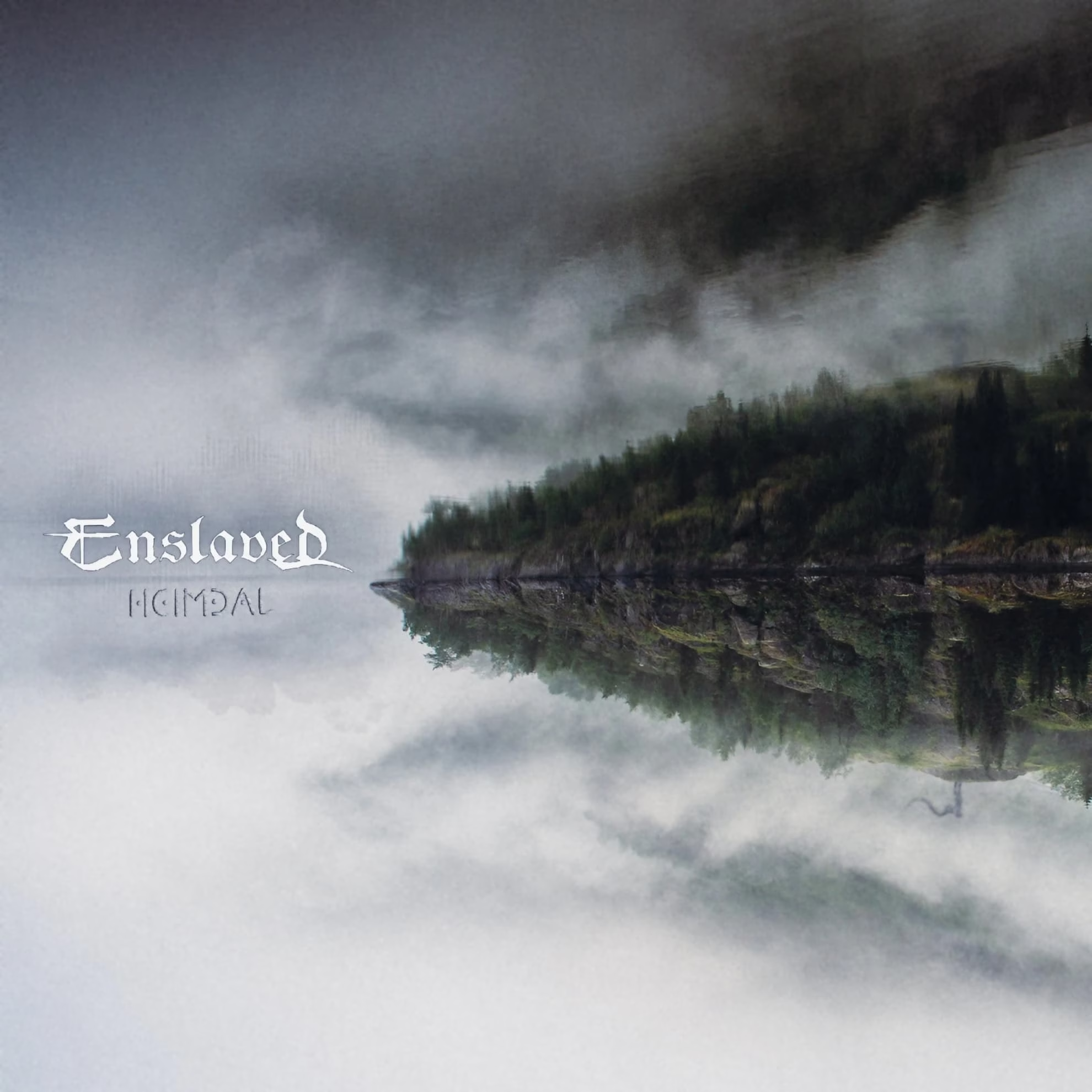
Recorded across a cluster of studios in Bergen, the album folded jazz-derived compositional structures and progressive rock’s harmonic vocabulary into a black metal instrumental base, extending a direction the band had pursued since the mid-2000s without ever fully resolving it into a fixed style.
It also absorbed ‘Caravans to the Outer Worlds,’ a track originally released on a 2021 EP of the same name that the band had built as a bridge between ‘Heimdal’ and its predecessor, 2020’s ‘Utgard.’
That practice of using a shorter release to test ideas before committing them to a full album recurs across Enslaved’s recent catalogue, and it signals a band treating each record as a continuation of an ongoing compositional argument rather than as a self-contained statement.
‘Mið’ extends that argument rather than closing it. Where ‘Heimdal’ was organized around a single guardian figure standing at a threshold, ‘Mið’ is organized around the threshold itself, abstracted from any one myth and applied instead to the record’s own internal logic.
A Solar Reckoning
The evidence available ahead of the full release includes two confirmed advance singles. ‘Spirit Helper,’ released July 2nd in collaboration with Blackfeet Nation elder Kevin Kicking Woman, arrived first; ‘Solar Will,’ released August 20th alongside the album announcement itself and a video by Kolibri Media, the Bergen studio that has worked with Enslaved for years, followed seven weeks later.
The track is built on the kind of riff writing Bjørnson has described in blunt terms: describing the sun as a parent capable of both nurturing and obliterating, he has said the subject demanded classic, imposing guitar work, drumming in the mold of John Bonham, and melodic flares to match.
What is audible on the released track bears that out. ‘Solar Will’ moves between mid-tempo, sky-facing heavy metal passages and denser black metal sections without settling permanently into either, a structure that positions the album toward the more rock-centered register the band has favored since ‘Utgard,’ following a period in the two thousands and twenty-tens defined by denser, more harmonically knotted writing.
Kjellson has offered one further detail about the album’s lyrical concept: the songs center on a rivalry between two archetypal Norse figures the band has deliberately declined to name. Norse cosmology offers no shortage of paired rivals bound by pursuit rather than resolution, of which the sun goddess Sól and the wolf Sköll who chases her are only the most documented fit for a song called ‘Solar Will.’1
Whether or not that particular pairing is the one Kjellson has in mind, the tradition he is drawing on is recorded at length across Old Norse mythological sources, structured around the same principle of endurance rather than conquest that governs the single itself.
Enslaved have built a career on treating that inheritance as usable material rather than as costume, a distinction scholars of the genre have located specifically in this band’s refusal of the anti-Christian shock imagery that defined its Norwegian black metal contemporaries in the early nineties, in favor of a folk-mythological register shared with acts such as Windir.2
Voices From Outside Bergen
Two of the album’s eight tracks carry guest contributions that extend well past Enslaved’s usual collaborators. ‘I Am Ice’ features Sámi joik artist Johan Sara Jr, credited on the album without further public comment from the band to date, while ‘Spirit Helper’ features Kevin Kicking Woman, an elder of the Blackfeet Nation, and its release as a standalone single in July gave that collaboration a fuller account than the tracklist alone provides.
Guitarist Ivar Bjørnson traced its origins to 2019, through connections built around the Fire In The Mountains Festival and By Norse Music, the label Enslaved co-founded with Wardruna; Kevin Kicking Woman said the song expresses “relationship and responsibility, belonging and accountability,” rooted in what he described as the Blackfoot way of knowing.
Neither collaboration sits in a vacuum. Joik is Sápmi’s oldest vocal tradition, an unaccompanied singing style that Norwegian state assimilation policy suppressed for the better part of a century before a postwar revival returned it to public performance and eventually to collaboration with popular and heavy music.3
Blackfeet, or Niitsítapi, musical tradition carries its own documented history of songs tied to specific ceremonial and social functions, transmitted and adapted across generations through frameworks distinct from the European folklore that most metal criticism defaults to when discussing this kind of collaboration.4
Placed against a Norwegian record built around solar myth and the concept of a center, the two features do something more specific than gesture at breadth. They put Enslaved’s Old Norse material into direct contact with two indigenous musical traditions that have each negotiated their own relationship to suppression, revival, and continued practice, on the album’s own terms rather than through a vague appeal to reach.
That is the clearest documented evidence of where ‘Mið’ extends beyond Bergen, and it says more about the record’s positioning than any promotional framing could.
The Center That Keeps Moving
Physical formats remain the frame for this release. Nuclear Blast has confirmed ‘Mið’ for CD, a digipak CD edition carrying the bonus track ‘Fourth of July,’ and vinyl, including a limited Arctic Blue Pearl colored pressing. Digital availability exists as a secondary format; pre-orders across the confirmed physical editions are open now through Nuclear Blast’s own store.
The album coincides with a short run of Norwegian dates rather than a conventional international cycle: a September 18th appearance at Sortland Jazzfestival, an album release show at Bergen’s Kulturhuset on October 29th, a signing session at Oslo’s Big Dipper on October 30th, and, on October 31st, a shared bill with Dimmu Borgir and Satyricon at Oslo Spektrum. The band has not announced South American dates in connection with this cycle.
What ‘Mið’ argues, on the evidence available before its full release, is continuity organized around a fixed point rather than a fixed style. Sixteen albums into a catalogue that has moved through black metal, progressive rock, jazz structure, and now collaboration with traditions well outside Norway, Enslaved have built ‘Mið’ around the one thing that does not change across all of it: a center that keeps generating new directions rather than settling into one.
For a band whose two constant members have spent thirty-five years treating each record as an unresolved argument, what does a record built explicitly around the idea of a fixed center suggest about how much distance they still see left to travel?
Reference
- Rudolf Simek, ‘Dictionary of Northern Mythology,’ trans. Angela Hall (Cambridge: D.S. Brewer, 2007), 291–293. ↩︎
- Imke von Helden, ‘Norwegian Native Art: Cultural Identity and Locality in Metal Music from Norway,’ in ‘Global Metal Music and Culture: Current Directions in Metal Studies,’ ed. Andy R. Brown et al. (New York: Routledge, 2016), 33–47. ↩︎
- Thomas R. Hilder, ‘Sámi Musical Performance and the Politics of Indigeneity in Northern Europe’ (Lanham: Rowman & Littlefield, 2015), 12–18. ↩︎
- Bruno Nettl, ‘Blackfoot Musical Thought: Comparative Perspectives’ (Kent, OH: Kent State University Press, 1989), 45–52. ↩︎


Leave a Reply