

A cathedral repurposed into an asylum is not, strictly, an invention. Across nineteenth-century Europe and North America, decommissioned religious structures and their monastic annexes were converted into institutions for the confinement of the mentally ill with some regularity, their vaulted ceilings and cloistered corridors judged, by the standards of the period, suitable for containment.
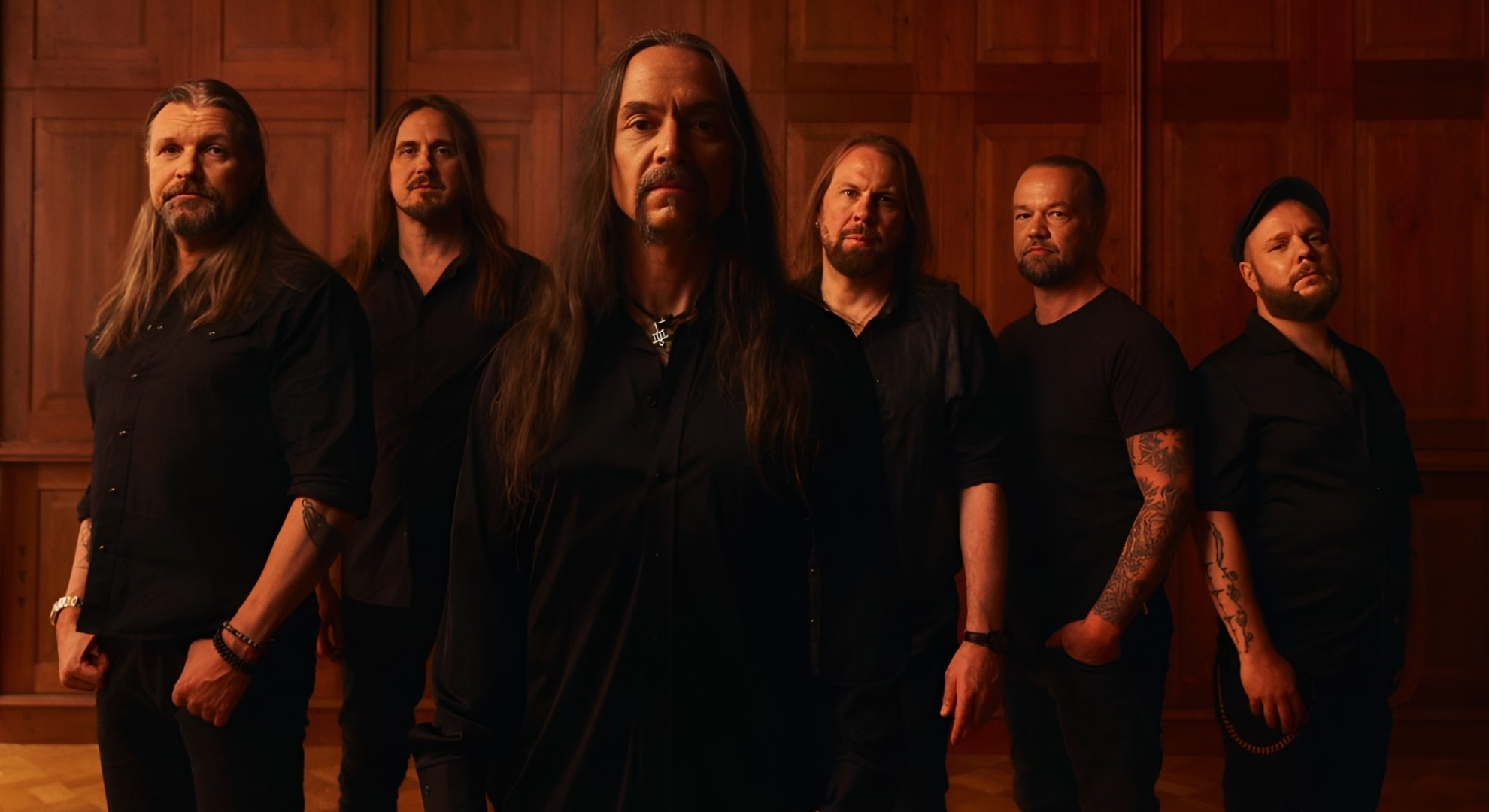
The image sits at an uneasy junction: a space raised to gesture toward transcendence, repurposed to manage minds the era had decided could not be trusted with it. That junction is where Kamelot situates ‘Dark Asylum,’ the American symphonic metal band’s fourteenth studio album, scheduled for release on August 28th, 2026, through Napalm Records.
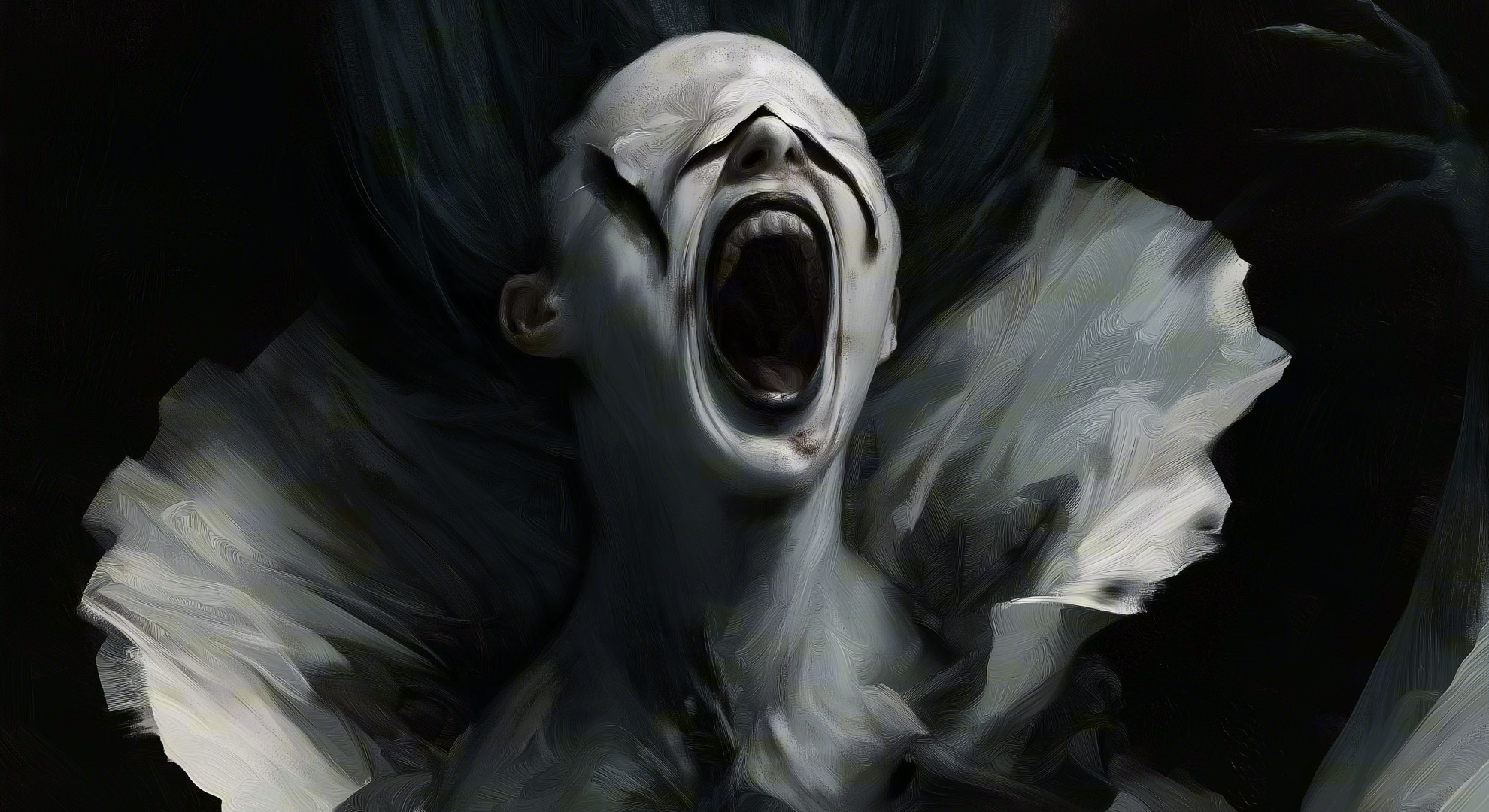
The record is set within a fictional institution called RavenHill Asylum, described in the band’s own account as a structure once raised as a grand cathedral before its conversion into a place where science, faith, and instability uneasily coexist.
Kamelot founder and guitarist Thomas Youngblood described the album’s narrative as following a soul trapped inside a world of masks, fractured memories, and psychological torment, wandering the halls of RavenHill in search of truth, identity, and redemption. Vocalist Tommy Karevik, in a separate statement, framed the record around the duality of human nature and the struggle to remain sane within a cold and barren world, adding that salvation, in the narrative the band has constructed, is not found externally but discovered from within.
Both statements point toward a concept album grounded in confinement, and confinement is a subject with a specific, documented history that the record’s premise summons whether or not the band engages it directly.
A Cathedral Reconsidered
The physical conversion of religious structures into asylums was not incidental to nineteenth-century institutional psychiatry; it reflected a set of design assumptions about what a curative environment ought to look like. Gothic Revival design, which dominated English and American institutional structures through much of the eighteen hundreds, was prized for precisely the qualities that made the style suitable for both worship and confinement: soaring verticality intended to inspire awe, thick masonry that muffled sound and restricted movement, and a cloistered plan that separated inhabitants from the world outside its walls.1
The style’s revival was itself an argument about moral order, one that its Victorian proponents extended from the cathedral to the reformatory, the workhouse, and the asylum with little sense of contradiction.
RavenHill, as Kamelot describes it, inherits this exact design logic without inheriting its era’s confidence that the logic was sound. The album’s premise treats the asylum less as a place of cure than as a structure that outlived the certainty that raised it, its cathedral bones now housing an institution whose stated purposes, in the album’s telling, blur into instruments of control.
That blurring is not simply Gothic set dressing. It maps onto a documented tension in the actual history of psychiatric confinement, one the record’s concept invites without fully naming.
Moral Treatment and Its Unfinished Reforms
The specific historical current that RavenHill evokes is the moral treatment movement, a set of reforms that swept through European and North American psychiatric institutions beginning in the final years of the seventeen hundreds. Moral treatment rejected the chains, isolation cells, and mechanical restraints that had defined earlier custodial practice, arguing instead that structured routine, occupation, and a controlled but humane environment could restore reason where physical coercion could not.
English Quaker reformers established the York Retreat on these principles in 1796, and the approach spread across the continent through the following decades, reshaping asylum design in the process; the cloistered, quasi-monastic layouts that Gothic Revival architects favored were, in part, a physical expression of moral treatment’s belief that order and structure were themselves curative.2
The movement’s reforms, however, proved difficult to sustain at scale. As public asylums expanded across the nineteenth century to accommodate rapidly growing populations, the individualized attention that moral treatment required gave way, in many institutions, to overcrowding, custodial routine, and the reintroduction of the very restraint practices the reform had set out to abolish.
The structure raised to embody one set of intentions increasingly housed another. It is this specific historical arc, reform curdling into a confinement it once opposed, that gives RavenHill Asylum’s premise its documented weight. A structure erected as a cathedral and later repurposed as an asylum, in Kamelot’s telling one where science, faith, and instability now uneasily coexist, dramatizes precisely the gap between a structure’s founding intention and its eventual function that defined the fate of moral treatment itself.
Youngblood’s description of a soul navigating fractured memories in search of identity and redemption inside such a structure gives that historical irony a personal register, translating an institutional history into a single trapped consciousness.
Founding a Symphonic Vision
Kamelot’s own history begins considerably further from RavenHill’s Gothic corridors, in Tampa, Florida, where guitarist Thomas Youngblood formed the band in 1987 under the name Camelot, a name his mother suggested for its association with John F. Kennedy.
The following year, the group contributed the song ‘Breaking the Silence’ to a local metal compilation, an early credit for a band that would spend the next four decades assembling a catalogue inside American power metal’s domestic scene. Kamelot signed to Noise Records in 1994 and released its debut album, ‘Eternity,’ in 1995, establishing the melodic, keyboard-inflected power metal foundation the band spent the following decade reshaping.
Vocalist Roy Khan, a Norwegian singer, joined Kamelot for ‘Siège Perilous’ in 1998, and his roughly thirteen-year tenure defined the band’s most widely discussed creative period.
Working alongside Youngblood, Khan helped steer Kamelot toward the two-part concept album ‘Epica’ (2003) and its sequel ‘The Black Halo’ (2005), both inspired by Johann Wolfgang von Goethe’s ‘Faust’ and structured as a rock opera divided across the two records, corresponding to Goethe’s own two-part structure.
The albums married Kamelot’s power metal foundation to more explicitly symphonic orchestration and a literary conceptual framework, a combination that would recur, in different form, on ‘Dark Asylum’ two decades later.
Khan departed the band in April of 2011, and Youngblood announced on June 22nd, 2012, that Swedish vocalist Tommy Karevik would take his place. Karevik made his studio debut fronting Kamelot on ‘Silverthorn,’ released on October 24th, 2012, and has remained the band’s vocalist and a co-writer of its material in the years since.
The Awakening’s Unfinished Reckoning
‘Dark Asylum’ follows ‘The Awakening,’ released on March 17th, 2023, through Napalm Records, Kamelot’s thirteenth studio album and its first full-length in five years, released after 2018’s ‘The Shadow Theory.’
‘The Awakening’ marked the recording debut of drummer Alex Landenburg following the departure of Johan Nunez, and its material turned inward, engaging with themes of introspection and psychological reckoning that critics and the band alike identified as among the more personal Kamelot had committed to record.
Where earlier Kamelot concept records, ‘Epica’ and ‘The Black Halo’ foremost among them, had drawn their psychological drama from an external literary source, ‘The Awakening’ located its confrontation with identity and reckoning inside a more contemporary, less mythologized frame, without the accompanying narrative apparatus of a fictional setting.
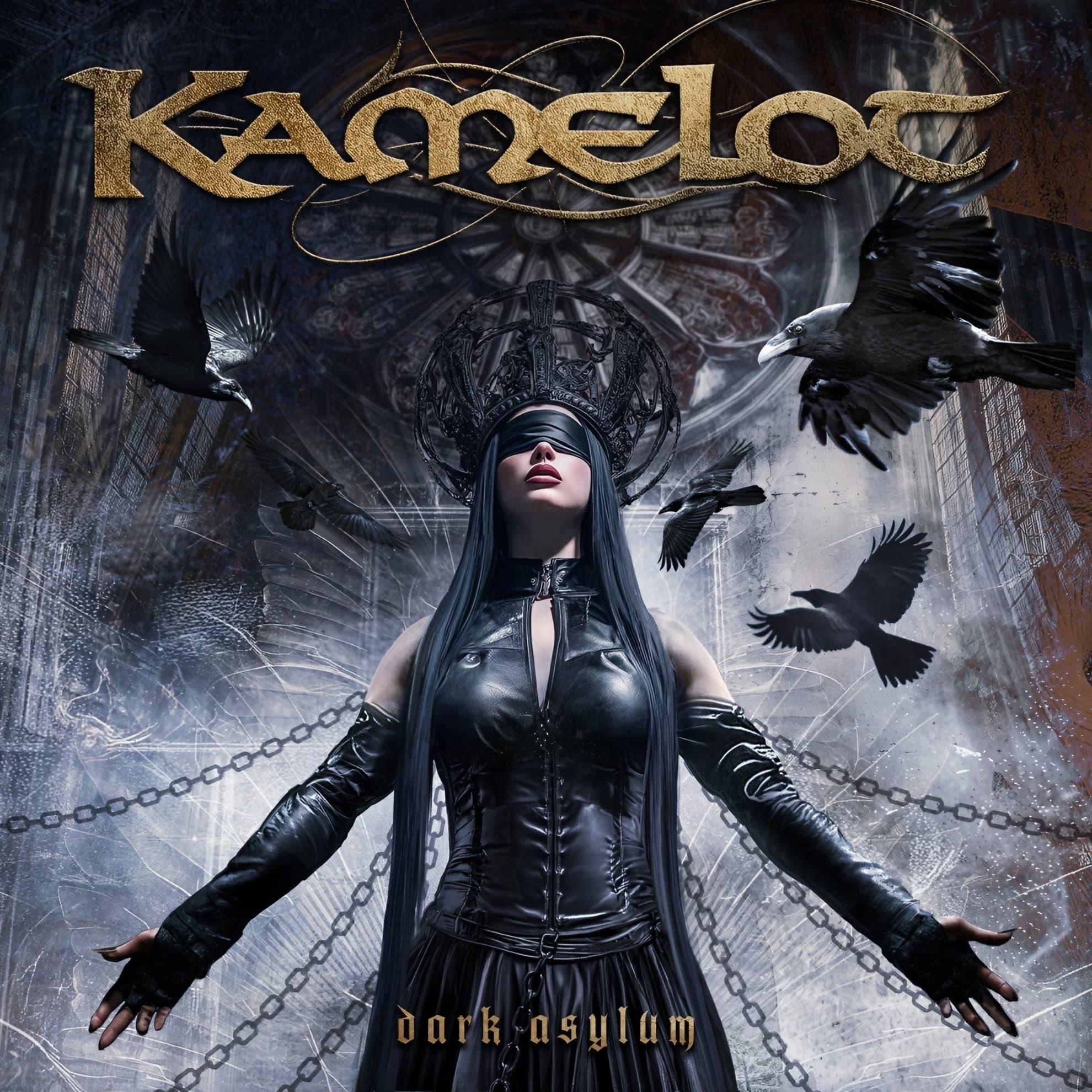
‘Dark Asylum’ returns to that same terrain of fractured identity and psychological confrontation but restores around it the kind of structured narrative world Kamelot had set aside on the previous record, relocating the introspective concerns of ‘The Awakening’ into RavenHill’s fictional walls.
Where the earlier album asked its listener to sit with reckoning in the abstract, ‘Dark Asylum’ gives that reckoning a structure, literalizing confinement as both setting and metaphor. The continuity Youngblood and Karevik describe, of a soul working through fractured memory toward eventual identity and redemption, extends a psychological project ‘The Awakening’ opened but did not resolve, now given a concept album’s narrative scaffolding to carry it further.
Sascha Paeth’s Long Return
Producer Sascha Paeth’s involvement with Kamelot extends back to the band’s earliest German-recorded material, and his return to helm ‘Dark Asylum,’ where he also contributes additional guitar parts, continues a collaborative relationship that has shaped the band’s sound since ‘Siège Perilous.’
Paeth’s production work across Kamelot’s catalogue, and across the wider European symphonic and power metal scene through his work with acts including Avantasia, has consistently favored layered orchestration integrated tightly with guitar-driven arrangements rather than treated as an ornamental addition, a signature that recurs across the records he has helmed for the band. Jacob Hansen, who has handled mixing and mastering across several recent Kamelot releases, returns in the same capacity for ‘Dark Asylum.’
The specific facility where ‘Dark Asylum’ was tracked had not been confirmed via official sources at the time of publication. Paeth’s own studio history includes a long association with Gate Studios in Wolfsburg, Germany, where earlier Kamelot records, including ‘Epica,’ were produced, though no confirmed credit ties ‘Dark Asylum’ to that specific facility, and production credits from one Kamelot record cannot be assumed to carry forward to the next without independent confirmation.
Ashen World Opens the Gate
The sole confirmed advance single from ‘Dark Asylum,’ ‘Ashen World,’ was released on July 2nd, 2026, and offers the clearest available evidence of the direction the fuller record takes.
The track opens with an introduction voiced by Kiara Huber before expanding into the orchestration-forward, guitar-anchored arrangement that has defined Kamelot’s sound since the Karevik era, arranged around a chorus scaled for the kind of festival stage the band has occupied across three decades of touring.
Youngblood described the track as capturing a moment poised between darkness and hope, at the threshold of a larger journey, a framing that positions ‘Ashen World’ as an entry point into RavenHill rather than a self-contained statement.
Taken as a single confirmed data point, ‘Ashen World’ suggests a record that opens its narrative with scale rather than restraint, establishing the cinematic register the band has signaled for ‘Dark Asylum’ before its remaining, unheard tracks presumably turn inward. What the single cannot confirm is how that register holds across a full album organized around confinement rather than motion.
A Neo-Victorian Language Heard Widely
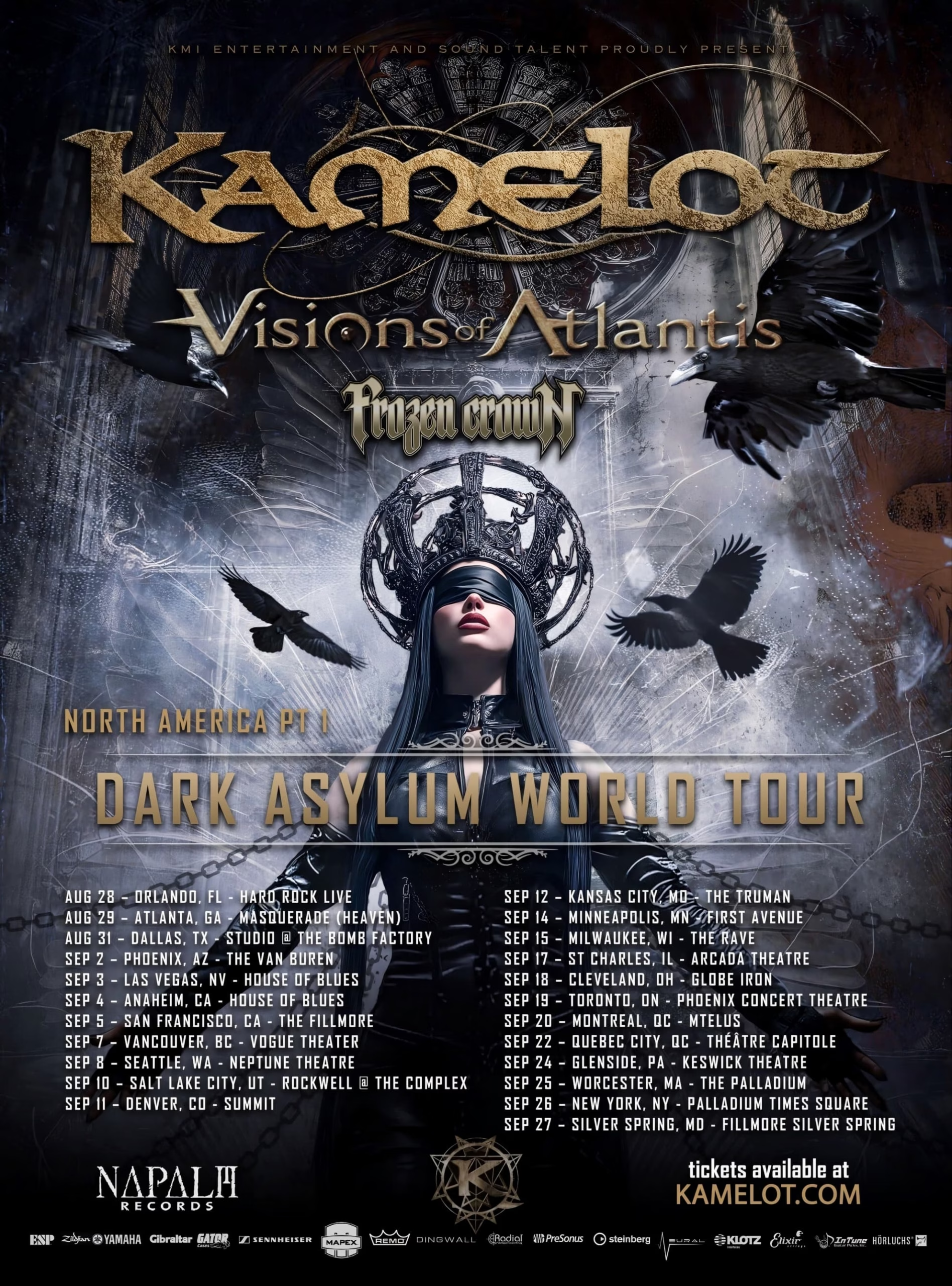
Kamelot’s documented audience does not sit inside a single national scene. The band’s confirmed 2026 itinerary runs from Orlando, Florida, through eighteen venues across Europe, closing in Madrid, alongside a two-night event at O13 in Tilburg, the Netherlands, sharing bills with labelmates including Xandria, Leaves’ Eyes, Visions of Atlantis, and Exit Eden, acts drawn from the same European symphonic and power metal circuit that has sustained Kamelot’s audience since the Khan era.
That circuit has its own compositional grammar, one grounded in close integration between orchestral arrangement and metal instrumentation rather than the treatment of orchestration as a decorative overlay, a distinction documented in analyses of the genre’s harmonic conventions.3
‘Dark Asylum,’ with contributions from Avantasia’s Tobias Sammet, Visions of Atlantis’s Clémentine Delauney, and Eluveitie’s Lea-Sophie Fischer among its confirmed guest performers, sits inside that same compositional lineage and, through those specific collaborations, inside the same touring and recording network.
The Neo-Victorian aesthetic RavenHill draws on carries its own separate history of international circulation. Neo-Victorian fiction, film, and visual culture, which reimagine nineteenth-century settings and institutions for contemporary audiences, have functioned since the late twentieth century as a vehicle through which readers and viewers across different national contexts reexamine the period’s confidence in reform, science, and institutional order, typically by exposing the coercion such confidence concealed.4
‘Dark Asylum’ extends that same interrogation into symphonic metal’s specific vocabulary, translating a literary and visual tradition largely established in prose and film into the genre’s orchestral and vocal registers, and offering the touring circuit documented above a Neo-Victorian narrative shaped for a stage rather than a page.
RavenHill’s Doors Remain Ajar
‘Dark Asylum’ stands as the fourteenth entry in a catalogue that has repeatedly returned to structured, literary narrative as a vehicle for psychological material, from the Faustian design of ‘Epica’ and ‘The Black Halo’ to the more contemporary introspection of ‘The Awakening.’
What truly distinguishes RavenHill from Kamelot’s earlier conceptual worlds is its specific historical grounding: a structure whose cathedral origins and asylum afterlife trace an actual, documented arc in the history of institutional reform, one in which structures raised to embody a curative intention outlived the confidence that erected them.
Youngblood and Karevik have each described a narrative that moves from fracture toward the possibility of healing found from within rather than imposed from outside, a movement that, read against the moral treatment history RavenHill’s design invokes, reads less as resolution than as a return to the reform’s original, unfinished promise.
Only ‘Ashen World’ can be weighed against that promise directly at this stage, and one track scaled for its opening is not the same evidence as an album designed for confinement. What ‘Dark Asylum’ argues about the distance between a structure’s founding purpose and its eventual use will depend on material still unheard, tracked in a studio the band has not named, inside walls that, fictional or not, carry a documented history behind them.
When a record borrows the design of a real historical reform to frame a fictional confinement, does the listener owe that history more scrutiny than the story raised on top of it, or does the story earn the right to stand on its own?
References
- Chris Brooks, ‘The Gothic Revival’ (London: Phaidon Press, 1999), 210-215. ↩︎
- Andrew Scull, ‘Madness in Civilization: A Cultural History of Insanity’ (Princeton: Princeton University Press, 2015), 178-184. ↩︎
- Esa Lilja, ‘Theory and Analysis of Classic Heavy Metal Harmony’ (Helsinki: IAML Finland, 2009), 92-97. ↩︎
- Ann Heilmann and Mark Llewellyn, ‘Neo-Victorianism: The Politics of History in Contemporary Fiction’ (Basingstoke: Palgrave Macmillan, 2010), 41-47. ↩︎

Leave a Reply