

In the low forests east of Ede, in the Dutch province of Gelderland, older residents once described a certain light that appeared at the edge of the marsh after dusk. It drifted low, it receded the moment it was approached, and it returned the moment the traveler gave up and walked on. To follow it too far, the telling went, was to risk not coming back.
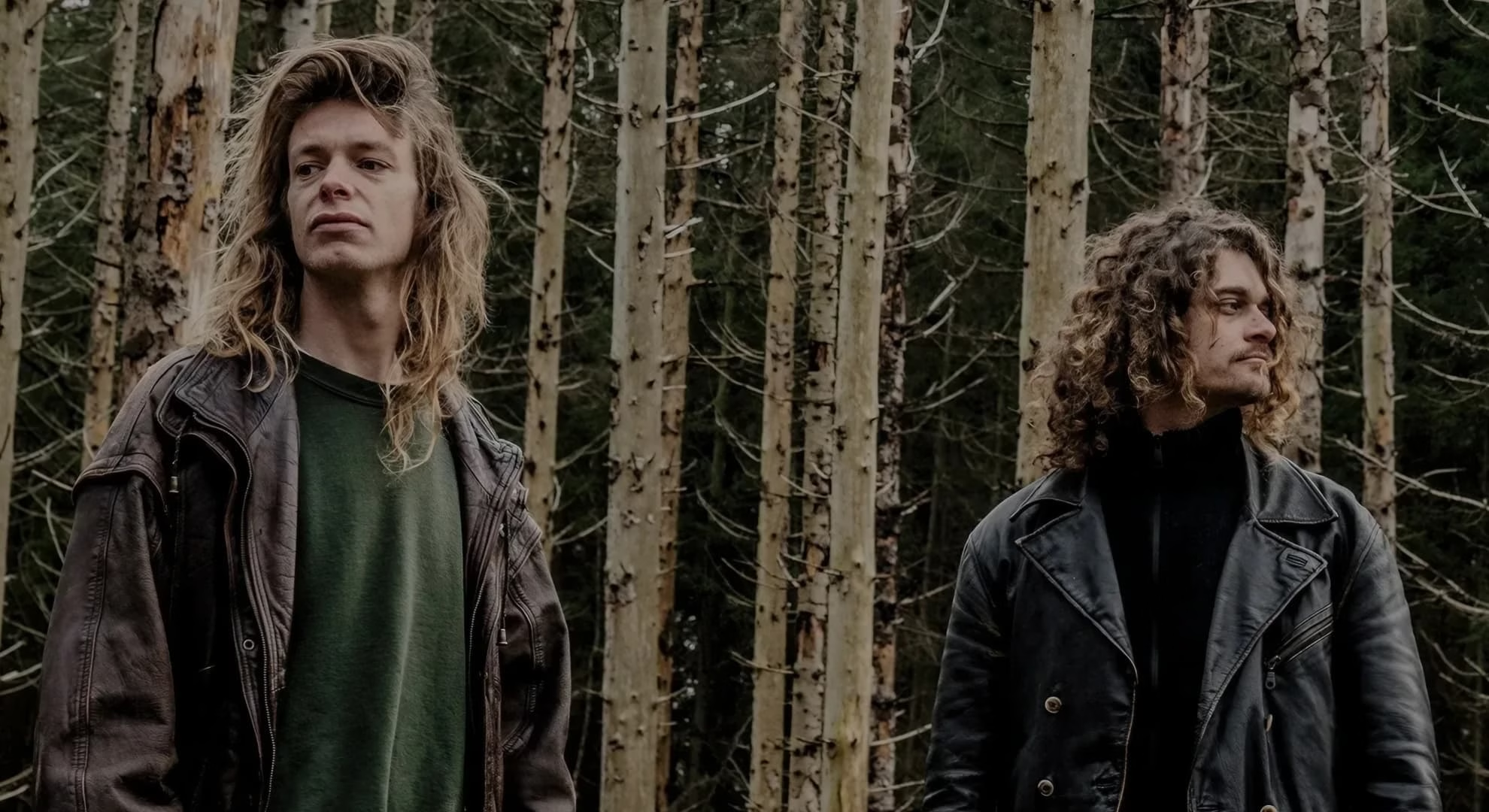
Fluisteraars, the atmospheric black metal band from the village of Bennekom, spent the better part of two decades translating that regional inheritance into sound. On September 11th, 2026, the band release ‘Jacht der Mysteriën’ on the German label Eisenwald, their sixth full-length record and, by the band’s own account, the first fully conceived and performed as a complete live band statement rather than assembled piece by piece.
The Light That Leads Astray
The Dutch dwaallicht, literally the wander-light, belongs to a family of will-o’-the-wisp beliefs that stretch across the marshes and heathlands of northern Europe, known under different names in nearly every regional dialect from Groningen to Flanders.
Folk narrative researcher Theo Meder, whose work at the Meertens Institute in Amsterdam has documented the country’s oral storytelling tradition for decades, situates these lights within a broader Dutch legend cycle in which the terrain itself, not any single supernatural author, produces the danger.1
Rationalized today as the ignition of marsh gas above decomposing peat, the dwaallicht nonetheless persisted for centuries as something closer to an agent than a phenomenon, a presence that noticed a traveler and drew him from the path.
‘Jacht der Mysteriën’ draws its concept from one strand of this cycle in particular, a local account of a figure who followed such a light into the woods around Bennekom and never returned. The band has described shaping the album’s three compositions directly around that story, alongside close observation of the terrain the legend inhabits.
Read against the folkloric record, the choice carries a precision that separates it from generic gothic dressing. The dwaallicht legend was never a morality tale about temptation in the abstract. It was a story rural communities told about their own immediate ground, about specific bogs and specific tree lines, and about the particular danger of trusting a light that seemed to want to be followed.
Fluisteraars import that specificity rather than a generalized darkness, and the album’s structure, three compositions rather than a longer track list, mirrors the shape of a single sustained pursuit rather than a collection of separate encounters.
From Bennekom to a Full Band
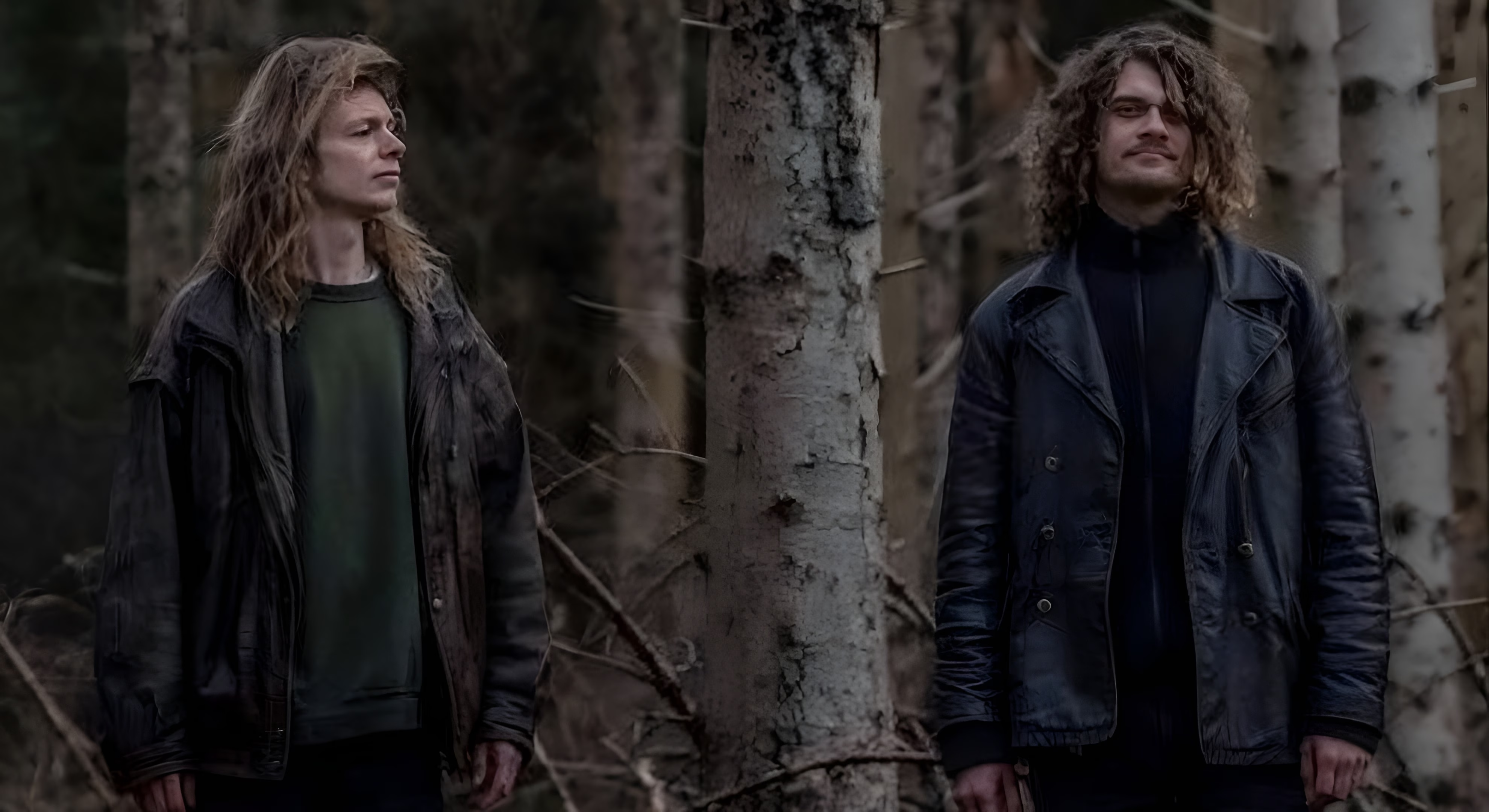
Fluisteraars formed in Bennekom in 2009, around vocalist and lyricist Bob Mollema and multi-instrumentalist Mink Koops, with Asher de Vries on bass until 2020. Two early demos, later compiled as ‘Relaas,’ established the trio’s raw, tremolo-driven foundation before the 2014 debut full-length ‘Dromers’ set the template the band has spent six full-length records complicating: long, folk-inflected compositions shaped less by riffs than by sustained melodic movement.
The 2015 follow-up ‘Luwte’ sharpened that approach, and a 2018 split with fellow Dutch act Turia, ‘De Oord,’ paired a single Fluisteraars composition with a companion piece by Turia, extending the collaborative and regional side of the project outside the band’s own catalog rather than adding to its full-length count.
Then 2020’s ‘Bloem’ brought in a string quartet and a men’s choir, tracked at E-Sound Studios under producer T. Cochrane, in the band’s most orchestrated statement to date.
‘Gegrepen door de Geest der Zielsontluiking’ followed in 2021, but it was 2024’s ‘Manifestaties van de Ontworteling,’ that set the direct precedent for the new record. That album pushed toward louder, more experimental terrain while holding onto the band’s atmospheric core, and it was captured live using vintage analog equipment rather than assembled in overdubs, a choice the band has framed as a deliberate pursuit of rawness over polish. ‘Jacht der Mysteriën’ completes the turn that ‘Manifestaties van de Ontworteling’ only began.
Where the 2024 record used analog hardware to rough up a largely conventional recording process, the new album abandons the conventional process altogether. No fixed studio in the ordinary sense was used for the sessions: the band captured all three compositions live in a single take with longtime producer T. Cochrane, then reamped the recording through the hollow cylinder of an abandoned water tower to obtain its final character.
The lineup that carried this out has grown well past the founding trio. Alongside Mollema and Koops, drummer N. de Wit and Cochrane himself on bass appear as full performing members, with additional contributions credited to S. Claessen and A. van Bennekom on a passage titled ‘Lawine van Duisternis’ and to a musician performing as Reus van de Steenen Tafel on a passage titled ‘Ruimte,’ both embedded within the album’s three compositions rather than standing as separate tracks.
The result, the band has said, is the first Fluisteraars album conceived from the outset as a complete band performance rather than a studio arrangement assembled around a smaller core.
Captured Whole in One Take
The decision to record live and in a single pass places ‘Jacht der Mysteriën’ inside a much older argument within recorded music about where a record’s authority properly resides.
Historian Susan Schmidt Horning has traced how the twentieth-century recording studio gradually reversed the relationship between live performance and the finished record, so that the studio version, rather than the concert, became the default reference point for what a piece of music was supposed to sound like.2
Fluisteraars, working with a producer they have returned to across multiple records, push against that default rather than working within it. Reamping through an abandoned water tower is not a mixing trick applied after the fact. It is a decision to let a specific physical space, its concrete walls, its height, its decay, imprint itself on the performance the same way the marsh imprinted itself on the dwaallicht legend the album draws on.
Given the band’s account of the sessions, no conventional recording studio, in the sense of a dedicated facility, was employed in the making of this record; the album was captured live in a single take with producer T. Cochrane and subsequently reamped through the hollow cylinder of an abandoned water tower to reach its finished sound.
Cochrane’s relationship with the band extends back at least to 2020’s ‘Bloem,’ where he engineered and mixed alongside the group, giving this collaboration a documented history rather than a first-time pairing. Mixing on the new record is credited jointly to Cochrane and Koops, mastering to G. Chandler, and artwork and photography to Mollema himself, continuing the band’s practice of keeping the visual identity of its records in-house.
The First Single’s Evidence
The sole confirmed advance material from ‘Jacht der Mysteriën’ is ‘Condities der Afstraffing,’ released as the album’s first single on August 17th, 2026, roughly 10 minutes in length and positioned as the second of the record’s three compositions. Its release, and the language the band and label have used to frame it, positions the album toward a specific sonic outcome rather than confirming that outcome outright.
Eisenwald has described the reamped recording as producing a drifting, fog-like quality, one meant to suggest that something might vanish or surface without warning, and has tied that description explicitly to the sense of urgency and impermanence the live, single-take approach was meant to create.
Taken at face value, that framing suggests a record less interested in the layered clarity of ‘Bloem’ than in a rougher, harder-to-pin-down presence, closer to the analog grain of ‘Manifestaties van de Ontworteling’ but pushed one step further from the control a conventional studio process would ordinarily supply.
Whether the finished album bears that quality across all three compositions remains for its full release to confirm; what can be said now is that the single’s producer, format, and stated intent all point in a consistent direction.
Hearing It Beyond Gelderland
Extreme metal drawn from tightly regional folklore faces a particular test once it leaves the region that produced it. Sociologist Motti Regev has described how pop-rock genres, metal included, function as a form of aesthetic cosmopolitanism, in which musicians across very different national contexts draw on a shared musical vocabulary while still asserting the specific, local material that makes their version of the genre distinct.3
Fluisteraars sit close to the center of that tension. Their reamped, single-take approach and Gelderland-specific legend are not gestures aimed at a domestic audience alone; they are precisely the kind of local specificity that gives an internationally circulating genre something to hold onto.
Deena Weinstein’s sociological account of heavy metal culture describes a scene formed, from its earliest Anglo-American iterations onward, around bands who root their identity in a particular place while still speaking a musical language legible to metal audiences who have never been there.4
Norwegian black metal’s insistence on raw, unpolished production in the early nineteen-nineties supplied one influential version of that logic. Fluisteraars, recording in a Dutch water tower rather than a Norwegian forest, extend the same underlying premise into new regional material.
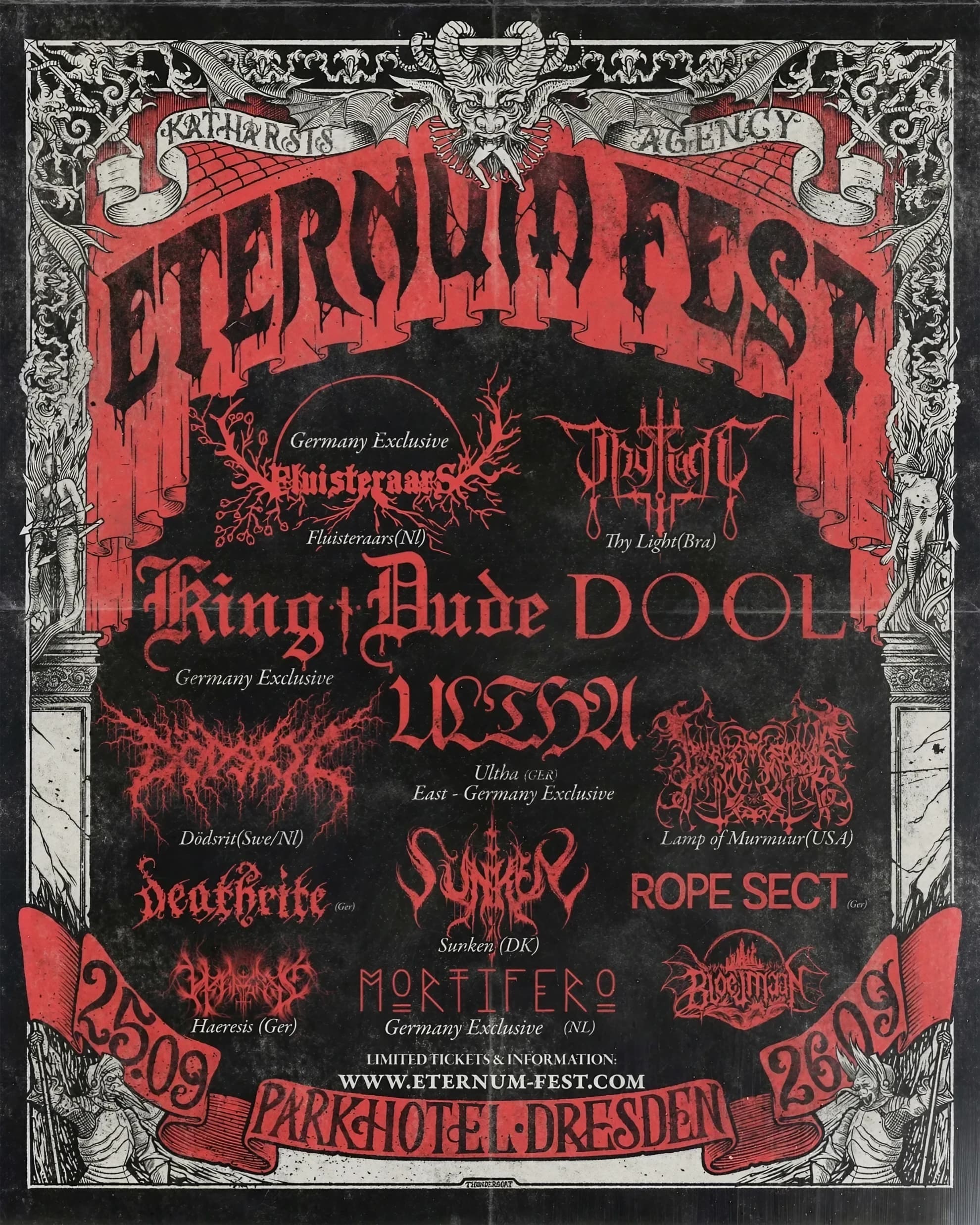
The band’s documented reach beyond the Netherlands is concrete rather than assumed. Fluisteraars appeared at Roadburn Festival in Tilburg in 2024, a booking that has long marked standing within the European avant-garde and extreme metal festival circuit, and the current tour calendar for ‘Jacht der Mysteriën’ carries the band to Eternum Fest in Dresden and to Doornroosje in Nijmegen in the weeks following the album’s release.
Eisenwald itself, the German label handling the release, has assembled a specialist roster around exactly this kind of regionally rooted extreme metal, and the label’s collectors, evident in the multiple vinyl variants and the limited 999-copy digipak pressing prepared for ‘Jacht der Mysteriën,’ constitute a documented audience with a direct stake in the physical object rather than an abstract international following. It is that audience, assembled around specific pressings, specific festival stages, and a specific label’s back catalog, that the record is made to reach.
The Woods Keep Their Names
‘Jacht der Mysteriën’ does not resolve its own central image. The figure who followed the lights into the Gelderland woods stays lost at the end of the legend, and Fluisteraars have made a record that refuses to supply the ending folklore withheld.
What the album offers instead is a document of the pursuit itself, captured once, in one room, in one continuous take, with no second pass available to smooth over what the water tower’s concrete did to the sound. That refusal to resolve, paired with a production method that cannot be undone or redone, gives the record its stakes independent of how any single listener responds to it.
A regional legend has been carried, largely intact, into a genre made for international circulation, and the record now depends on whether audiences outside Bennekom hear the specificity Fluisteraars worked into it or only the atmosphere that specificity produces.
Listeners who know their own region’s version of the wandering light, whether swamp fire, ghost lantern, or something closer to home, might ask what a band would need to get right, sonically and structurally, to carry that story convincingly into a genre made for audiences who have never seen the light themselves.
If you are a band, artist, label, or promoter navigating the dark and independent scene, you need press materials that speak the language — not generic copy. Our Studio writes press releases, EPKs, bios, and website content for the underground and the vanguard alike. Plans start at $150, with turnaround as fast as 2 days.
References
- Theo Meder, ‘The Flying Dutchman and Other Folktales from the Netherlands’ (Westport, CT: Libraries Unlimited, 2008), 45-49. ↩︎
- Susan Schmidt Horning, ‘Chasing Sound: Technology, Culture, and the Art of Studio Recording from Edison to the LP’ (Baltimore: Johns Hopkins University Press, 2013), 112-118. ↩︎
- Motti Regev, ‘Pop-Rock Music: Aesthetic Cosmopolitanism in Late Modernity’ (Cambridge: Polity Press, 2013), 61-67. ↩︎
- Deena Weinstein, ‘Heavy Metal: The Music and Its Culture,’ rev. ed. (New York: Da Capo Press, 2000), 98-103. ↩︎


Leave a Reply