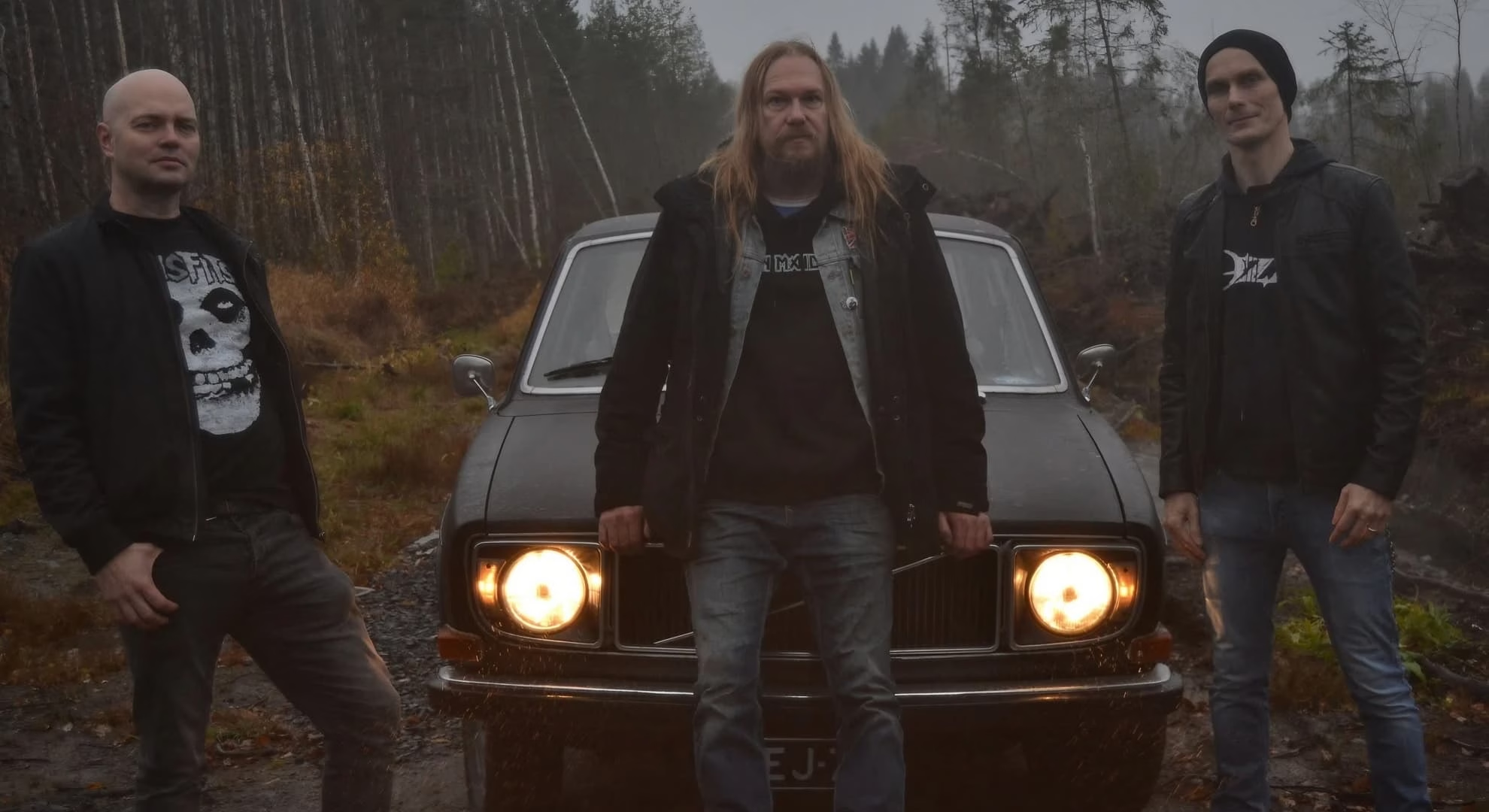


The popular imagination has long pictured the leper colony as a place of ritual erasure: the diagnosed declared dead to their community, walked through a symbolic funeral rite, and cast beyond the village bounds to spend what remained of a life the community had already mourned. It is a vivid, durable image, repeated across sermons, folklore, and popular history long after the practices it describes had faded from documented use.
Oulu’s Occult Master have built the emotional core of their self-titled debut album around exactly this territory of memory and myth, using it not as scenery but as the record’s central argument about isolation, devotion, and what a body cast outside a community is still permitted to feel.
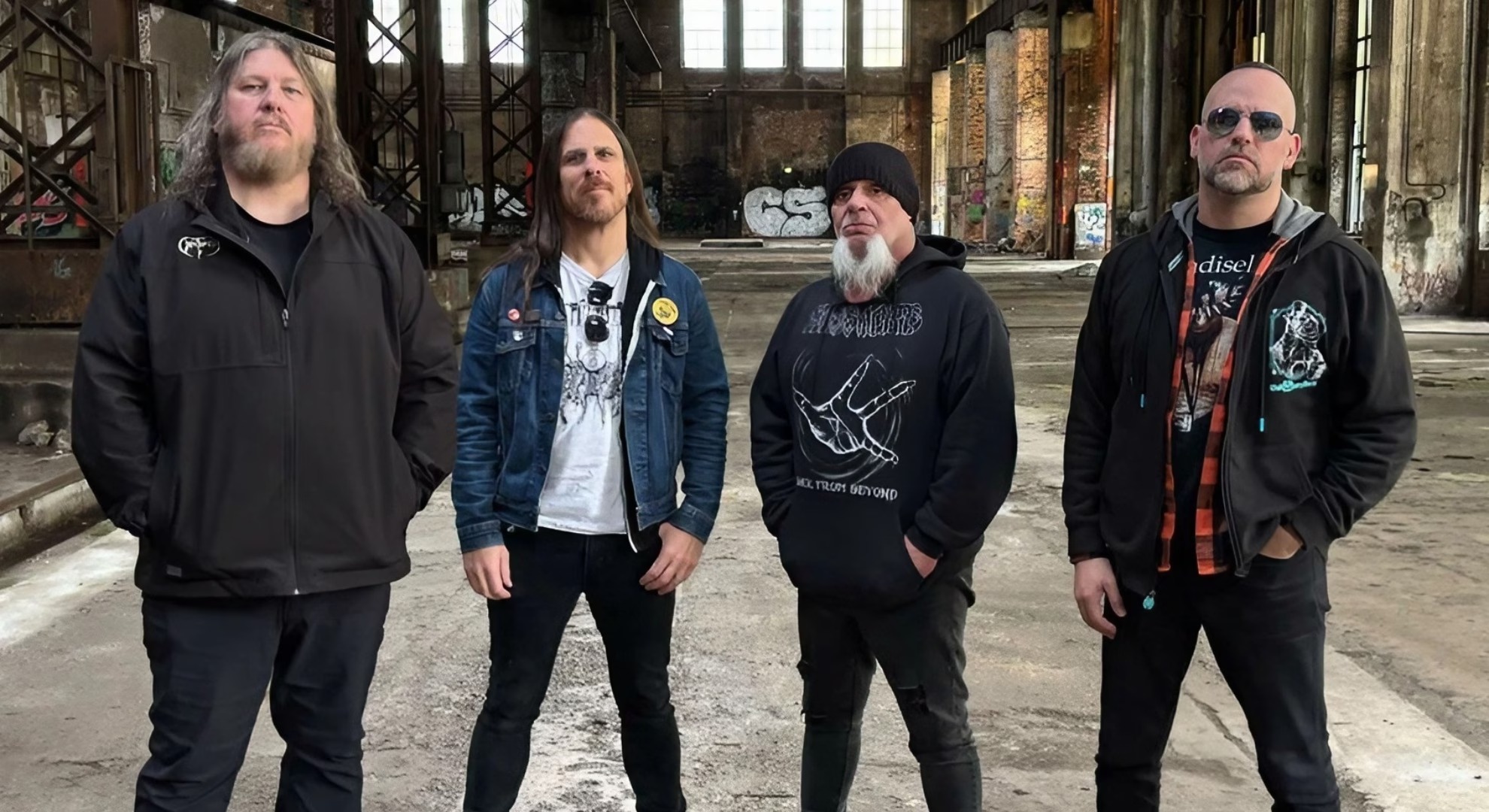
The album is released on August 14th, 2026, through Inverse Records, closing a gap in the trio’s history that stretches back 14 years. Ari Eskola handles guitar and vocals and wrote both the music and lyrics; Toni Mäki plays bass and contributes backing vocals; Jussi Risto plays drums and recorded the sessions himself.
Nine tracks make up the record, opening with ‘Just Another Nail in the Failier’s Coffin’ and closing with ‘Gnarly Geezer,’ with the doom-centered set piece ‘Island of Leper’ positioned second in the sequence, directly after the record’s opening track.
Oulu’s Long Return to Old Metal
Occult Master formed in Oulu in 2012, in the north of Finland, as a heavy rock and doom outfit built around the same three musicians who appear on the debut. A lineup change in 2020 pushed the material in a faster, more rhythmic, and more technically demanding direction, a shift the band itself has described as the moment its sound gained versatility without abandoning its original weight.
14 years separate that founding from a first full-length statement, an unusually long runway that positions ‘Occult Master’ less as a young act’s opening gambit than as a considered, mature document assembled after more than a decade of internal refinement.
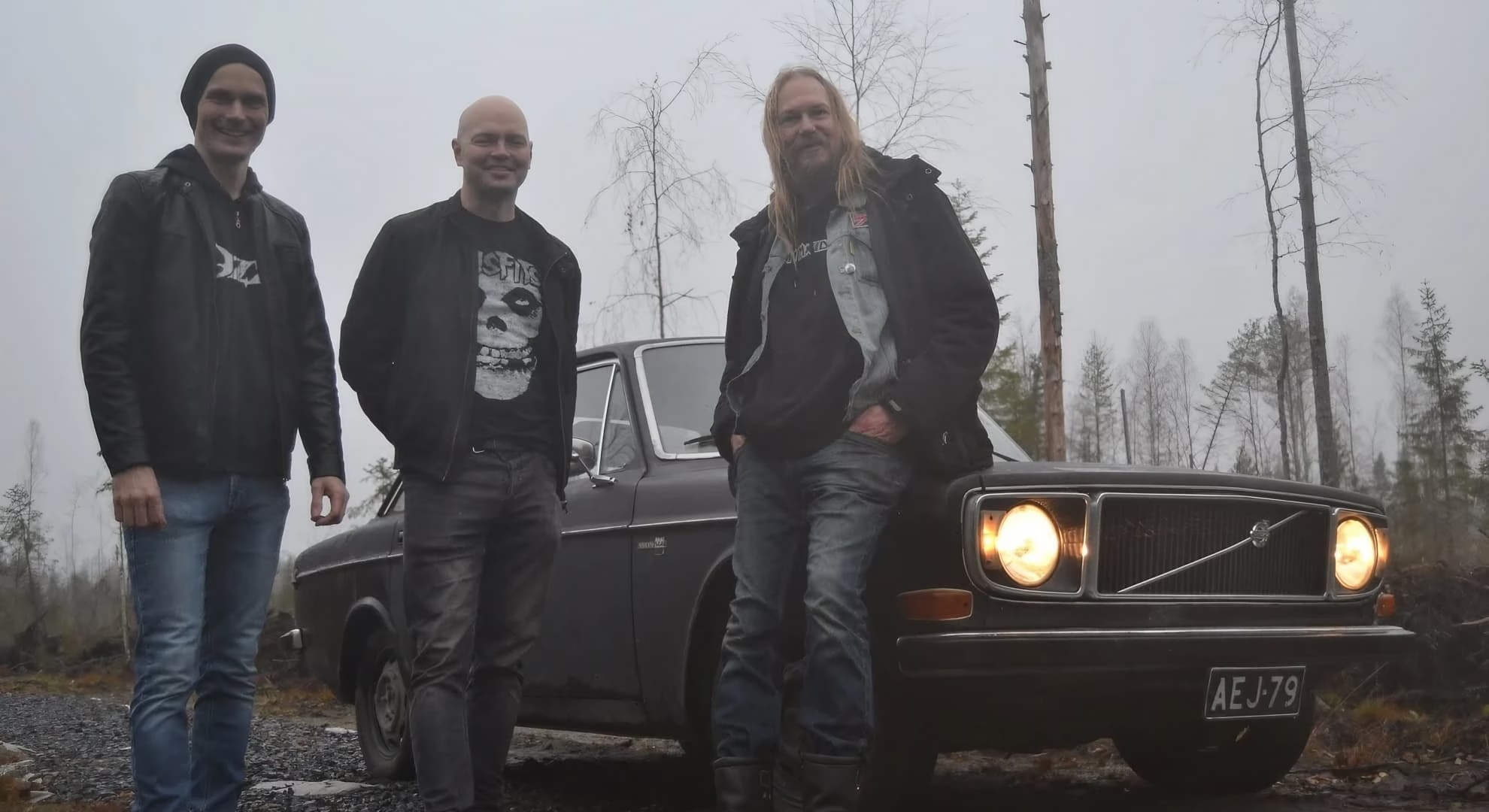
Eskola, Mäki, and Risto have repeatedly named Black Sabbath, Mercyful Fate, and Blue Öyster Cult as reference points, and the connection is not incidental coloring.
Those three acts, along with Led Zeppelin, are the bands most closely associated with the moment heavy metal separated itself from blues rock as a distinct musical form, a process centered on Birmingham’s industrial decline in the late nineteen-sixties and early nineteen-seventies and the specific harmonic and rhythmic vocabulary that city’s musicians developed in response to it.1
For a Finnish band recording in 2026 to reach for that exact blueprint is a deliberate act of lineage rather than simple nostalgia: it identifies Occult Master’s home tradition not as the internally focused Nordic black metal or funeral doom scenes with which Finnish extreme music is more commonly associated internationally, but as the older, Anglophone heavy metal tradition those Nordic scenes themselves grew out of a decade later.
Because ‘Occult Master’ is the band’s debut full-length, there is no earlier album against which to measure it. What exists instead is 14 years of a project’s slow formation, three musicians deciding, apparently more than once, what kind of record their first one would need to be before committing it to tape.
The Island That Swallowed Two Lives
‘Island of Leper,’ the album’s second track and first advance single, follows two former lovers who contract leprosy and reunite on the island where sufferers of the disease were sent, spending what time remains to them remembering a youth that disease has now foreclosed.
The song draws its emotional force from a specific historical association: the idea that a leprosy diagnosis functioned, in the medieval imagination, as a kind of death before death, complete with formal rites of separation and permanent removal from ordinary community life.
That association has a genuine, well-documented root. Medieval Christian Europe practiced a ceremony known as the Separatio Leprosorum, in which a person confirmed as having the disease was led to an open grave, had earth cast over them by the presiding priest, and heard a funeral rite conducted in their presence, declaring them dead to the world though still living.
The practice, first recorded following the Lombard Edict of Rothari in the seventh century, spread across Christian Europe through later royal and ecclesiastical decree. It is this ceremony, or the popular memory of it, that ‘Island of Leper’ draws on most directly for its imagery of a couple accepting their island as a final resting place.
The fuller historical record complicates how representative that ceremony actually was. Carole Rawcliffe’s revisionist history of medieval English leprosy found that outright banishment was neither universal nor the ordinary fate of the diagnosed, and that many leper hospitals were modeled closely on standard monastic institutions rather than built as sites of punitive exclusion, with the Separatio Leprosorum itself far from a routine event in most English communities.2
Luke Demaitre’s study of premodern medical responses to the disease adds further texture: physicians of the period retained a documented interest in patients’ welfare even as a diagnosis stripped away legal and social standing, since the loss of ordinary status, rather than physical removal itself, was often what constituted a sufferer’s social death.3
Diagnosis could mean the loss of property, marriage, and legal personhood while the diagnosed person frequently continued to live within reach of, if not inside, their former community.
Read against that fuller record, ‘Island of Leper’ is working with a real but exceptional ceremony inflated by folklore into a universal medieval practice, and the distinction matters to how the song should be understood. Its island is invented, not drawn from any specific named leprosarium, and its funeral imagery belongs to the durable popular narrative built around the Separatio Leprosorum rather than to the more varied documented reality Rawcliffe and Demaitre describe.
What the song gets right, whether by design or instinct, is the deeper truth beneath the myth: that a diagnosis could end a life’s ordinary shape long before it ended the life itself, and that two people who once expected a future together might find their remaining time reduced to a single shared, isolated space.
Three Singles Toward One Portrait
Two of the album’s three advance singles carry enough confirmed detail to support close engagement; ‘Gnarly Geezer,’ the album’s closing track and the middle release in the band’s three-single campaign, is the exception: its promotional history has not surfaced beyond its release between ‘Island of Leper’ and ‘Heavy Metal Madness.’
‘Island of Leper’ itself argues for ambition beyond a straightforward doom or heavy metal single. Its multi-part structure and the band’s own description of it as a contemplative, progressive piece suggest a song built to function as a scene rather than a chorus-driven statement, positioning it as the album’s emotional anchor rather than one component among equals.
‘Heavy Metal Madness,’ released July 1st, 2026, as the campaign’s third and final single, pulls in the opposite direction. Described by the band as a fast, dark tribute to the origins of technical heavy metal and thrash, the track turns its attention to the unraveling of a mind rather than the loss of a companion, pairing insistent riffing and technical instrumental passages with a chorus built for repetition.
Taken together, the confirmed evidence from these two songs positions ‘Occult Master’ as a record willing to move between a slow, narrative-driven centerpiece and faster, more traditionally aggressive material, rather than committing to a single mood across its full runtime.
A Debut Without a Named Producer
No individual has been credited as producer on ‘Occult Master,’ and the release’s other technical credits reflect a compact, self-directed process. No third-party producer has been officially credited for the release; tracking was handled directly by drummer Jussi Risto, with mixing and mastering completed by Kimmo Lukkari. Specific tracking facilities remain uncredited in official release specifications at press time.
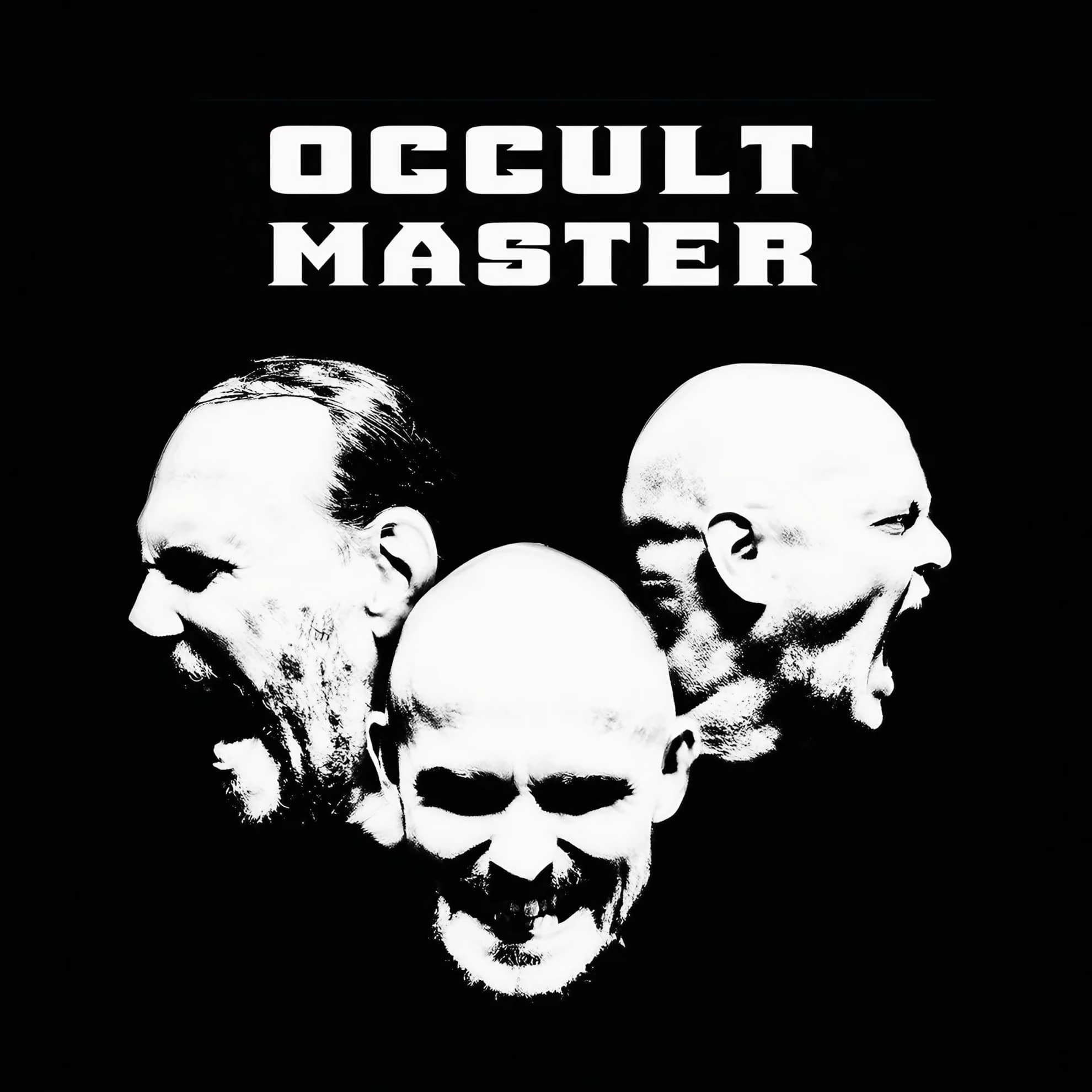
Artwork for the project splits across two separate credits worth keeping distinct. Jarno Vesa is credited with the album’s full cover artwork, while Kimmo Lukkari, in addition to his mixing and mastering role, produced the separate artwork used for the ‘Island of Leper’ single. Available on CD and digital streaming; no vinyl, tape, or box set formats have been confirmed at press time.
Old Metal Heard Beyond Finland
Ahead of its formal release date, ‘Occult Master’ had already circulated well past Finland’s own metal press. Italian outlet Heavy Metal Webzine, French site Heavy Sound, the German webzine vampster.com, and the Spanish-language outlet Volcano Radio FM each carried the band’s singles and album announcement independently of one another and of the domestic Finnish coverage the band received at home.
That kind of multi-language pickup, arriving before a single physical copy has shipped, reflects something specific about how heavy metal operates as an international genre rather than a domestic one.
Sociologist Deena Weinstein’s study of the genre’s culture describes heavy metal’s audience and press infrastructure as having organized itself, from an early stage, around dedicated publications and networks that function largely independent of mainstream music coverage, allowing individual releases to travel across language markets through genre-specific channels rather than general press attention.4
Occult Master’s own pre-release cycle, small as it is in absolute terms, follows that documented pattern closely: coverage generated not through crossover appeal but through the genre’s own established, transnational circuitry.
The specific tradition ‘Occult Master’ draws on helps explain why that circuitry responded. A record built from Birmingham-descended heavy metal vocabulary, executed by a Finnish trio with no interest in disguising its influences, offers international genre press a legible reference point that Nordic black metal’s more interior, national mythologies do not always provide to readers outside Scandinavia.
The album’s reach, in other words, tracks less with novelty than with recognition: listeners already fluent in Black Sabbath’s harmonic language have an immediate way into a record that never asks them to learn an unfamiliar cultural grammar first.
The Weight of a First Full Statement
A span of 14 years is a long time to carry an idea toward a single record, and ‘Occult Master’ plays like a band aware of exactly how much weight that timeline places on nine songs.
The album’s two poles, embodied by ‘Island of Leper’ and ‘Heavy Metal Madness,’ hold the record’s two arguments in view at once: a Finnish trio working in a tradition it did not invent but has spent over a decade learning to inhabit on its own terms, and a set of songs that international genre press had already found before the album reached its own formal release date, and whether the record ultimately rewards the patience it took to make is a question its handful of confirmed songs can only gesture toward, not answer in full, since the bulk of ‘Occult Master’ remains, for now, unheard beyond the band and its label.
Whether shared isolation deepens intimacy or only confirms its impossibility is one of the oldest questions doom metal keeps returning to, and in telling two lovers’ story through the lens of a disease that once redefined what community meant, ‘Occult Master’ leaves each listener to decide for themselves which answer the song’s island actually offers.
References
- Andrew L. Cope, ‘Black Sabbath and the Rise of Heavy Metal Music’ (Farnham: Ashgate, 2010). ↩︎
- Carole Rawcliffe, ‘Leprosy in Medieval England’ (Woodbridge: Boydell Press, 2006). ↩︎
- Luke Demaitre, ‘Leprosy in Premodern Medicine: A Malady of the Whole Body’ (Baltimore: Johns Hopkins University Press, 2007). ↩︎
- Deena Weinstein, ‘Heavy Metal: The Music and Its Culture,’ rev. ed. (New York: Da Capo Press, 2000). ↩︎

Leave a Reply