


A note left inside the house at 724 Hartford Street in Savannah, Georgia warns against entering the attic. Mickie and Delilah, the two sisters who inherit the property, climb the stairs anyway, within the opening pages of a novel that treats a disregarded warning as the oldest device the haunted house tradition owns.
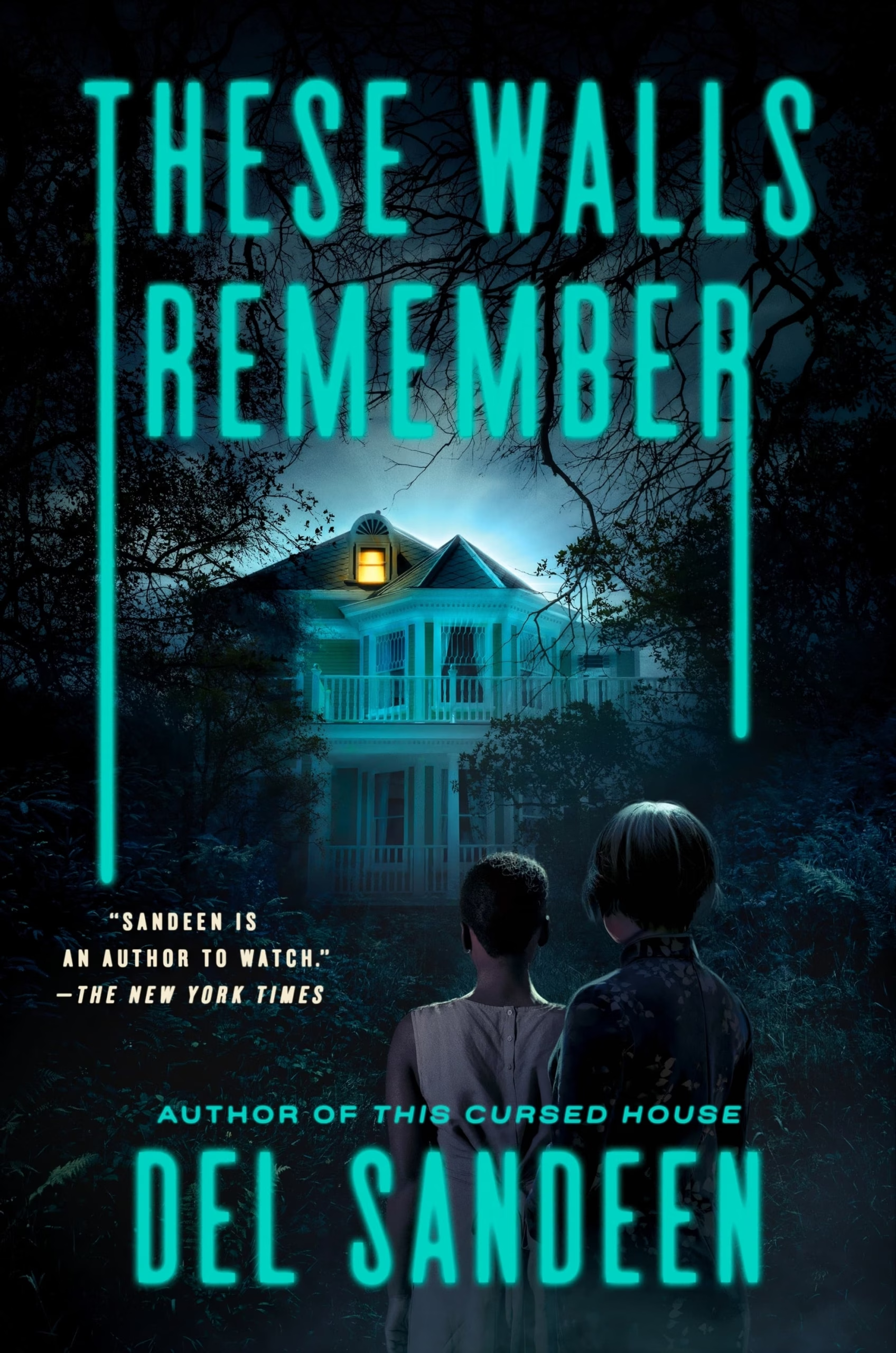
Berkley publishes ‘These Walls Remember,’ Del Sandeen’s second novel, on August 18th, 2026, in a 352-page hardcover carrying the ISBN 978-0593955666, alongside an eBook edition and an unabridged audiobook from Penguin Audio released the same day.
Mickie and Delilah arrive intending to sell the inherited property and divide the proceeds. What they find instead is a house, and a neighborhood, unwilling to let that transaction proceed without first accounting for what has gone unaddressed inside its walls since 1910.
Two Sisters and a Reluctant Sale
The premise Sandeen builds is deliberately modest in its opening mechanics. Two estranged sisters travel to a Southern city to liquidate a dead relative’s estate, a scenario that could belong to any number of contemporary domestic dramas before the supernatural register asserts itself.
Once Delilah’s behavior turns erratic, the sale stalls, and Mickie is left trying to separate her sister from a house that, according to Berkley’s confirmed synopsis, has already claimed prior occupants who simply disappeared from the historical record.
The surrounding Savannah neighborhood complicates the sisters’ position further. Longtime residents know more about 724 Hartford Street than they volunteer, a withholding that Sandeen’s synopsis frames as communal rather than individual — an entire block that has organized its silence around one address for more than a century. That detail moves the novel away from the isolated-family haunting of a single bloodline and toward a haunting sustained, in part, by a community’s collective decision not to speak.
A Second Turn in Southern Gothic
‘These Walls Remember’ follows Sandeen’s 2024 debut, ‘This Cursed House,’ also from Berkley, a 384-page Southern gothic set in 1962 that sends a young Black woman from Chicago into the employ of a New Orleans family concealing a generational curse.
That first novel was named one of Esquire’s Best Horror Books of 2024 and one of Crime Reads’ Best Gothic Novels of 2024, an early critical foothold for a writer whose short fiction had, before either novel, already appeared in FIYAH: Magazine of Black Speculative Fiction, Uncanny Magazine, Nightlight podcast, and Gay Magazine.

Sandeen, who works as a copy editor in northeast Florida and received both the Diverse Writers Grant and the Diverse Worlds Grant from the Speculative Literature Foundation in 2019, has now built two consecutive novels around the same structural premise: a family estate whose material inheritance turns out to be inseparable from an inheritance of unresolved harm.
Where ‘This Cursed House’ located that harm in a single bloodline’s curse, ‘These Walls Remember’ distributes it across a house, its earlier inhabitants, and the neighbors who have spent generations declining to discuss any of it.
A House That Keeps Its Own Time
The haunted-house novel in American popular fiction carries a documented formula: an isolated or inherited dwelling whose interior geography turns hostile precisely as its occupants begin to uncover what earlier residents left unresolved.1
Sandeen’s construction follows that formula while updating its mechanics for a dual-timeline structure, alternating the present-day sisters with a 1910 thread centered on Lewis, the man who built the house — the two chronologies converging on the same address rather than the same single spectral event.
That structural choice does specific narrative work. A single-timeline haunting, in the mode Shirley Jackson established for the form, withholds explanation and lets ambiguity do the frightening. A dual-timeline haunting instead supplies the reader with the originating history directly, then measures the present-day characters against what they do not yet know.
Sandeen’s 1910 thread promises the reader access Mickie and Delilah do not have, converting suspense from a question of what happened into a question of how long the sisters can survive not knowing it.
Grief as an Inherited Mechanism
The house’s specific mechanism, per Berkley’s confirmed synopsis, works through visions, memory lapses, and the recurrence of prior inhabitants who never formally left the property. That construction places the novel within a documented strand of American Gothic fiction in which a house functions less as a container for a ghost than as an active repository of racial and familial trauma that resurfaces through its living occupants rather than through a single haunting figure.2
The antagonist Sandeen builds is accordingly diffuse: not one restless spirit but the accumulated, unaddressed weight of everyone the house has ever held.
Read against ‘This Cursed House,’ the device is consistent rather than new. Sandeen’s debut used a curse to literalize the cost of a family’s unspoken history; ‘These Walls Remember’ uses a building for the same purpose. Both novels ask a protagonist to inherit a structure — a bloodline in one case, a physical address in the other — that will not release her until its history is named aloud.
The Weight Savannah Carries
Savannah’s gothic reputation is more often sold through atmosphere than argument — moss-hung squares, wrought-iron balconies, a ghost-tour industry built on repetition rather than specificity. ‘These Walls Remember’ declines that shorthand.
The city’s documented standing as one of the oldest planned settlements in the American South, and the specific weight of what a single Savannah address can be made to hold across more than a century, gives Sandeen’s premise a historical floor that mood alone does not supply.
The house at 724 Hartford Street is not haunted because it sits in Savannah; it is haunted because of what a city with Savannah’s specific documented past permits a single building to accumulate undisturbed.
The History a House Keeps
What ‘These Walls Remember’ proposes, on the evidence of its confirmed structure and premise, is that a haunting does not require a single restless figure when an entire property has been allowed to carry unaddressed history for more than a hundred years.
Sandeen’s second novel extends the concern that shaped her debut into a new form, trading a family’s curse for a house’s memory, and asking whether either kind of inheritance can be settled by a sale.
Between the two structural devices Sandeen has now used to make historical harm literal, a family curse in ‘This Cursed House’ and a house’s accumulated memory in ‘These Walls Remember,’ which do you find the more effective vehicle for translating generational trauma into the mechanics of a haunted-house narrative, and what does that preference suggest about where contemporary Southern gothic horror is placing its historical weight?
References
- Dale Bailey, ‘American Nightmares: The Haunted House Formula in American Popular Fiction’ (Bowling Green: Bowling Green State University Popular Press, 1999), 3-9. ↩︎
- Maisha L. Wester, ‘African American Gothic: Screams from Shadowed Places’ (New York: Palgrave Macmillan, 2012), 45-52. ↩︎




Leave a Reply