

The first truly heavy riff in recorded American music did not originate in a concert hall or a studio designed for it. It came up from the Delta, carried north by workers who settled in cities that had use for their labor and little patience for the music they brought with them. Chicago absorbed the Mississippi blues in the postwar years and returned it transformed: louder, more electric, more confrontational, the acoustic intimacy of Robert Johnson and Son House pressed through amplifiers that distorted the signal and, in doing so, discovered something the Delta had not yet heard.
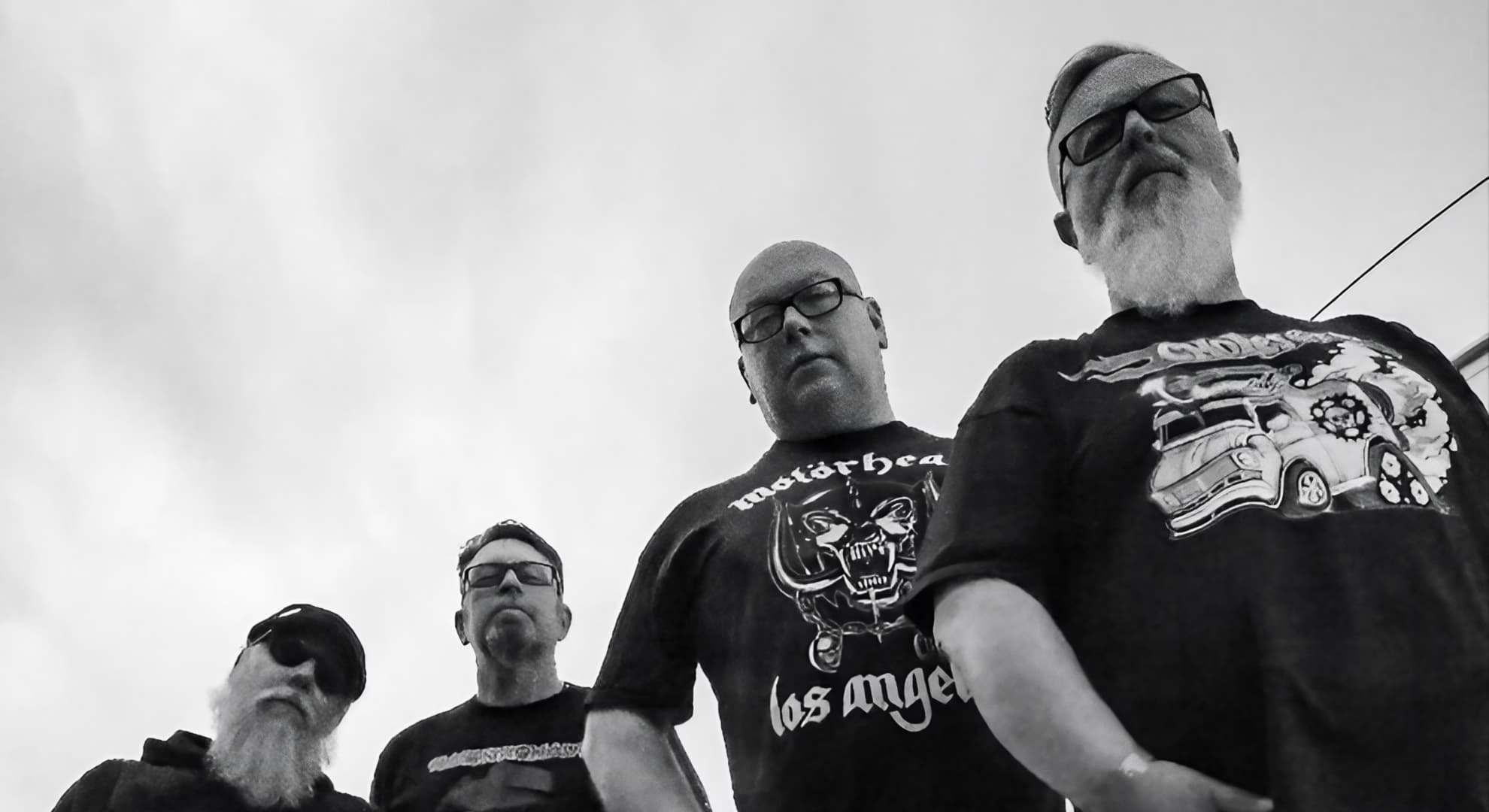
That transformation — from acoustic to electric, from rural grief to urban fury — is the root system beneath every piece of heavy music the American Midwest has produced in the fifty years since. It is also the foundation from which Shadow of Jupiter, a four-piece from Chicago and Northwest Indiana, draws the first argument of their second album, ‘Bones,’ released July 10th, 2026, on Ripple Music.
The band’s working description of their sound — what music critic Sunil Singh of Sonic Seducer named “Fury Blues,” identifying the compound of Robin Trower’s melodic weight, the bleak melancholy of early Black Sabbath, and the stripped-down aggression of Corrosion of Conformity — names something real about where Shadow of Jupiter sits in the American heavy underground. They are not a genre exercise. They are a working band from a working city, and the music they make carries the weight of both.
The Region and Its Riff
The geography of Shadow of Jupiter is not incidental context. Chicago and its industrial satellite communities across the Northwest Indiana border — Hammond, Griffith, the steel-and-rail towns that extend the Calumet region south from the lake — constitute one of the most distinctive zones in the history of American heavy music.
The tradition that runs from Muddy Waters through Howlin’ Wolf to the urban electric blues of the fifties and sixties established Chicago as the city where the blues stopped being a rural form and became an industrial one. What that transformation produced was a music calibrated to a specific kind of labor-exhausted grief: loud enough to hear over machinery, direct enough to land without ornamentation.
Shadow of Jupiter did not invent this lineage, but they inhabit it consciously. John Piotrowski’s vocals — which the band itself frames as “clean vocals, dirty riffs” — operate in the tradition of the blues shouter brought into a heavy rock context: a voice that does not hide behind distortion but stands in front of it, demanding to be heard on its own terms.1
The band’s debut full-length, ‘Porta Coeli’ (September 7th, 2023, self-released), recorded and mixed at Thunderclap Recording Studio in Hammond, Indiana by engineer John Carpenter, with additional production from TJ Cichon at Nugs Studios in Griffith, Indiana, established this geography in the very fabric of its making.
Two Northwest Indiana facilities, two engineers rooted in the regional underground, and a record that placed at number 20 on the monthly Doom Charts and number 19 on Desert Psychlist’s year-end list for 2023. That the debut was entirely self-released and still registered on international underground metrics suggests an audience that was not waiting to be told what to hear.
What ‘Bones’ Argues
The title carries its argument on its surface. Bones are what remains when everything else has been stripped away — the irreducible structure beneath flesh and circumstance. For a band whose strength has always been the weight of its riffs over the elaboration of its arrangements, a record named for reduction is a declaration of intent.
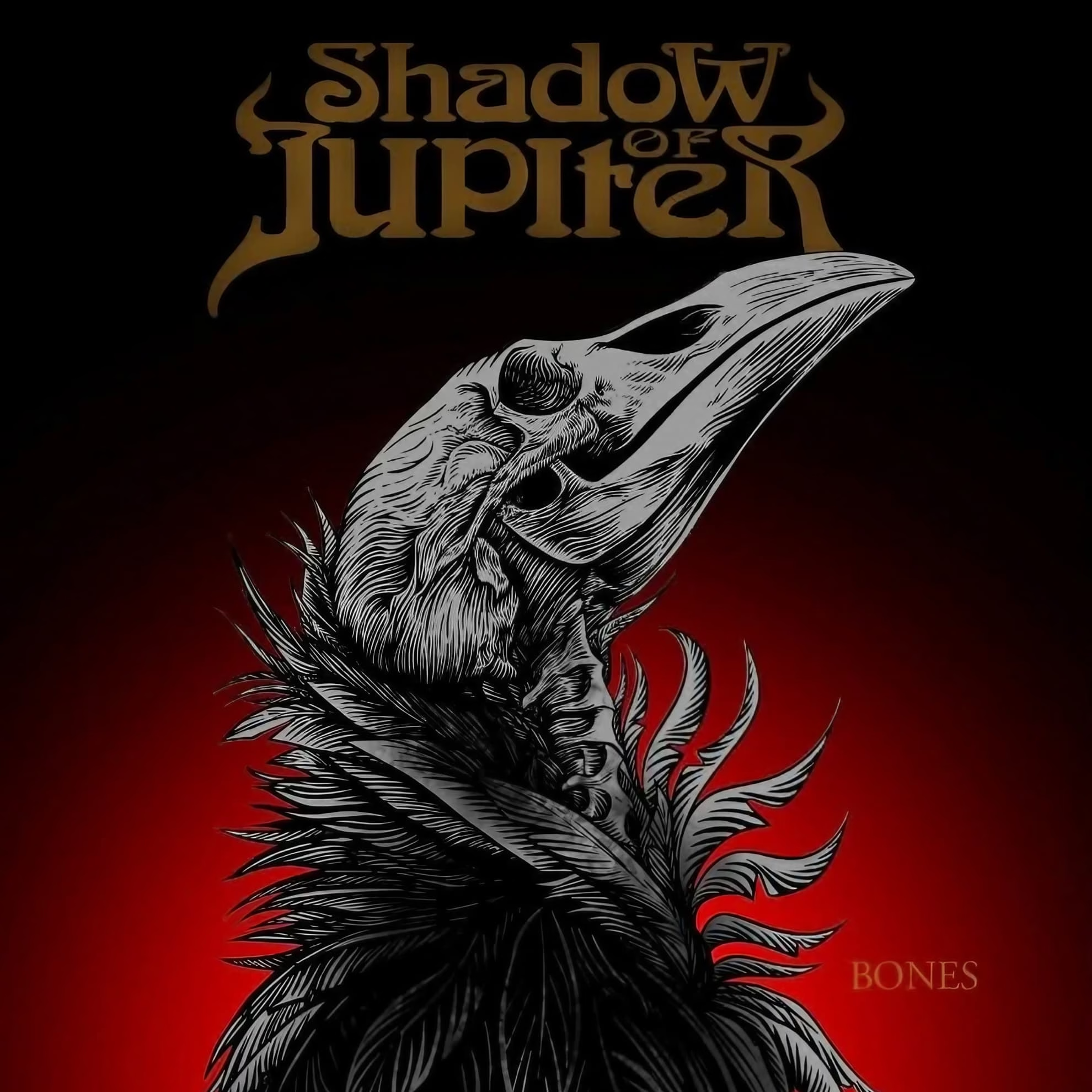
Seven tracks confirm the tracklist: the title track, ‘Whatever God You Fear,’ ‘Ugly on the Inside,’ ‘Echo Chamber,’ ‘Rumblestrip,’ ‘Riot Dogs,’ and ‘For Heaven Above.’ The titles alone map a territory of social disillusionment and physical endurance, and together they suggest a record less interested in transcendence than in reckoning — in the honest accounting of what survives when the weight of collective delusion has been cleared away.
The advance single ‘Bones’ opens on a lyrical image of someone absorbing punishment for wrongs that are not their own: “the stones you’re takin’, for the sins that aren’t your own / And the bones you’re breakin’, are the ones that nailed you down.” That image — of structural suffering, of a body used as the load-bearing element in someone else’s framework of blame — is not rhetorical. It is the kind of language that comes from a specific social experience, and the Calumet region has been supplying that experience to its residents for a century.
‘Echo Chamber’ and the Single’s Evidence
The confirmed advance single ‘Echo Chamber’ — which, alongside the title track, was made available for streaming ahead of the July 10th release date — positions ‘Bones’ at a specific point in the proto-doom and heavy psychedelic range the band has occupied since ‘Porta Coeli.’ The track runs 4:29 and represents the album’s more compressed register, a deliberate contrast to the 7:31 sprawl of the title track.
That dual register — the extended, riff-cycling weight of the title track against the more immediate drive of ‘Echo Chamber’ — suggests a record that does not choose between doom’s temporal patience and heavy rock’s forward momentum. The two confirmed streaming tracks hold both modes simultaneously, and the full tracklist’s seven-song, single-LP format positions ‘Bones’ as a record that earns its weight through concentration rather than length.2
The album’s press description introduces an element not present in ‘Porta Coeli’: Middle Eastern influences woven through the psychedelic textures. What that element signals, based on the audible evidence of the two streaming tracks, is a willingness to reach beyond the band’s documented Chicago-Midwestern lineage — not as exoticism but as the natural extension of a heavy psychedelic tradition whose own roots run through the modal experiments of late-sixties British and American rock.
Ripple Music and the Independent Argument
The signing to Ripple Music, announced in February 2026, is the structural event that most clearly marks where Shadow of Jupiter’s career stands after ‘Porta Coeli.’ Ripple, founded in 2010 in San Ramon, California, by former radio DJ Todd Severin and John Rancik, built its catalog over fifteen years as the primary independent infrastructure for American heavy psych, stoner rock, and proto-doom: a body of work now exceeding 300 releases, from archival reissues of the 1970s underground through contemporary acts like Mothership and Wo Fat.3
The label’s origin in a music review blog called The Ripple Effect — dedicated to covering what its founders described as “the best music you’re not listening to” — has shaped its institutional character. Ripple releases records that its founders believe in rather than records that commercial metrics recommend, and the community of dedicated underground listeners it has cultivated through RippleFest events in Austin, the Bay Area, and Europe is precisely the constituency that found ‘Porta Coeli’ on its own.
The label infrastructure gives that constituency a more reliable point of access to ‘Bones,’ now distributed through Season of Mist’s international network on vinyl and CD, with digital access through Bandcamp.
The Underground’s Listening Conditions
A record like ‘Bones’ does not reach its international audience through the same channels it reaches a Chicago listener who has seen Shadow of Jupiter at Reggie’s or at RippleFest Texas. The physical vinyl pressing represents a different order of access in markets where import costs are a real constraint on how dedicated listeners engage with underground American releases.
That friction produces a specific kind of listener: one who has already decided that the music is worth the cost of seeking it out, and who arrives with the patience that a doom record demands.4
The underground’s global audience is not a passive one. It is assembled from acts of deliberate discovery, sustained over years of sifting through label catalogs and festival circuits, and it brings to each new acquisition a seriousness of attention that the music itself requires.
Shadow of Jupiter’s performance history — Ripplefest Texas in Austin, Rhune Mountain Festival in Ontario, Grand Rapids Doomfest in Michigan, HUFR Fest in Denver — traces the contours of exactly this audience: a circuit that draws international attention without requiring mainstream infrastructure.
Weight Carried Forward
Three years after a debut that placed on international doom charts without label support, Shadow of Jupiter arrive at their second album having answered the first question that every underground act must answer: whether the initial momentum was the band or the novelty.
The Ripple signing is the music industry’s version of that answer. Labels like Ripple do not sign acts for novelty. They sign acts whose music they believe in, and whose audience they recognize as real.
‘Bones’ arrives July 10th, 2026, as the second argument in a career that has so far made only one claim: that heavy music rooted in the blues tradition of the American Midwest, played with craft rather than calculation, still has something to say that the genre’s more elaborate formations do not.
The seven tracks committed to a single LP do not attempt to do more than that claim requires: riffs that do not apologize for their weight, a voice that does not hide behind them, and an emotional register calibrated to what endures after everything else has been stripped away.
For those who have followed the American heavy underground through its independent label circuits and festival communities: does a record rooted so deliberately in the Midwestern blues-doom tradition — arriving through a label whose entire identity is built on that tradition — represent the fulfillment of a working argument, or does the weight of the genre’s own history press hardest against the bands that carry it most honestly?
References
- Robert Palmer, ‘Deep Blues: A Musical and Cultural History of the Mississippi Delta’ (New York: Penguin Books, 1981), 17—22. ↩︎
- Richard Middleton, ‘Studying Popular Music’ (Milton Keynes: Open University Press, 1990), 192—197. ↩︎
- Michael Hicks, ‘Sixties Rock: Garage, Psychedelic, and Other Satisfactions’ (Urbana: University of Illinois Press, 1999), 88—94. ↩︎
- Harris M. Berger, ‘Metal, Rock, and Jazz: Perception and the Phenomenology of Musical Experience’ (Hanover: Wesleyan University Press, 1999), 63—69. ↩︎
Leave a Reply