

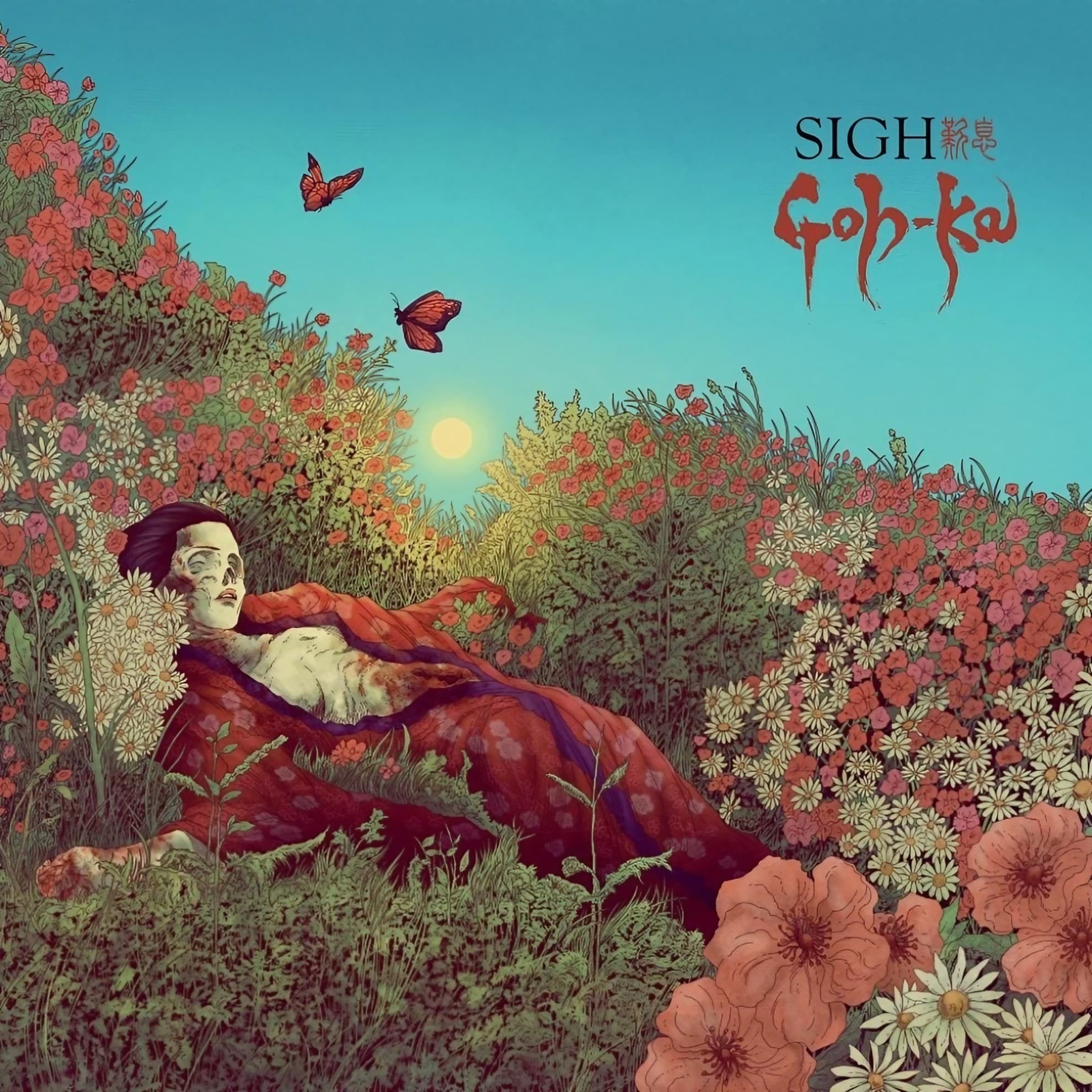
Nine images, copied and recopied across Japanese Buddhist monasteries since at least the medieval period, trace a single body from the hour of death to a scatter of bleached bone. The paintings are called Kusōzu, and monks did not commission them to frighten anyone. They were sat before, studied, and used as an antidote to a specific attachment: the belief that beauty and the body it lives in will last.
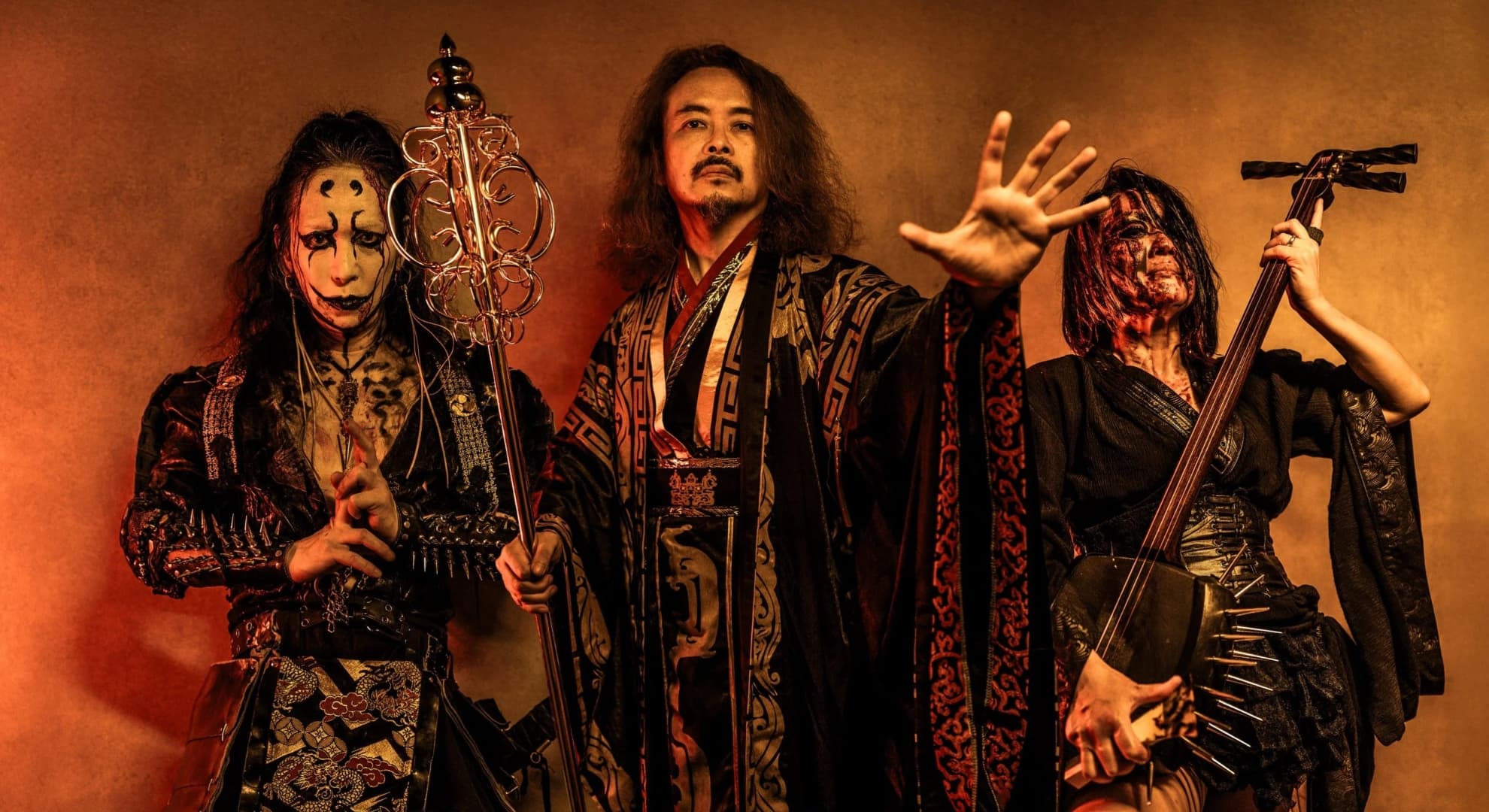
Sigh, the Tokyo trio that has spent thirty-six years refusing to sit still inside any single metal subgenre, has now organized an entire thirteenth studio album of original material, ‘Goh-ka,’ around that same nine-stage warning.
From Deathlike Silence to Peaceville
Mirai Kawashima formed Sigh in Tokyo in 1989, initially as a Nordic-leaning black metal project with drummer Kazuki Ozeki and guitarist Satoshi Fujinami.
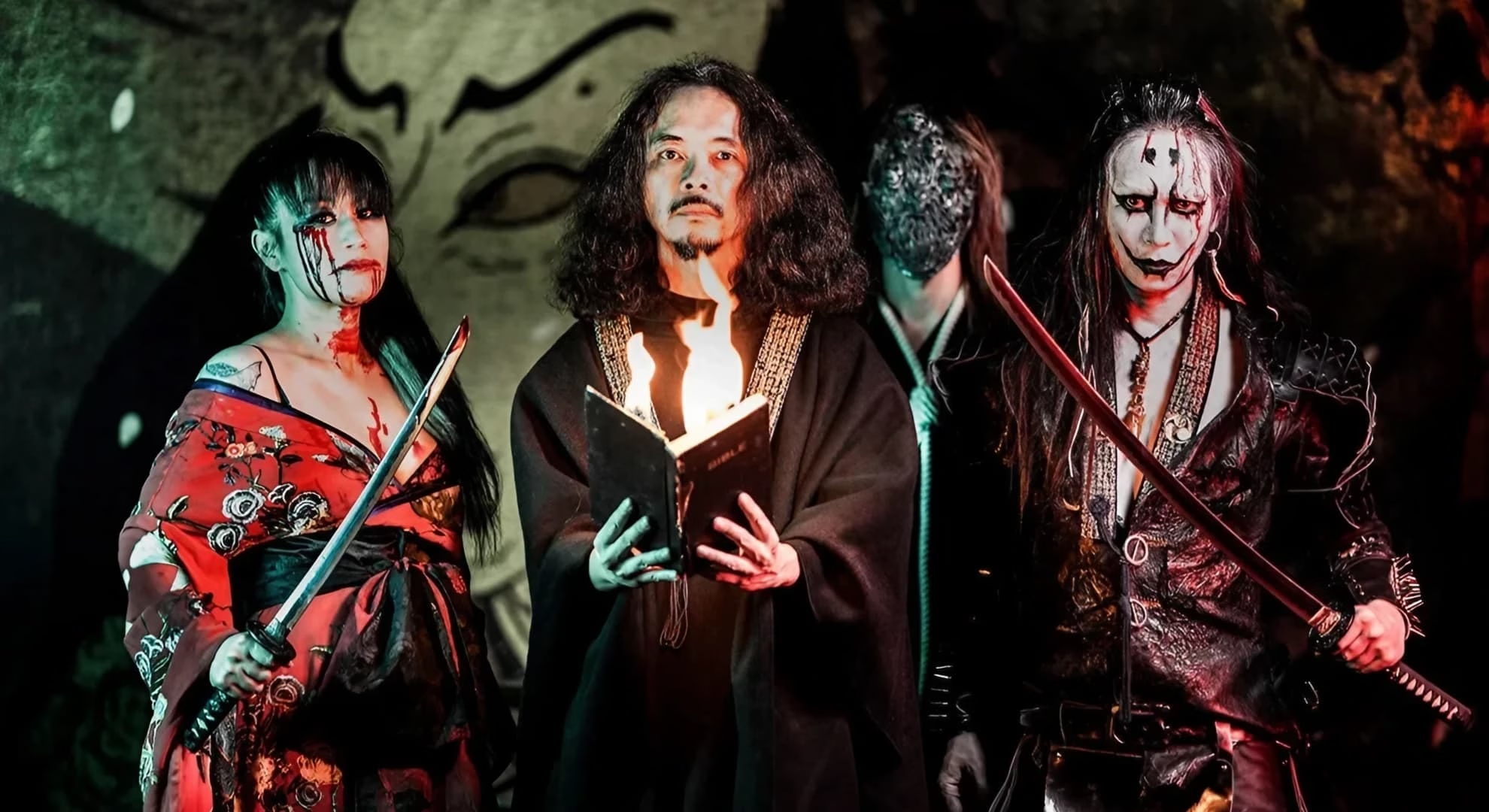
An early demo reached Norwegian musician and Deathlike Silence Productions founder Øystein Aarseth, who signed the trio and issued their 1993 debut, ‘Scorn Defeat,’ a record that still reads as one of the more faithful non-Scandinavian entries in second-wave black metal’s original catalogue.
Sigh did not stay there. Beginning with 1997’s ‘Hail Horror Hail,’ Kawashima folded in horror-film scoring, prog-rock structure, and Japanese folk instrumentation, a shift that alienated part of the band’s earliest audience while cultivating the reputation that now precedes them: Sigh as a permanent avant-garde outlier inside extreme metal, unwilling to repeat a formula twice.
The two decades that followed treated that outlier position as a working method rather than a single gesture. ‘Imaginary Sonicscape’ in 2001 pushed further into psychedelic structure on the band’s first release for Century Media, while ‘Gallows Gallery’ in 2005 introduced heavier use of clean vocals and a full-time fourth member for the first time in the band’s history.
‘Hangman’s Hymn’ followed in 2007, its German subtitle, ‘Musikalische Exequien,’ nodding openly toward Heinrich Schütz’s 1636 funeral work of the same name, before ‘Scenes from Hell’ in 2010 and ‘In Somniphobia’ in 2012 folded jazz voicing and denser orchestration into material that remained, at its core, still recognizably extreme metal. Each record complicated the one before it rather than consolidating a settled sound, a pattern that has held for over three decades.
Guitarist Nozomu Wakai, who joined ahead of 2022’s ‘Shiki,’ and vocalist Dr. Mikannibal, who joined ahead of 2010’s ‘Scenes from Hell,’ have anchored the band’s current core alongside Kawashima through repeated lineup turnover, including the 2021 departures of longtime members You Oshima and Satoshi Fujinami, while bassist Yukiko Shibutani joined the touring and recording lineup in 2024.
Sigh signed to Peaceville Records for 2022’s ‘Shiki,’ the label most associated historically with Katatonia, Paradise Lost, and Opeth, and marked the band’s thirty-fifth anniversary in 2025 with ‘I Saw the World’s End: Hangman’s Hymn MMXXV,’ a full re-recording of their 2007 album rather than a collection of new material.
That re-recording sat outside the band’s forward-moving discography by design, a deliberate look backward before ‘Goh-ka’ resumed the pattern of complication that has defined nearly every studio album since 1997.
The Weight the Title Carries
‘Goh-ka’ takes its name from a Japanese phrase with three layered readings: infernal fire that scorches the sinful, the conflagration that ends the world at the close of a cosmic cycle, and karma itself as accumulated consequence. Kawashima has said the record carries the same personal weight for him as 2022’s ‘Shiki,’ a comparison that positions ‘Goh-ka’ as a continuation of that album’s turn toward explicitly personal material rather than a departure from it.
Where ‘Shiki’ drew its title from the Japanese word for the four seasons and dealt in cycles of mortality tied to the natural world, ‘Goh-ka’ narrows that lens onto a single body and a single set of paintings.
The tracklist makes the intent explicit rather than allusive. Four of the album’s eleven pieces carry the title ‘Kuso-shi,’ a poetic form drawn directly from the Kusōzu paintings, distributed across the record’s sequence rather than gathered at one point, so that the body’s stages of decay recur as a structural device instead of a single illustrative interlude.
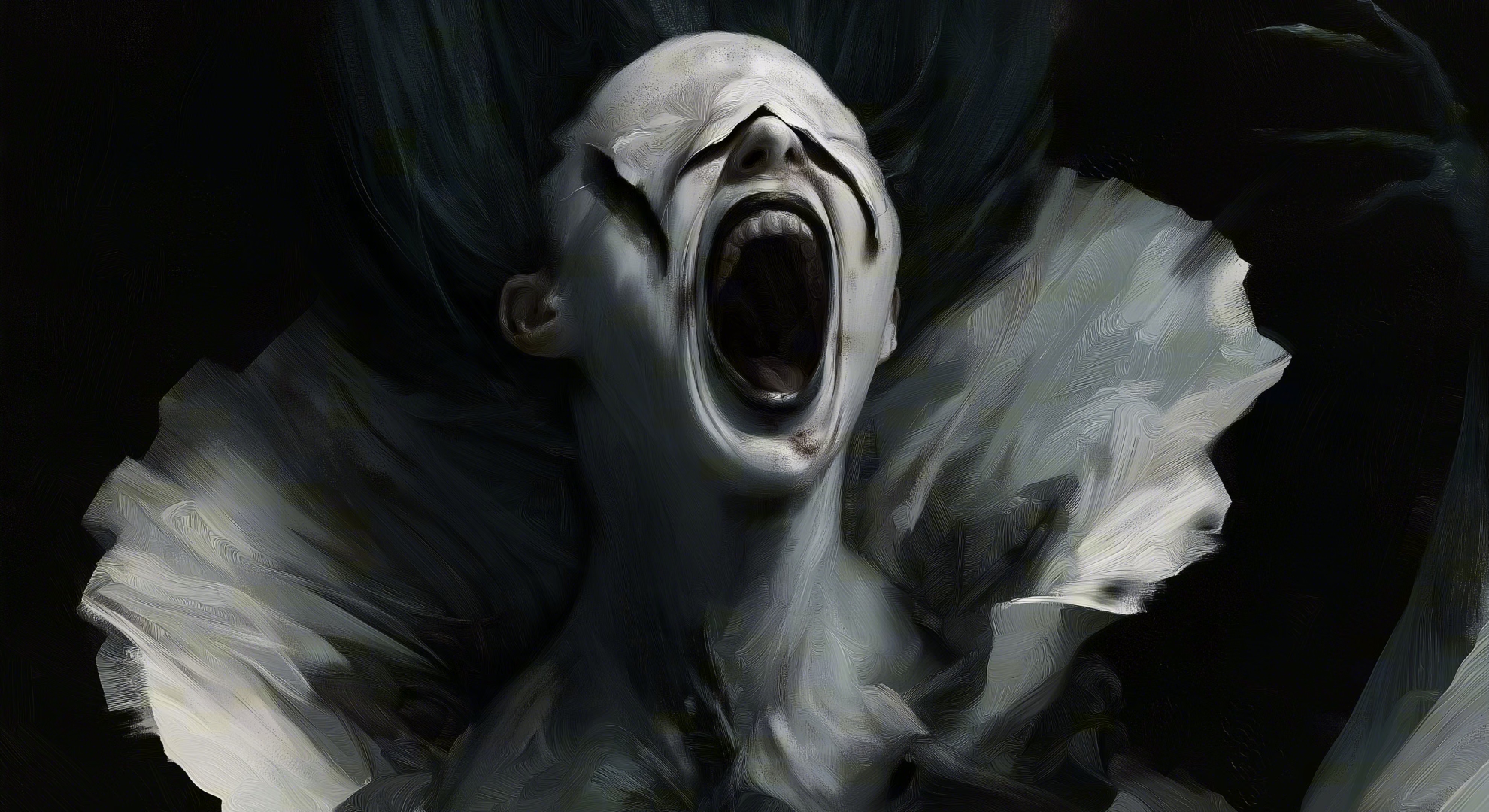
The cover and booklet artwork are, according to the band’s own statement, Kusōzu themselves, not illustrations referencing the tradition from a distance.
A Meditation Inherited
The nine-stage decay meditation predates Sigh’s engagement with it by well over a thousand years. Its earliest textual roots sit in the Pāli discourses on mindfulness of the body and in the contemplation of the impure, aśubhā-bhāvanā, a practice recommended across nearly every early Buddhist school as a direct antidote to sensual attachment.1
Indian Buddhist hagiographic literature returned to the decaying body specifically as an object of monastic contemplation, a repeated device that scholarship on the tradition has linked to a broader discomfort with desire itself rather than with any single body in particular.2
As the practice moved from South Asia through China and into Japan, the meditation acquired a visual counterpart. Kusōzu paintings began circulating in Japanese monastic settings from the medieval period onward, most often depicting a court woman’s corpse rather than a generic or male one, a detail art historian Gail Chin has traced to the tradition’s use as an instructional tool aimed specifically at monks and, in later readings, at women themselves, warned through the imagery against their own claimed vanity.3
The doctrinal purpose behind the paintings mattered as much as their imagery. Early Buddhist meditation manuals paired the decay contemplation with a companion practice, mindfulness of breath, and treated the two as complementary rather than opposed: one method dismantled attachment to the body’s permanence, the other steadied the mind once that attachment loosened.
Kusōzu inherited that pairing’s first half without softening it. Nothing in the paintings, or in the textual tradition behind them, promises comfort partway through; the corpse is meant to be sat with until revulsion itself becomes a kind of clarity, a discipline considerably closer to confrontation than to the atmospheric dread that extreme metal more commonly borrows from religious or folkloric material without engaging its actual practice.
The Argument of ‘Unputenpu’
The confirmed advance track, ‘Unputenpu,’ released as a single on July 31st, offers the clearest evidence available for how that inheritance sounds on record. The song carries a guest guitar solo from Opeth’s Mikael Åkerfeldt, a musician whose own catalogue runs through prog-inflected death metal restraint rather than blast-driven extremity, and the pairing is consistent with Sigh’s long pattern of pulling collaborators from well outside black or death metal circles rather than staying inside one scene’s approved guest list.
The track moves through the kind of tonal whiplash that has defined Sigh’s post-1997 material: passages that lean toward orchestral density sit beside blunter extreme-metal aggression without a clear seam between them, positioning the record toward dramatizing the instability the Kusōzu paintings themselves depict, a body that will not hold one form for long.
The Physical Object First
Peaceville is issuing ‘Goh-ka’ as a digipak CD with a twelve-page booklet, and as a double LP on black vinyl in a gatefold sleeve carrying an additional alternate mix of ‘Unputenpu’ not present on the CD edition, alongside further coloured vinyl variants.
Pre-orders placed directly through Peaceville’s own store or the band’s store include a bonus ten-track sampler, ‘Legacy of Horrors,’ pulled from across Sigh’s catalogue. Digital formats are available as a secondary option. The booklet’s Kusōzu reproductions make the physical edition, and particularly the CD’s larger printed format, the version through which the album’s visual argument is most legible.
Beyond the Scene That Made Them
Sigh’s audience beyond Japan has been assembled one specific stage at a time rather than through any single breakthrough. The band returned to the United States this year for its first American tour since 2008, including a stop at Montana’s Fire in the Mountains festival, itself a small gathering organized around exactly the kind of genre-crossing extremity Sigh has practiced since abandoning straightforward black metal in the late 1990s.
European touring has run alongside that history for three decades, and the guest presences on ‘Goh-ka’ extend the same pattern into the studio: Åkerfeldt’s Opeth cultivated its own following partly on the same refusal to stay inside one extreme metal lane, while bassist Frédéric Leclercq’s work with Kreator ties the record to German thrash’s continuing international reach.
None of these points describes a single unified listening public. They describe a specific, traceable set of scenes willing to follow a band that keeps changing what it sounds like, the kind of scene-crossing mobility scholarship on globalized metal culture has identified as increasingly definitional to extreme metal rather than exceptional to it.4
The Argument the Paintings Keep
A thirty-six-year catalogue organized around refusing repetition does not make ‘Goh-ka’ inevitable, but it does make the choice of subject matter legible as continuation rather than gimmick. Kawashima has spent three decades treating extreme metal as a container flexible enough for orchestral density, Japanese folk instrumentation, and now a centuries-old meditation on bodily decay, without asking any of those elements to soften the others.
The paintings that gave ‘Goh-ka’ its structure were never meant to comfort the people who sat with them. They were meant to correct a specific, persistent error about how long a body, or the attachment organized around it, is supposed to last. Sigh has not resolved that argument on ‘Unputenpu’ alone, and the fuller record due September 4th will be the actual test of whether eleven tracks can hold nine stages of decay without flattening either the music or the tradition it borrows.
Which extreme metal records have sent you looking into the religious or historical material behind them, rather than treating that material as decoration?
References
- K. L. Dhammajoti, ‘Meditative Experiences of Impurity and Purity—Further Reflection on the aśubhā Meditation and the śubha-vimokṣa,’ Religions 12, no. 2 (2021): 86. ↩︎
- Liz Wilson, ‘Charming Cadavers: Horrific Figurations of the Feminine in Indian Buddhist Hagiographic Literature’ (Chicago: University of Chicago Press, 1996). ↩︎
- Gail Chin, ‘The Gender of Buddhist Truth: The Female Corpse in a Group of Japanese Paintings,’ Japanese Journal of Religious Studies 25, no. 3–4 (Fall 1998): 79–121. ↩︎
- Andy R. Brown, Karl Spracklen, Keith Kahn-Harris, and Niall Scott, eds., ‘Global Metal Music and Culture: Current Directions in Metal Studies’ (New York: Routledge, 2016). ↩︎
Leave a Reply