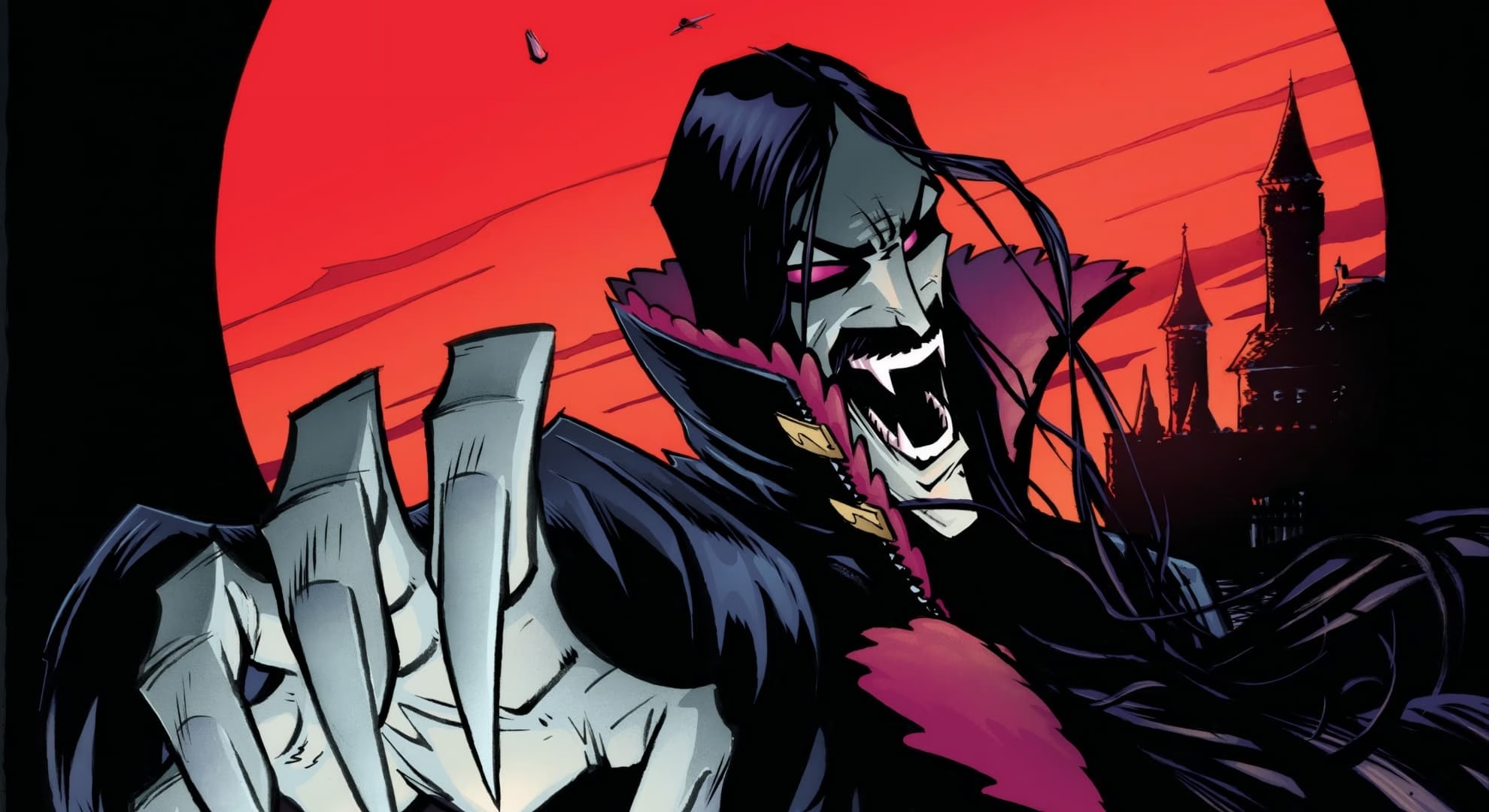


A monster that passes into the public domain becomes a standing invitation. Once Bram Stoker’s Count slipped free of copyright, the character belonged to anyone willing to bend him toward a new purpose, and the comics medium has spent decades testing how far that bending can go.
The newest test arrives this summer, and it is an audacious one. It takes the most patrician vampire in fiction, seals him inside a coffin, and air-drops him behind enemy lines.
A Vampire Air-Dropped Into War
‘Operation: Iron Coffin’ #1 reaches comic shops on July 8th, 2026, from IDW Dark, the horror imprint of IDW Publishing, priced at $4.99 USD, approximately COP 17,200, across 40 full-color pages.
The premise is built for momentum. The lately revived Dracula, seeking to redeem centuries of slaughter, joins the British war effort and is dropped onto a heavily guarded Nazi train carrying a vampire plague that, if it reaches its destination, would breed a new generation of the undead.
His task is to move the length of the train and stop it, opposed by a horde of soldiers, a trio of augmented super-soldiers, a fictional occult unit serving Hitler, and two young vampires named Hazel and Ivy who run the operation and hold a private stake in his failure. The first issue opens a three-issue limited series.
Dracula in the Public Domain
Stoker’s 1897 novel long ago passed into the public domain, and that legal freedom has produced an unruly afterlife on the comics page. Publishers have made the Count a superhero, a romantic lead, a Saturday-morning cartoon, and a recurring antagonist, each version possible only because no rights holder polices the character.
Setting him against the Third Reich extends a specific strain of that afterlife, one in which the vampire is enlisted rather than merely feared. The move turns Stoker’s predator into a weapon, which is a sharper inversion than it first appears.
Dracula is a figure of aristocratic blood and inherited monstrosity, a lineage the novel treats as both his power and his curse. Pointing that bloodline at a regime organized around its own blood mythology gives the pulp setup a real thematic charge beneath the carnage.
Nazis, the Occult, and Pulp
The occult Nazi is one of the durable engines of adventure fiction, and comics have run it hard. Mike Mignola’s ‘Hellboy,’ launched in 1994, raised an entire mythology on Nazi sorcerers reaching for powers beyond the battlefield, and the trope reaches back through wartime serials to the earliest pulps.
That fiction has a documented kernel. The SS-Ahnenerbe, founded in 1935 as Heinrich Himmler’s institute for ancestral research, pursued pseudo-scientific expeditions and racial mythology under the cover of scholarship.1
‘Operation: Iron Coffin’ borrows that historical texture for its own ends, swapping documented absurdity for a frankly supernatural threat and letting the horror, rather than the history, carry the weight.
IDW Dark and Its Horror Line
IDW Publishing has held horror credentials since its early years, when ‘30 Days of Night’ by Steve Niles and Ben Templesmith arrived in 2002 and became the studio’s signature contribution to modern vampire fiction. The new imprint formalizes that history under a single banner.
IDW Dark gathers the publisher’s horror output, mixing licensed expansions of properties such as ‘A Quiet Place’ and ‘Smile’ with original work. ‘Operation: Iron Coffin’ belongs to the original column, which is where an imprint proves it can generate monsters rather than only license them.
The Creative Team
Kenny Porter writes the series, following mainstream assignments that include ‘Superboy: Man of Tomorrow’ and ‘DC: Mech.’ He has framed the book as a deliberate turn toward pulp, describing the result as the comic that would exist “if John Wick had been a horror film starring Dracula.”
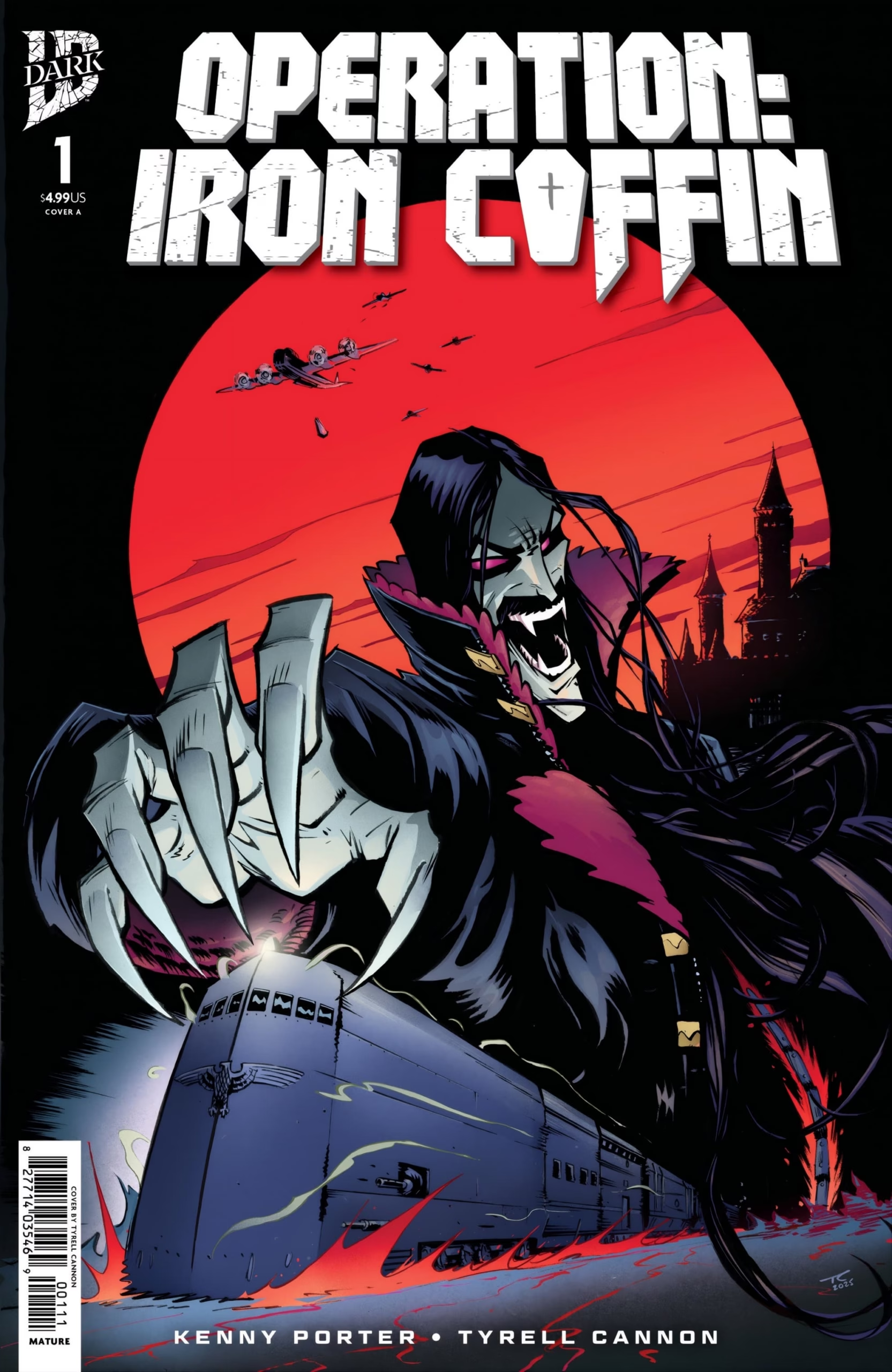
Tyrell Cannon handles both art and colors, and has spoken of feeding the pages with horror cinema and nineteen-nineties anime while pushing the gore to its limit. Shawn Lee letters the issue, Dave Wielgosz edits, and Cannon supplies the principal cover.
The variant program places the book beside Juan Ferreyra, Edison Neo, and Serena Mercado, whose covers name the register the series reaches for before any interior panel is public.
A Side-Scroller in Comic Form
The structure is the book’s cleverest formal choice. A single train, entered at one end and cleared toward the other, gives the issue the left-to-right logic of a side-scrolling game, where each car functions as a level and each obstacle as an escalation.
The preview pages released ahead of the issue make the visual approach plain. One sequence shows Dracula tearing through a car of soldiers as though they offered no resistance, the panels crowded and kinetic, the violence staged less as suspense than as forward motion.
That choice carries a cost and a wager. Cannon’s Dracula is framed closer to an action lead than to a creeping revenant, trading the slow dread of classic vampire horror for propulsion, and the issue appears to know it, holding its supernatural menace in reserve for the threat still waiting deeper in the train.
Whose Monster Dracula Becomes
The interest in ‘Operation: Iron Coffin’ is not that it sends a vampire to war, which the genre has done before, but that it asks a public-domain predator to earn a conscience. A creature built to embody appetite is handed a mission that demands restraint, and the friction between those two impulses is where the book locates its horror.
For IDW Dark, an original creature feature that can hold an argument beneath its gore is the strongest possible proof of the imprint’s purpose. Whether the series sustains that balance past its opening salvo will decide if it reads as a stunt or as a real addition to the long shelf of vampire comics.
If a character’s power has always been his refusal of human limits, can a redemption arc deepen Dracula, or does giving the Count a cause risk taming the very thing that made him frightening?
Reference
- Heather Pringle, ‘The Master Plan: Himmler’s Scholars and the Holocaust’ (New York: Hyperion, 2006). ↩︎

Leave a Reply