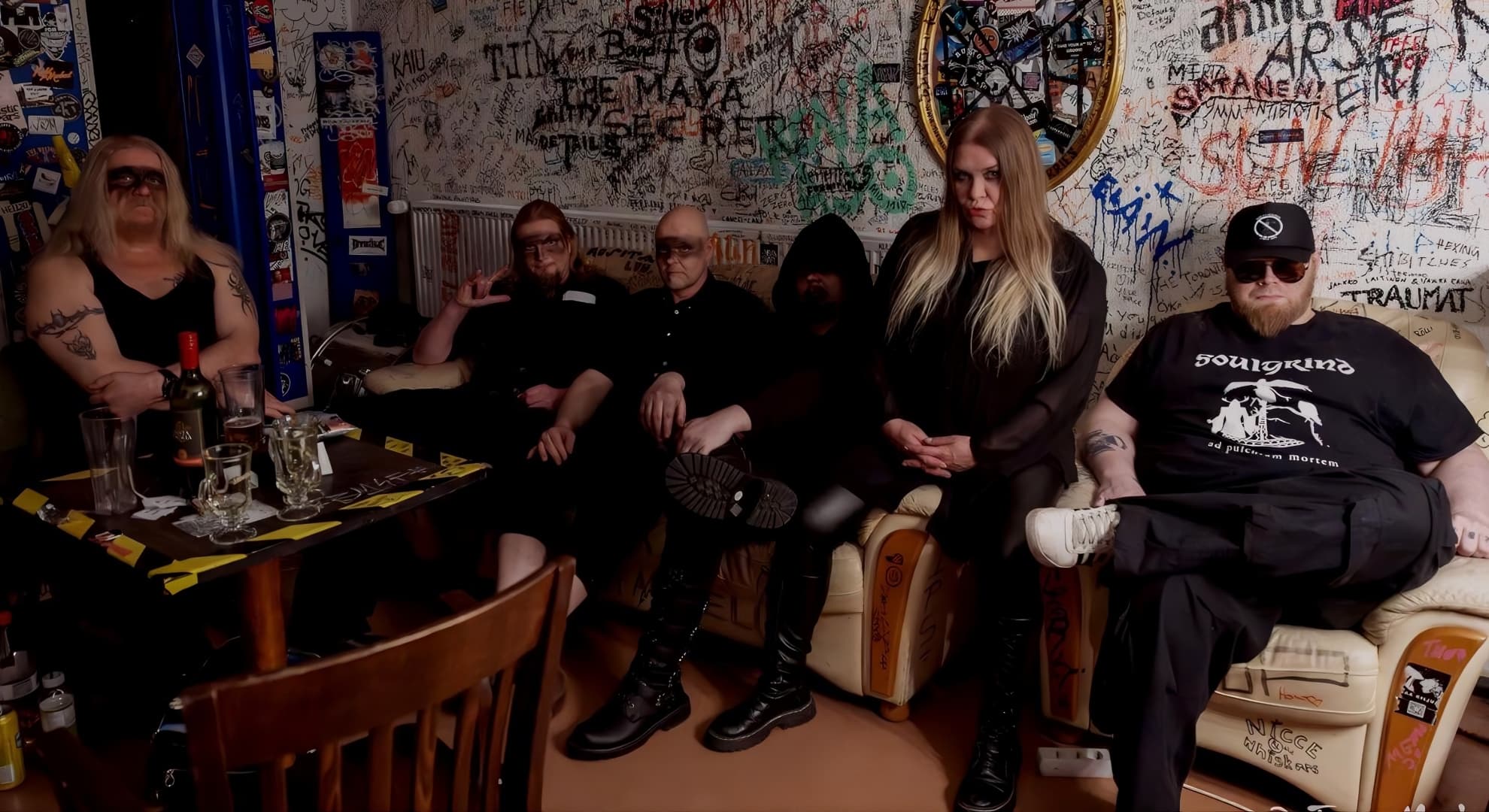


In Finnish folk poetry, the passage toward Tuonela does not announce itself with thunder. It comes as a narrowing: a path through birch and dark water, a boatman who asks no questions, a shoreline where the living learn to lower their voices. For more than three decades, a small circle of Helsinki musicians has returned to that threshold again and again, treating it less as an ending than as a method for approaching mortality by increments, one song at a time.
10 albums into that project, a 15-year silence between studio full-lengths has closed. Soulgrind, the gothic and black metal band founded in Helsinki in 1992, releases its tenth studio album, ‘Ad Pulchram Mortem,’ on August 14th through Inverse Records.
The Latin title translates roughly as a movement toward beautiful death, and across 10 tracks the record treats that translation as an argument rather than an atmosphere: the underworld river first recorded in Finland’s national epic becomes terrain to walk through, not a decorative backdrop for gloom.
The Long Corridor from Whitsongs
Lord Heikkinen founded Soulgrind in Helsinki in 1992, and he has held the guitar chair and much of the band’s compositional direction across every subsequent lineup change.
The band’s first two full-lengths, ‘La Matanza, El Himno Pagano’ (1994) and ‘Ladit A.D. 1999: Bihttpotb’ (1995), were rooted in a death-doom register closer to the era’s Finnish underground than to the sound the band would settle into. ‘Whitsongs,’ the band’s third full-length, was released in 1997, already committed to the gothic-black hybrid that would define the catalogue: minor-key melody set against blast-driven aggression, sung in both Finnish and English.
‘Kalma’ followed in 1999, its title the Finnish word for corpse, tightening the band’s focus on death as subject. ‘Elixir Mystica’ (2001) and ‘Into the Dark Vales of Death’ (2002) pushed further into a more theatrical, keyboard-inflected register, drawing the band closer to the Finnish gothic metal current running alongside acts such as Entwine and The 69 Eyes, without adopting either band’s radio-facing polish.
‘The Origins of the Paganblood’ (2005) and ‘Pakana’ (2007) — the latter title simply meaning pagan — marked the years when Soulgrind’s mythological commitments hardened into a governing subject rather than a recurring motif. Where ‘Kalma’ had treated death as private grief, ‘Pakana’ argued for it as an inherited condition, a national temperament rather than an individual one. That argument set up the record that would close the band’s first working decade and, as it turned out, open a much longer silence.
A Path Already Named for the Underworld
‘The Tuoni Pathway,’ released in 2010 through Femme Metal Records, is the album this new release answers most directly, and its title already does half the work Soulgrind spends ‘Ad Pulchram Mortem’ finishing. Tuoni is the Finnish god of death and ruler of Tuonela; a pathway bearing his name is, structurally, an invitation rather than a warning.
The 2010 record built its 9 tracks around water imagery and departure narratives, its lead track ‘The Call of the Dancing Waters’ setting a pattern the band has now returned to directly with ‘Dark Water Wide.’ Where ‘The Tuoni Pathway’ approached the underworld as a destination glimpsed from its threshold, the new record proceeds as though the crossing has already been made, its argument now concerned with what lies on the other side of the river rather than whether to approach it at all.
15 years separate the two records, and the band has been candid about why: guitarist Azhemin and Heikkinen continued to develop material intermittently, while vocalist Tanya Lilith’s residence in Austria slowed the writing process further, according to comments Heikkinen gave to the press ahead of the album’s announcement.
The pace changed only in 2024, when the band found itself writing new songs faster than they could be arranged, drawing on ideas stored away across the intervening years.
Tuonela Before the Record
The river Soulgrind now names directly belongs to a text older than the band by more than a century and a half. The ‘Kalevala,’ compiled by Elias Lönnrot from oral folk poetry gathered across Karelia and published in its expanded form in 1849, gave Finland a national epic assembled rather than authored, its meter and formulaic repetition preserved from generations of sung transmission.1
Lönnrot’s compilation work was itself an act of cultural argument: nineteenth-century Finland, then a Grand Duchy under Russian administration, used the epic to assert a distinct linguistic and mythological inheritance separate from both Swedish and Russian rule.2
Within that text, Tuonela is the realm of the dead, reached by crossing a black river on a narrow strait, guarded by Tuoni and his daughter, and populated by a serpent whose presence turns back all but the most determined travelers. The hero Väinämöinen’s journey there, and the smith Ilmarinen’s later expedition to retrieve a bride’s ransom from Tuonela’s inhabitants, both frame the underworld not as annihilation but as a bordered country with its own laws of passage.
Soulgrind’s use of the river motif in ‘Dark Water Wide’ draws on this framing directly: death in the Kalevala tradition is crossable terrain, not termination, and the record’s Latin title, oriented toward a beautiful death rather than an avoided one, sits comfortably inside that older logic rather than importing a foreign gothic sensibility onto it.
Four Songs Before the Crossing
The four confirmed advance singles chart the record’s approach to its subject with more precision than any press description could. ‘Jylhä Metsämies,’ released in August 2025 as the album’s introduction, follows a man who bows to nothing above him, below him, or on the earth he walks; Heikkinen has described the song as covering the band’s own trajectory from ‘Whitsongs’ through ‘Pakana’ to ‘The Tuoni Pathway,’ framing the opening single as much a self-accounting as a narrative.
‘Tears of the Earth,’ issued in October 2025 as the second confirmed single, followed soon after. Details of the track’s specific lyrical focus had not been confirmed via official statement at the time of publication.
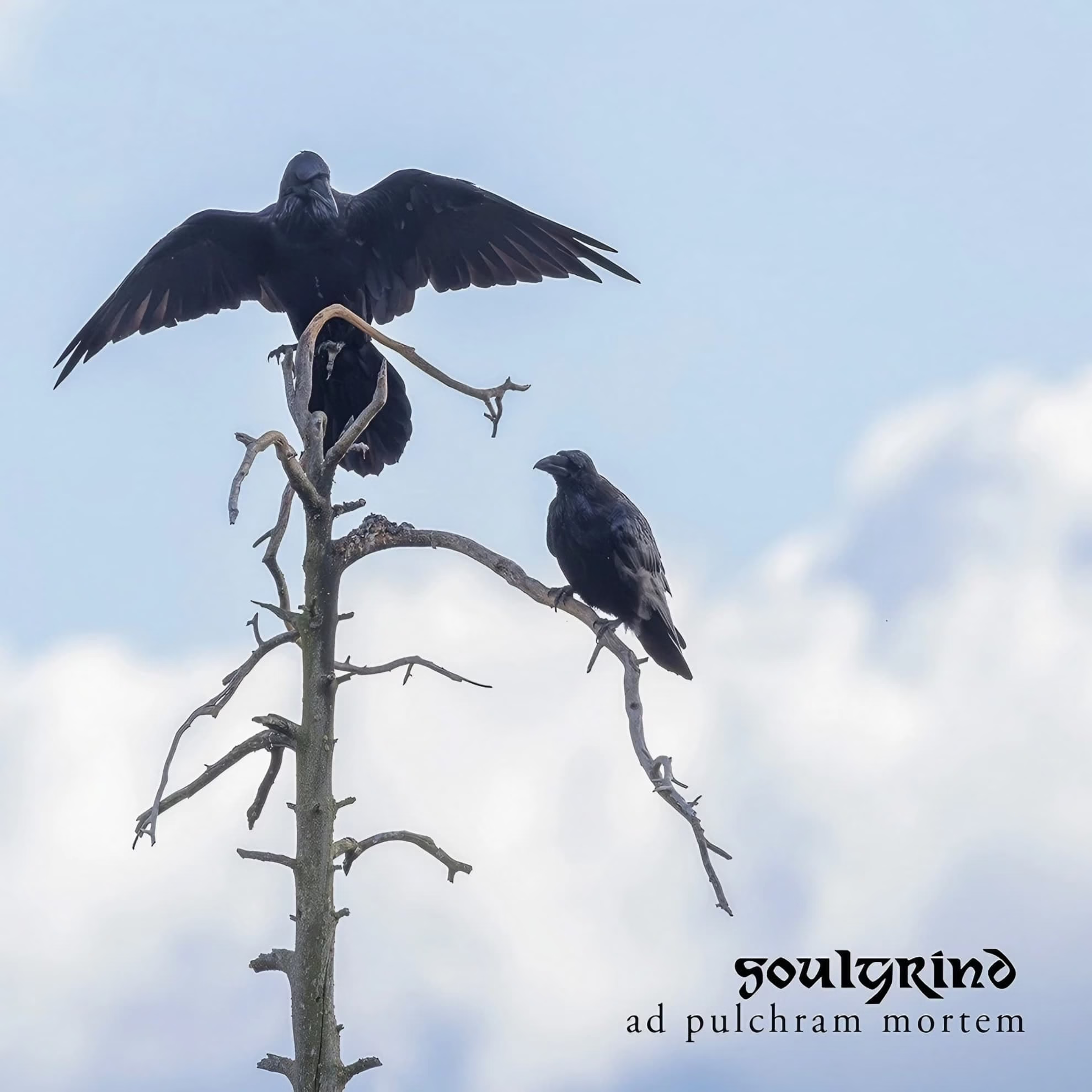
‘Dark Water Wide,’ released in May 2026 as the record’s third preview, returns explicitly to the river. The band described the song as carrying listeners into the shadowed reaches of Tuonela’s currents, where the journey turns toward its darker half and the mind moves into that darkness, the track built around minor harmonies that pair a Nordic melodic surface with Finnish severity. Composition is credited to Heikkinen and Azhemin, with lyrics by Heikkinen.
The final preview single, ‘A Whispered Curse Upon the Gale,’ released in July 2026, inverts the record’s governing metaphor: rather than death standing as release, love itself becomes the haunting presence, the band describing it as a specter that refuses to loosen its hold even once its original object is gone.
Taken together, the four singles suggest a record less interested in death as a single event than in the varied forms of haunting that follow loss, whether the loss is of a person, a place, or a beloved companion.
A Grief That Travels Past Finland
Soulgrind’s return sits inside a specific, verifiable niche. Inverse Records’ catalogue, visible through outlets such as Levykauppa Äx and Album of the Year’s label listings, is built almost entirely from Finnish and European extreme and dark metal acts with modest but devoted followings, the kind of roster collectors track record by record rather than through mainstream press cycles. That collector base is who ‘Ad Pulchram Mortem’ is actually reaching on release day.
The emotional register Soulgrind works in, Nordic and specifically Finnish in its inheritance, differs in kind from other regional death-facing metal traditions built from entirely different social conditions. Where British doom metal grew from the deindustrialized working-class conditions of the West Midlands, and where American death metal built its aggression from hardcore’s confrontational lineage, the Finnish current Soulgrind belongs to draws its darkness from a specific literary and folkloric inheritance rather than an industrial or urban one — the melancholy is textual before it is social.3
For those encountering that inheritance without it, the appeal often has less to do with shared circumstance than with a documented historical pattern: extreme metal, wherever it has taken root, has repeatedly functioned as a means of processing collective loss under difficult conditions, a pattern scholars of the genre’s global spread have traced across multiple national contexts rather than treating as unique to any single scene.4
Soulgrind’s Kalevala-rooted vocabulary of underworld crossing offers exactly the kind of specific, translatable grief that pattern depends on: a mythology precise enough to be foreign, and universal enough in its subject to be recognized wherever the genre has found listeners willing to sit with difficult material.
The Far Shore Still Ahead
‘Ad Pulchram Mortem’ does not resolve the 15-year gap it emerged from so much as make an argument for what the gap was for. A band that spent three decades approaching Tuonela in increments has now shaped a record entirely around the crossing itself, drawing on a mythology old enough to predate the genre that carries it and specific enough to resist flattening into generic darkness.
Whatever the record’s reception beyond Finland’s borders, the four confirmed singles already establish a governing logic: death here is neither an ending nor a spectacle, but a country with its own rivers, its own weather, and its own rules for who gets to cross and what they are permitted to bring back.
Does a mythology this specific to one folk tradition deepen a first encounter with extreme metal’s darker subjects, or does something get lost in translation for those without that inherited vocabulary?
References
- Anna-Leena Siikala, ‘Mythic Images and Shamanism: A Perspective on Kalevala Poetry’ (Helsinki: Academia Scientiarum Fennica, 2002), 78–82. ↩︎
- William A. Wilson, ‘Folklore and Nationalism in Modern Finland’ (Bloomington: Indiana University Press, 1976), 45–49. ↩︎
- Deena Weinstein, ‘Heavy Metal: The Music and Its Culture’ (Cambridge, MA: Da Capo Press, 2000), 134–138. ↩︎
- Karl Spracklen, ‘Metal Music and the Re-imagining of Masculinity, Place, Race and Nation’ (Bingley: Emerald Publishing, 2020), 61–65. ↩︎



Leave a Reply