


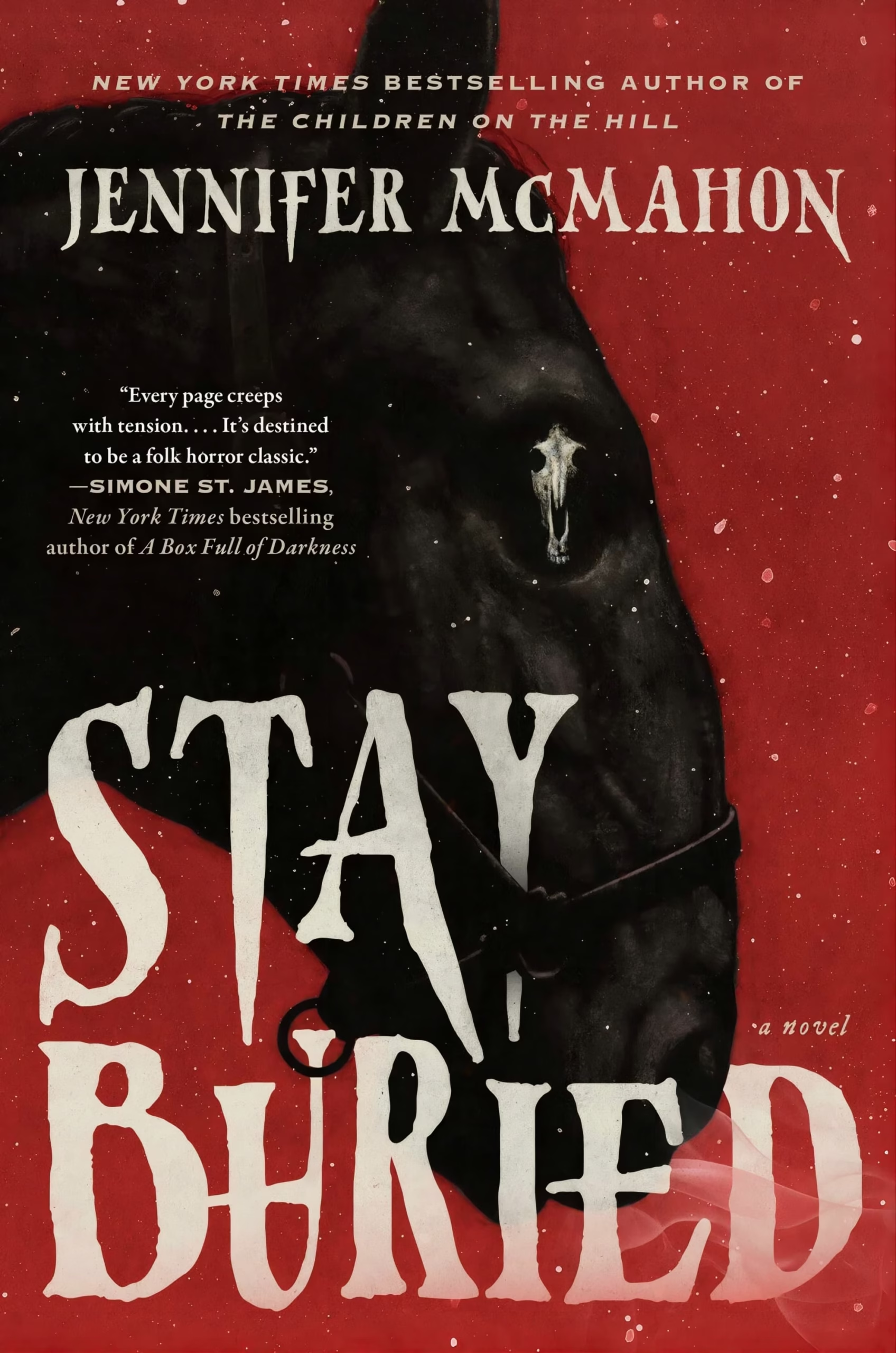
A rural knacker’s yard sat at the edge of nearly every farming town in the early twentieth century, the place where dying and disabled livestock went to be rendered into tallow, glue, and bone meal by a tradesman most of his neighbors preferred not to think about too closely. That documented occupation is where Jennifer McMahon plants patient zero in ‘Stay Buried,’ the novelist’s 13th book and the first she has agreed to have marketed without qualification as horror.1
Gallery Books, an imprint of Simon and Schuster, publishes ‘Stay Buried’ on August 11th, 2026, in a 400-page hardcover carrying the ISBN 978-1-6680-6945-5.
The novel follows McMahon’s 2023 book ‘My Darling Girl’ and extends a bibliography that includes the New York Times bestsellers ‘The Children on the Hill,’ ‘Promise Not to Tell,’ and ‘The Winter People,’ a body of supernatural suspense fiction the author herself has described as always working at the edge of horror without the label attached to the cover.
The Trade the Town Feared
‘Stay Buried’ sets its earlier timeline in 1919, in the isolated Vermont town of Boone’s Ferry, where Frankie O’Massey studies medicine under her uncle, Dr. Thomas Endicott, while a mysterious illness spreads through the community and its livestock alike. The presumed point of origin is the town’s knackerman, the recluse whose occupation is collecting the dead and dying animals no one else in Boone’s Ferry wants near their own property.
The knacker trade is documented occupational history rather than invented atmosphere. Knacker’s yards processed dead and dying horses, cattle, and other livestock into fat, tallow, glue, gelatin, and bone meal well into the twentieth century, work that put its practitioners in daily, direct contact with disease and decay that their neighbors were able to avoid.
A tradesman whose livelihood depended on handling what the rest of a rural town refused to touch was, in most such communities, already positioned as an outsider before any outbreak gave that position a supernatural charge.
McMahon compounds that inherited suspicion with the documented rural experience of the 1918 to 1919 influenza pandemic, when farming communities without reliable medical infrastructure built improvised systems of quarantine and blame around a disease whose transmission they could not yet explain.
Vermont’s Inherited Rituals
The novel’s second timeline picks up in 2016, when siblings Ashley and Malcolm inherit their late grandmother’s property in Boone’s Ferry after the earlier loss of their own mother, and travel to a town their family refused to discuss for generations.
What they encounter, per the publisher’s confirmed synopsis, is not a community that has forgotten its 1919 outbreak but one that never stopped observing it: townspeople who leave seasonal offerings to a vengeful spirit tied to the knackerman, an unmarked grave, and a set of customs treated as ordinary practice by residents born a century after the disease that produced them.
That structure, a town that folds historical trauma into unremarkable present-day custom, places ‘Stay Buried’ within a documented critical framework for folk horror: an isolated community, a skewed set of beliefs specific to that community, and a summoning event that brings the belief system into violent contact with an outsider or a doubting insider.2
Boone’s Ferry, on the terms the publisher has confirmed, follows that structure closely, with isolation, an inherited belief system built from a documented disease event, and a protagonist arriving from outside who does not yet know the rules she is expected to follow.
Two Timelines Converge
The dual-timeline structure gives ‘Stay Buried’ two distinct kinds of suspense operating on the page at once. The 1919 sections withhold the medical explanation for an illness that a doctor and his trainee are working to reason through without the diagnostic tools a reader already knows they lack, while the 2016 sections withhold the reason an entire family severed contact with a town whose existence they never denied.
The two mysteries converge on the same buried event, so that what the earlier timeline experiences as unexplained horror the later one has already processed into ritual, without ever naming its origin aloud. The construction gives the historical thread the burden of supplying a cause and gives the contemporary thread the burden of showing the cost paid by those who inherited the ritual without asking for it.
McMahon’s Turn to Explicit Horror
McMahon’s own account of the novel treats the horror label as an overdue formalization rather than a departure. In an interview with Library Journal, published ahead of the book’s release, she said her earlier fiction had “always employed horror storytelling traditions and techniques,” citing ghosts, possession, and characters returned from death as recurring elements across a career that predates this book’s explicit genre framing.
That earlier work runs from ‘Promise Not to Tell’ (2007), her HarperCollins debut, through the New York Times bestsellers ‘The Winter People,’ ‘The Drowning Kind,’ and ‘The Children on the Hill,’ the 2022 novel that Gallery’s own marketing for ‘Stay Buried’ cites as the author’s most recent point of reference.
‘Stay Buried’ does not represent a change in McMahon’s material so much as a change in how that material is being presented to readers, a distinction the author draws explicitly rather than one imposed by outside critical reading.
Where Folk Horror Draws Its Power
The specific mechanism ‘Stay Buried’ describes, a community that survives collective trauma by converting it into a repeating obligatory ritual rather than a remembered event, belongs to a documented line within American folk horror that runs at minimum from Shirley Jackson’s 1948 story ‘The Lottery’ through the genre’s more recent literary expansions.
What distinguishes McMahon’s approach, on the terms of the confirmed synopsis, is the specificity of the historical anchor: not an unexplained inherited custom but one traceable to an actual occupational figure and a documented disease event, given a name, a grave, and townspeople old enough to have inherited the obligation from parents who remembered why it started.
The publisher’s own description of ‘Stay Buried’ as a queer folk horror adds a further claim: that the 2016 timeline’s central relationship operates inside the same inherited system of secrecy the 1919 timeline documents, rather than functioning as a subplot separate from the town’s ritual logic. Whether the two timelines fully justify that structural connection is a question the finished book, not its marketing copy, will answer.
The Ritual That Outlives the Century
What ‘Stay Buried’ proposes, on the evidence of its confirmed synopsis and structure, is that a community does not require centuries to develop an inherited ritual. One severe, unexplained season of death is sufficient, provided the town keeps repeating the customs it built to survive that season long after the reason for them has been buried along with the event itself.
McMahon grounds that argument in two ordinary historical facts, a documented rural trade and a documented pandemic, and grafts a rural Vermont myth onto both without asking either to function as metaphor for something else. That refusal to treat history as decoration, more than the outbreak or the knackerman individually, is what places the novel inside a documented American tradition of grounding folk horror in verifiable rather than invented custom.
Given McMahon’s account of horror running through her fiction long before ‘Stay Buried’ carried the label outright, does a documented occupational and epidemiological history like the one behind the knackerman make a folk horror premise more effective than an invented mythology would, or does grounding the ritual in real history change what readers expect the novel to resolve?
References
- Jennifer McMahon, interview by Library Journal staff, ‘LJ Talks with Jennifer McMahon, Author of ‘Stay Buried,’’ Library Journal, June 17, 2026. ↩︎
- Adam Scovell, ‘Folk Horror: Hours Dreadful and Things Strange’ (Leighton Buzzard: Auteur Publishing, 2017). ↩︎


Leave a Reply