

The English occult revival of the nineteen-seventies left a residue that outlasted its films and its paperbacks. Dennis Wheatley’s black-magic thrillers, Hammer’s cinema of the inverted altar, and a renewed public fascination with Aleister Crowley handed a generation of British listeners a settled grammar of dread.
Black Sabbath had already pulled that dread out of Birmingham’s industrial gloom and slowed it to a crawl, and the genre that followed took the city’s working-class fatalism as its founding key. The two inheritances, occult and industrial, have rarely been claimed at full strength by the same band.
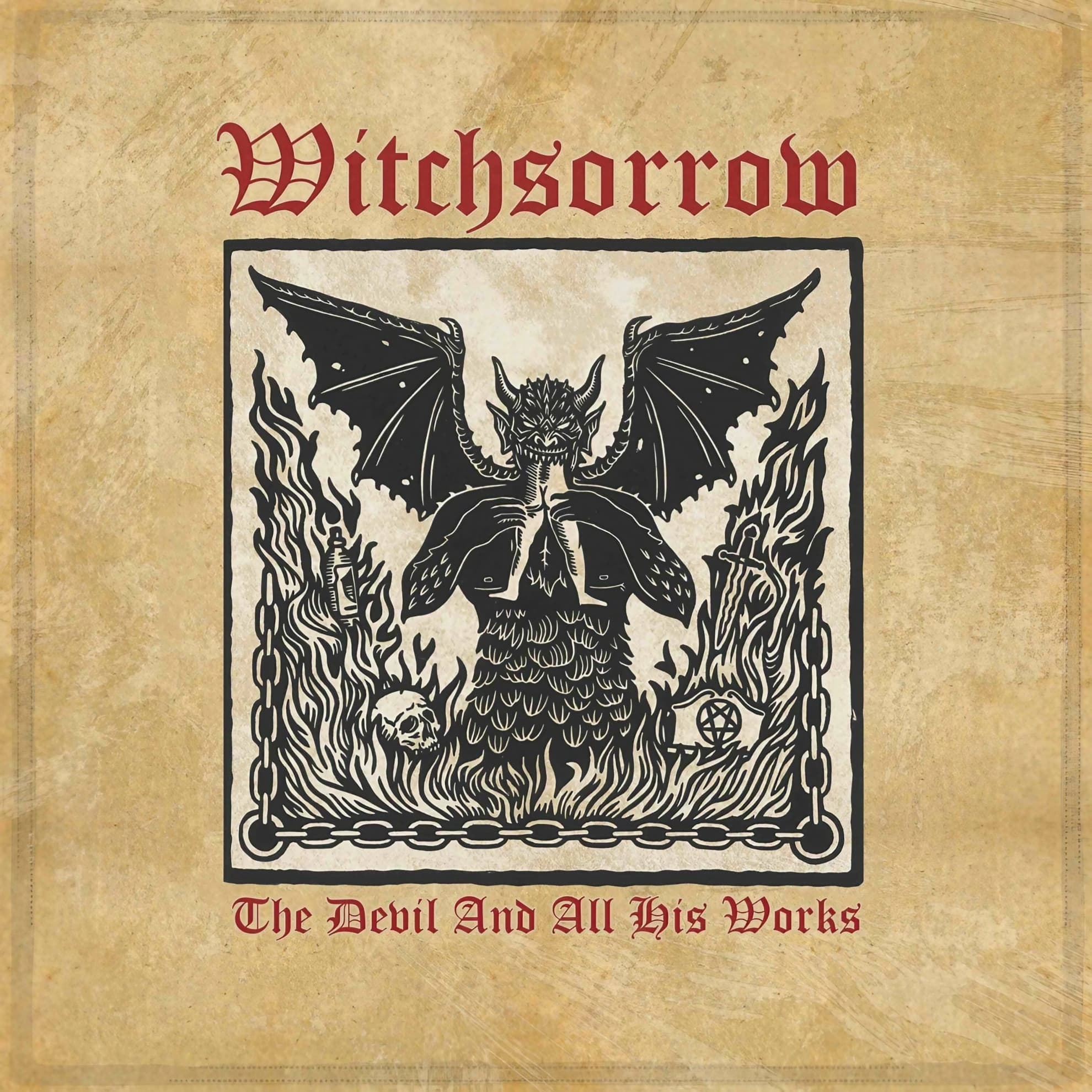
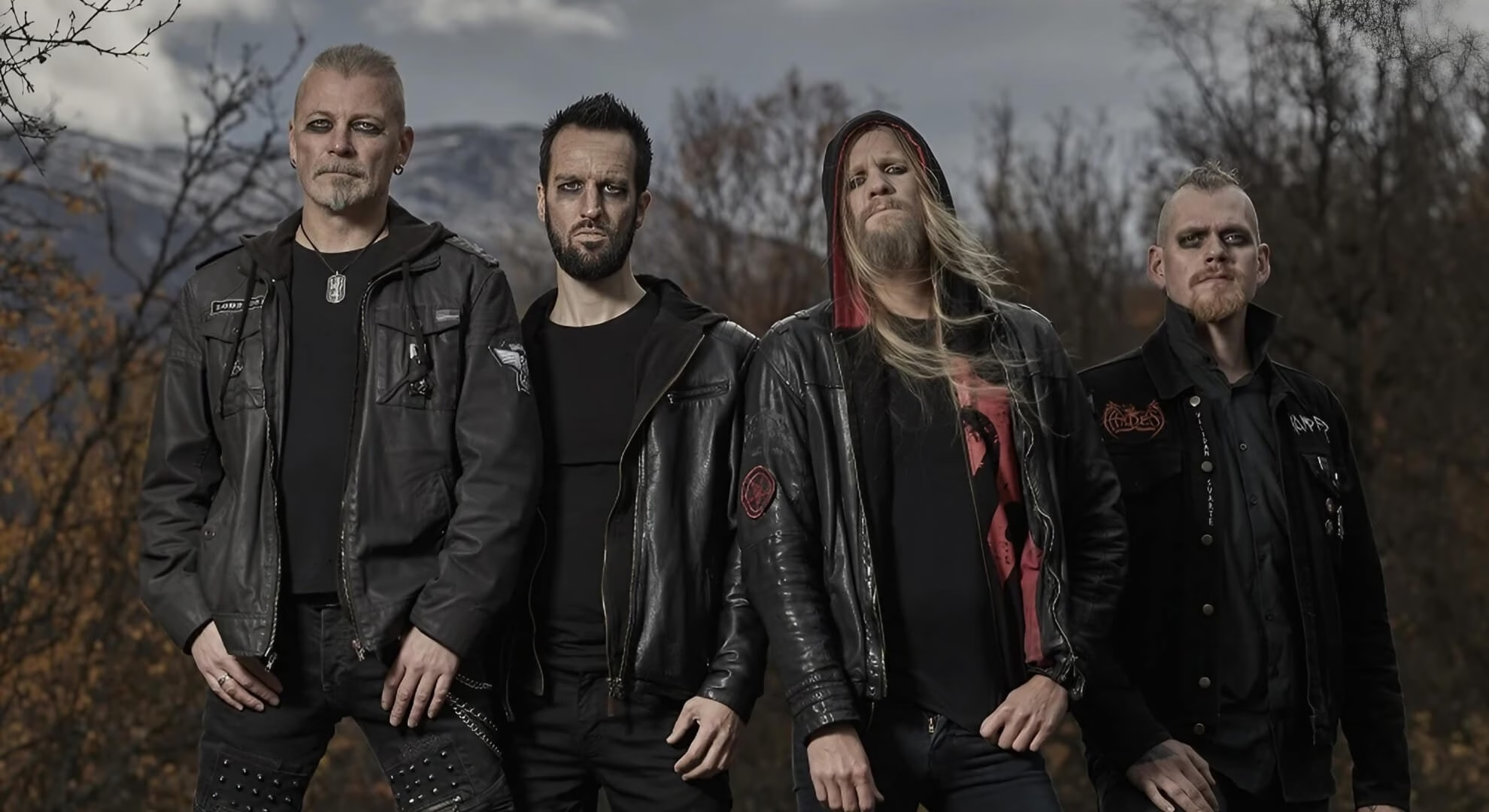
On July 3rd, 2026, a Hampshire trio that has spent two decades declining every available compromise returns with a record that holds both. Witchsorrow’s fifth album arrives through Church Road Records as their first new music in eight years, and its title alone sets the terms.
Two Decades in the Parish
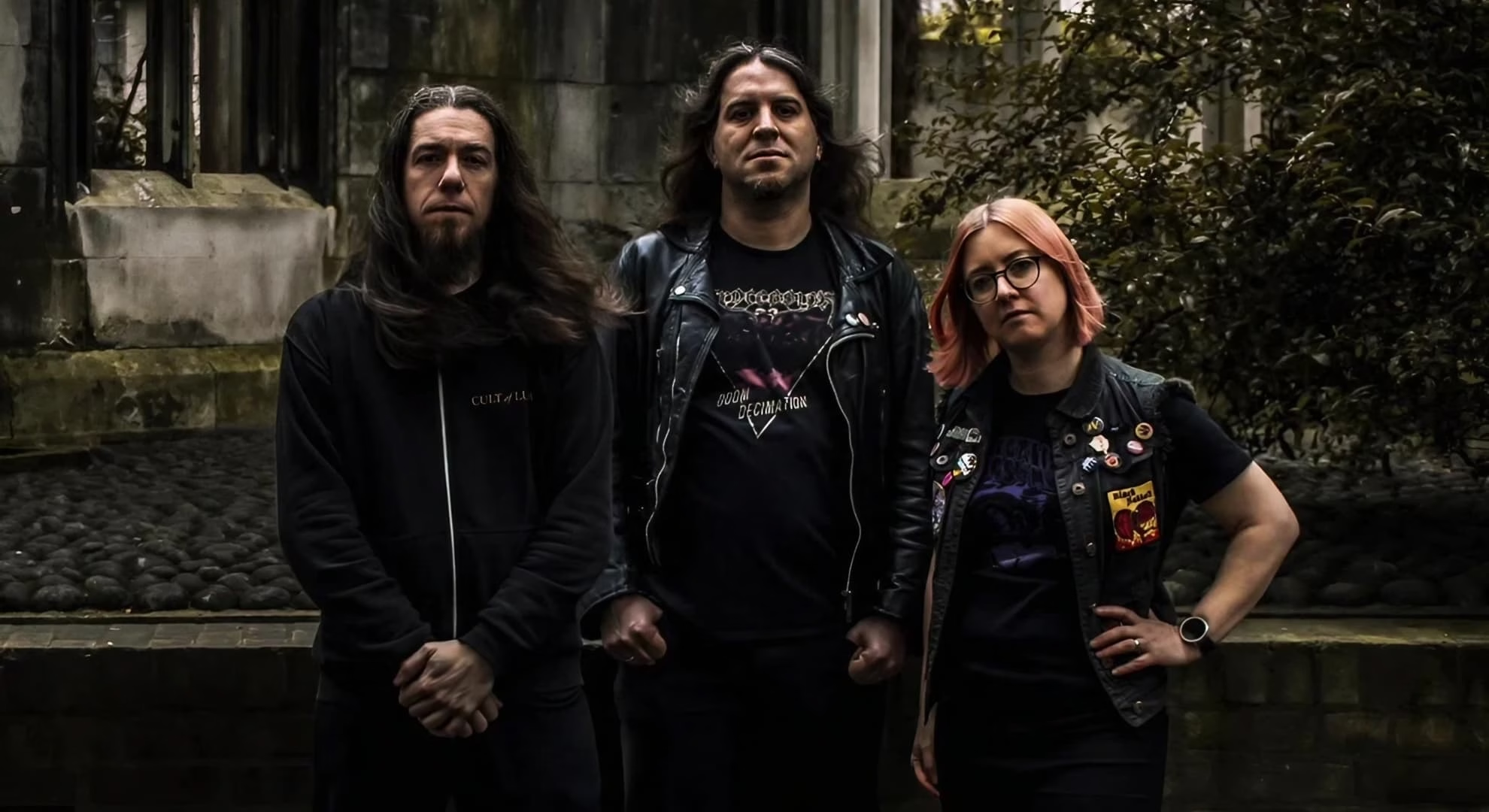
Witchsorrow began in Hampshire in 2006 as the work of two people: Nick Ruskell, who performs as Necroskull on guitar and vocals, and the bassist Emily Witch. Their early circulation was small and self-determined, the records pressed for conviction rather than reach.
The self-titled debut appeared in 2010 on Rise Above Records, the label run by Lee Dorrian of Cathedral, placing the band squarely within the line of British doom that Cathedral had helped restore a generation earlier. The heaviness they took as inheritance came out of Black Sabbath’s Birmingham, where the tritone and the down-tuned crawl first turned industrial fatalism into a working method.1
Three further albums followed, the last being 2018’s ‘Hexenhammer.’ The eight years between that record and ‘The Devil And All His Works’ are long even in a genre that treats slowness as principle, and the silence makes the new album’s arrival a deliberate act rather than a routine one.
The Wheatley Inheritance
The album takes its title and much of its subject from Dennis Wheatley, the English novelist whose mid-century occult thrillers turned the black mass into popular entertainment and fixed a particular image of English Satanism in the national imagination.
Wheatley belonged to a wider current, the modern British fascination with witchcraft, ritual magic, and Crowley’s afterlife that took shape across the twentieth century and colored how the country pictured its own buried pagan past.2 Witchsorrow draw on that current directly rather than through the secondhand occultism most metal inherits.
Necroskull has described the Devil arriving as a recurring figure in his writing, a metaphor that bent toward both good and bad. “There was something of him there in everything I was coming up with,” he said.
Renouncing the Renunciation
The phrase “the devil and all his works” is older than Wheatley. It belongs to the baptismal rite, the renunciation a godparent speaks on a child’s behalf, and the album turns that formula inside out by taking the renounced thing as its subject.
That reversal places the record inside the long Gothic habit of reading sacred language against itself, the tradition in which the forms of faith are kept intact precisely so that they can be profaned.3 Necroskull frames the idea less as blasphemy than as balance: knowing when to let the Devil in and when to cast him out.
Two Sermons Before the Service
Two of the album’s seven tracks have been issued ahead of it. ‘Bacchus’ arrived on May 6th, 2026, with a video, and ‘Hades Chains’ followed in early June, each offering a different reading of what the whole might hold.
‘Bacchus’ moves at the band’s accustomed crawl, the riff trailed by organ, its subject the pleasure of excess shadowed by impermanence. Necroskull described the method behind the album plainly: “I wanted everything to be as pure as possible.”
‘Hades Chains’ lifts the tempo into a fist-raised chug and brings in Serena Cherry of Svalbard and Noctule on guest vocals. Heard together, the two singles point toward a record that holds weight and momentum in a single grip, though the balance across the remaining five tracks cannot be assessed before release.
Fielding and the Doom Console
Production fell to Chris Fielding, whose work on records by Electric Wizard, Conan, Primordial, and Winterfylleth has made him one of the most trusted hands in British heavy music. Fielding has recorded Witchsorrow before, tracking ‘Hexenhammer’ with them at Skyhammer Studio in Cheshire, his longtime base.
That history makes his return less a hire than a continuation, the same partnership turned to a harder brief. The specific recording location for ‘The Devil And All His Works’ had not been confirmed through official sources at the time of publication, though Fielding’s documented manner, dry and weighty and resistant to gloss, is audible across the advance singles.
Guests at the Altar
The album ends with ‘A Quintessence Of Dust,’ which features a lead from Sammy Urwin of Employed To Serve, a guitarist out of Britain’s hardcore-rooted extreme scene rather than the doom underground, and a measure of how freely players now cross the country’s heavy subgenres.
Serena Cherry’s turn on ‘Hades Chains’ works the same way, drawing a voice known from black metal and post-hardcore into a traditional doom setting. Neither guest pulls the record off its center; a band two decades into a single obsession takes in visitors without being steered by them.
The drums are the last that David Wilbraham recorded with the band, his final performance closing that chapter before Scott Taylor took the live seat. The record is, among its other purposes, a parting document.
Doom as a Borderless Tongue
Witchsorrow’s material is local in nearly every particular: Hampshire, Wheatley, the baptismal English of an older church. Doom travels anyway, because its grammar is so reduced that tempo, weight, repetition, and endurance carry where idiom does not.
The worldwide doom community receives a record like this less as English folklore than as a shared way of bearing time, a means of making slowness into something that can be inhabited. The vocabulary of a small British scene becomes common property the moment it crosses a border, taken up by a cosmopolitan underground that no longer asks where a sound began.4
Church Road’s direct-to-listener model, physical pressings and Bandcamp downloads sold straight to the faithful, suits a record built for an audience that seeks the music out rather than waiting to be handed it. That audience is less a demographic than a congregation, dispersed and self-selecting.
Total Doom and Nothing Else
Eight years is a long absence, and Witchsorrow have chosen to break it with the least accommodating record they could make. ‘The Devil And All His Works’ arrives on July 3rd as a refusal of every softening the intervening years might have invited.
Its English particulars, the occult paperbacks, the inverted prayer, the Birmingham crawl two decades in the practicing, are exactly what carry it outward, into an underground that hears in pure doom a discipline rather than a style. The record asks its audience to stay slow, stay heavy, and want nothing else.
When a record this rooted in one country’s particular dread, its occult fiction, its inverted liturgy, its single industrial city of origin, reaches listeners with no access to those references, the open question is what survives the crossing: the specific English darkness Witchsorrow draw from, or the slower, wordless endurance that doom holds out to anyone willing to sit inside it?
References
- Andrew L. Cope, ‘Black Sabbath and the Rise of Heavy Metal Music’ (Farnham: Ashgate, 2010), 1–14. ↩︎
- Ronald Hutton, ‘The Triumph of the Moon: A History of Modern Pagan Witchcraft’ (Oxford: Oxford University Press, 1999), 224–231. ↩︎
- David Punter, ‘The Literature of Terror: A History of Gothic Fictions from 1765 to the Present Day,’ 2nd ed. (London: Longman, 1996), 18–22. ↩︎
- Motti Regev, ‘Pop-Rock Music: Aesthetic Cosmopolitanism in Late Modernity’ (Cambridge: Polity Press, 2013), 90–96. ↩︎

Leave a Reply