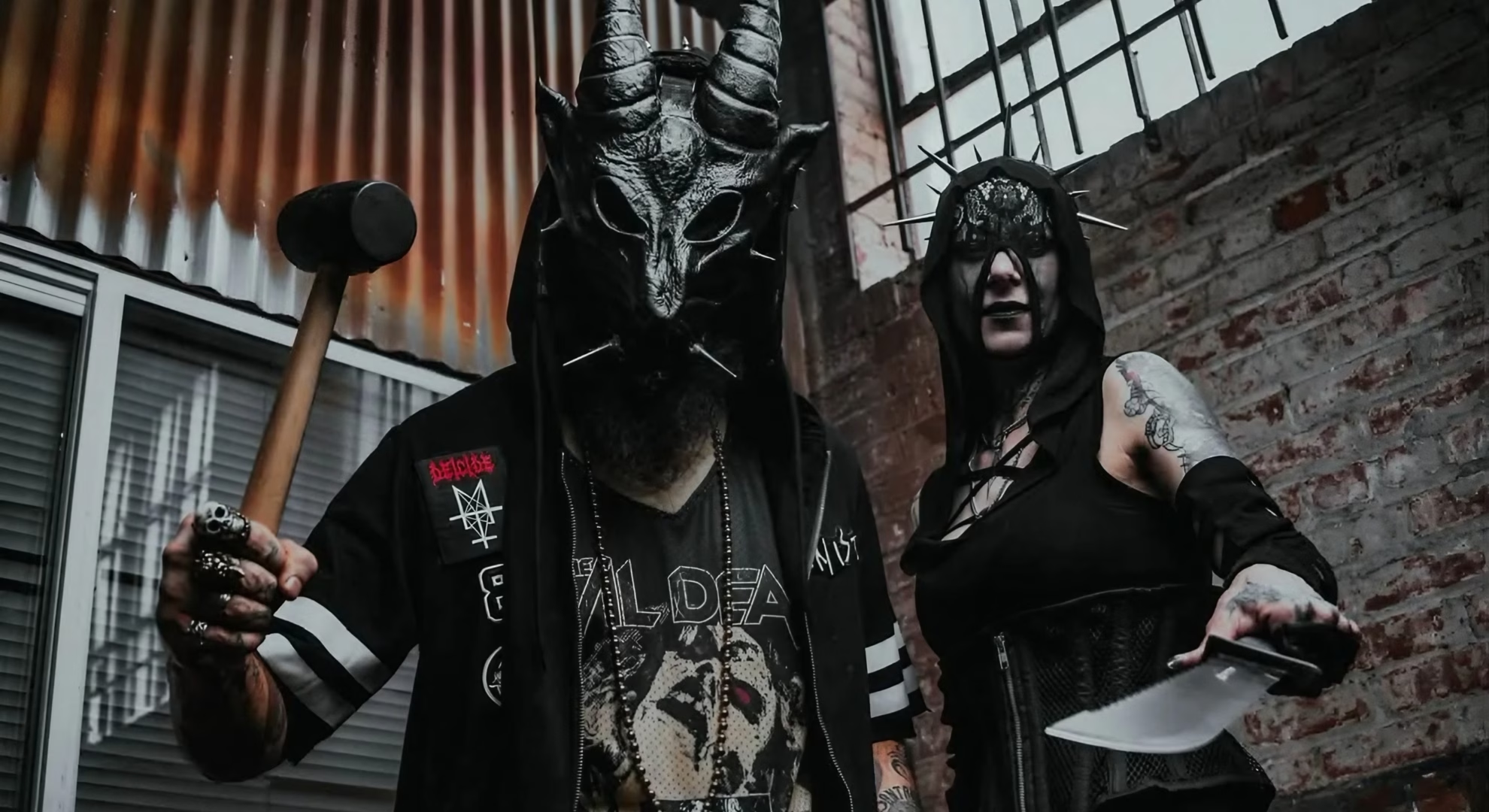


Greek worshippers had a word for the moment of meeting Hecate, and the word cut both ways. Antaia, one of her titles, is usually glossed as one who meets or one who is besought with prayers, and its root can also mean set against in hostility. A California duo took a harsher variant of that title as its name. The video for ‘33’ has to picture the meeting over a song that contains no guitars.
Bass Music to Black Metal
The band’s account places the project’s start in Joshua Tree, California, in 2023, as a doom-bass act. Dr. Luna, a former metal bass player, had started writing on a keyboard while traveling and pushed the result toward the weight of black metal. Kali Mortem, who first worked with him as the photographer for his earlier project Luna 13, took the vocals.
At two bass-music events, Luna recalled, audiences reacted well while organizers judged the act too dark for a return booking. The industrial and metal circuits took to it quickly.
That route places the duo inside California’s dark industrial circuit. As this publication noted in its coverage of Psyclon Nine’s ‘And Then Oblivion,’ Antania was named among the acts announced to share select tour dates with that San Francisco project.
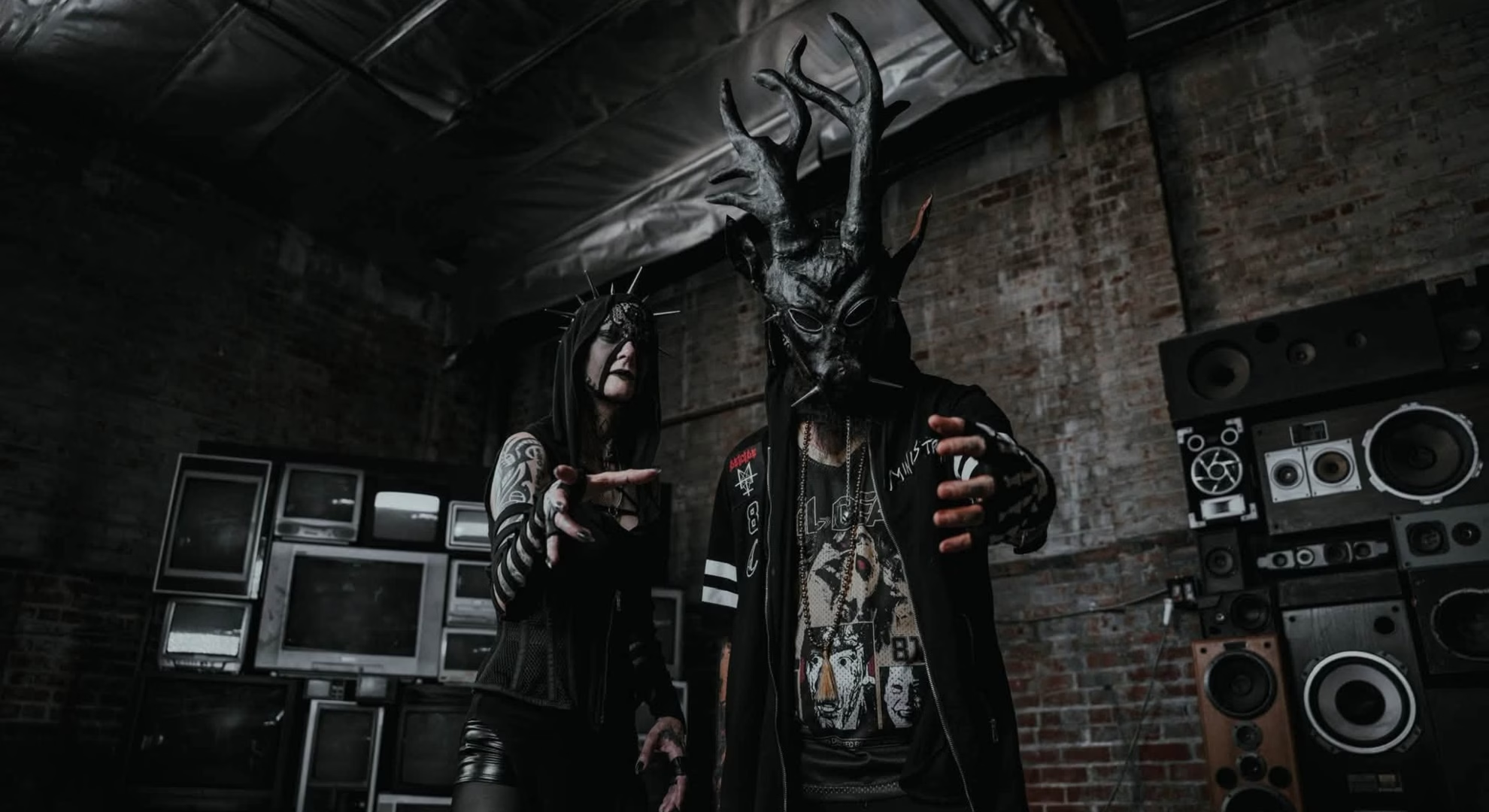
Beyond that circuit, the duo’s documented audience gathers at specific points: a Suicide Commando bill in Portland on October 17th, 2025, and the Tokyo dates of Marduk’s November 2025 Japan tour, including the Shibuya Cyclone on November 21st. The Argonauta announcement adds dates with The Crown across Asia and an appearance with Evergrey in India.
The American tradition behind that circuit runs through Ministry, the Chicago band the duo cite as a reference. Their other references run abroad, to Skinny Puppy of Vancouver and to Mysticum, Dødheimsgard, and Thorns, three Norwegian black metal acts that brought industrial electronics into the genre.
The first album, ‘Lividity,’ appeared on June 9th, 2023 with a guest appearance by Erk Aicrag of the dark electro band Hocico. A deal with Triad Records followed in December 2023, and the second album, ‘The God Complex,’ appeared on January 5th, 2024, with 15 tracks that included remastered songs from the debut.
The names attached to the sound have moved with the catalogue, from doom bass in 2023 to aggrotech death metal around ‘3AM 666’ and, under the Argonauta signing, to avant-garde industrial black metal. Each change moves the description one step from bass music toward black metal, and ‘33’ sits at the far end of that movement.
A Goddess With Two Faces
Hecate belongs to Greek tradition as a goddess, and the record of her is a set of poems, plays, and ritual texts rather than history in the narrow sense. Each source below presents her differently, and the differences matter for a title that was borrowed from her.
Hesiod gave Hecate one of the most generous portraits in Greek poetry. In the ‘Theogony,’ composed around 700 BCE, Zeus honors her above all others and grants her a share of earth, sea, and starry sky.1
The ‘Homeric Hymn to Demeter’ places her inside a different story. Torch in hand, she hears Persephone’s cry as the girl is seized, and after the reunion she stays beside her as attendant and companion.2
Later ritual texts pushed her toward the cosmos and the spell. The Chaldean Oracles cast her as a mediating power in a ritual cosmology,3 and the Greek Magical Papyri, recovered from Egypt, preserve spells that call on her by name.4
Crossroads and Restless Dead
The same goddess stood where three roads met. Households left food for her at crossroads at the new moon, a practice known as Hecate’s supper.5
Sarah Iles Johnston argues that Greek sources treat the crossroads goddess as mistress of the restless dead, above all those who died before their time or by violence.
Tragedy joined that authority to crime. Euripides’ Medea, who kills her rival and her own children, swears by Hecate as the power she reveres above all others, her chosen accomplice at the innermost hearth.6
The pairing of murder and the occult, which the band names as its subjects, therefore has a precedent more than 2,000 years old.
A Name Met Face to Face
The band explained in a 2024 interview that its name is a title of Hecate meaning “Enemy of Mankind.” The same answer described Dr. Luna, the project’s founder, as a high priest at a Temple of Hecate in New York City, and named murder and the occult as the project’s subjects.
Scholarly reference works record the closely related Antaia, applied to Hecate and to Demeter, with the sense of one who is besought in prayer. Its hostile shading comes from the related verb, which can mean to set oneself against.7 The spelling Antania and its harsher gloss circulate in modern epithet lists, and no ancient source for that exact form could be confirmed at the time of publication.
The gap between the two readings is where the project sits. A title that can mean prayer or opposition describes a meeting whose outcome is not guaranteed, and it turns the video’s task into one of staging an encounter.
Luna also said that he performs Hecate invocations before writing music, which puts the devotion upstream of the sound. The temple affiliation rests on the band’s own statement, and no independent confirmation was available at the time of publication.
From Goddess to Witch Queen
Roman poets sharpened her sorcerous side. In Ovid’s ‘Metamorphoses,’ Medea prepares her nocturnal rite and calls on triple Hecate as the power that knows her designs and aids her charms.8
English drama then fixed the image. In ‘Macbeth,’ Hecate appears as queen of the witches and rebukes them for acting without her, in a scene many editors attribute to Thomas Middleton rather than Shakespeare.9
The witch queen is thus a product of tradition, while the earlier Hecate rests on poems and cult. The difference matters for a project that claims worship, because the band’s account does not say which Hecate its practice follows.
The Road Before ‘33’
The immediate predecessor is the ‘666 Unalive Remix EP,’ a set of four remixes released on November 6th, 2025, and led by ‘Trophy3.’ It follows ‘3AM 666,’ the duo’s third album, released on June 20th, 2025, through Triad Records.
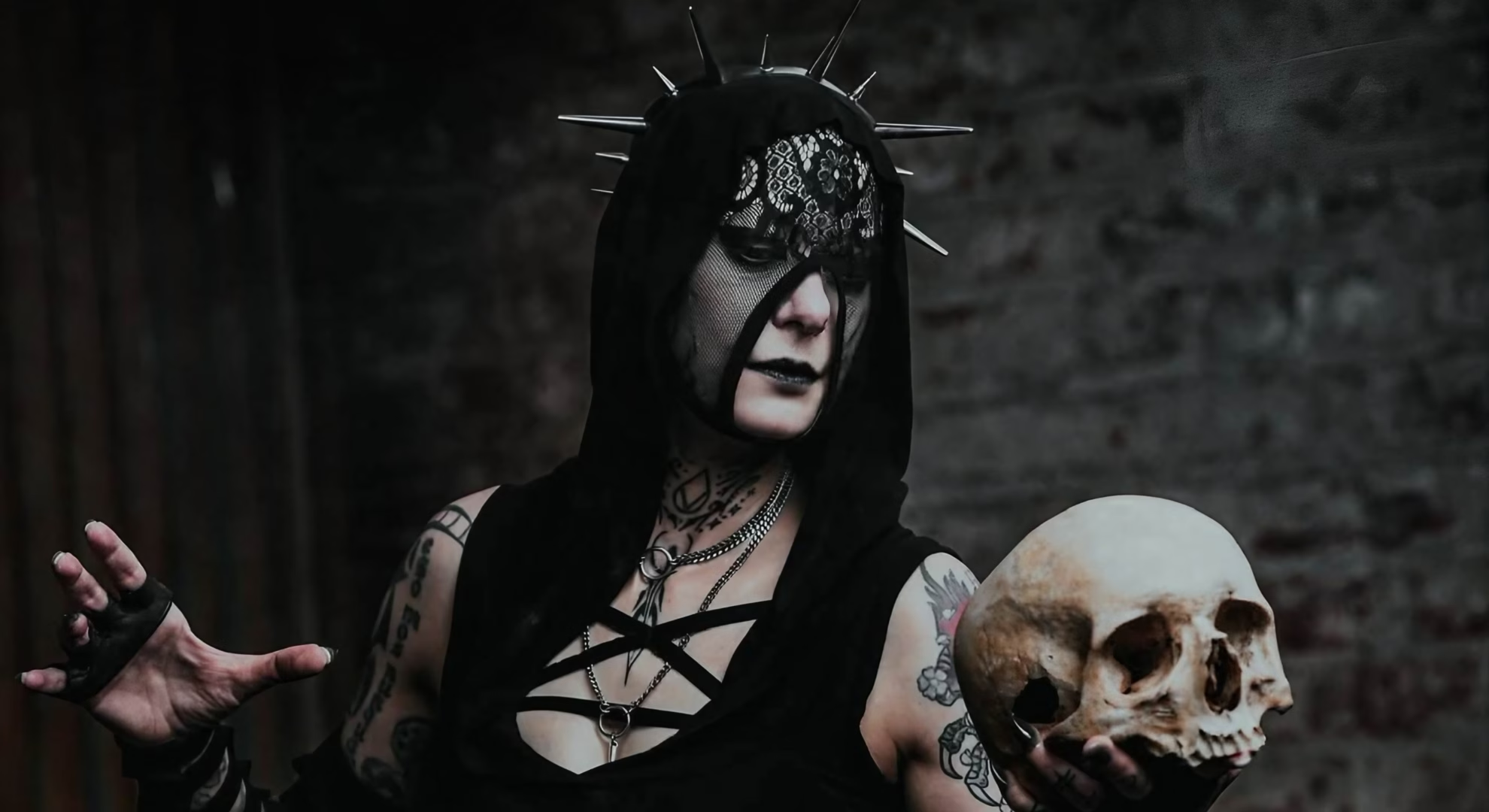
‘3AM 666’ carried ‘Pigz,’ ‘Sewn,’ and ‘BloodLove’ among its 10 tracks. ‘BloodLove’ received a video that drew on the case of the British serial killer Joanna Dennehy.
The title song of ‘The God Complex’ had already placed Charles Manson at its center. Two songs, then, took a documented killer as their subject, and that habit is the standard against which a single titled with a bare number is read.
The Director Returns
The video for ‘33’ was directed by Matt Zane of Lord Zane Productions, and it is not his first work for the band. Luna said in 2024 that he chose Zane for the video for ‘The God Complex’ after watching Society 1, the band Zane leads, and seeing his videos.
Zane’s earlier credits include work with Wayne Static and Zakk Wylde. He also directed the video for ‘BloodLove’ in 2025, which makes ‘33’ at least his third video for the band.
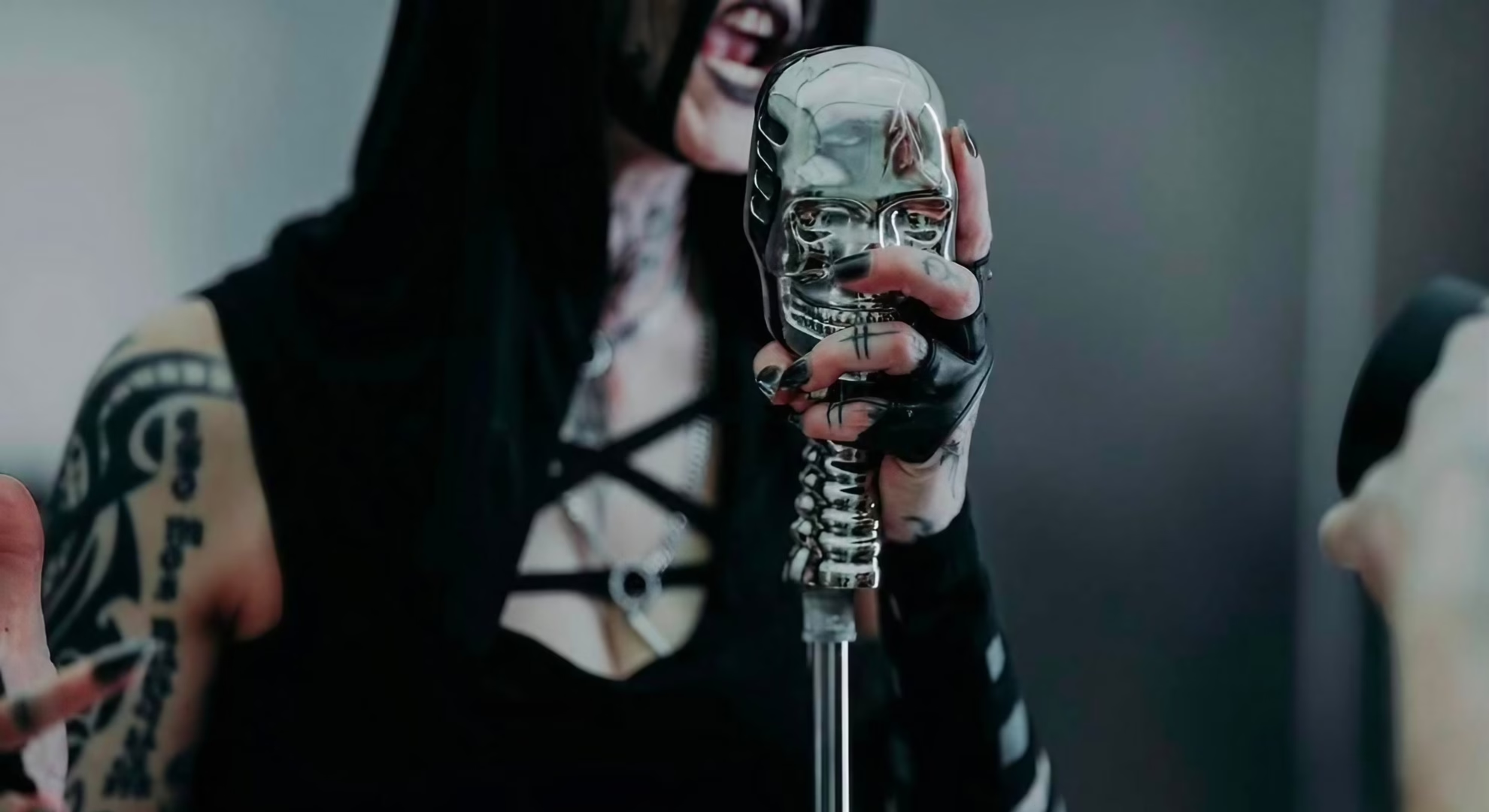
A song built entirely from synthesizers, distorted textures, and machine-like rhythms leaves a video without the usual furniture of a metal performance clip. There is no fretting hand to film and no bass to lean on, so the camera has to decide where the body goes.
What can be stated is the line the video extends. It continues the band’s own collaboration with Zane, begun with ‘The God Complex,’ and it belongs to the American industrial-metal video tradition in which Zane has already worked.
Before the Album Opens
Argonauta Records, the independent label based in Genoa, Italy, announced ‘33’ and its video on September 10th, 2026, as the first single from ‘The Unholy 33.’ The single previews an album whose 11 tracks open with ‘33’ itself, and continue through ‘DVHM3R,’ ‘Sn0wAnGeL,’ ‘Gloomzday,’ ‘ThUgG33,’ ‘Cykl0pZ,’ ‘Flies,’ ‘AntVniV,’ ‘Frazzledrip,’ and ‘Kultz,’ and close with ‘HEarSe.’
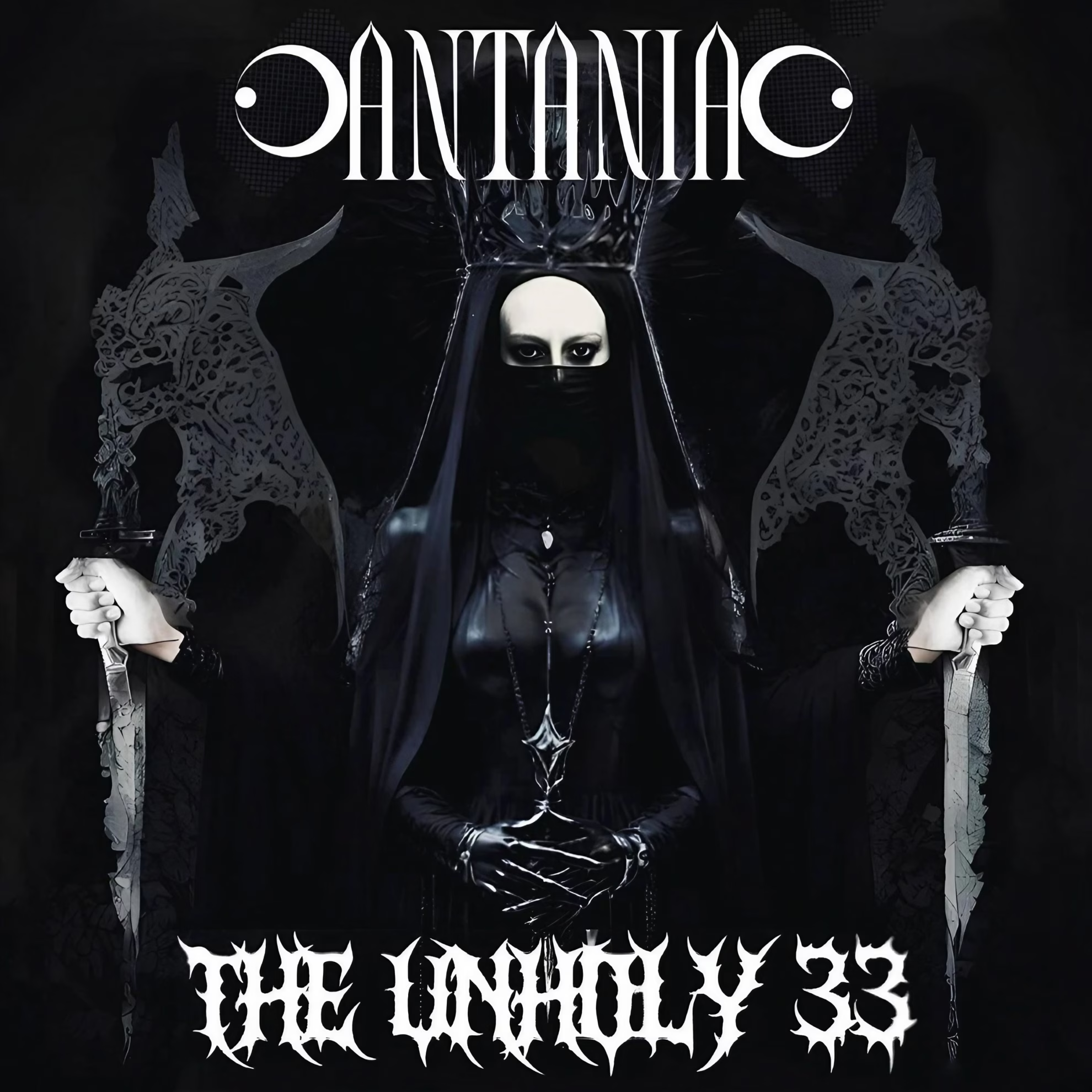
The album is due digitally on October 16th, 2026, with CD and vinyl editions to follow at a later date.
A label rooted in doom, stoner, and sludge suits a project that began as doom bass, even as its sound has moved toward black metal. The signing also sets an American desert project, a Greek goddess’s epithet, and an Italian imprint side by side, which is the cultural tension the single has to carry.
A Title Fit for Machines
A title that can mean both approach and enmity suits a sound assembled from machines. Invocation and machine rhythm share a method, which is repetition, and the band’s account of invocations before writing puts the one behind the other, and that is what gives ‘33’ its interest: a practice presented as worship, carried out in a medium with no hand in it. The album will show how far the tension carries.
What would you need to see and hear in ‘33’ before you believed that Antania mean their name as a practice rather than a pose?
If you are a band, artist, label, or promoter navigating the dark and independent scene, you need press materials that speak the language — not generic copy. Our Studio writes press releases, EPKs, bios, and website content for the underground and the vanguard alike. Plans start at $150, with turnaround as fast as 2 days.
References
- Hesiod, ‘Theogony,’ lines 411–452, in ‘Theogony and Works and Days,’ trans. M. L. West (Oxford: Oxford University Press, 1988). ↩︎
- ‘Homeric Hymn to Demeter,’ lines 24–25, 52–61, and 438–440, in ‘The Homeric Hymn to Demeter,’ ed. N. J. Richardson (Oxford: Clarendon Press, 1974). ↩︎
- Sarah Iles Johnston, ‘Hekate Soteira: A Study of Hekate’s Role in the Chaldean Oracles and Related Literature’ (Atlanta: Scholars Press, 1990). ↩︎
- Hans Dieter Betz, ed., ‘The Greek Magical Papyri in Translation, Including the Demotic Spells,’ 2nd ed. (Chicago: University of Chicago Press, 1992). ↩︎
- Sarah Iles Johnston, ‘Restless Dead: Encounters between the Living and the Dead in Ancient Greece’ (Berkeley: University of California Press, 1999). ↩︎
- Euripides, ‘Medea,’ lines 395–397, in ‘Euripides I: Cyclops, Alcestis, Medea,’ ed. and trans. David Kovacs, Loeb Classical Library (Cambridge, MA: Harvard University Press, 1994). ↩︎
- Henry George Liddell, Robert Scott, and Henry Stuart Jones, ‘A Greek-English Lexicon,’ 9th ed. with revised supplement (Oxford: Clarendon Press, 1996), s.v. ‘ἀνταῖος.’ ↩︎
- Ovid, ‘Metamorphoses,’ 7.194–219, in ‘Metamorphoses, Books 1–8,’ trans. Frank Justus Miller, rev. G. P. Goold, Loeb Classical Library 42 (Cambridge, MA: Harvard University Press, 1977). ↩︎
- William Shakespeare, ‘Macbeth,’ 3.5, ed. Sandra Clark and Pamela Mason, Arden Shakespeare, 3rd ser. (London: Bloomsbury, 2015). ↩︎



Leave a Reply