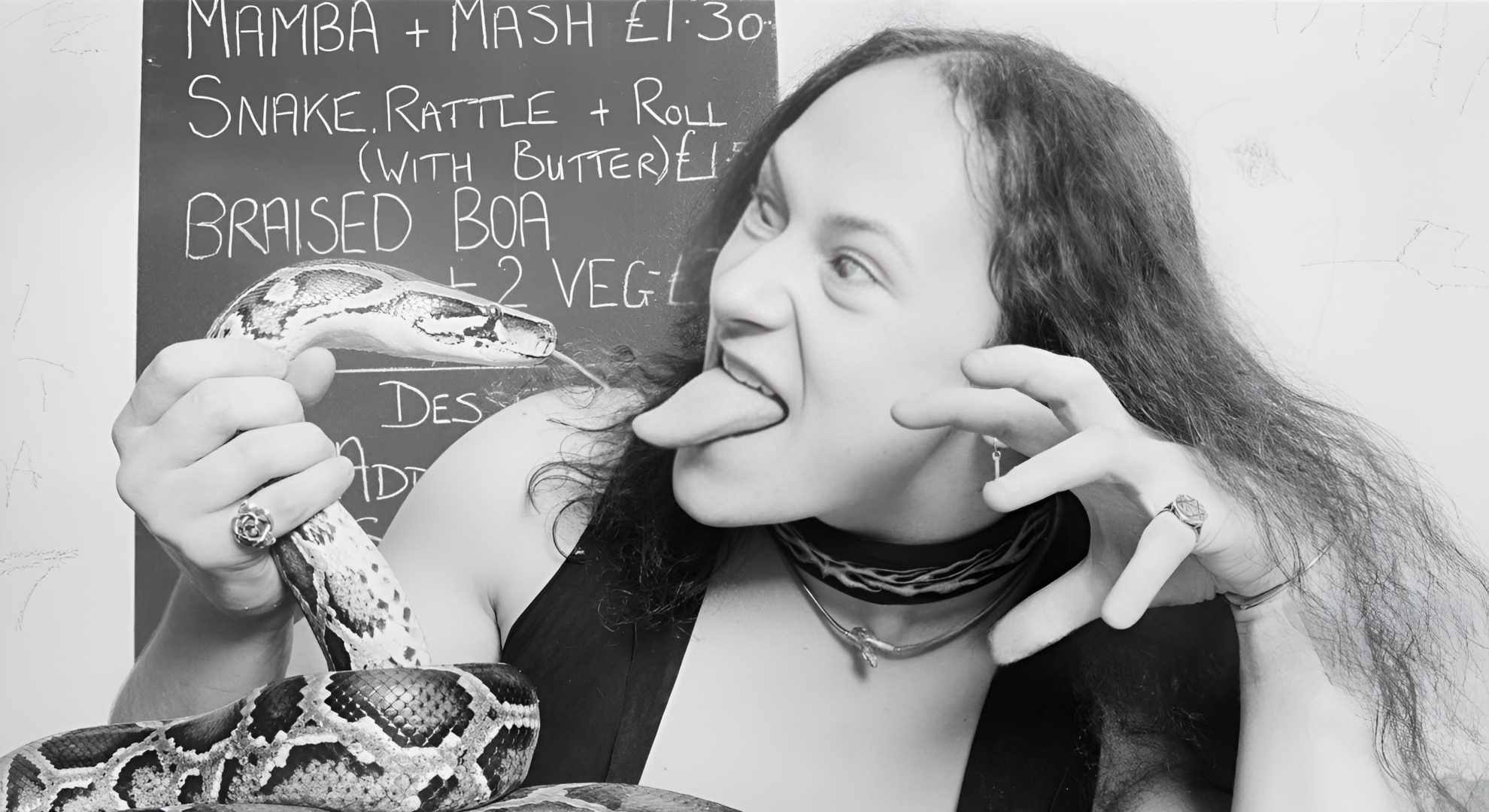


Conrad Thomas Lant, the bassist, vocalist, songwriter, and visual designer who founded the British band Venom and performed as Cronos for more than four decades, died on September 29th, 2026. He was 63. Venom announced his death two days later, on Thursday, October 1st, 2026, a delay made at the request of his family, in a statement that carried a message from his son, Nathan.
The cause of death has not been disclosed. Lant’s significance rests on an unusual concentration of roles in a single member of a founding extreme metal band. He was the apprentice studio engineer who talked Venom into the recording room at Impulse Studios in Wallsend, the lyricist who moved Satan from a figure sung about to a voice sung from, and the draftsman whose logo and sleeve for ‘Black Metal’ (1982) fixed a visual grammar that the genre named after that record still uses. He then held the Venom name through a departure, a reunion, and an attempted dismissal, long enough to release the band’s 16th studio album, ‘Into Oblivion,’ five months before his death.
Newcastle Origins, 1963–1980
A Childhood Moved North
Lant was born on January 15th, 1963, in London, and moved with his family to Newcastle upon Tyne as a young child. Published accounts differ on whether he was seven or eight at the time of the move, and give the London district of his birth as Kensington in some cases and Chelsea in others.
He was the younger brother of Graham Lant, later the drummer of Prefab Sprout, and the elder brother of Anthony “Antton” Lant, who would play drums in Venom. In a profile published on October 1st, 2026, the day his death was announced, he recalled fighting on his first day at a Newcastle school because of his southern accent.
The same profile documented a working life that ran parallel to Venom for decades: Lant also worked as a fitness instructor in the 1990s, a multimedia engineer, and a graphic designer, and was a birdwatcher. Of those trades, graphic design mattered most to heavy metal, because the logos and sleeves he drew for Venom were the work of a man who treated design as a craft rather than an afterthought.
The Impulse Apprenticeship
In 1979 Lant applied for work at Impulse Studios in Wallsend, the recording facility attached to Neat Records, the independent label founded by David Wood that became a principal outlet for the New Wave of British Heavy Metal on Tyneside.
He trained there as an assistant engineer and tape operator while playing guitar in local groups, first a short-lived project called Album Graecum and then Dwarfstar. The position gave a teenage guitarist something few of his peers had: daily access to the machinery that turned a rehearsal into a record, and daily contact with the people who decided which bands got studio time.
Through that circle Lant met Jeffrey Dunn, who was then playing guitar in a Judas Priest covers band called Guillotine with drummer Anthony Bray and vocalist Clive Archer. Lant joined on rhythm guitar at the end of the 1970s, and the band took the name Venom in 1979 at the suggestion of a roadie.
The covers repertoire of Motörhead and Judas Priest gave way to original material as Lant brought in songs he had already written, including ‘Sons of Satan,’ ‘Bloodlust,’ and ‘Welcome to Hell,’ while Dunn supplied ‘Angel Dust,’ ‘Buried Alive,’ and ‘Raise the Dead.’ Late in 1979 Lant also presented his first designs for the Venom logo and the satanic imagery that would mark the band’s records.
The October 1980 Session
The studio job became the band’s lever. A cassette of a church-hall rehearsal, recorded on a basic portable machine, impressed no one at Impulse; the hall’s reverb swallowed the band. Lant, by his own account, then struck a bargain with engineer Mickey Sweeney and with Wood: he would stay behind unpaid every night to assist on other sessions in exchange for a few free hours.
In April 1980, Venom recorded a three-song demo, and Lant copied and mailed it to labels, radio stations, and the music press. Bassist Alan Winston had left that February, days before the band’s first show, and Lant had moved from guitar to bass.
On October 10th, 1980, during one of Neat’s four-hour, £50 demo sessions, again paid off in Lant’s labor, Dunn asked him to sing ‘Live Like an Angel.’ Dunn and Bray preferred his delivery to Archer’s, Archer left the band, and Venom became the trio of Cronos on bass and vocals, Mantas on guitar, and Abaddon on drums.
The stage names had been adopted earlier that year because, as the band later explained, singing about the occult under ordinary names felt wrong. The sequence is the foundation of Lant’s significance: the voice that defined first-wave black metal was discovered not on a stage but inside a recording session its own singer had bartered for, and the trio that recorded every record now credited with seeding the genre was assembled by the person who also controlled the tape.
The First Neat Records, 1981
In League with Satan
Neat agreed to a single, and Venom returned to Impulse in January 1981. ‘In League with Satan,’ backed with ‘Live Like an Angel,’ appeared in April 1981. The A-side opens with a reversed recording of Lant’s voice, a backmasked threat that, played forward, became one of the earliest deliberate satanic messages hidden in a rock record.
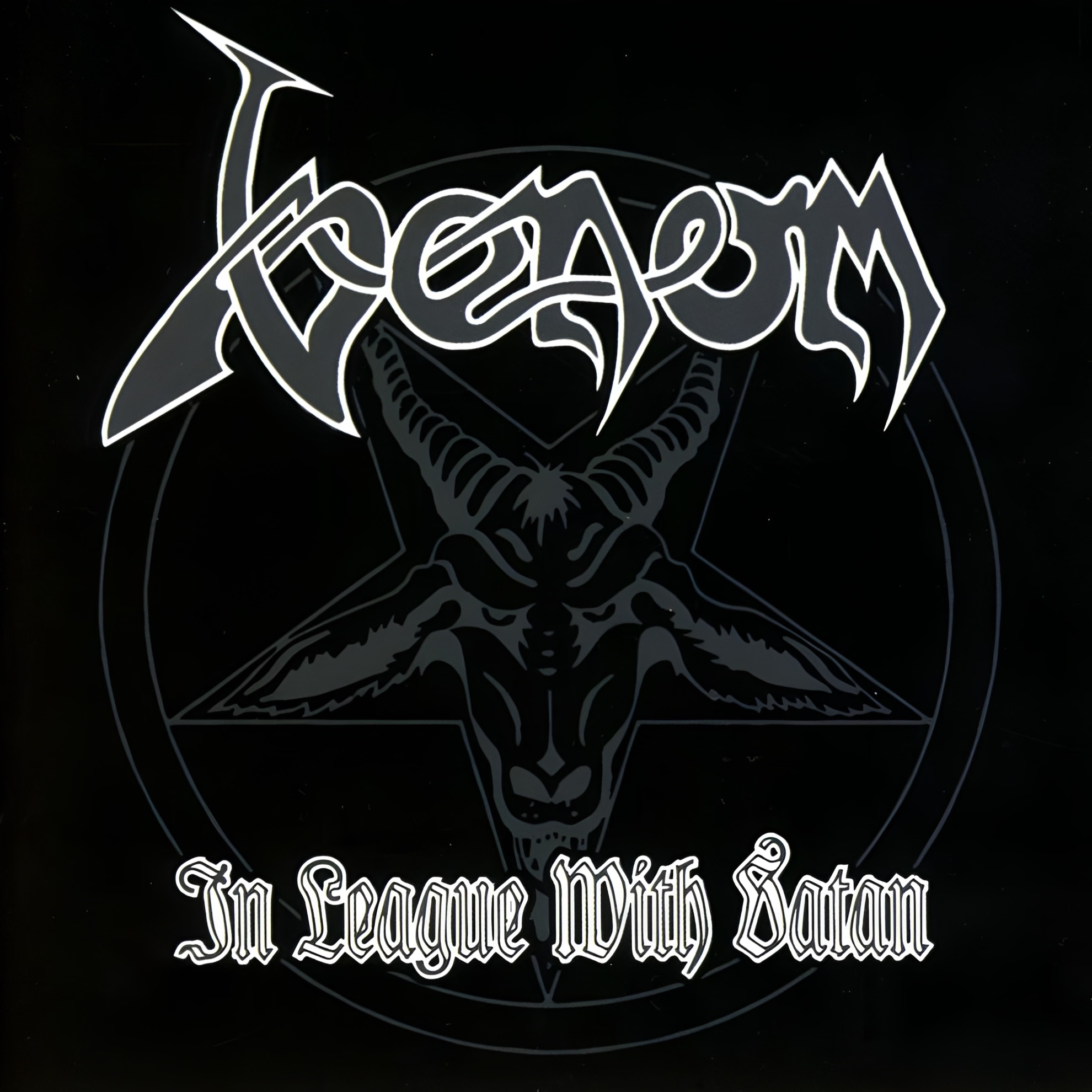
The device was a studio trick, and it came from the band member who knew how to operate the studio. The single sold well enough that Neat asked Venom to record everything they had.
Three Days at Impulse
In August 1981 the trio re-recorded its entire repertoire at Impulse over three days. Neat chose to release the results as they stood, unpolished, and ‘Welcome to Hell’ appeared in December 1981, produced by Keith Nichol and the band. Bray designed the cover, a gold pentagram enclosing the goat head of Mendes on a black field.
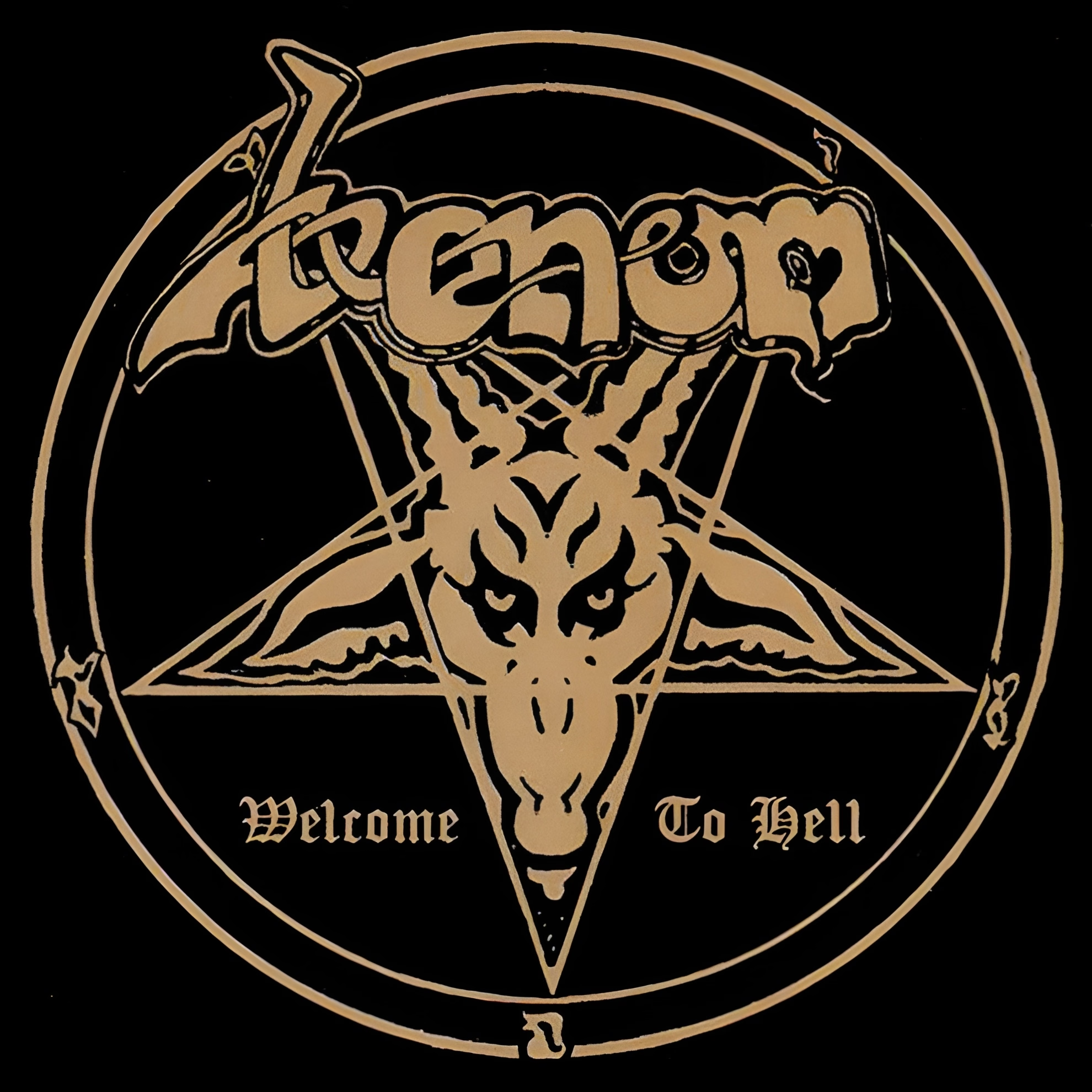
The 11 songs moved between hedonism, sexual excess, drug use, a serial killer’s monologue in ‘Schizoid,’ witchcraft in ‘Witching Hour,’ and open devotion to Satan in the title track and ‘In League with Satan.’ The title track sets a woman’s recitation of Psalm 23 against the band’s din.
The record’s defining quality was a sound produced by necessity: a power trio playing faster and harder than its New Wave of British Heavy Metal contemporaries, recorded with almost no time to correct anything. Journalist Geoff Barton awarded it five stars in a contemporaneous review while observing that it had the high-fidelity dynamics of a 50-year-old pizza. Both halves of that verdict proved durable.
Lant’s vocal on the record, a barked, throat-first delivery with no interest in operatic range, broke with the high tenor that dominated British metal in 1981, and it is the vocal register, more than any lyric, that later extreme metal singers inherited.
Critics and Converts
The album found its most consequential listeners abroad. On June 4th, 1982, Venom played to more than 3,000 people at a sports hall in Poperinge, Belgium, a show Lant sought precisely because the audience there knew nothing of the band’s local reputation. In the United States, copies imported by the New York record seller Jon Zazula reached a generation of teenage musicians.
Anthrax guitarist Scott Ian later recalled that the album struck him and his friends as a new kind of insanity, and Metallica drummer Lars Ulrich said that Venom started black, speed, and death metal alike with that single record. The Norwegian band Mayhem took its name from the album’s instrumental ‘Mayhem with Mercy’ and recorded ‘Witching Hour’ on its 1987 EP ‘Deathcrush.’
Inside Black Metal, 1982
Seven Days in Wallsend
‘Black Metal,’ released on November 1st, 1982, through Neat in the United Kingdom and Combat Records in the United States, is the work through which Lant’s significance is most precisely measured, because it is the record on which all of his roles met at full strength.
The band attributed its heavier, more distinctive sound to a clearer sense of its own identity and to Lant’s growing experience as a studio engineer. The album was recorded at Impulse in seven days, with Lant working long hours alongside the house engineer and then mixing the tracks himself. Keith Nichol and Venom again shared the production credit.
Lant described his intention in plain technical terms. He said that he tried every skill he had learned as an engineer to capture the band’s live noise and simply went for the heaviest sound he could get on tape, adding that there was no way Venom was ever going to sound like Lynyrd Skynyrd.
The label’s time limits and the band’s limited technique constrained the result; Lant’s engineering choices decided what those constraints would sound like. The coarse, cellar-room density of ‘Black Metal’ is therefore not an accident that happened to a band, but the output of a member who understood the equipment and pushed it toward saturation rather than clarity.
Chainsaw, Mud, and Tipp-Ex
The record’s sound effects document the same hands-on approach. The title track opens with the noise of a real chainsaw, brought into the studio and run against clamped steel plates; Lant said that every tooth on the saw broke in the process.
For the opening of ‘Buried Alive,’ the band wanted the sound of earth falling on a coffin during a burial service. Cutting cabbages failed to produce it, so they placed microphones inside a cardboard box and shoveled mud onto them. ‘Countess Bathory,’ a song about the Hungarian noblewoman accused of murdering young women, took its opening riff, Lant said, from the theme of the children’s television series ‘The Magic Roundabout’; it was finished on a day Bray turned up late, with a roadie’s drum pattern kept because Lant and Dunn preferred it.
The album is divided into a ‘Black’ side and a ‘Metal’ side. Its lyrics run from the satanic material of ‘To Hell and Back,’ ‘Leave Me in Hell,’ ‘Sacrifice,’ and ‘Heaven’s on Fire’ to the witchcraft of ‘Don’t Burn the Witch,’ the premature-burial horror of ‘Buried Alive’ and ‘Raise the Dead,’ and the schoolboy fantasy of ‘Teacher’s Pet.’
The closing track is a two-minute preview of ‘At War with Satan,’ the long-form concept Lant had begun writing while still at school, placed there as a warning of the next record. The mix of horror-film subjects with schoolyard provocation is exactly the range Lant always claimed for the band: theater first, doctrine never.
The Sleeve Lant Drew
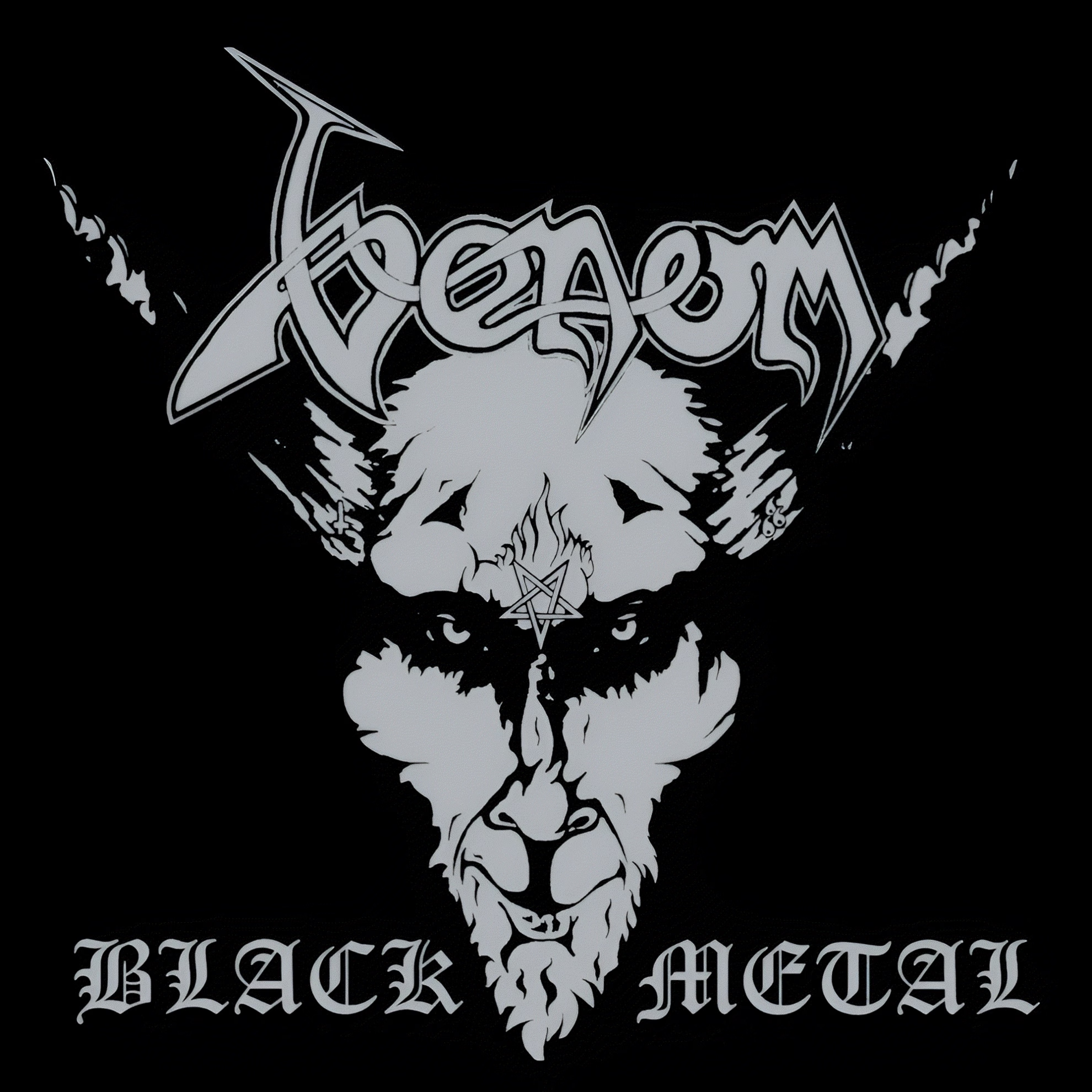
Lant designed the cover himself, in black and white, originally working in Tipp-Ex correction fluid. It shows the face of a horned demon with a pentagram on its forehead, an inverted cross on one horn and the number 666 on the other, the Venom wordmark above, and the album title in gothic lettering split by the demon’s chin. On early pressings the title was printed black on black, legible only when tilted toward the light.
The first pressings came with a gothic-lettered lyric insert and a black-and-white poster of the three members. Every element of that package, from monochrome austerity to blackletter type and inverted Christian symbols, reappears in black metal design of the following four decades, and it originated not with a hired illustrator but with the band’s singer.
A Title Turned Taxonomy
The title track functioned as a manifesto, an anthem addressed to the style itself, and its name outlived its authors’ intentions. Communication scholar Ian Reyes, tracing the black turn in metal aesthetics, identifies Venom as the first band to reappropriate the black metal label directly and argues that the second-wave Norwegian bands of the early 1990s revived the crude, low-fidelity sound of the first wave as a deliberate rejection of the polished heaviness death metal had reached by that point.1
That reading explains a paradox of Lant’s career. Through the 1980s Venom’s records were treated as a crude prelude that thrash and death metal had improved upon; by the early 1990s their roughness was prized as authenticity. The quality that critics had mocked became the property that a new generation chose to inherit.
Bathory drummer Jonas Åkerlund cited ‘Countess Bathory’ as the source of that Swedish band’s name. Mayhem recorded the title track on its 1986 demo ‘Pure Fucking Armageddon,’ Cradle of Filth recorded it for a special edition of ‘Cruelty and the Beast,’ and Vader, Hypocrisy, and Dimmu Borgir have all released versions; Dimmu Borgir’s 2023 covers compilation ‘Inspiratio Profanus,’ covered previously on this publication, opens with it.
The Japanese band Sigh devoted an entire 1995 release to Venom songs. The breadth of those covers, across Swedish, Norwegian, English, Polish, and Japanese bands, documents a single record functioning as shared repertoire for a global scene.
America and Excess, 1983–1986
Staten Island, April 1983
Zazula, who was then starting his own label, asked Neat whether Venom would play in the United States. An importer friend showed Lant a bootleg video of a young San Francisco band whose guitarist wore a Venom shirt; that band, Metallica, opened for Venom at the Paramount Theatre on Staten Island on April 22nd and 24th, 1983.
On the second night the band’s pyrotechnics blew a hole in the stage and sent a fireball toward the balcony. United States customs then impounded Venom’s equipment, forcing the band to withdraw from the Aardschokdag festival in the Netherlands that June and cancel a European tour; the three members appeared at the festival anyway to apologize to the crowd.
At War with Satan
‘At War with Satan,’ released in 1984, devoted its entire first side to a 20-minute title track written by Lant, a narrative of war between heaven and hell in which hell prevails. Lant intended the piece as a rebuttal to critics who said that Venom could not play, and its sustained structure, with shifts of tempo and texture across a single side, anticipated the extended compositions later attempted by bands on both sides of the Atlantic.
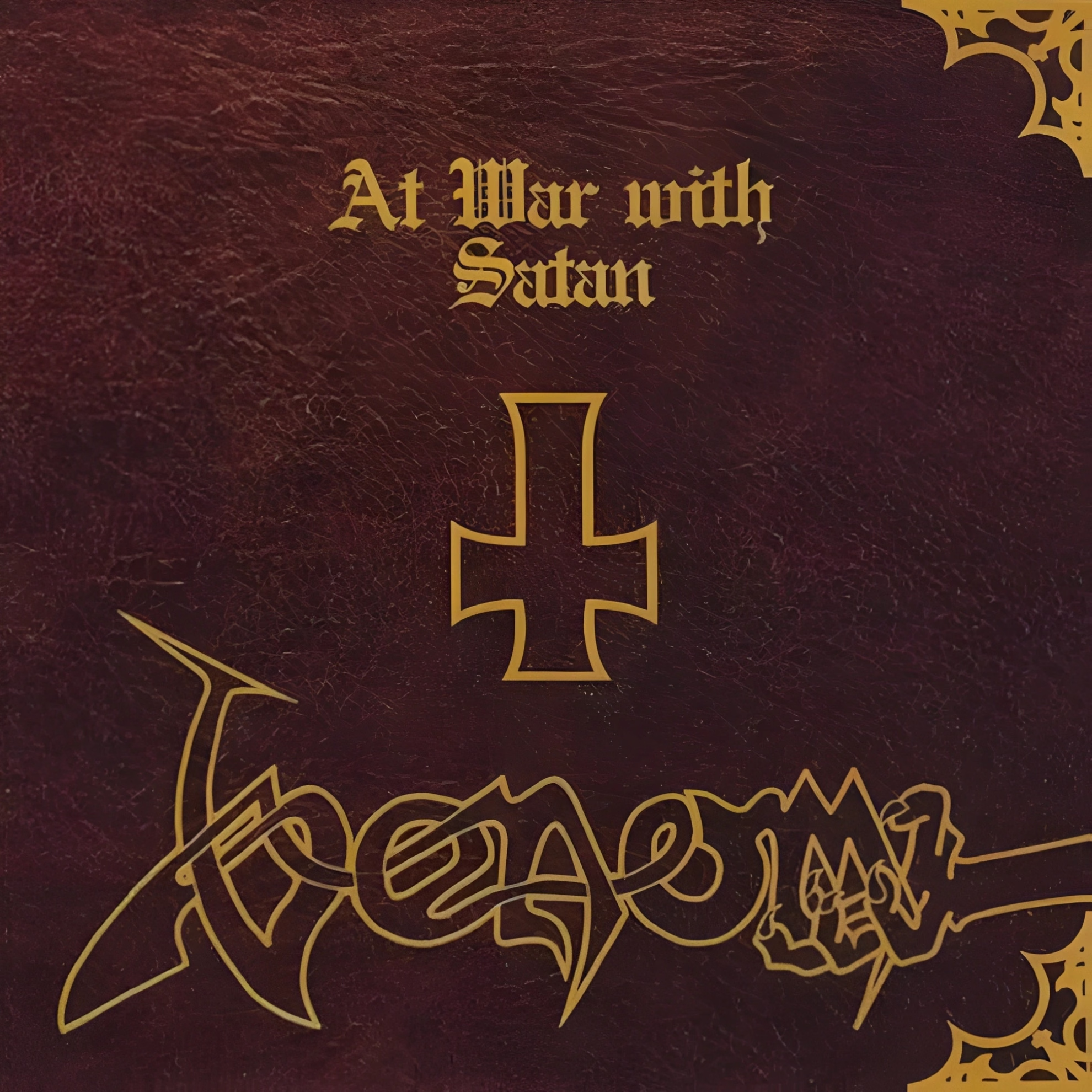
The second side returned to short, fast songs, including ‘Stand Up and Be Counted.’ The same year the band headlined a seven-date European tour with Metallica in support, and the video ‘The 7th Date of Hell,’ filmed at London’s Hammersmith Odeon, preserved the stage show that had damaged the Paramount.
Possessed and the PMRC
‘Possessed,’ released in 1985, was recorded in a stately home amid the excess the band’s success allowed. Lant later defended it as underrated, arguing that its songs were strong even where the recording fell short. Its title track entered American politics when the Parents Music Resource Center placed a Venom song on its “Filthy Fifteen” list for occult content, part of the campaign that led to the Parental Advisory labels on recorded music.
In 1985 Venom also toured the United States with Slayer and Exodus. Exodus guitarist Gary Holt, writing after Lant’s death, called those tours the greatest his band ever did and said that Lant helped shape Exodus into what it became. In the same period, a Florida death metal band took the name Mantas from Dunn’s stage name before splitting into Death and Massacre.
The question of what Venom’s Satanism meant was present from the beginning. Sociologist Massimo Introvigne, in his social history of Satanism, places Venom at the head of the first wave of black metal and characterizes its satanic content as closer to the parodic, theatrical register of Anton Szandor LaVey’s Church of Satan than to sincere devotion, a register later bands would reject.2
Lant’s own statements never varied on the point. Speaking in an interview published in June 2008, he said that he had always been interested in Satanism but that Venom were entertainers who used it the way horror films do, comparing a Venom album to an ‘Evil Dead’ film and noting that David Bowie was not actually from Mars.
Exile and Return, 1987–1999
Calm Before the Storm
Relations inside the trio deteriorated during sessions in March and April 1986 for an album to be called ‘Deadline,’ which was never completed. Dunn left to pursue a solo record, and guitarists Mike Hickey and Jim Clare replaced him on ‘Calm Before the Storm’ (1987), which set aside satanic themes for sword-and-sorcery material. After poor sales and short tours of Japan and Brazil, Lant left Venom, taking Hickey and Clare with him.
The Cronos Band Years
Lant formed his own band, Cronos, in 1988 with Hickey, Clare, and drummer Chris Patterson. It released ‘Dancing in the Fire’ (1990) and ‘Rock ’n’ Roll Disease’ (1991), and in 1995 a compilation confusingly titled ‘Venom,’ which gathered material from those records, songs from the shelved album ‘Triumvirate,’ and re-recordings of old Venom songs.
The 1995 Reunion
Lant, Dunn, and Bray reunited the classic trio to headline the Waldrock festival in the Netherlands on June 24th, 1995. The self-released ‘Venom ’96’ EP led to a contract with the German label SPV, a live box set titled ‘The Second Coming,’ and ‘Cast in Stone’ (1997), a double album pairing new songs with re-recordings of early material. It was the first record by the original lineup in 12 years.
The 1999 Leadership Crisis
The reunion had soured by 1999. Bray and manager Eric Cook resolved to stop working with Lant, and Bray wrote to dismiss him. Lant took the matter to SPV, which said it would not work with Venom without him. Lant later described his position directly: he was the one who had put the band together, and the artwork, ideas, songs, and vision were his, so he was not going to be pushed out of something he had created.
The episode settled the question of who Venom was for the rest of his life. From that point the name followed its founding singer rather than its founding lineup.
Keeper of the Name, 2000–2026
Lineups Around One Constant
‘Resurrection’ (2000) featured Lant’s younger brother, Antton Lant, on drums. Dunn left in 2002. That year Lant was struck on the neck by a falling rock while climbing in Wales, an injury that left him unable to sing or play for nearly two years and put Venom on hold; he spent the recovery deepening his computing work in streaming media and games.
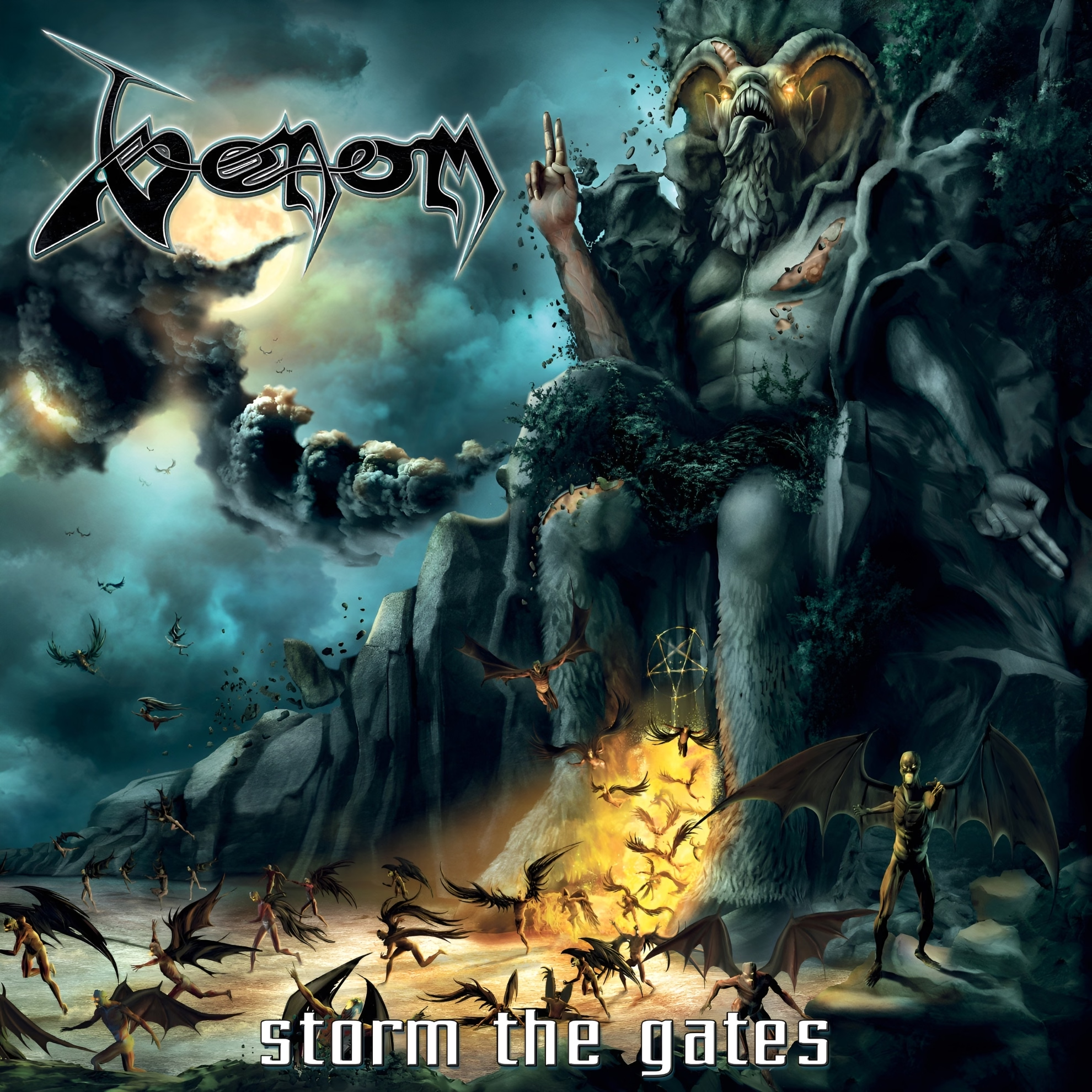
Hickey returned for ‘Metal Black’ (2006). The career-spanning box set ‘MMV’ followed in late 2005. Guitarist Stuart “Rage” Dixon joined in 2007 and played on ‘Hell’ (2008), and drummer Danny “Dante” Needham joined in 2009. That trio released ‘Fallen Angels’ on November 28th, 2011, ‘From the Very Depths’ on January 27th, 2015, the EP ‘100 Miles to Hell’ on December 22nd, 2017, and ‘Storm the Gates’ on December 14th, 2018, an album Lant produced and for which he designed the sleeve concept, logos, and layouts.
Speaking in an interview published on May 31st, 2019, Lant called the Dixon and Needham lineup the best Venom ever had, and argued that without Venom, bands such as Metallica and Slayer either would not exist or would sound very different. Alongside Venom he lent his voice to other projects, among them Dave Grohl’s Probot, Cradle of Filth, and Warfare.
The same decade produced a rival claim to the band’s history. In 2015 Dunn, Dolan, and Bray reunited at Germany’s Keep It True festival and continued as Venom Inc., playing the music of the 1988 to 1992 era and the classic records alike; Bray left that band in 2018 and Dunn in 2024.
In 2026 both Lant’s Venom and a Dolan-led Venom Inc. were still performing the early material at festivals. Lant’s Venom was the one that carried the name, and his insistence on continuity, rather than on reassembling the 1982 lineup, is the clearest documented statement of how he understood authorship: the songs and the symbols were his to keep performing.
Into Oblivion
‘Into Oblivion,’ Venom’s 16th studio album and its first in eight years, was released on May 1st, 2026, through Noise and BMG. Its completion had been delayed by the pandemic and by a restart of the recording process; Lant produced most of it, and Dixon said that Lant typically brought four or five lyric ideas for the different songs.
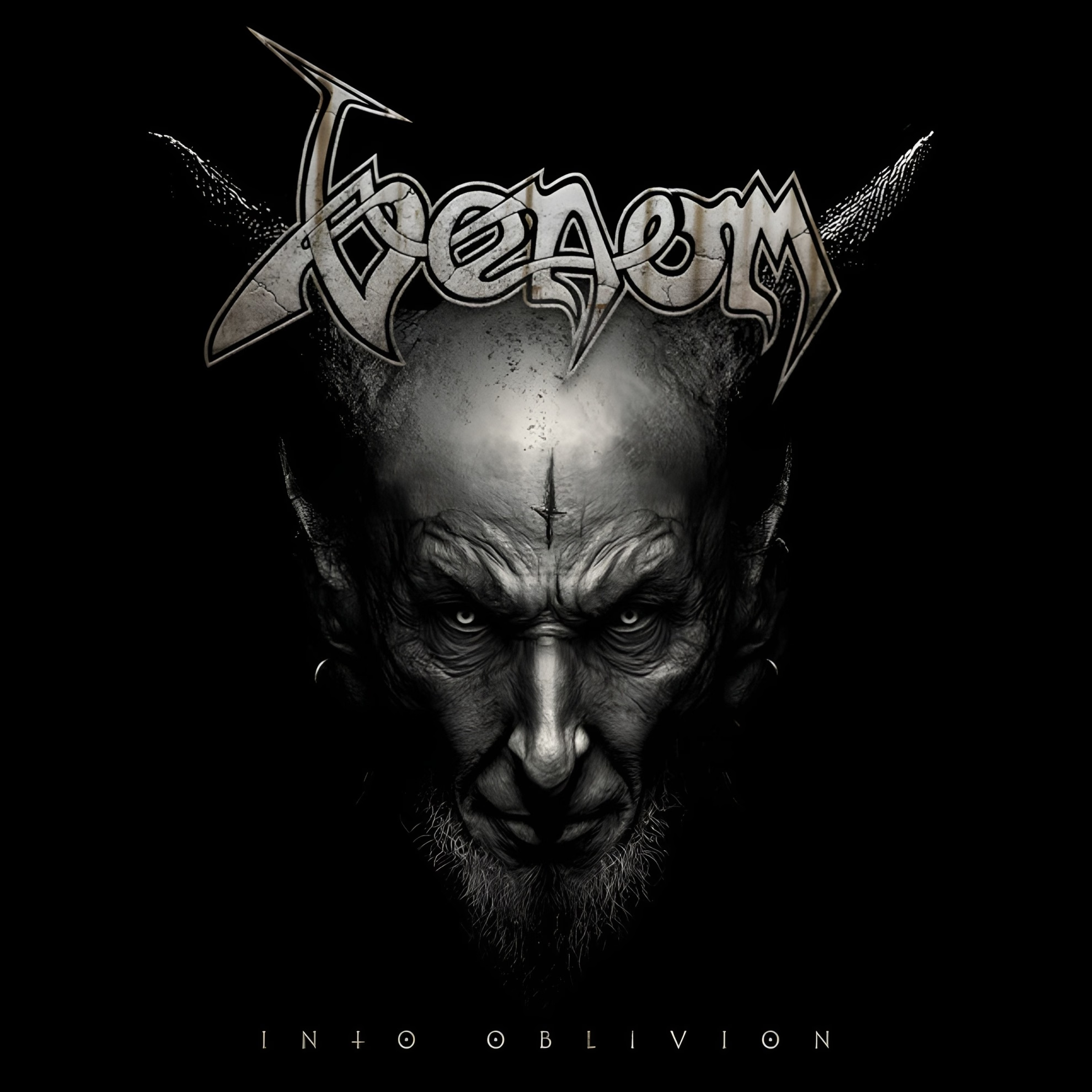
Lant said of the record that a killer album is paid for in blood, sweat, and tears, and described its lead single, ‘Lay Down Your Soul,’ released on March 5th, 2026, as an effort to bring early ideas into a new setting. He performed with Venom at Sweden Rock Festival on June 5th, 2026.
In the message Venom published with the announcement of his death, Nathan Lant wrote that his father had laid down his soul and that his music would live on, words that echo the title of his father’s final single.
The comparison with Tomas Lindberg, whose death in September 2025 this format marked, is specific. Lindberg recorded his vocals for a final At the Gates album in a single day before surgery and did not live to see it released. Lant lived to release, promote, and tour his last album, and died with the record five months old and his band active. His career therefore has no unfinished final chapter in the usual sense; its closing work is a completed statement made by the founder under the founding name.
The Lineage Venom Seeded
Thrash Across the Atlantic
Venom’s influence on American thrash is documented in the words of the musicians who absorbed it. Slayer vocalist Tom Araya said that Venom shaped Kerry King’s approach to imagery and songwriting, and King said that Slayer looked like Venom in its early days.
Megadeth’s Dave Mustaine recalled listening to Venom and Motörhead with James Hetfield while driving. Kreator’s Mille Petrozza named Venom among his favorite bands early in his career, the Canadian band Voivod recorded seven Venom songs across its early demos, and Jeff Becerra of the band Possessed named Venom and Exodus as his group’s two main influences. Possessed and Repulsion, both indebted to Venom, became foundational for death metal and grindcore.
Against Sabbath’s Recoil
Lant defined Venom’s stance against the band most often named as heavy metal’s origin. He said that Venom’s celebration of evil was inspired by the need to outdo singers like Ozzy Osbourne of Black Sabbath, who would sing about evil things and dark figures and then spoil it by crying out to God for help, a reference to the plea at the close of Black Sabbath’s 1970 title song.
This format’s remembrance of Osbourne, who died on July 22nd, 2025, treated his voice as the measure of heavy metal’s weight and wit. Lant’s contribution was to remove the recoil from that weight: where Sabbath’s narrator fled the devil, Venom’s narrator spoke as him. That shift of grammatical person, from witness to speaker, is the single most transferable idea in Lant’s work, and every later band that sang in the voice of the demonic inherited it, whether or not it shared his sense of humor.
The Norwegian Inheritance
The second wave of black metal in Norway took Venom’s name for its genre and much of its iconography while reversing its spirit.
Scholar of religion Kennet Granholm argues that early Norwegian black metal was in fact more pronouncedly heathen than satanic in its ethos, and that the first wave, with Venom at its head, had been the more explicitly satanic in lyrical content.3 Lant watched that inheritance with interest rather than resentment.
In a later interview, he said that when he read the lyrics and interviews of the early 1990s Norwegian bands, he saw them saying something similar to Venom but about their own country, its pre-Christian religion, and its gods, and that he admired them for having invented something of their own.
The Author Leaves the Name
Black metal is one of the few musical genres whose name has a single, identifiable author, and until this week that author could still be asked what he meant. Lant’s answer, given repeatedly in interviews, was consistent: the band were entertainers, the devil was material, and the records belonged on the shelf next to horror films.
Later scenes moved to the opposite pole. Granholm’s study of the Swedish ritual black metal scene describes musicians who frame their art explicitly as occult practice and venues organized around that premise, a sincerity Venom never claimed.4 For as long as Lant lived, the distance between his intent and his genre’s later self-understanding remained an argument with a living participant. With his death, it becomes a matter for the record alone.
That record is unusually specific about how the founding sounds were made, and nearly all of it comes from Lant. The chainsaw against steel, the mud in a cardboard box, the backmasked voice, the Tipp-Ex demon, the three-day debut, and the seven-day ‘Black Metal’ were choices made by a tape operator with no budget and a clear wish for the heaviest sound available.
Generations of bands later recreated that sound as an aesthetic principle, treating low fidelity as a sign of authenticity. Lant was the founder whose working method shaped it from the engineer’s side of the glass, and the only one who carried its name forward without a break from 1999 until 2026.
What closes with his death is not black metal, which long ago outgrew its namesake, but the possibility of hearing its origin explained by the person who engineered it. The band he named did not say whether it would continue.
He is survived by his son, Nathan, and by his brothers, Graham Lant and Anthony “Antton” Lant. Our deepest condolences go out to Nathan and Hel, whom Venom named in its own statement of condolence, to his brothers, family, and friends; to Jeff “Mantas” Dunn and Tony “Abaddon” Bray, with whom he wrote the records that gave a genre its name; to Stuart “Rage” Dixon and Danny “Dante” Needham, who stood beside him through the longest-serving lineup in Venom’s history; and to the Legions, the fans he thanked across four decades.
References
- Ian Reyes, ‘Blacker than Death: Recollecting the “Black Turn” in Metal Aesthetics,’ Journal of Popular Music Studies 25, no. 2 (2013): 240–257. ↩︎
- Massimo Introvigne, ‘Satanism: A Social History’ (Leiden: Brill, 2016), 462–505. ↩︎
- Kennet Granholm, ‘“Sons of Northern Darkness”: Heathen Influences in Black Metal and Neofolk Music,’ Numen 58, no. 4 (2011): 514–544. ↩︎
- Kennet Granholm, ‘Ritual Black Metal: Popular Music as Occult Mediation and Practice,’ Correspondences 1, no. 1 (2013): 5–33. ↩︎

Leave a Reply