
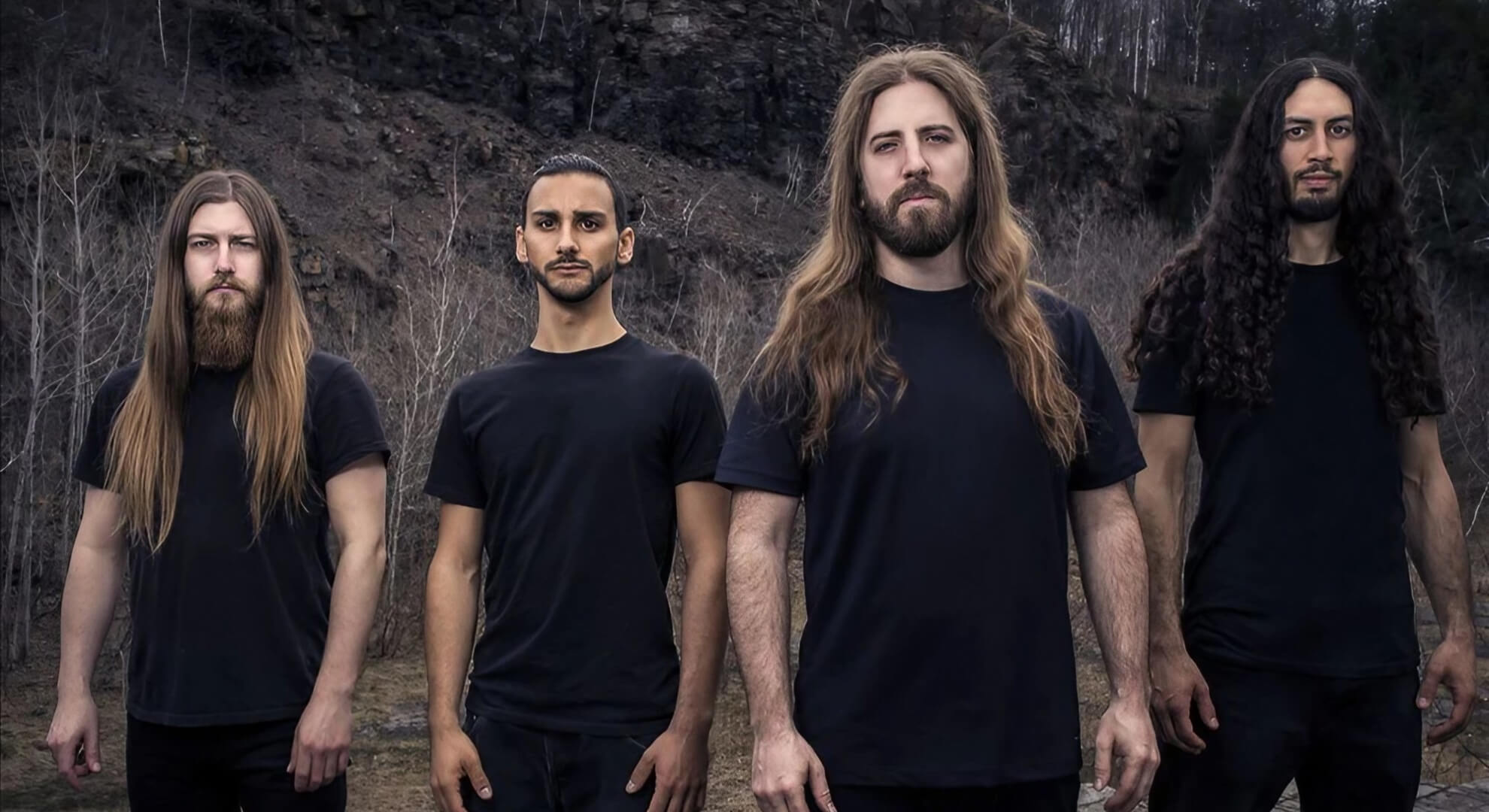


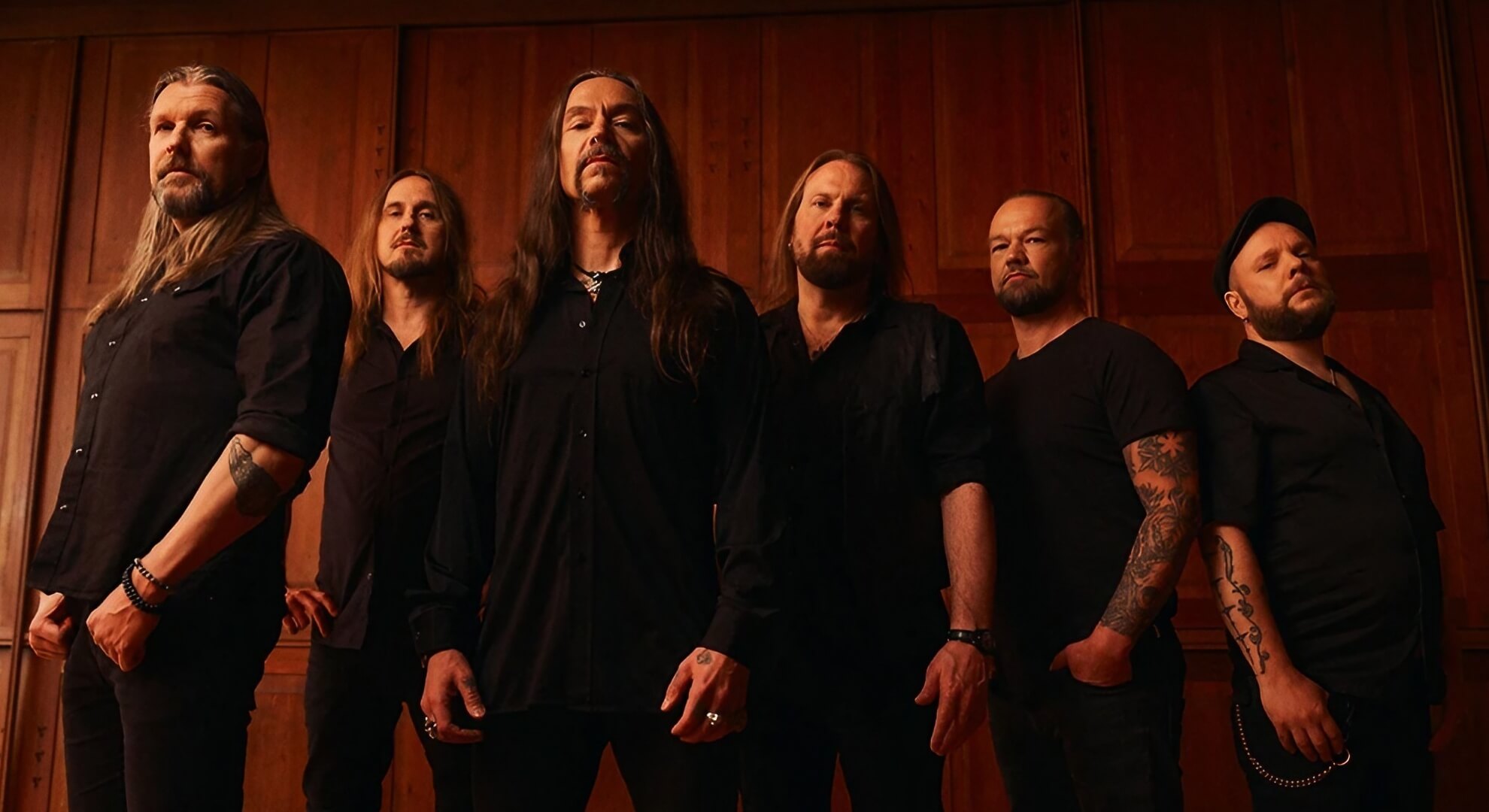
The most daring gesture in extreme metal is rarely the loudest one. When Beyond Creation released their debut record in 2011, the Montréal four-piece made an argument that has only grown more persuasive with time: that technical death metal’s relentless precision could accommodate emotional space, that a fretless bass could carry as much narrative weight as any percussive assault, and that Montréal’s long tradition of musical intelligence — a city where conservatoire rigour sits comfortably alongside its jazz improvisation culture — had something irreducible to offer the most demanding corner of extreme music. Fifteen years on, ‘The Aura’ remains the fixed coordinate by which the band’s entire subsequent career is measured.
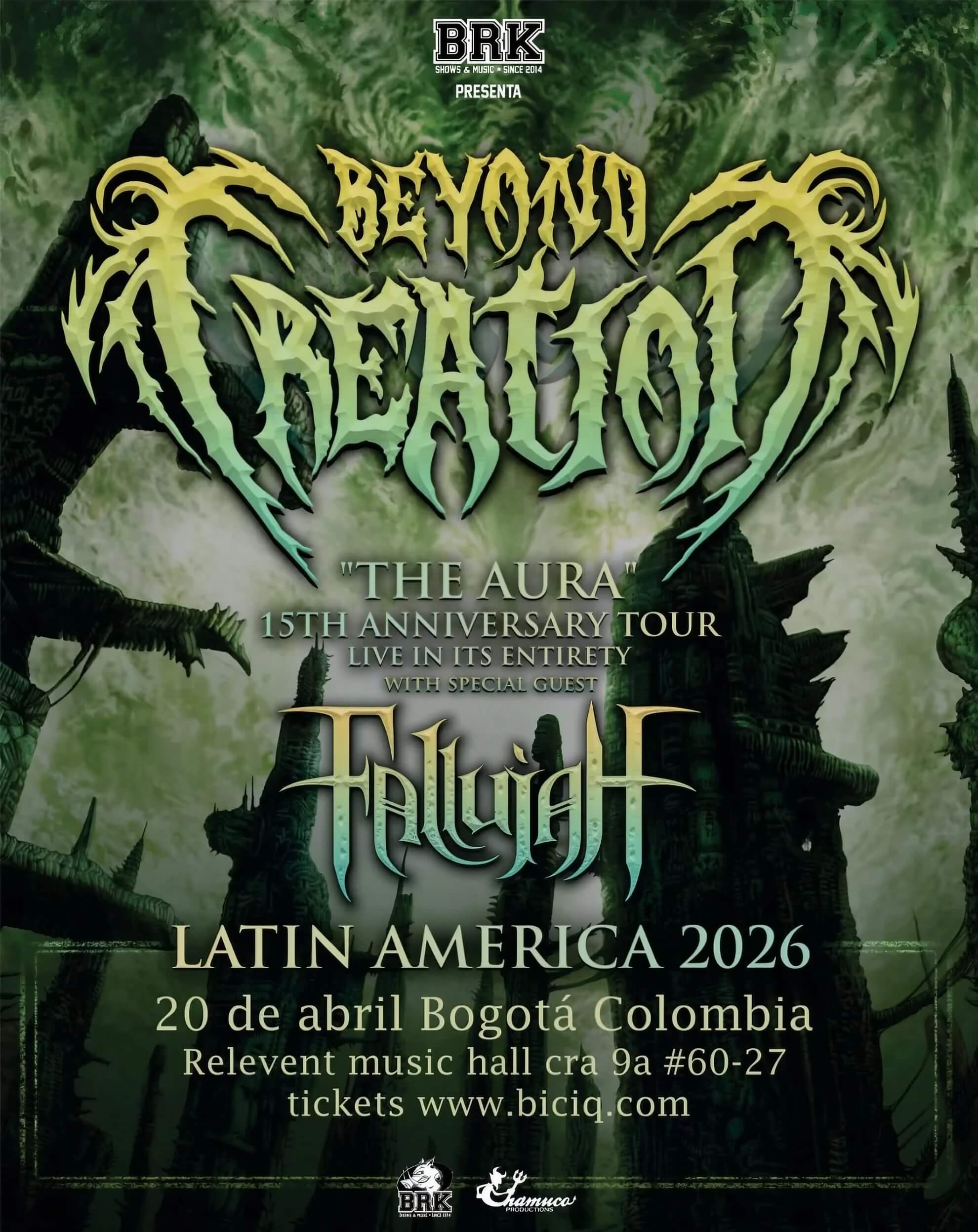
On April 20, Beyond Creation performs at Relevent Music Hall in Bogotá as part of The Aura 15th Anniversary Tour — and for the first time in the band’s history, they perform the debut album live in its entirety. Joining them as special guest across all ten dates of the Latin American run is Fallujah, the San Francisco atmospheric death metal band, making their first appearance anywhere in Latin America.
The Weight of a Debut
Technical death metal, as it crystallised in the early nineties through the foundational work of Death and Cynic, proposed a radical compression of musical intelligence into extreme form. What the genre could rarely sustain was its own ambition — the tendency toward pure display at the expense of the listening experience, precision deployed in service of spectacle rather than feeling.1
‘The Aura’ arrived in 2011 as a corrective. Its ten tracks, from the opener ‘No Request for the Corrupted’ through to the devastating closer ‘The Deported,’ moved through a set of compositional priorities that the genre had not assembled in quite that configuration before: polyrhythmic complexity, melodic fretless bass lines that functioned almost as a second lead voice, and a tonal palette belonging as much to progressive rock as to death metal.
Simon Girard, the band’s vocalist and guitarist, framed the occasion plainly when the anniversary tour was announced. “Fifteen years ago, ‘The Aura’ marked the beginning of our sonic journey,” he said, “a relentless and intricate force that carved a lasting legacy into the heart of the technical death metal scene.” The anniversary tour is not a nostalgia exercise — it is a reclamation. ‘The Deported’ has never been performed live in Latin America before this run. Its Bogotá performance April 20 will be the first.
Fretless and Unbound
In a genre that privileges the fretted guitar as its central instrument and treats the bass primarily as rhythmic foundation, the fretless bass is nearly a category error. Its expressive range demands that the player internalise pitch without mechanical guidance, producing a portamento quality that no fretted instrument can replicate.
The jazz tradition, from which the fretless bass in a rock context substantially derives, has long understood this as a tool of melodic personalisation rather than mere accompaniment.2
Dominic Forest Lapointe, who played bass on ‘The Aura,’ is the element most consistently cited as Beyond Creation’s decisive differentiator on that record. His lines do not double the guitar parts or anchor the low end in the manner of conventional death metal bass — they move independently, introduce harmonic colour, and create a textural depth that gives the album a warmth unusual in the genre.
‘Omnipresent Perception,’ the album’s most widely heard track with more than six million streams on YouTube, succeeds precisely because Lapointe’s melodic contributions allow the track’s considerable rhythmic complexity to remain navigable on repeated contact. The combination drew comparisons to Cynic’s fusion-inflected death metal, but Beyond Creation’s approach was more compressed and less overtly atmospheric — the jazz influence absorbed rather than displayed.
A Tour That Doubles as a Statement
The timing of The Aura 15th Anniversary Tour carries weight beyond simple commemoration. In February 2026, Beyond Creation released ‘Reverence,’ their first new studio recording in eight years — a single whose live debut takes place on this same Latin American run.
The years following ‘Algorythm’ — the 2018 album that earned the band a JUNO nomination and an Independent Music Award — were spent largely on the road rather than in the studio.3 Appearances at Hellfest, 70,000 Tons of Metal, and UK Tech-Fest, alongside tours with Decapitated and Rivers of Nihil, maintained the band’s standing during a studio silence that would have diminished lesser acts.
The reappearance of new material alongside a complete performance of the debut creates an unusual listening context. The Bogotá audience April 20 receives both the record that established Beyond Creation’s vocabulary and the first new phrase the band has added to it in nearly a decade — a compression of the full arc into a single evening.
Girard offered the clearest statement of intention when the tour was announced: “We will perform our debut album in its entirety for the first time ever.” As declarations of purpose go, it is difficult to improve upon.
Fallujah Crosses the Equator
Fallujah arrives in Latin America carrying a different kind of institutional weight. The San Francisco band, whose atmospheric approach to death metal crystallised on their 2014 album ‘The Flesh Prevails’ and deepened on 2016’s ‘Dreamless,’ has spent nearly two decades positioning itself as one of the few acts capable of holding technical ferocity and genuine melodic beauty in sustained tension.
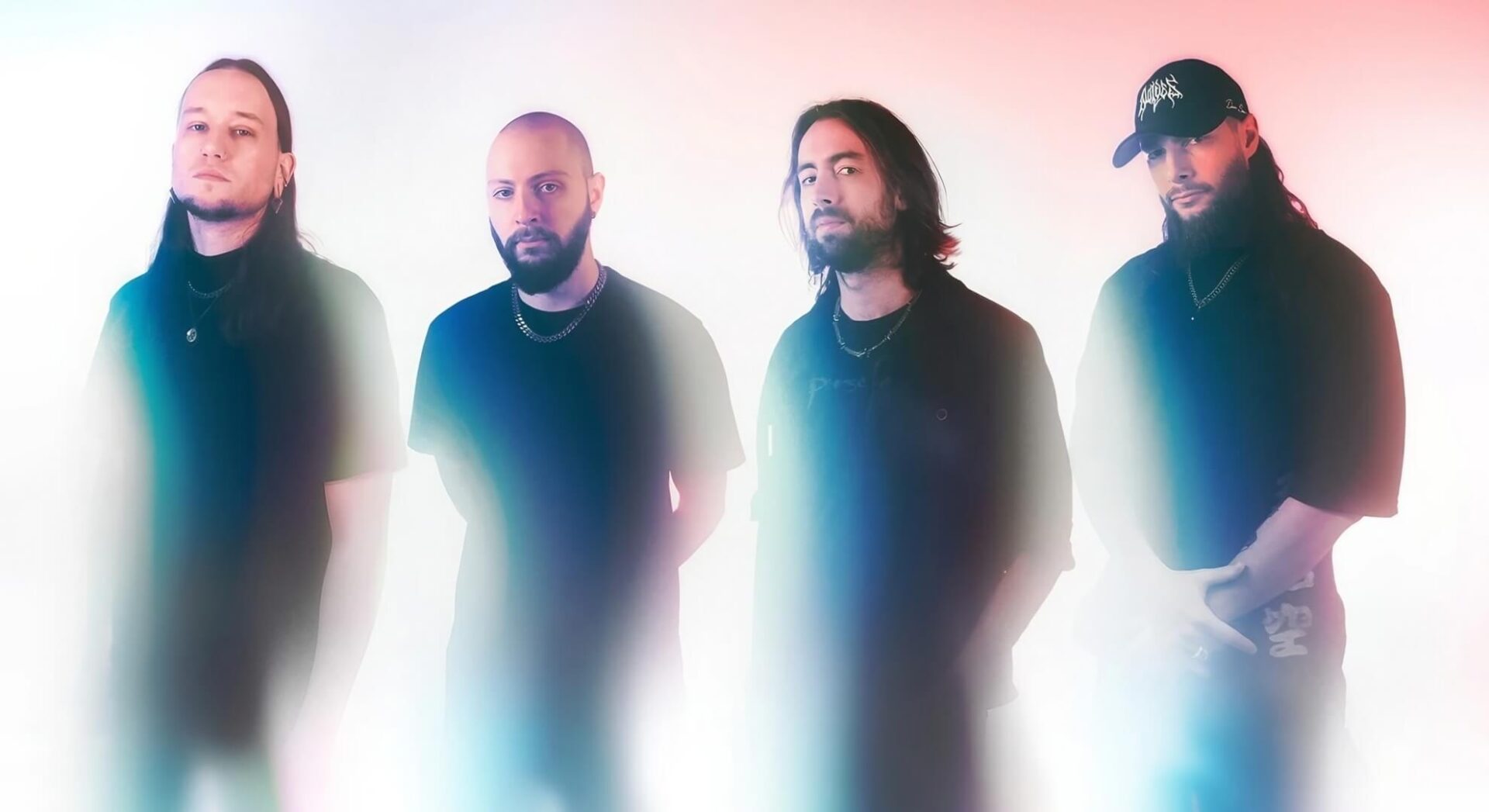
Founding guitarist Scott Carstairs, now the only remaining member from the band’s 2007 formation, has guided Fallujah through several significant lineup shifts without surrendering the core approach: long, luminous phrases suspended above technical rhythmic frameworks, the contrast between atmospheric translucence and death metal density pushed into compositional territory that few peers have occupied with equivalent consistency.
That Fallujah has never toured Latin America before this run is something of a regional anomaly. Their influence on the area’s metal communities — particularly among the atmospheric and progressive death metal scenes that have taken root in cities like Bogotá over the past fifteen years — has been substantial and largely unacknowledged in person. The April 20 date at Relevent Music Hall represents their first formal recognition of that relationship, performed in a room rather than transmitted across a screen.
The pairing with Beyond Creation is not arbitrary. Both bands share a commitment to atmosphere as a compositional discipline rather than a decorative afterthought, and both operate at the intersection of technical virtuosity and emotional reach that defines the most durable work in the genre. A Bogotá audience that has steadily deepened its engagement with extreme metal programming across two decades receives this double bill as the kind of curation that rarely arrives in the city from outside it.
Into Relevent Music Hall
Relevent Music Hall, situated in the Chapinero district at Carrera 9a #60-27, has established itself as one of Bogotá’s primary venues for international heavy music programming. Its dimensions and technical capacity suit the specific demands that both Beyond Creation and Fallujah impose on a live space — the layered low-end complexity of the former and the textural contrast of the latter both require consistent acoustic reproduction to register with the precision their compositions demand.
Fifteen years is long enough for a debut record to have become its own kind of fixed point — something against which everything that follows is measured, consciously or not. For Beyond Creation, ‘The Aura’ has performed that function since 2011, not merely as a document of where the band began but as a statement of what technical death metal could contain if the conditions were right: the right city, the right instrument, the right willingness to let melody and brutality negotiate openly.
What the Bogotá performance April 20 offers is not repetition but completion — the debut heard not as a recorded artefact but as a living event, in a room, with an audience that has waited for it without quite knowing it was waiting. The question is not whether ‘The Aura’ holds. The question is what it sounds like when it does.
Which piece from ‘The Aura’ — whether you have lived with the album for years or are only now approaching it — do you find yourself returning to, and what does the prospect of hearing it performed in full alter about the way you hold it?
References:
- Keith Kahn-Harris, ‘Extreme Metal: Music and Culture on the Edge’ (Oxford: Berg Publishers, 2007), 27–31. ↩︎
- Paul Berliner, ‘Thinking in Jazz: The Infinite Art of Improvisation’ (Chicago: University of Chicago Press, 1994), 147–152. ↩︎
- Simon Frith, ‘Performing Rites: On the Value of Popular Music’ (Cambridge: Harvard University Press, 1996), 205–209. ↩︎
Leave a Reply