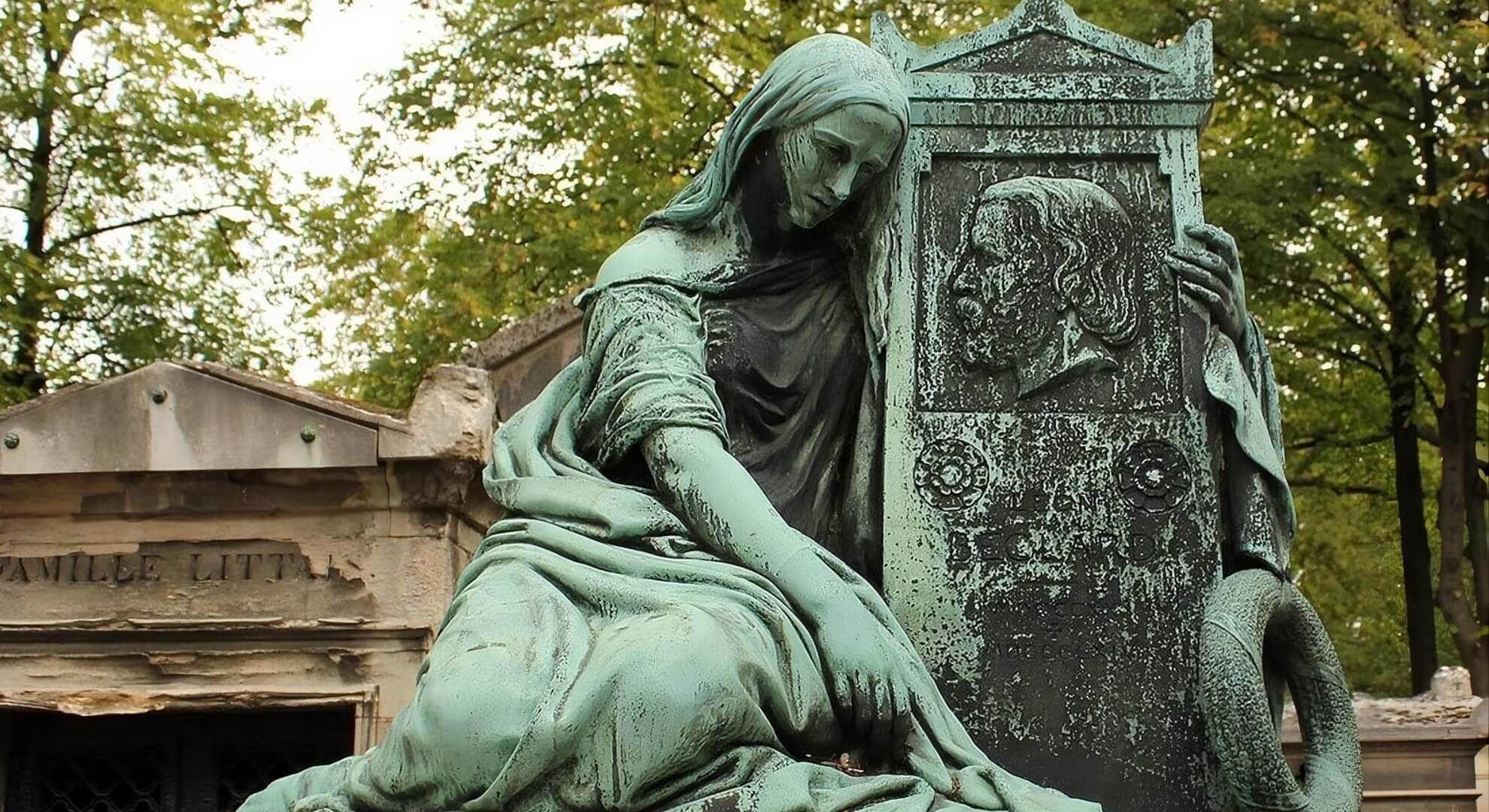


On May 28, 1871, 147 men were marched to the northeastern wall of a Paris cemetery and shot. Their bodies were thrown into an open trench at the wall’s base and covered with lime. The French state that ordered the execution had built the cemetery sixty-seven years earlier—partly as a monument to what a post-revolutionary republic believed the dead deserved.
Cimetière du Père-Lachaise opened on May 21, 1804, on the former Jesuit retreat of Père François de la Chaise, confessor to Louis XIV.1 Its designer was architect Alexandre-Théodore Brongniart, who laid out the hillside in the style of an English garden—irregular paths, varied plantings, topography that invited contemplation rather than transit. Napoleon had declared during the Consulate that “every citizen has the right to be buried regardless of race or religion.”
The cemetery was a cultural act as much as an administrative solution. Thomas Laqueur, in his history of how the living have cared for the dead, traces the transition from the crowded, Church-dominated churchyard to the secular garden cemetery as a defining shift of post-Enlightenment modernity: the moment when the state assumed custodianship of the dead and, in doing so, assumed responsibility for what those dead could mean.2 Père Lachaise was, from its opening, an attempt to give the dead of a secular republic the weight that the Church’s dead had carried.
The cemetery’s early commercial failure was instructive. Catholics refused burial in unsanctified ground; many Parisians considered the site too distant from the city. In 1804, Père Lachaise held only 13 graves.
Nicolas Frochot, the Prefect of the Seine, devised an answer: with deliberate public ceremony, the city organized the transfer of the remains of Jean de La Fontaine and Molière to the new cemetery. In 1817, the purported remains of Pierre Abelard and Héloïse d’Argenteuil followed. By 1830, the cemetery contained more than 33,000 graves.
This was the founding act of modern celebrity dark tourism—the principle that proximity to the famous dead generates desire for proximity among the living. Frochot’s strategy predates by two centuries the contemporary dark tourism industry, but its logic is identical: significance can be transferred, placed, and staged.
What the strategy could not have anticipated was that the cemetery’s most demanding pilgrimage tradition would be generated not by careful placement but by sudden massacre.
The Massacre That Wrote the Cemetery’s Truest Record
The Paris Commune of 1871 held the city for seventy-two days before being crushed by the Versailles government’s forces in a campaign of documented exceptional violence. During the Semaine Sanglante—the Bloody Week of May 21–28—between 10,000 and 30,000 Communards were killed.3 The Commune’s final fighters retreated through the working-class quarters of the 20th arrondissement.
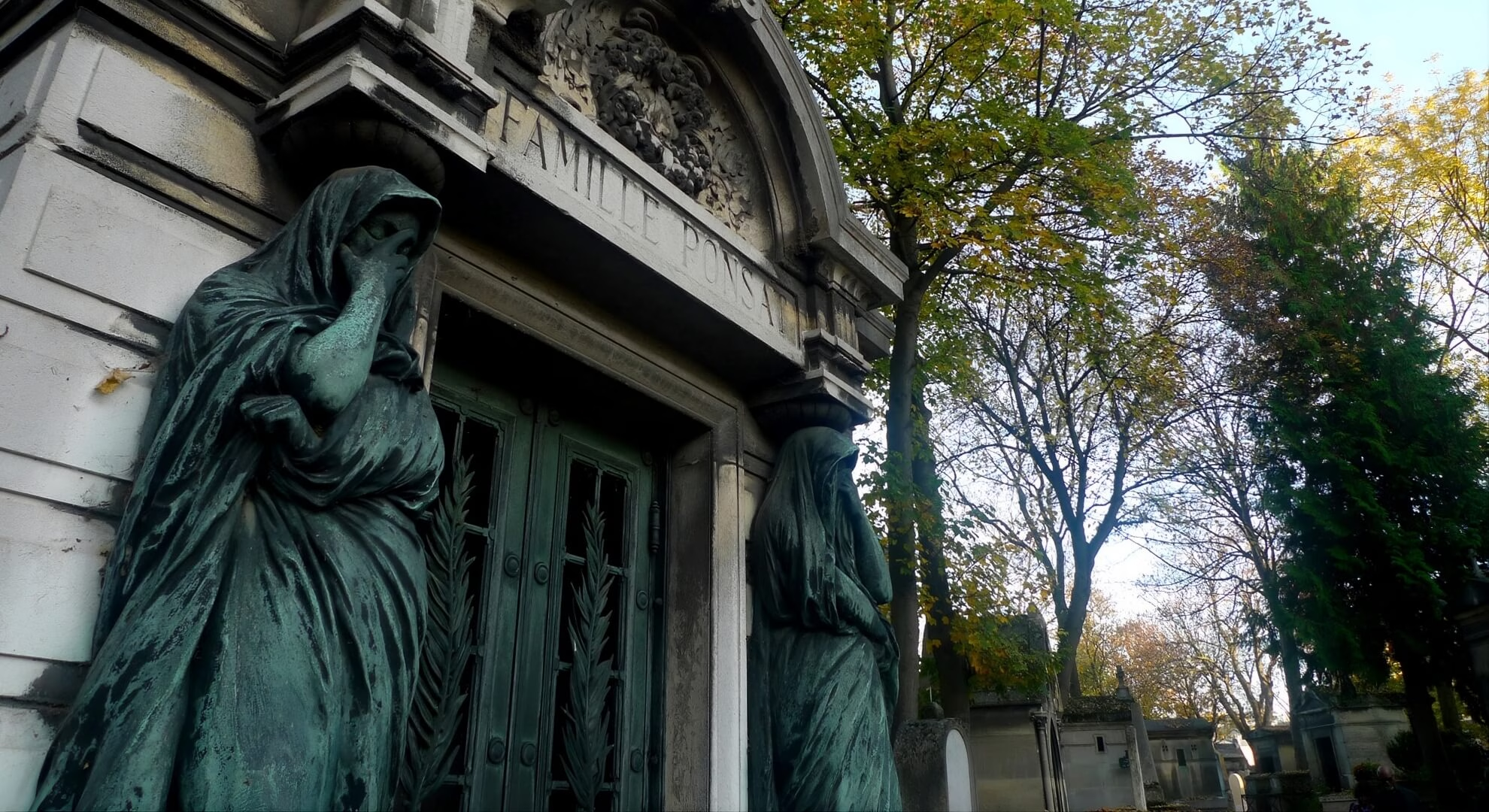
The last 147 captured were brought to the cemetery’s northeastern wall and shot on May 28. Their bodies were buried in an open trench at the wall’s base. The Mur des Fédérés—the Communards’ Wall—still bears the original bullet holes.
What followed was immediate and unmanaged. From the 1880s onward, French socialist and communist movements established an annual pilgrimage to the wall that continued through the twentieth century. This tradition preceded by decades the celebrity grave circuit that would come to dominate Père Lachaise’s popular image. It was political mourning operating through spatial practice—coming to stand where the murdered had fallen, connecting that act of presence to a living political identity.
The Mur is formally understated: a plain brick wall with a marble plaque in the cemetery’s northeastern corner. Stéphanie Toussaint and Alain Decrop, in their analysis of Père Lachaise as a site of thanatourism, identified the cemetery as a heterotopic space—a site where multiple, incompatible social logics coexist without resolution.4 The Mur’s quiet ferocity and the celebrity circuit’s cheerful pilgrimage do not address each other. They occupy the same forty-four hectares and belong to entirely different traditions of confrontation with the dead.
The Monument Paris Tried to Suppress
In 1908, Oscar Wilde’s literary executor Robert Ross commissioned Jacob Epstein to produce a tomb for the playwright, whose remains had been transferred from a temporary grave at Bagneux to Père Lachaise’s Division 89 the previous year. Epstein’s design was a twenty-ton block of Hopton Wood stone carved into a winged sphinx in a modernist-Egyptian idiom, drawing on the Assyrian figures he had studied at the British Museum and on Wilde’s poem ‘The Sphinx.’
Parisian authorities covered the monument with a tarpaulin upon its installation in 1912, finding its nudity indecent for a public setting; a bronze covering was placed over the sculpture’s genitalia without Epstein’s consent. The monument was unveiled in August 1914—the first weeks of the First World War—by the occultist and poet Aleister Crowley. The testicles were vandalized off the stone in 1961, reportedly by two English women who used stones from the adjacent path.
A glass barrier was installed in 2011 to protect the corroding limestone from the lipstick kisses that had accumulated from the 1990s onward.5 The epitaph, drawn from ‘The Ballad of Reading Gaol,’ has been read by successive generations of visitors as a prophecy that proved accurate in a direction Wilde could not have foreseen.
What Jules Dalou’s Bronze Left for the Living to Do
Victor Noir was a journalist of twenty-one, born Yvan Salmon in 1848, shot dead on January 10, 1870, by Prince Pierre Bonaparte—a cousin of Emperor Napoleon III—during an altercation over a newspaper dispute. Bonaparte was tried and acquitted. More than 100,000 people attended Noir’s funeral in Neuilly.
When Noir’s remains were transferred to Père Lachaise in 1891, the sculptor Jules Dalou depicted him at the moment after the bullet—a life-size bronze of an elegantly dressed man on the ground, his top hat fallen beside him, his face rendered with the precision of a death mask. Dalou gave the effigy a noticeable protuberance at the groin, the origins of which have never been definitively established.
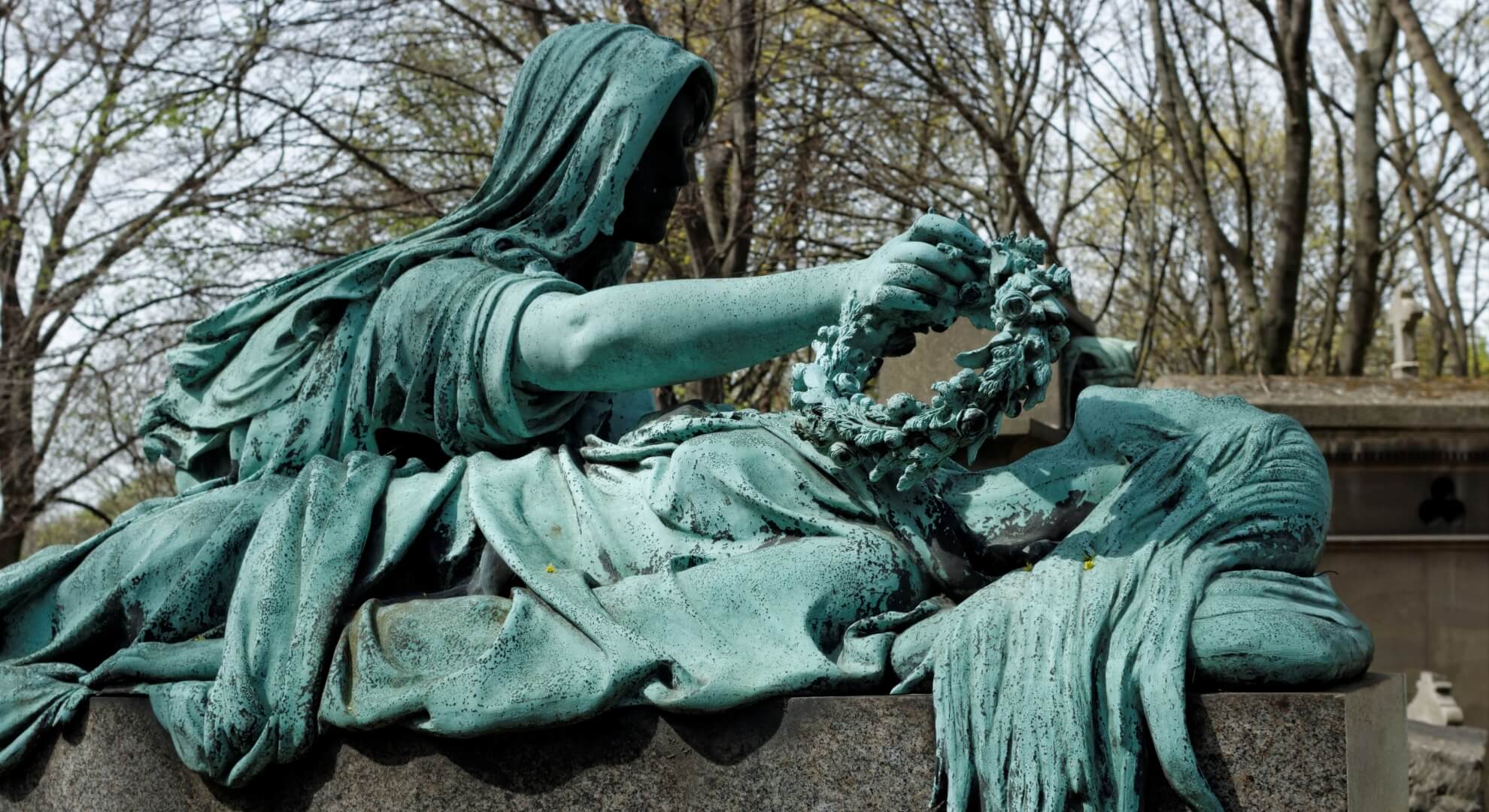
Decades later, a myth reportedly propagated by students transformed the tomb into a fertility oracle: rubbing the effigy, kissing its lips, and depositing a flower in the upturned hat would bring sexual happiness or fertility within the year. By 2004, the practice was sufficiently widespread that the Paris authorities erected a protective barrier around the statue; it was torn down after public protests by women who objected to the restriction.
The trajectory from republican martyr to political symbol to fertility idol demonstrates the process Laqueur identifies as central to the cultural life of mortal remains: the living do not leave the dead where they placed them. Meanings accumulate, are stripped, and are replaced across political regimes and generations.
At Père Lachaise, these accumulations are unusually visible—the cemetery’s two-century life has compressed them into the same terrain, leaving multiple, layered histories available to whoever arrives with enough patience to read them.
The Two Pilgrimages Père Lachaise Sustains
Philip Stone and Richard Sharpley, in their foundational work on the theory and practice of dark tourism, identified what they called “mortality mediation”—the way encounters with death in heritage contexts allow visitors to engage with their own finitude through a framework of cultural and historical meaning.6 Père Lachaise offers this in two registers that the site’s geography does not reconcile.
The first is the celebrity pilgrimage: organized, mapped, commercially serviced, moving between the graves of Frédéric Chopin, Édith Piaf, Marcel Proust, and Jim Morrison—whose Division 6 grave has required dedicated security since the early 1970s due to intensive visitation and attempted vandalism—together with Oscar Wilde and the literary and artistic canon accumulated across two centuries.
This pilgrimage offers what Frochot designed: proximity to the famous dead, a secular communion with artistic achievement. The dead it venerates are assessed, canonized, and placed.
The second is the pilgrimage to the Mur des Fédérés, which offers something different in kind. At Highgate Cemetery in London, dark tourism is formally managed: access to the Victorian section requires guided tours organized by the Friends of Highgate Cemetery, and the Victorian funerary character of the site is carefully curated for a specific visitor expectation. At Père Lachaise, the Mur operates entirely outside that logic.
No guide is required. No interpretation is offered. The bullet holes in the brick ask their question without mediation.
What dark travel provides at its most serious—and what the Mur des Fédérés offers with particular clarity—is the encounter with a past that is not finished. The 147 Communards buried at the wall’s base were never individually named or formally commemorated by the French state.
The political questions their massacre raised—what the republic owes its citizens, what violence the state may deploy in its own defense—have not been resolved by French political culture. Standing at the wall does not provide those answers. It requires only the willingness to reckon with what the bullet holes are.
What the Cemetery Still Demands
Père Lachaise was engineered for pilgrimage: transfer the famous dead, and the living will follow. What its founders could not have calculated was that the cemetery would also absorb the genuinely murdered—the Commune’s last fighters shot at its northeastern wall, Noir killed by imperial impunity and transformed by the living into an idol, Wilde exiled and then claimed by generations of mourners his society had made possible.
The celebrity dead draw visitors. The martyred and the exiled require something of them—and I would argue that this distinction, between being drawn and being required, is the axis on which serious dark travel turns. That requirement—to confront the unresolved, not merely to venerate the famous—is what distinguishes the most demanding dark travel from its more comfortable iterations.
Père Lachaise compresses two centuries of argument about what the secular dead deserve into forty-four hectares of hillside. To walk from the Mur des Fédérés to Epstein’s sphinx in a single afternoon is to move between two entirely different claims on the living—one political, one personal, neither resolved.
The distance between the bullet holes in the northeastern wall and the lipstick-stained glass in Division 89 is not far. What it asks of whoever crosses it cannot be summarized in advance.
Père Lachaise holds two sites that attract dark pilgrims for opposite reasons—Oscar Wilde’s tomb, where thousands of visitors have pressed lipstick kisses into a protective glass barrier, and the Mur des Fédérés, where 147 Communards were shot without individual names and buried in the ground beneath. If you have stood at both in the same afternoon, did they feel like parts of the same journey—or like encounters with entirely different kinds of darkness?
Tourism Partnership
We reach an audience that travels with intention — drawn to documented history, dark heritage, and the cultural weight of the places they seek out. If you operate tours, cultural experiences, accommodation, or heritage sites aligned with that ethos, we would like to hear from you. We consider partnerships with tour operators, travel agencies, hostels, hotels, museums, and any organization whose work engages seriously with dark tourism, gothic culture, or historical travel. We do not promote services we cannot stand behind editorially. Reach us through our Contact page.
References
- ‘Père-Lachaise Cemetery,’ Encyclopaedia Britannica. ↩︎
- Thomas W. Laqueur, ‘The Work of the Dead: A Cultural History of Mortal Remains’ (Princeton: Princeton University Press, 2015). ↩︎
- John Merriman, ‘Massacre: The Life and Death of the Paris Commune of 1871’ (New York: Basic Books, 2014). ↩︎
- Stéphanie Toussaint and Alain Decrop, ‘The Père-Lachaise Cemetery: Between Thanatourism and Heterotopic Consumption,’ in Leanne White and Elspeth Frew, eds., ‘Dark Tourism and Place Identity: Managing and Interpreting Dark Places’ (London: Routledge, 2013), 13–27. ↩︎
- Ellen Crowell, ‘Oscar Wilde’s Tomb: Silence and the Aesthetics of Queer Memorial,’ BRANCH: Britain, Representation and Nineteenth-Century History, 2013. ↩︎
- Richard Sharpley and Philip R. Stone, eds., ‘The Darker Side of Travel: The Theory and Practice of Dark Tourism’ (Bristol: Channel View Publications, 2009). ↩︎


Leave a Reply