
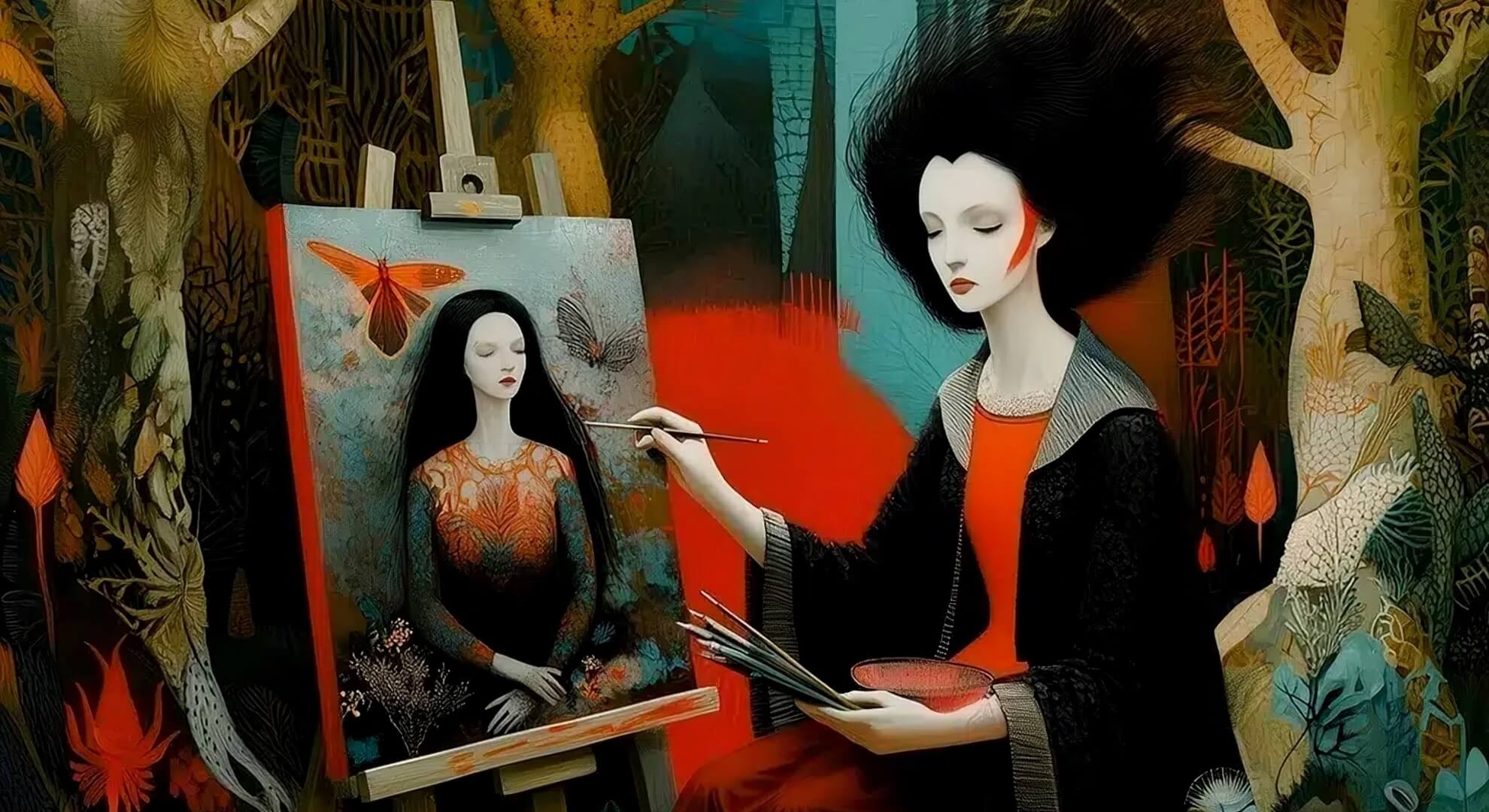


The retrospective is, by definition, an act of conversion. An artist who worked in estrangement from institutions — against official traditions, outside the frameworks of critical recognition — is reconstituted by the museum, dated and attributed and placed in a white-walled room with a curator’s essay. What the institution offers is not simply visibility but a specific kind of legibility: the artist’s particular transgression becomes a chapter in a recoverable narrative.
Three major exhibitions running simultaneously in spring 2026 — ‘Leonora Carrington’ at the Musée du Luxembourg in Paris, through July 19th; ‘Hammershøi. The Eye that Listens’ at the Museo Nacional Thyssen-Bornemisza in Madrid, through May 31st; and ‘The Family Album of Ralph Eugene Meatyard’ at the High Museum of Art in Atlanta, through May 10th — each perform this conversion on a visual tradition whose defining characteristic was precisely what institutions tend to exclude: the esoteric, the silent, the uncanny.
The Retrospective as Conversion
The three exhibitions share nothing obvious in aesthetic terms. Carrington’s eruptive mythological paintings — hybrid beings drawn from Celtic lore, alchemical manuscripts, and esoteric cosmology — have nothing visible in common with Hammershøi’s austere gray interiors, where the most dramatic event is the angle at which light crosses an empty floor.
Neither has obvious kinship with Meatyard’s black-and-white photographs of his family in Halloween masks, staged in the dilapidated farmhouses of rural Kentucky. What they share is not aesthetic affinity but institutional circumstance: each artist developed a practice at the deliberate margins of institutional art, and each is now being returned to the institution as art-historical property.
The visual traditions at stake in these three shows are distinct and non-interchangeable. Carrington’s practice belongs to post-Surrealist esoteric painting — a tradition whose sources run through Max Ernst’s mythological automatism, through the mystical symbolism of Remedios Varo, and back into the late-medieval alchemical image-world that European Surrealism claimed as its own precursor.
Hammershøi works in the line of late nineteenth-century Northern European Symbolism, specifically the Danish tradition of melancholic interior painting — closer in spirit to the German Romantic introspection of Caspar David Friedrich than to the optical exuberance of French Impressionism that dominated the Parisian critical world of his time.
Meatyard belongs to a distinctly American tradition he named himself: “romantic-surrealist,” after the American satirist Ambrose Bierce’s definition of Romance as fiction that “owes no allegiance to the God of Things as They Are” — a Southern Gothic sensibility inflected by Zen Buddhist practice, the photographic mysticism of Minor White, and the literary-intellectual circle of Lexington, Kentucky.
Carrington at the Musée du Luxembourg
The Musée du Luxembourg presents its ‘Leonora Carrington’ retrospective — the first of this scale in France, gathering 126 works across her career — through a curatorial framing that describes her as a ‘Vitruvian Woman’: a total artist, a figure of harmony and innovation.
The metaphor is historically pointed: Carrington did insist throughout her life on a practice entirely her own, refusing the role of muse that the Parisian Surrealist group imposed on the women in its orbit, and she developed an independent visual world of extraordinary density in Mexico, largely outside European institutional attention for decades. But the ‘Vitruvian Woman’ framing performs a specific transformation on her work.
Carrington’s paintings are not harmonious. They are inhabited by hybrid creatures in states of unsettling metamorphosis — part human, part animal, part mythological being — and their relationship to occult traditions is not decorative but operational.
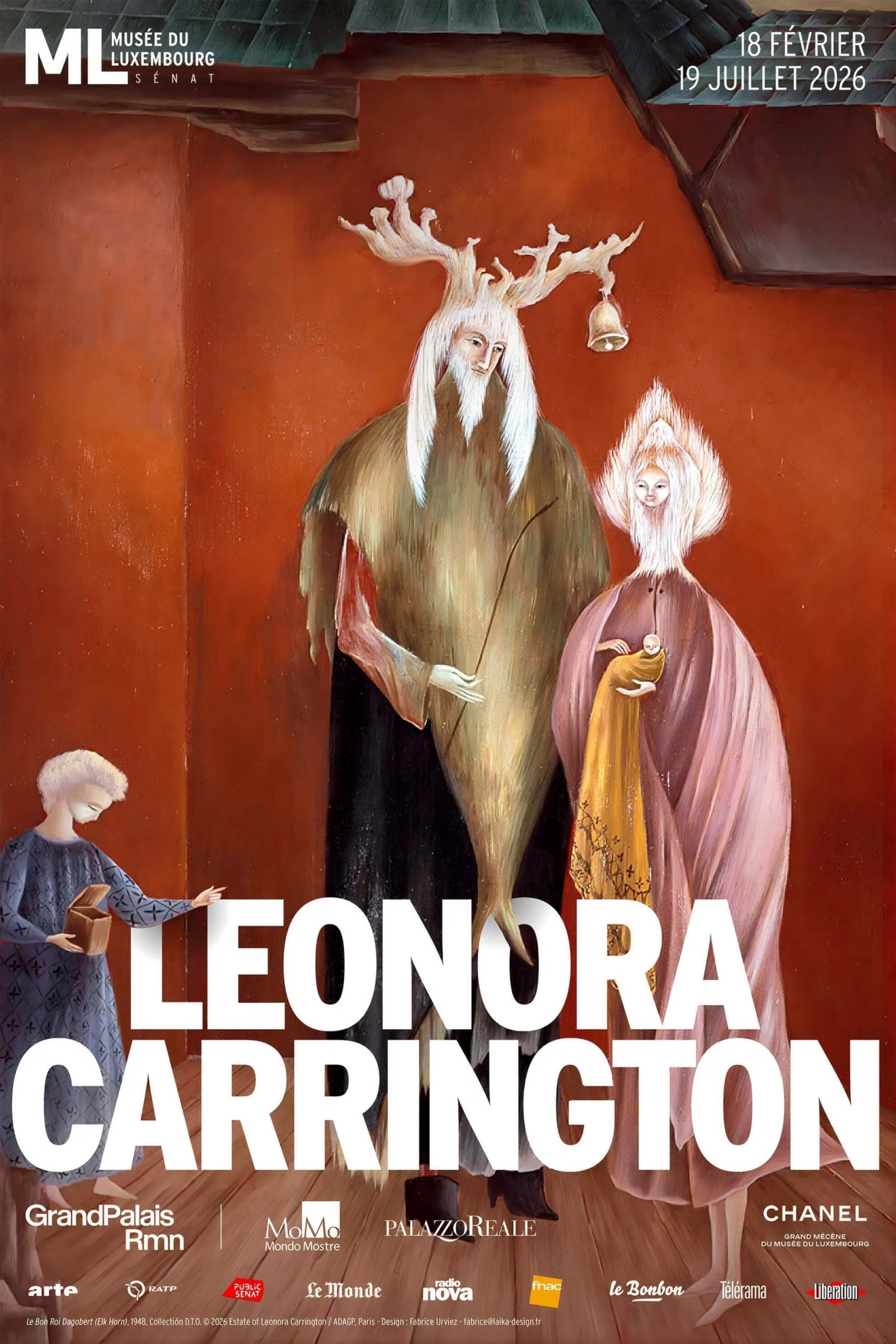
Works like ‘Artes 110’ (1944) and ‘The Pleasures of Dagobert’ (1945) engage Celtic folklore, Cabalistic symbolism, and alchemical process not as visual motifs but as intellectual frameworks that resist reduction to biography or self-expression.1
Aberth noted that Carrington’s relationship with Surrealism was consistently inflected by systematic engagement with alchemical and Celtic traditions that distinguished her practice from automatist orthodoxy. What the museum receives from Carrington is a version of Surrealism filtered through feminist recovery — a legitimate and significant critical operation, but one that tends to fold the esoteric dimension of her work into a narrative of independence and self-determination, rather than engaging it on its own anti-rational terms.
The institution can accommodate the feminist Carrington; the practicing alchemist requires a more difficult frame, and it is worth attending to how much of that frame the Musée du Luxembourg’s exhibition actually provides.
Hammershøi at the Thyssen-Bornemisza
‘Hammershøi. The Eye that Listens’ at the Thyssen-Bornemisza gathers around ninety works for the first major Spanish retrospective of the Danish painter, and positions his austere domestic interiors in dialogue with seventeenth-century Dutch masters and with Edward Hopper.
The comparison to Hopper is revealing precisely because of how much it flattens Hammershøi’s particular darkness. Hopper’s interiors are narrative — they are inhabited by isolation, but they remain populated with psychological content, with the specific American loneliness of gas stations and lunch counters and hotel rooms.
Hammershøi’s rooms are something more unsettling: spaces from which narrative has been so thoroughly subtracted that the emptiness becomes its own subject. His wife Ida appears in his interiors not as a presence but as a shape — always seen from behind, never engaged — and the effect is not loneliness but something closer to the deliberate erasure of psychological legibility.
The exhibition’s subtitle — ‘The Eye that Listens’ — points toward what the institution requires of this silence: it must be converted from negation into presence, from absence into aesthetic quality. Hammershøi’s work fell into near-total critical obscurity after his death in 1916 and was only systematically recovered beginning in the nineteen-eighties, a timeline that is itself significant.
The darkness of his interiors — the way his gray palette and subtracted narrative produce an image of suspended time, of waiting without object — was precisely what made him marginal to the dominant institutional formations of the early twentieth century. It is also, the Thyssen-Bornemisza’s retrospective argues, what makes him legible now.
What the exhibition does not say directly is that contemporary interiority has been aestheticized in ways that make Hammershøi’s formal strategies newly comfortable — that his palette of off-whites and milky grays is now also the palette of minimalist design culture. After its Madrid presentation, the show travels to the Kunsthaus Zürich in Switzerland, where it runs from July 3rd through October 25th, 2026. The darkness, in other words, has been made habitable.
Meatyard at the High Museum
The High Museum of Art’s ‘The Family Album of Ralph Eugene Meatyard’ takes a specific and unusual approach to its subject: the 36 gelatin silver prints on display are precisely the 36 photographs Meatyard selected for his 1970 Gnomon Press monograph — the survey he edited while dying of cancer, intending it to stand as his definitive artistic statement.
In displaying exactly those photographs, the High honors Meatyard’s own editorial judgment, which is not what posthumous retrospectives typically do. The exhibition runs through May 10th, 2026, and coincides with the centenary of his birth.
What is harder to locate in the High’s framing is Meatyard’s specific relationship to the tradition he named “romantic-surrealist,” drawn from Bierce’s definition, but whose visual logic runs through staged scenes in dilapidated Southern farmhouses, with his family members in masks enacting symbolic dramas that serve a specifically spiritual purpose.
His circle included the Trappist monk and writer Thomas Merton, the poet Wendell Berry, and the critic Guy Davenport — a specifically Kentuckian intellectual world in which photography, poetry, and contemplative practice were understood as inseparable.
Meatyard worked as an optician in Lexington, positioning himself consciously outside what he regarded as mainstream photographic modernism. The curatorial framing at the High describes him as “pioneering” — accurate, but insufficient to the nature of his practice, which was less about formal invention than about using the camera as an instrument for spiritual inquiry, in a tradition closer to the Christian contemplative South than to the New York avant-garde.
When Darkness Becomes Heritage
The question each of these shows poses without fully answering is whether the darkness they contain is still the same darkness that produced it. Carrington’s esoteric hybrid creatures, Hammershøi’s emptied domestic spaces, Meatyard’s masked Southern family — each practice was developed in a specific, documented condition of estrangement from institutional norms.
Each resisted the kind of legibility that allows an institution to mount a retrospective: the esoteric exceeds rational framing by design; Hammershøi’s silence resists narrative resolution; Meatyard’s amateurism was a deliberate departure from professional photographic practice. What the museum offers all three is the one condition they were, at some level, working against: the condition of being completely apprehended.
This is not a criticism of the Musée du Luxembourg, the Thyssen-Bornemisza, or the High Museum of Art, each of which is doing serious curatorial work and making genuinely important shows available. Institutional absorption is not a neutral operation, however.
Darkness that has passed through the retrospective — labeled, dated, placed in dialogue with Dutch masters or feminist history or a centenary — is not the same darkness that was produced at the margins. The transformation is the institution’s central function, and it is worth attending to what it produces: not visibility for these three practices, exactly, but a specific version of visibility, in which the esoteric becomes innovative, the silent becomes an aesthetic quality, and the uncanny becomes a contribution to photographic history.
The commission the institution gives is legibility. What each of these artists originally refused was precisely that.
References
- Susan L. Aberth, ‘Leonora Carrington: Surrealism, Alchemy and Art’ (Farnham: Lund Humphries, 2004), 45—62. ↩︎
Leave a Reply