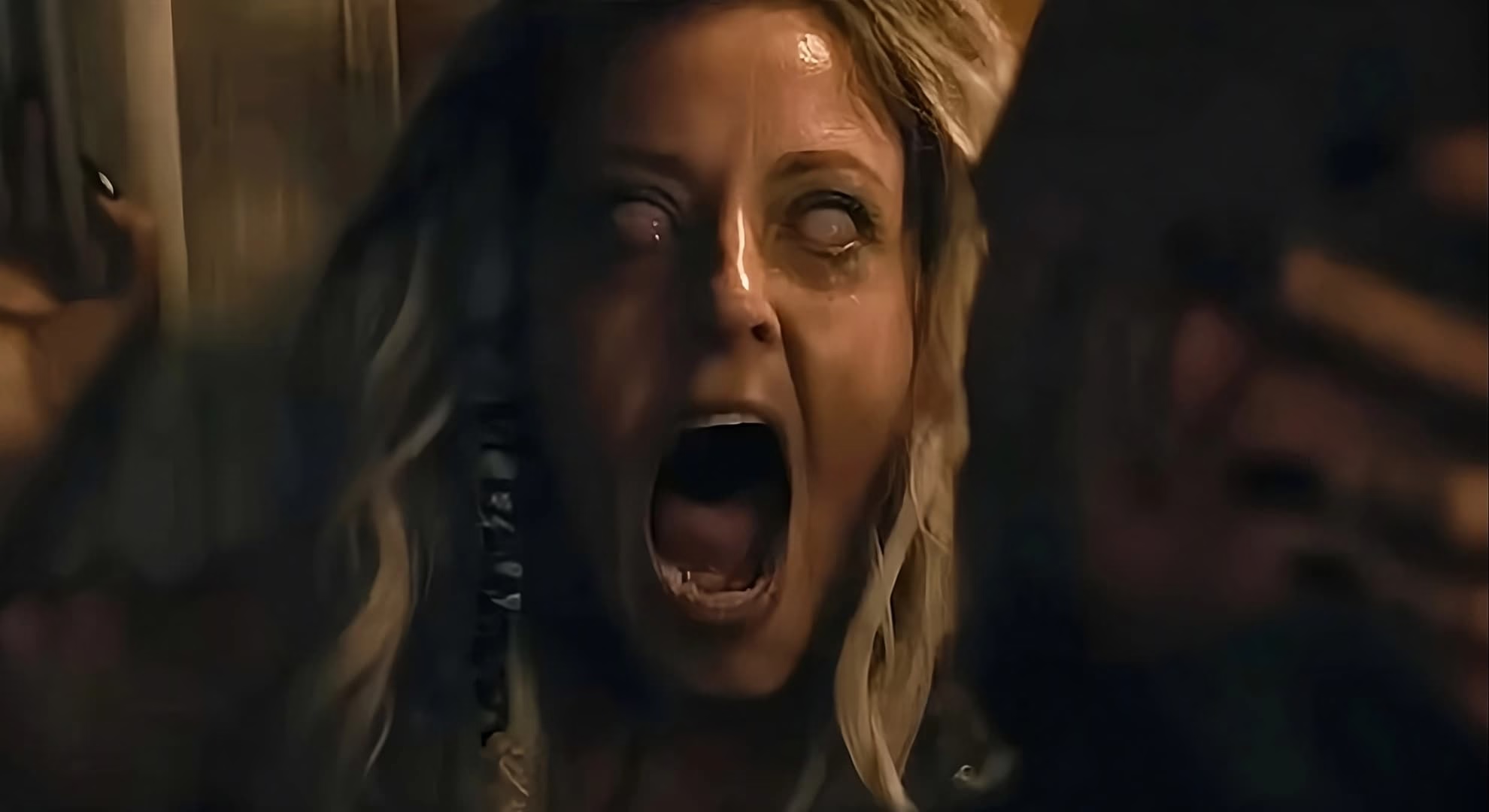


Horror that works through the ear carries a longer pedigree than the horror film itself. Mid-twentieth-century radio anthologies such as Suspense, broadcast on CBS from 1942 to 1962, and Inner Sanctum Mysteries built their dread from voice and silence, leaving the images to the listener.
That contract — the audience supplies what the medium withholds — found a contemporary heir in the audio-horror podcast. The most austere example of the form now reaches the one venue it seems least suited to survive, the movie theater.
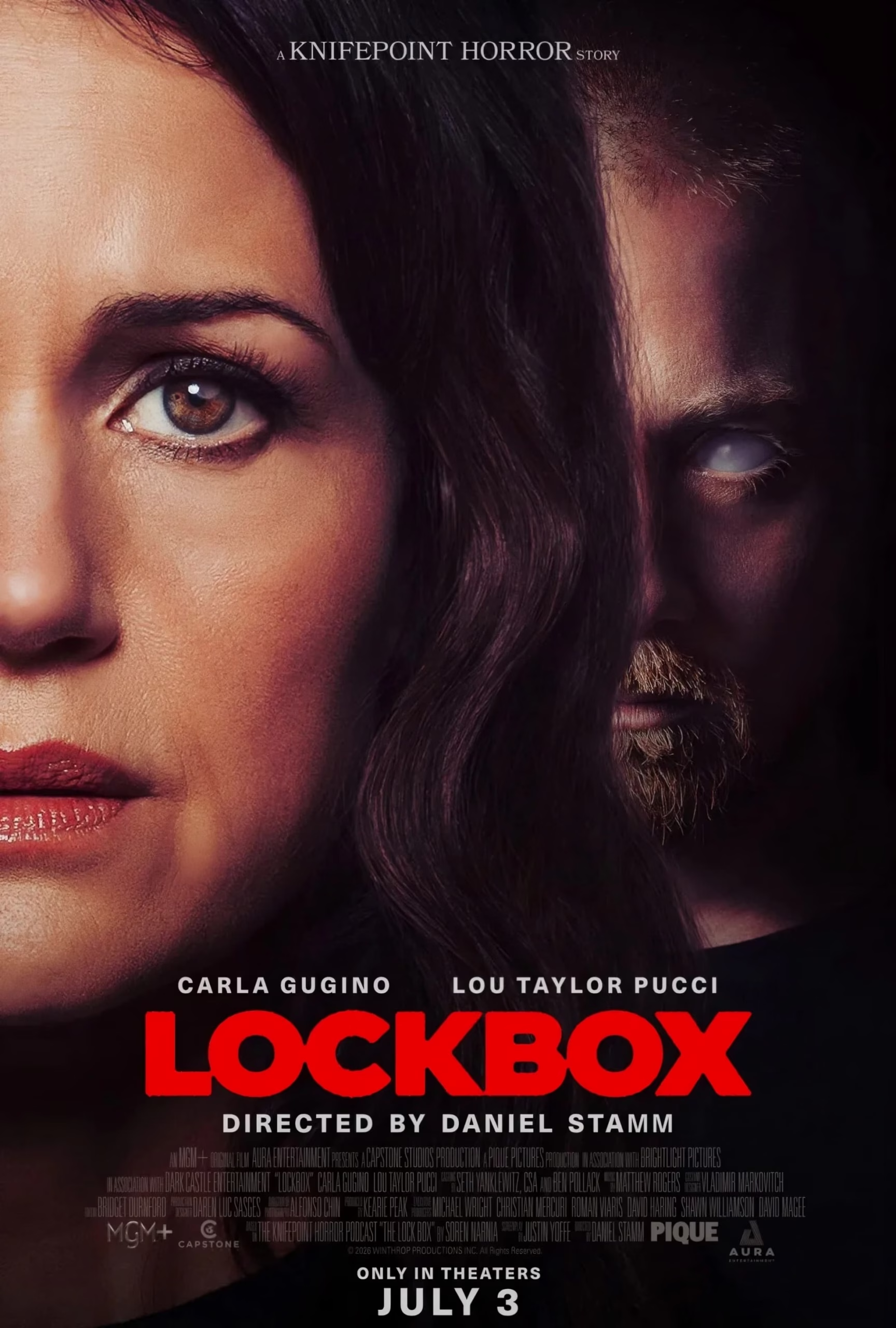
‘Lockbox,’ directed by Daniel Stamm, opens in select US theaters on July 3rd, 2026 through Aura Entertainment, with a later streaming and video-on-demand window planned at MGM+. Rated R, the film adapts ‘The Lock Box,’ a 2019 entry in Soren Narnia’s Knifepoint Horror podcast, from a screenplay by Justin Yoffe.
Carla Gugino plays Ellen, a woman who retreats to a rural town and takes in her severely traumatized cousin, Winthrop, played by Lou Taylor Pucci. Their fragile household comes apart when a neighbor warns that Winthrop is dangerous and an otherworldly entity proves to have followed him there. Katharine Isabelle completes the principal cast.
Narnia’s Horror of Subtraction
Knifepoint Horror premiered on November 23rd, 2010, and has gathered its following through refusal rather than accumulation. Its episodes are first-person confessions, narrated most often by Narnia himself in a flat and even register, with no scoring and almost no sound design.
The stories arrive as uninterrupted testimony, frequently printed without paragraph breaks, an effect closer to a confession recorded than a drama performed. Narnia has said the solitary voice was simply the most logical way to carry the material rather than a stylistic pose.
Writing for Vox in 2021, the critic Aja Romano located the show’s power in that same minimalism, and in the way its silences fill the listener’s mind. The fear is produced by what the format declines to provide — no music to cue it, no effect to confirm it, only a voice describing something the listener must assemble alone.
‘The Lock Box’ belongs to that method. Its horror, like the series around it, is a function of withholding.
From the Ear to the Eye
The adaptation therefore inherits a precise problem. A medium defined by showing must carry material whose entire charge comes from not showing.
Cinema can certainly withhold, since the unseen threat is among the oldest tools in the horror director’s kit. It cannot withhold in quite the way a voice in the dark does, because the camera is always, by default, presenting something to look at.
The question ‘Lockbox’ raises before a single screening is whether implication that lived in the listener’s head can be made concrete on screen without collapsing into the literal. The history of horror adaptation is crowded with properties whose power evaporated the moment an effect was asked to stand in for a suggestion.
Narnia’s stated engine of fear — isolation, weather, the quality of the air and the light — points toward what a faithful version would need to keep, and toward what is easiest to lose.
Stamm’s Disciplined Quiet
Daniel Stamm is a useful director to set against that problem. The German filmmaker’s ‘The Last Exorcism’ (2010) treated the found-footage form as a structural discipline rather than a stunt, holding back its possession imagery until the framing had done the preparatory work.
His later studio assignment, ‘Prey for the Devil’ (2022), operated inside more conventional supernatural machinery, yet the earlier film established a sensibility organized around restraint and delayed revelation.
Advance materials for ‘Lockbox,’ including the trailer Aura released in June, foreground silence and slow accumulation over the stinger-and-shock rhythm that governs most studio horror. The approach, should the finished film hold to it, is the one the source most requires.
Cinematographer Alfonso Chin and composer Matthew Rogers join Stamm on a production shot in and around Vancouver under the working title ‘Winthrop.’ A composer’s presence is itself part of the project’s central tension, given a source that uses almost no music at all.
Performers From the Genre Margins
The casting gathers performers with documented standing in cult and genre work. Carla Gugino has assembled a body of horror performance around control under duress, from the single-room ordeal of ‘Gerald’s Game’ (2017) to her recurring collaborations with Mike Flanagan.
Lou Taylor Pucci, who carries the role of the hunted cousin, came up through genre features including the ‘Evil Dead’ remake (2013) and the body-horror romance ‘Spring’ (2014). The part calls for exactly the frayed, withholding register that the source’s dread depends on.
Katharine Isabelle remains inseparable from ‘Ginger Snaps’ (2000), the werewolf film that treated adolescence and transformation as a single process and earned a durable cult following. Her presence signals the kind of horror that accrues a devoted rather than a mass audience.
An Open License, a New Pipeline
‘Lockbox’ is the first feature to emerge from Knifepoint Horror, and it will not be the last. Narnia has long released the stories under Creative Commons terms that permit others to adapt them, an unusual openness that lowers the barrier between a freely distributed podcast and a commercial film slate.
A second feature is already in production. ‘Fiona’, directed by Nicholas McCarthy from a screenplay by Justin Yoffe and Evan Hart, began shooting in Toronto in late May 2026, with Maggie Grace and Steve Howey leading a story about a rural romance that turns toward apocalyptic ends.
The two films share more than a source. Both come through producer Kearie Peak’s Peak Pictures alongside Capstone Studios, and both are set for Aura Entertainment theatrical runs ahead of MGM+ streaming — the outline of a podcast adapted at scale.
From Castle’s Gimmicks to Narnia’s Silence
The production carries one further irony in its credits. ‘Lockbox’ is made in association with Dark Castle Entertainment, the label Joel Silver, Robert Zemeckis, and Gilbert Adler founded in 1998 and named for William Castle.
Castle was mid-twentieth-century horror’s great showman of apparatus, from the seat buzzers wired into theaters for ‘The Tingler’ (1959) to the flying skeleton of ‘House on Haunted Hill’ (1959). Dark Castle’s 1999 debut revived the practice, handing scratch-off tickets to ticketholders.
That lineage now stands behind a property whose power runs in the opposite direction, toward the removal of every device. The pairing is accidental, yet it states the wager ‘Lockbox’ is making with unusual clarity.
The Wager of the Visible
What ‘Lockbox’ tests, when it opens on July 3rd, is whether the most subtracted form of contemporary horror can withstand the most additive medium available to it. The source earned its following by trusting the audience to supply the image, and the film must decide how much of that trust to keep and how much to spend.
Should Stamm hold to the restraint his early work and the advance materials promise, the result will measure something larger than one adaptation — the distance between horror that is heard and horror that is shown. That measurement, more than the entity pursuing Winthrop, is the experiment opening this week.
Aura Entertainment is now developing several features from Soren Narnia’s work; do you think a podcast whose dread depends on the absence of images can sustain a full run of films, or does each adaptation spend down the very restraint that gave the source its hold?
Leave a Reply