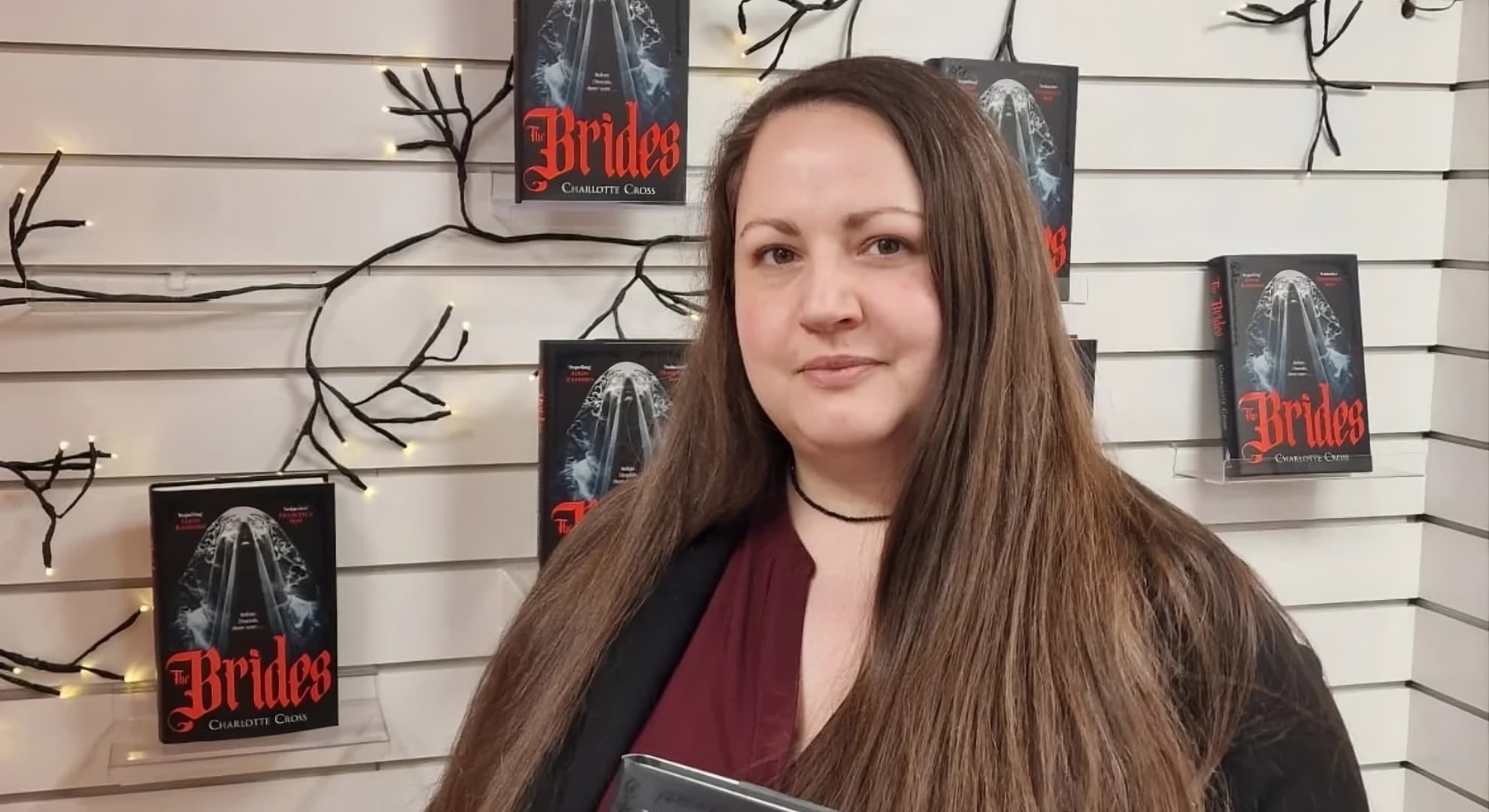


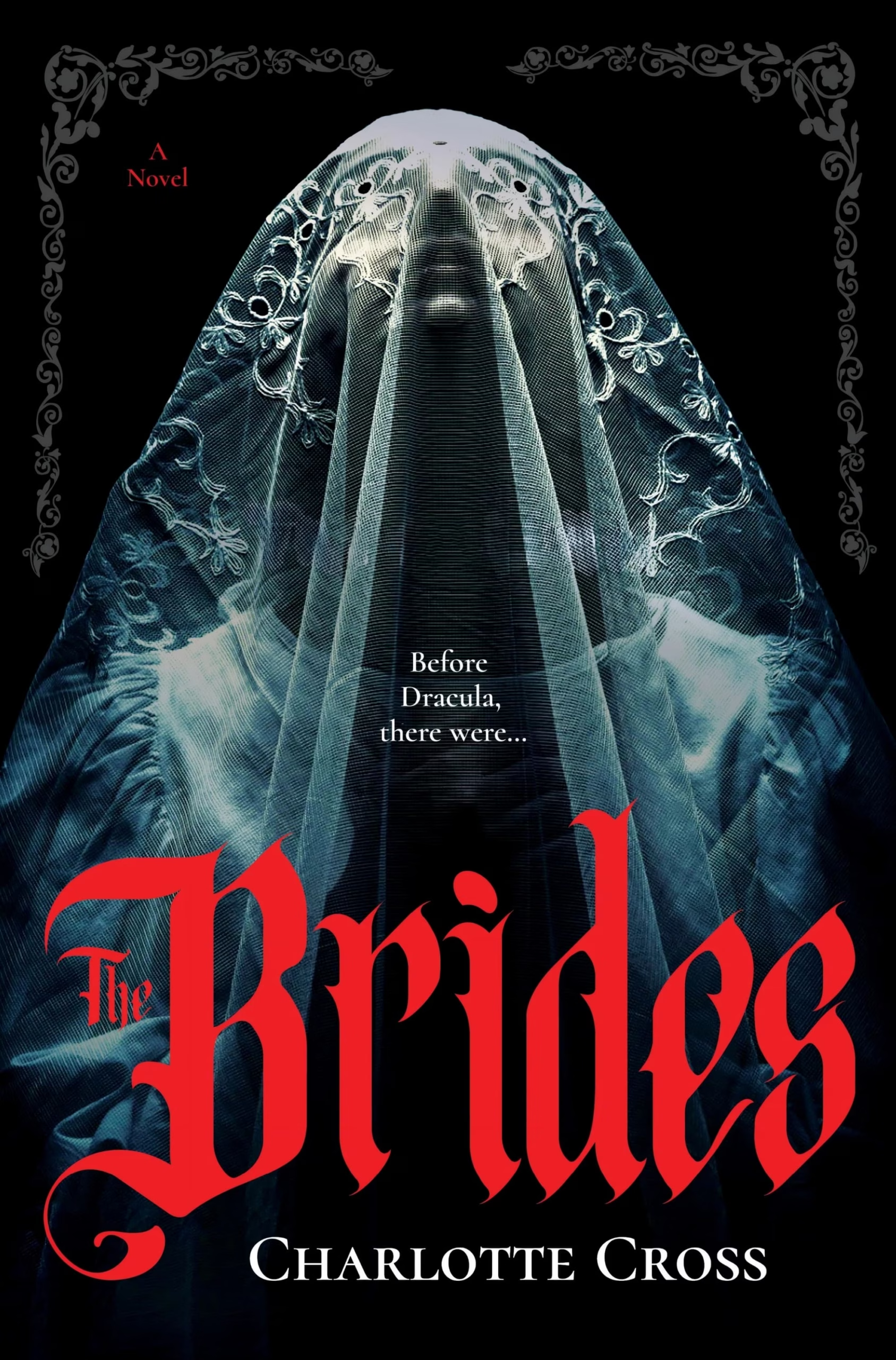
In Bram Stoker’s 1897 novel ‘Dracula,’ three women appear at the Count’s castle just long enough to corner Jonathan Harker, promise him ruin, and yield to their master before the narrative moves on without them. They are never named. They speak only to threaten, and now that gap is the one Charlotte Cross has set out to fill.
Her debut, ‘The Brides,’ reaches American readers on July 7th, 2026, in a 400-page hardcover from Hanover Square Press, following a United Kingdom edition issued earlier in the year through Pan Macmillan.
Told entirely in letters and diary entries, ‘The Brides’ is a feminist gothic horror that promotes those brief figures to its central narrators, recovering the interior lives the original left blank.
The Women Stoker Left Unnamed
In the source text, the three vampire women — sometimes called the weird sisters — amount to a single scene of temptation and threat. Harker records them with a mixture of desire and revulsion, Dracula claims him for himself, and they recede from the book.
Critical attention has long read that scene as a register of late-Victorian male anxiety. Christopher Craft, in his study of gender in the novel, located its dread in the way the women invert the period’s expected roles, becoming the agents of pursuit rather than its objects.1
The brides belong to a wider pattern. Carol Senf argued decades ago that ‘Dracula’ answers the figure of the New Woman — the financially independent, sexually candid woman who unsettled Victorian convention — by punishing its female characters for the very autonomy the period feared.2
Cross writes inside that founding tension rather than around it. By granting the women journals and correspondence of their own, she gives them the one thing Stoker withheld: a first-person account of what the myth cost them.
A Debut Told in Letters and Diaries
The epistolary form is no neutral choice here. Stoker assembled ‘Dracula’ from journals, letters, telegrams, and clippings, a method that lent the supernatural the texture of documentary evidence.
Cross adopts the same apparatus and redirects it. Where the original used the form to corroborate the men’s hunt for the Count, ‘The Brides’ turns it toward testimony the earlier book never gathered.
The novel moves across two timelines. One follows the women in 1884; the other, set roughly a decade after the events of ‘Dracula,’ is framed by John Seward — a survivor of Stoker’s novel — who encounters a patient whose ordeal reaches back to the Count.
That structure makes the book at once a prelude and an aftermath, sitting before Stoker’s plot and extending past it without contradicting the canonical novel it brackets.
The doubled timeline is the central formal wager. Suspense depends less on whether the women reach the castle — readers of ‘Dracula’ can guess their fate — than on the distance between what they record in the moment and what the later frame reveals they became.
Four Travelers and One Survivor
The premise gathers four women on a journey south. Mafalda travels to Budapest to care for a grieving aunt; her secret love, Lucy, follows from London with a chaperone, Eliza, and a lady’s maid, Alice, who is troubled by visions she cannot control.
When Eliza falls to a wasting illness, the party turns toward Transylvania and the healing waters said to lie there. An invitation from a local nobleman draws them to Castle Dracula, where the host’s purpose proves to be the making of brides.
Three of the four become what the title names. The fourth escapes. At the center sits a doomed romance between two of the women, which gives the familiar abduction plot a stake the original never carried.
This is where Cross departs most sharply from her source. Stoker’s brides are punished for their sexuality; Cross treats desire between women as the emotional core of the book rather than the sign of its monstrosity.
Carmilla’s Long Shadow
The sapphic vampire is not new to the form; it predates ‘Dracula’ itself. Sheridan Le Fanu’s ‘Carmilla,’ published in 1872 within the collection ‘In a Glass Darkly,’ gave the literature its first sustained portrait of a female vampire who preys on, and loves, other women.
Stoker knew that tradition and absorbed it, then subordinated it to the Count. ‘The Brides’ restores the older line, placing women’s desire and women’s narration back at the front of the vampire story.
Read this way, Cross’s novel is less a correction of ‘Dracula’ than a return to a current that ran beside it from the start — the gothic’s long fascination with the woman who refuses the role assigned to her.
Hanover Square’s Turn Toward Horror
The book also arrives at a particular moment for its publisher. Hanover Square Press, an imprint of Harlequin Trade Publishing within HarperCollins, launched in 2017 with a list weighted toward narrative nonfiction and general fiction.
In early 2025, a reorganization of Harlequin’s trade imprints formally added horror and fantasy to the Hanover Square line, alongside its existing crime, literary, and speculative titles.
A debut gothic horror by a first-time novelist is the kind of acquisition a recently widened horror program exists to make. ‘The Brides’ stands among the early signs of what that direction will produce.
The Brides Speak at Last
For more than a century, the women at the heart of the most famous vampire novel in English have been a problem the book raised and declined to answer: desirable, dangerous, and denied a single line of self-account.
What Cross offers is not a sequel that tames the original or a rebuttal that dismisses it, but a companion that listens to the figures Stoker reduced to a scene. Whether that act of attention deepens or merely decorates the source is the question ‘The Brides’ sets for every reader who already knows how the castle’s story ends.
When a contemporary novelist returns to a canonical horror text to give voice to its silenced figures, where does genuine reinterpretation end and dependence on the original begin — and which side of that line do you expect ‘The Brides’ to fall on?
References
- Christopher Craft, ‘‘Kiss Me with Those Red Lips’: Gender and Inversion in Bram Stoker’s Dracula,’ Representations 8 (1984): 107–133. ↩︎
- Carol A. Senf, ‘Dracula: Stoker’s Response to the New Woman,’ Victorian Studies 26, no. 1 (1982): 33–49. ↩︎

Leave a Reply