

Public dissection was once a paid event. In the permanent anatomical theatres that Padua and Leiden raised at the end of the sixteenth century, audiences climbed tiered galleries to watch a corpse opened and read aloud, the body converted into a text whose meaning was extracted in front of witnesses.1
The figure who cuts into a body and finds more than medicine accounts for has shadowed the gothic imagination ever since, from Mary Wollstonecraft Shelley’s assembled creature to the modern morgue thriller. That lineage is the proper setting for the home-video event arriving at the end of this month.
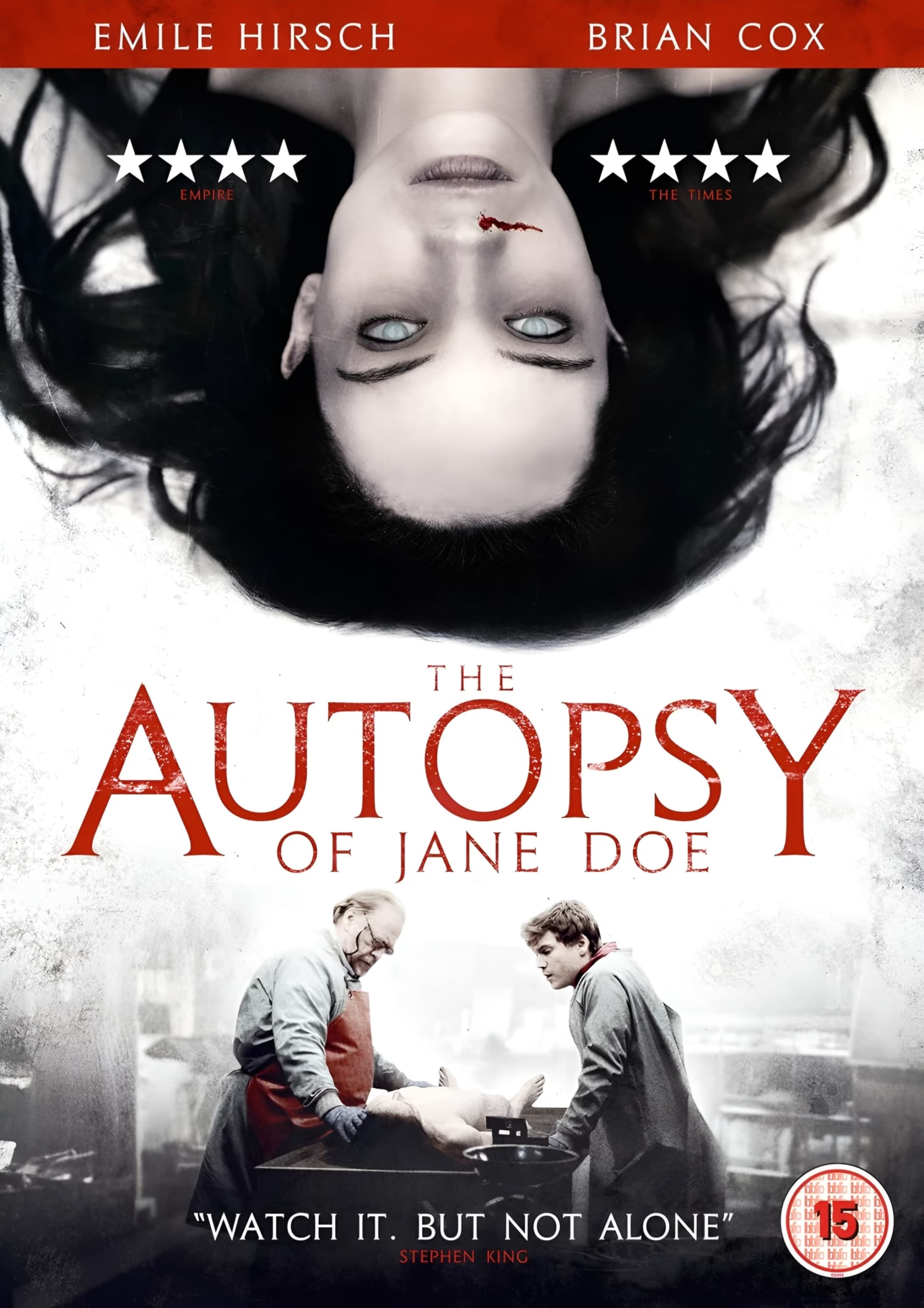
André Øvredal’s ‘The Autopsy of Jane Doe’ reaches Ultra HD for the first time on June 26th, 2026, released by Severin Films as part of the label’s Summer Sale. The two-disc set pairs a fresh 4K scan of the 2016 film with a Blu-ray carrying a deep slate of newly produced interviews.
The Opened Body as Spectacle
The early modern anatomy theatre treated the interior of the body as public knowledge, staged with the same ceremony a court reserved for a trial. The corpse on the slab was not a patient but a document, and the anatomist a reader performing in front of a crowd.
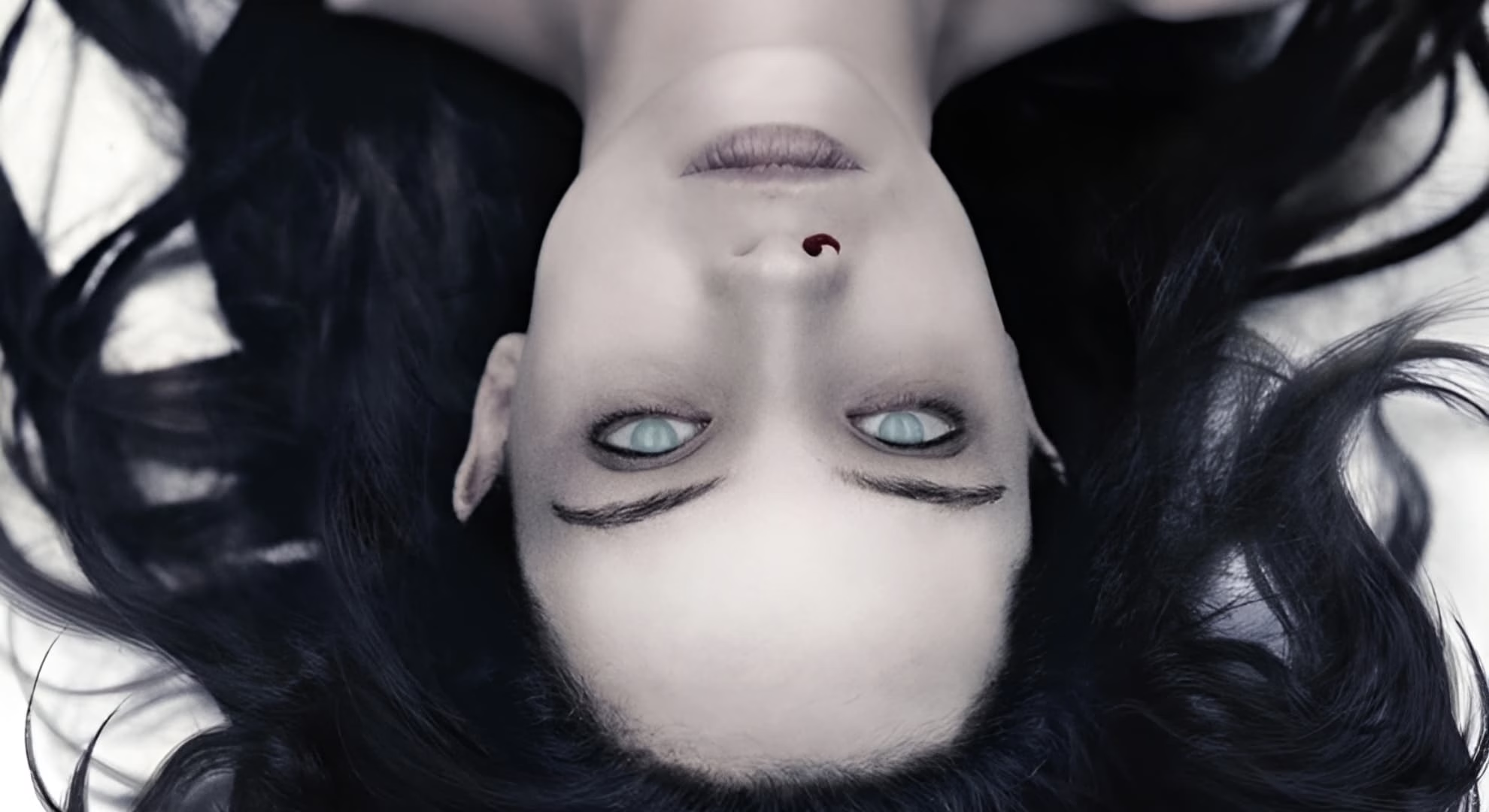
Øvredal’s film literalizes that arrangement. Tommy and Austin Tilden, a father-and-son coroner team played by Brian Cox and Emile Hirsch, receive an unidentified woman’s body — Olwen Catherine Kelly, motionless on the table for the picture’s duration — and the film proceeds as a single autopsy whose every incision deepens the mystery rather than resolving it.
What the Tildens read inside the corpse is not a cause of death but a history of persecution, the body’s interior turned into a record that indicts the living world that produced it. The dissection becomes the plot, and the slab the only set that matters.
Øvredal and the Single Room
Øvredal arrived at this material after the found-footage creature feature ‘Trollhunter’ (2010), and the contrast in method is the point. Where the earlier film roamed the Norwegian wilderness, his first English-language feature shut the doors and confined nearly all of its action to one underground chamber.
The change announced a director willing to subordinate spectacle to procedure. The threat in ‘The Autopsy of Jane Doe’ does not stalk; it waits, inert on a steel table, while two technicians talk themselves deeper into a room they cannot leave.
That restraint places the film inside the lineage of single-location horror — the chamber piece that draws its pressure from confinement rather than expanse, a form that reaches back through the besieged interiors of the genre to the locked-room logic of the gothic tale.
What the Camera Refuses to Show
Roman Osin’s cinematography keeps the morgue legible without flattering it, lighting the examination table with the cool, even exposure of a working autopsy suite while letting the corridors behind it fall into depth and shadow. The dread is positional: the frame stays clinical at its center and unresolved at its edges.
Øvredal stages his frights in the periphery, withholding the full figure and letting the eye snag on a shape half-seen down a hall. The film’s most sustained source of unease is sound — a corpse’s ankle bell, a radio that retunes itself — rather than the image, which keeps its compositional calm as the situation deteriorates.
Danny Bensi and Saunder Jurriaans score the film with a restraint that matches the camera, holding back the orchestral announcement of the scare in favor of low, continuous pressure. The structural wager is that an autopsy, read aloud incision by incision, can carry a feature without the picture ever leaving the room.
Cox and Hirsch carry the first act as a credible father and son, the family business and its frictions established before the supernatural intrudes. Kelly’s wholly still performance, a body that must read as recently dead across hours of screen time, is the film’s quietest technical feat.
Severin and the Cult Canon
Severin Films made its name on rescue. Founded in 2006 by David Gregory, Carl Daft, and John Cregan out of the Blue Underground lineage, the boutique label has spent two decades reviving provocative and frequently suppressed cinema — Eurohorror, mondo, exploitation, the British Video Nasties — for collectors who treat physical media as preservation rather than convenience.
Its house signature is the documentary-grade supplement, the feature-length making-of and the deep interview reel that frame a film’s critical standing rather than merely advertise it. A Severin release is an argument that a title belongs in the canon the label is assembling.
That a relatively recent, studio-distributed picture like ‘The Autopsy of Jane Doe’ now enters that catalogue is the notable part. The label best known for reviving half-forgotten drive-in and Eurohorror obscurities is conferring archival status on a 2016 film, treating a modern cult object as the heritage item it has quietly become.
A Disc Built Like a Dissection
The Severin edition is the film’s first appearance on 4K UHD, a worldwide debut for the format after a 2017 Blu-ray from Scream Factory served as the prior home edition. The two-disc configuration places the new 4K scan on the UHD disc and a full supplementary program on the accompanying Blu-ray.
That program runs deep: separate new interviews with Øvredal, Hirsch, and Kelly; conversations with co-writers Ian Goldberg and Richard Naing; and on-set material featuring Brian Cox, producer Ben Pugh, and supporting player Ophelia Lovibond, among others. Each carries the punning title Severin favors, from Head Examiner to Coroner’s Report.
The packaging extends the label’s collector address — a vertical split rigid slipcase illustrated by Trevor Henderson, the artist behind a generation of internet-native horror creatures, with reversible case artwork beneath. Full technical specifications for the transfer, including the high-dynamic-range format and disc bitrates, had not been released at the time of publication.
When a Cult Object Becomes an Artifact
A film about reading a body for the truth it was forced to hide is a fitting candidate for a release that reads a film the same way. The autopsy at the center of Øvredal’s picture treats the corpse as evidence; Severin’s edition treats the picture itself as evidence, worth preserving at the highest fidelity the format allows.
The early modern anatomists opened bodies in public so that knowledge would survive the individual death. A boutique restoration performs a smaller version of that act for cinema, documenting a film exhaustively and committing it to a form meant to outlast the streaming licenses and disappearing catalogues that now govern most viewing.
‘The Autopsy of Jane Doe’ was always concerned with what a careful examination can recover. Its arrival on 4K UHD turns that argument on the film itself.
Severin’s decision to grant a 2016 studio horror picture the archival treatment it reserves for vintage cult and Eurohorror raises a question worth sitting with — when a boutique label confers heritage status on a film barely a decade old, how should we weigh the work of canonization that physical-media restoration now performs for contemporary horror?
Reference
- Jonathan Sawday, ‘The Body Emblazoned: Dissection and the Human Body in Renaissance Culture’ (London: Routledge, 1995), 41–53. Sawday documents the early modern anatomical theatre and the public dissection as civic spectacle in which the opened body was treated as a text to be read before an audience. ↩︎


Leave a Reply