

In April 2019, an international consortium of radio telescopes published the first photograph ever taken of a black hole — the supermassive object at the center of the galaxy Messier 87, roughly 55 million light-years from Earth. Hawaiian language scholars later named it Pōwehi, an embellished dark source of unending creation.
That phrase, lifted almost intact, now titles a song on a record made by four Dutch musicians who have spent three decades treating darkness as a subject to be contemplated rather than merely depicted.
Their fifth album does not announce the cosmos as metaphor. It takes the indifference of deep space as a literal frame, and asks what a human life weighs when measured against it.
Out of the Asphyx Ashes
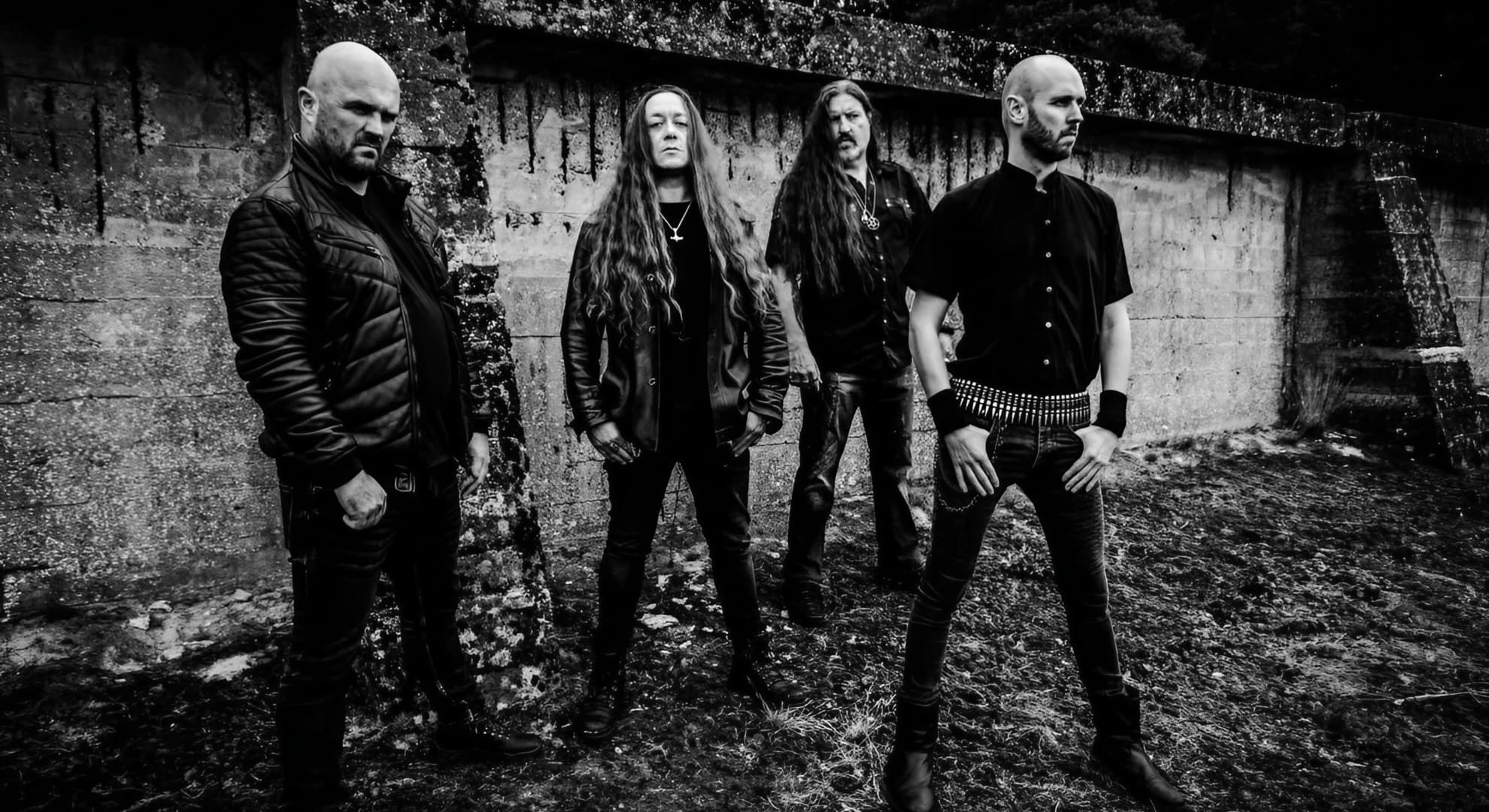
Soulburn began in 1996 as a fracture inside another band. When the Dutch death metal group Asphyx came apart that year, guitarist Eric Daniels and drummer Bob Bagchus kept playing together under a new name, channeling their shared devotion to Venom and Bathory into something starker than Asphyx had been.
The debut, ‘Feeding on Angels,’ followed in 1998 on Century Media before the project went quiet and Asphyx resumed. Soulburn returned in 2013, and the lineup that records today — Daniels on guitars, Twan van Geel on bass and vocals, Remco Kreft on second guitar, Marc Verhaar on drums — has carried the band through ‘The Suffocating Darkness’ (2014), ‘Earthless Pagan Spirit’ (2016), and ‘Noa’s D’Ark’ (2020).
That run places the band within a specific Dutch underground — the early-nineties scene of Asphyx, Pentacle, and Sinister that built death metal around weight and decay rather than speed.1 It is a tradition distinct from the British doom of Paradise Lost or the Swedish death metal sound, and ‘Quantifying Cosmic Doom’ is the record on which Soulburn push hardest against their own borders.
A Universe Indifferent to Us
The cosmic turn was not planned as a concept. In interviews, Daniels has described the lyrics emerging after the music, once van Geel heard the first home demos and began writing toward the scale the riffs implied.
What van Geel wrote reaches past the usual extreme-metal preoccupation with personal death. He has said that ‘M87 — What Hopes to Be Born?’ treats time not from the standpoint of mortality but as the ongoing struggle of life2 — a distinction that moves the record from the deathbed to the geological clock.
The track titles map that ambition directly. ‘Down Among the Stars,’ ‘An Innocuous Swathe of Sky,’ and the galaxy-named ‘M87’ set human extinction against a span so vast that catastrophe begins to read as arithmetic rather than tragedy.
Two Singles in Different Orbits
The two advance singles stake out the album’s range. ‘The Braveheart of Nightmares,’ issued in March 2026 as a music video, opens the record and introduces something the band had not foregrounded before — clean, sung vocals threaded through their blackened death metal.
Van Geel described the song’s character as drawn from “the fabric of dreams and nightmares,” a phrasing that suits its slow, narrative pull more than any single riff. Daniels noted that the track “opens a door to some hidden inner world,” language that frames the expansion as introspective rather than grandiose.
‘M87 — What Hopes to Be Born?,’ released as a lyric video on April 22nd, 2026, sits at the album’s center and, in Daniels’s account, exists in its own orbit. Where the opener moves through melody, this second single holds the cosmic theme most plainly, its title posing a question the music declines to answer.
Three Rooms, One Record
The making of ‘Quantifying Cosmic Doom’ was split across three facilities, a method that says something about how the band guards its sound. Erwin Hermsen and Fons van Dijk handled recording, production, mixing, and mastering at Hermsen’s Toneshed Recording Studio in Horst, in the southern Netherlands.
Hermsen is a Dutch engineer with more than 15 years at Toneshed and a catalog running from post-metal to death metal, including recent work for the Dutch underground acts Aum Zorion and Ceremony. Drums were tracked separately by Jörg Uken at Soundlodge Studio in Rhauderfehn, Germany, and guitars by Tom Meier in Enschede.
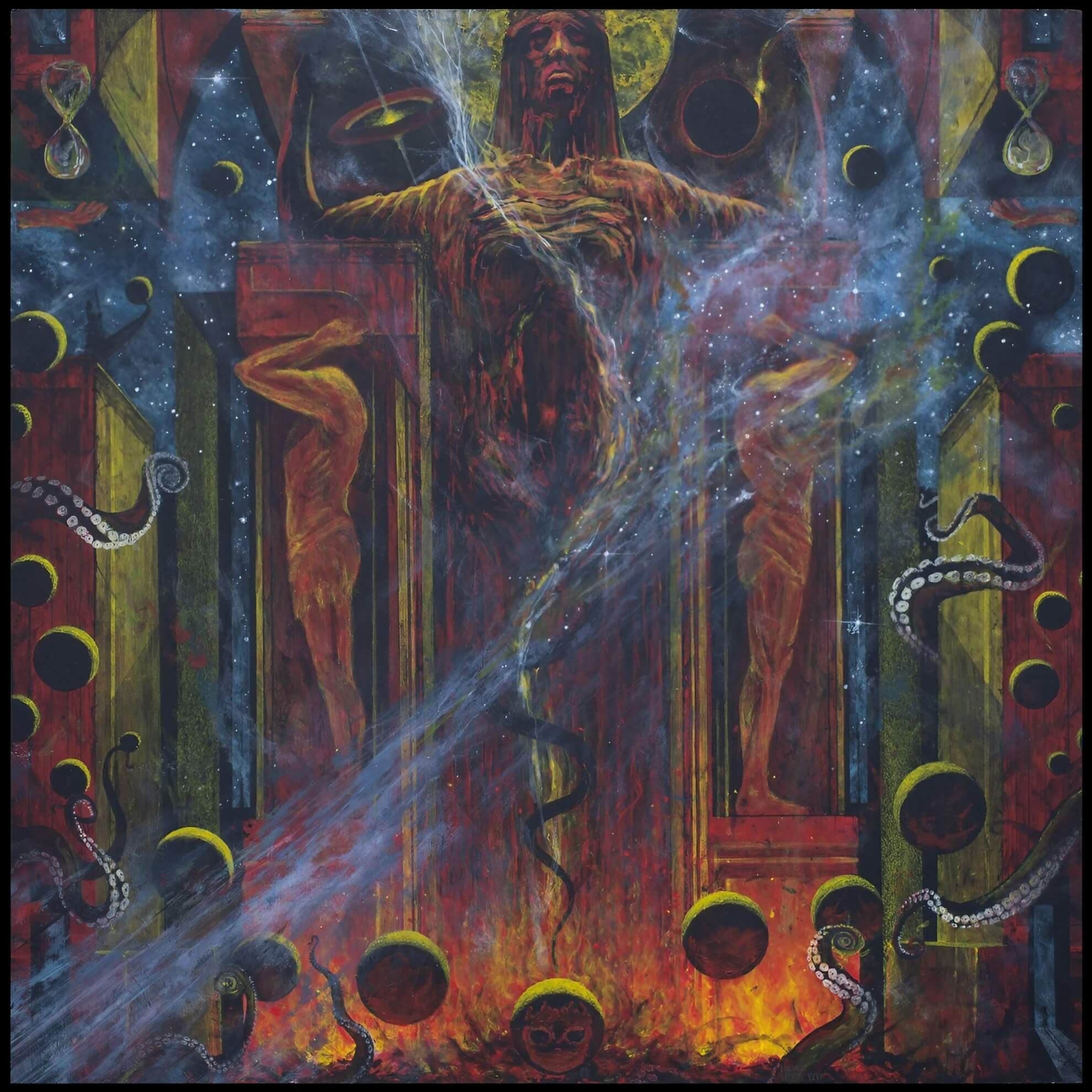
Distributing the recording this way keeps each layer under dedicated control, a discipline suited to music whose force depends on clarity of attack rather than density.3 The cover artwork is the work of Manuel Tinnemans of Comaworx, with layout by van Geel and Dave van Beek.
The Underground That Receives It
Testimony Records, the German label Soulburn signed to in February 2026, is not a multinational. It is a smaller operation built for listeners who seek out extreme metal deliberately, through specialist stores and direct sales rather than mainstream channels.
That distribution model matters for a record like this one. Extreme metal has always traveled farthest among audiences who treat it as a private discipline, a way of holding dread at a contemplative distance, and those audiences are scattered across the globe, far from the Dutch border towns where the music was made.4 A philosophical framing of darkness, rather than a sensational one, is precisely what carries across that distance.
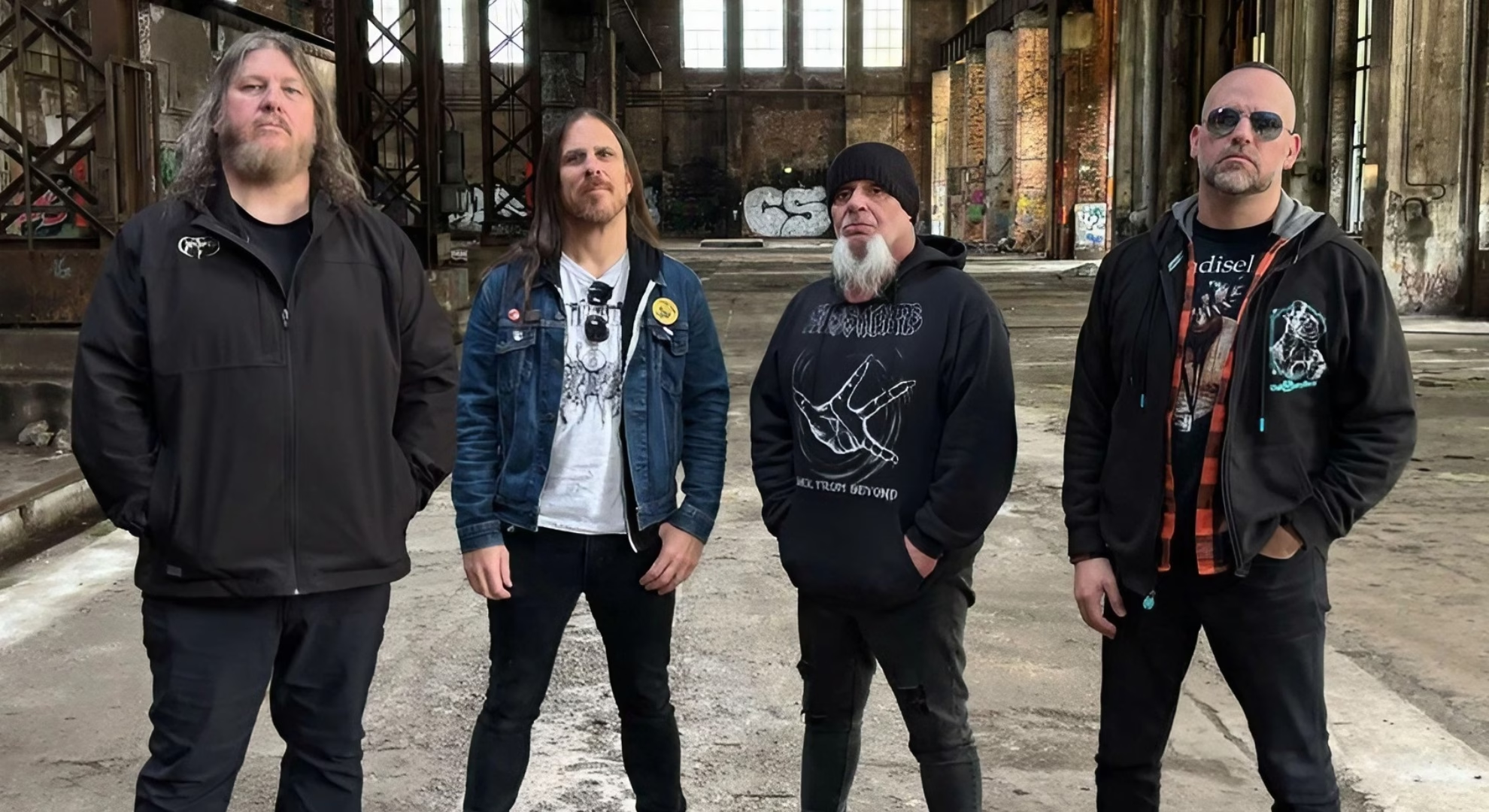
The band brings the record to European stages in October 2026 in support of Mork, the Norwegian project whose ‘Monolitt’ this publication featured ahead of its own June 2026 release. The pairing is apt — two acts that treat severity as a first principle rather than a pose.
The Comfort of Indifference
A record that names its songs after black holes and dead-star light could easily collapse into spectacle. What keeps ‘Quantifying Cosmic Doom’ from that fate is the plainness of its premise — that the universe will not notice us, and that this is not, in the end, a horror.
Soulburn have spent their entire run refusing to settle into a single mode, and the clean vocals and cosmic scale of this fifth album extend that refusal rather than abandon it. The band now treats extinction the way an astronomer treats a distant galaxy — as something to measure, name, and sit with.
For an audience that has always used extreme music to make dread bearable, that is a strangely consoling proposition: not that the dark means something, but that it does not have to.
When a band you have followed turns from the visceral toward the cosmic, from the body’s death to the slow indifference of deep space, does that widening of scale change what the music offers you, or does the dread it carries feel the same no matter how far out it points?
References
- Robert Walser, ‘Running with the Devil: Power, Gender, and Madness in Heavy Metal Music’ (Hanover, NH: Wesleyan University Press, 1993), 14—17. ↩︎
- Dipesh Chakrabarty, ‘The Climate of History: Four Theses,’ Critical Inquiry 35, no. 2 (Winter 2009): 197—222. ↩︎
- Paul Hegarty, ‘Noise/Music: A History’ (New York: Continuum, 2007), 133—138. ↩︎
- Arjun Appadurai, ‘Modernity at Large: Cultural Dimensions of Globalization’ (Minneapolis: University of Minnesota Press, 1996), 27—33. ↩︎

Leave a Reply