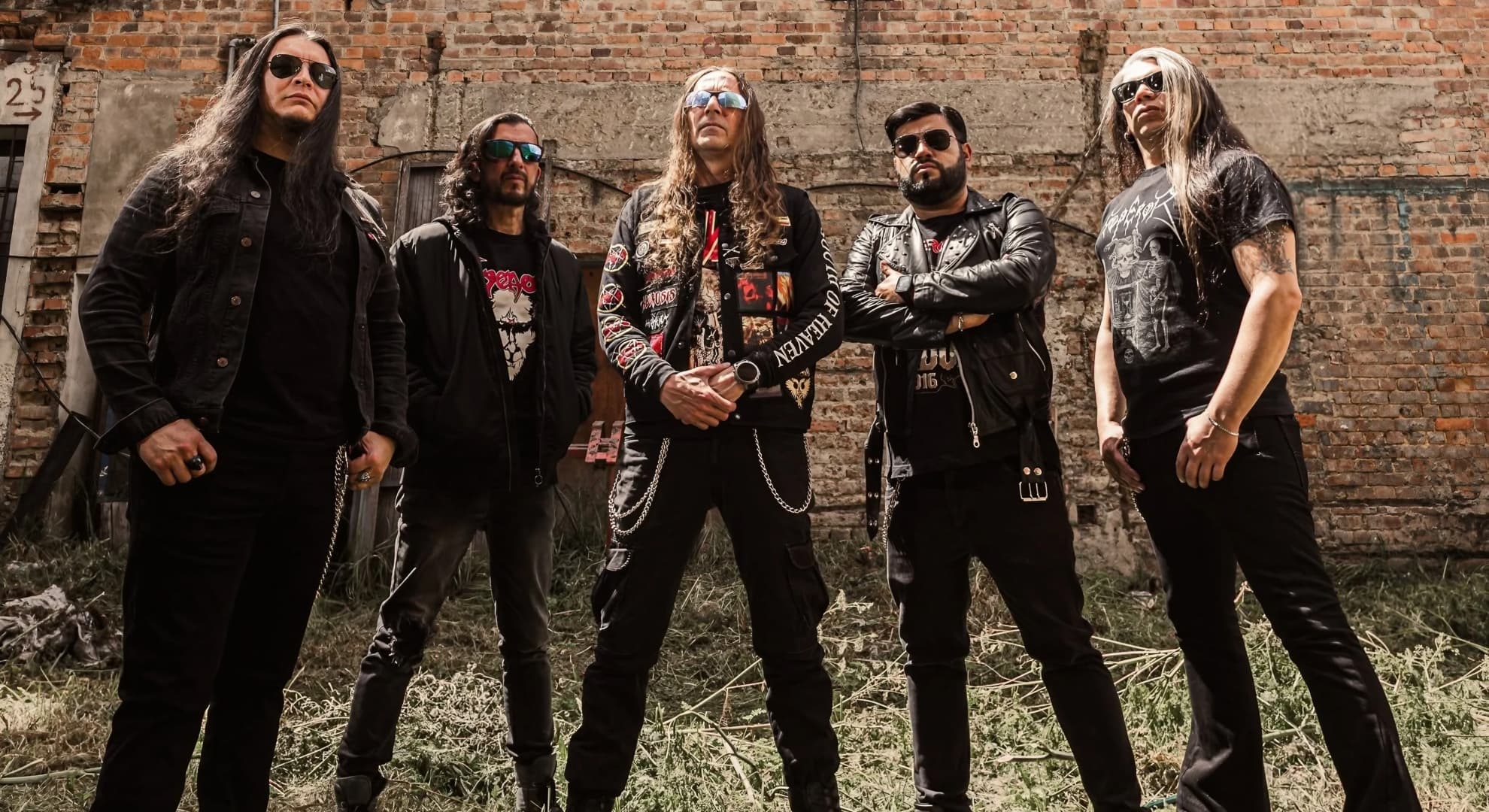


A battle-of-the-bands round is normally judged on its own narrow terms: a handful of unsigned acts, one slot in a later final, and a crowd deciding the winner simply by how loudly it stays in the room. Bogothrash Sessions, a newly launched elimination series taking shape inside Ozzy Company on Bogotá’s Avenida Boyacá, keeps that structure fully intact for its opening round on August 23rd. What changes the arithmetic is who shares the stage once the six contenders finish.
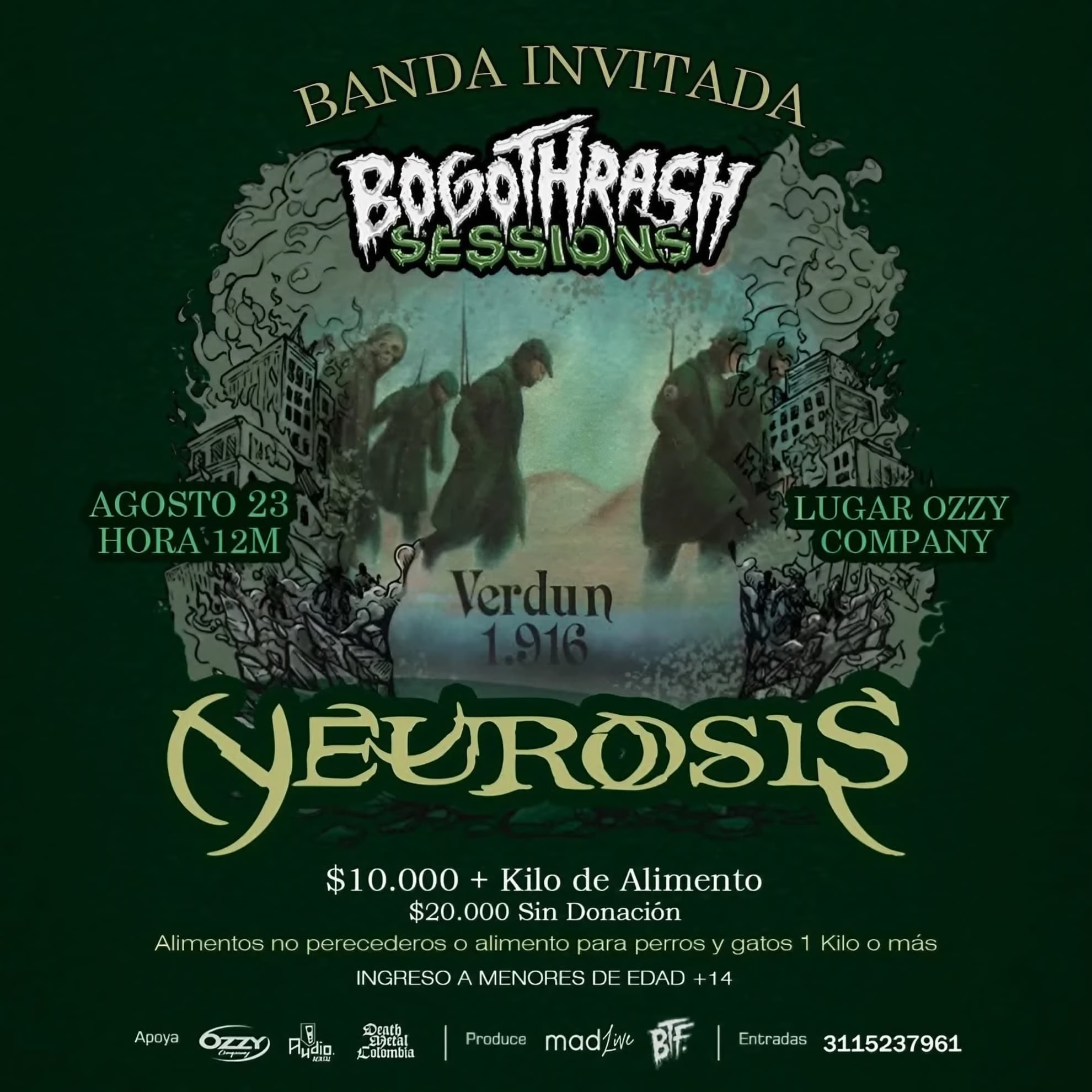
Hostilion, Fractal Spider, Aethernaut, Siphycide, Fusha, and Rysky will play their sets from noon onward, each hoping to advance toward a stated live final on September 27th. Following them is a special guest slot built around a single record: ‘Verdun 1916,’ the 1995 album that gave Neurosis, the Bogotá thrash and death metal outfit founded in 1987, its most enduring reputation.
Nearly four decades after Jorge Mackenzie first assembled the band, that record remains the reason people still show up.
The Capital’s Own Bloodline
Mackenzie formed Neurosis on August 1st, 1987, not long after leaving Darkness, one of the first bands to give Bogotá’s rock underground a distinctly metal vocabulary. The new project spent its earliest concerts, beginning in January 1988, playing Slayer, Venom, and Kreator covers before Mackenzie began writing original material of his own.
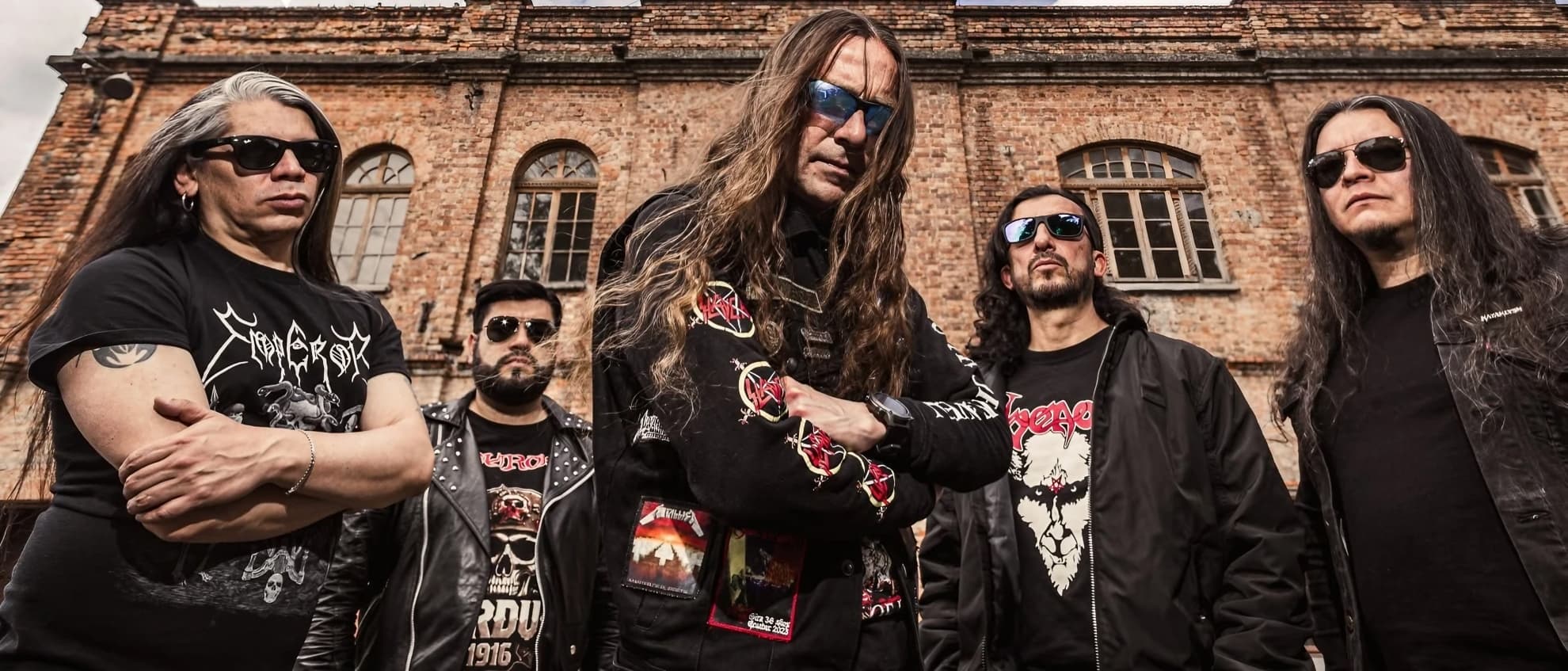
That original material surfaced first on the 1991 demo ‘Más Allá de la Demencia,’ a cassette that sold a thousand copies through word of mouth alone. The lineage that passed through the band’s early years reads like a partial map of Colombian extreme metal’s founding decade: drummer Mauricio Montoya went on to found Masacre, and guitarist Francisco Nieto had already co-founded La Pestilencia, the band that introduced Bogotá’s early hardcore punk sound, before later joined in La Derecha.
Bogotá’s underground took a different shape than Medellín’s, where the raw, primitivist sound later labeled Ultra Metal was answering the cartel violence engulfing that city directly. Neurosis and its contemporaries built something more technically deliberate, closer to the thrash and death metal templates arriving from North America and Europe, filtered through a scene that nonetheless carried its own weight of loss.1
The band has since played Rock al Parque seven times and toured Ecuador, Peru, Bolivia, Chile, and Argentina in 1999 under the banner Perturbando el Continente.
A War Reopened on Tape
‘Verdun 1916’ was recorded at Estudios Audiovisión in September 1994 and released the following March through Talismán Music. The album took the Premio Subterránea for best metal band in Colombia, and its title track was featured on MTV Latino’s Headbanger’s Ball in 1996, a rare piece of international visibility for a record made entirely inside Bogotá’s underground economy.
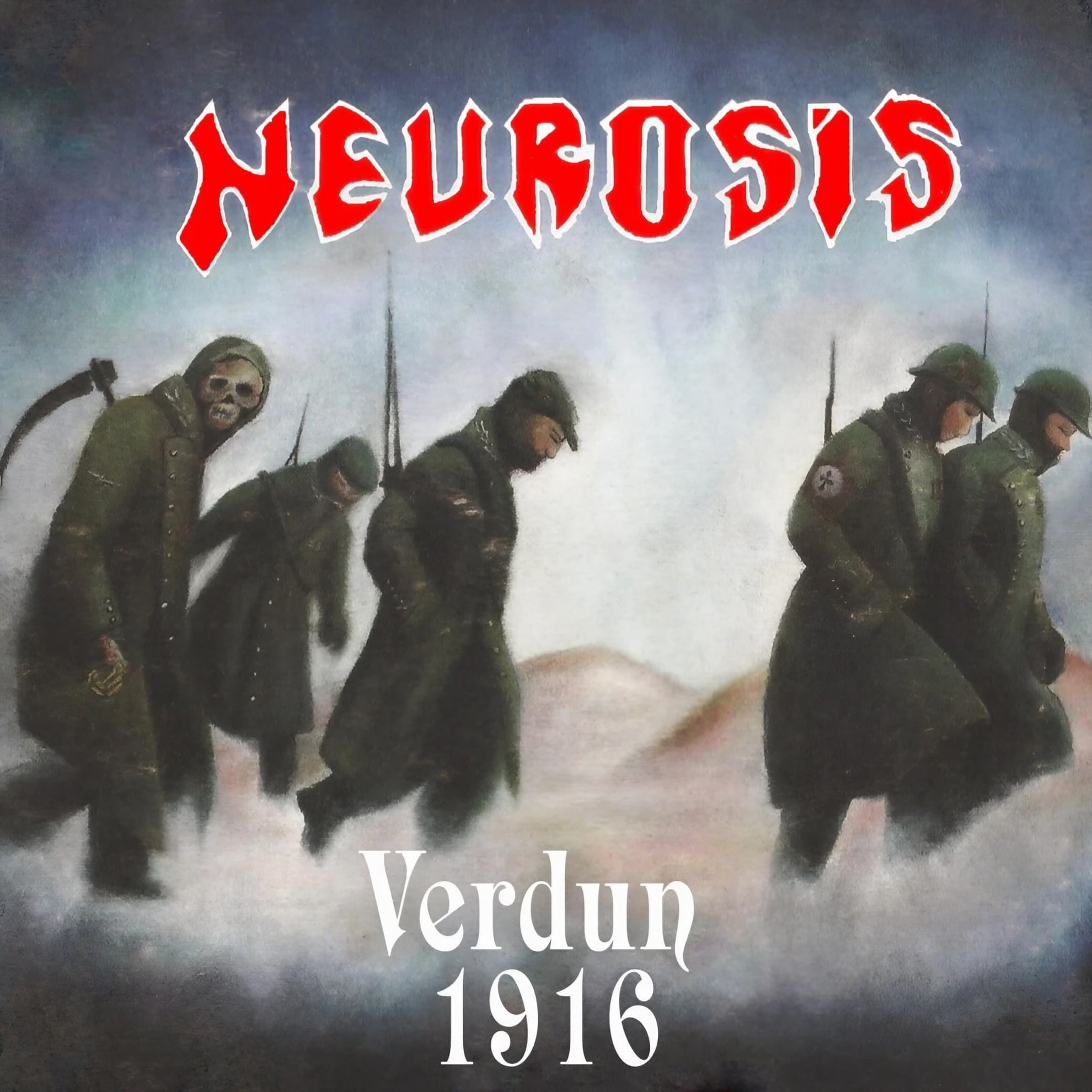
The title refers to the actual Battle of Verdun, the ten-month campaign that consumed close to a million French and German lives between February and December of 1916 and stands among the deadliest set-piece engagements of the First World War.2
Mackenzie’s lyrics open with the birds gone silent over the battlefield and follow conscripted soldiers who wanted peace and were given graves instead, a war-atrocity narrative built from European death metal’s own conventions but transplanted, unusually, into a Colombian catalogue.
The record has not stayed frozen in 1995. Late in 2025, to mark thirty years since its release, Neurosis re-recorded the entire album with updated production under the title ‘Verdun 2025,’ issued through Green Revolution Records with new cover art by Indonesian artist Ardha Leppa.
A companion anthology, ‘Resistencia — La Historia de Neurosis 1987–2025,’ arrived the same year, pairing a documentary DVD with a compiled CD spanning the band’s full discography. The August 23rd set, built entirely around the original record, arrives as the freshest possible chapter of a three-decade-old story rather than a nostalgia exercise revisiting it from a distance.
A Paid Alternative to the Park
Bogothrash Sessions is a current program of Festival Bogothrash, which first tested this premise in August 2013, when Festival Bogothrash gathered a national bill that included Witchtrap, Ursus, and Neurosis itself for a night proving Bogotá’s thrash underground could sustain a ticket-funded event. Where Rock al Parque relied on municipal subsidy to keep its gates free, Bogothrash charged at the door and used that revenue to keep expanding.
Alongside Perpetual Warfare and Medellín’s Athanator, that founding roster anchored a national core the festival built on for several editions, expanding by 2014 and 2016 to book Brazil’s Nervosa and Ireland’s Gama Bomb on the same bill. Financial strain forced repeated postponements toward the end of the decade, a struggle the organizers attributed publicly to the cost of running an independent metal festival without institutional backing.
Bogothrash Sessions runs at a smaller scale, inside a single room rather than a touring bill, but the geography has not moved far: Ozzy Company itself served as one of the festival’s authorized ticket points as early as 2014. What August 23rd extends is a decade-old argument that Bogotá’s thrash scene can fund itself, one door charge at a time.
Six Bands for One Slot
The undercard is where Bogothrash Sessions is assembling its own future rather than commemorating anyone else’s past. Hostilion, Fractal Spider, Aethernaut, Siphycide, Fusha, and Rysky are drawing from the deep end of Bogotá’s do-it-yourself metal circuit, acts operating without label backing or festival slots, the kind of bands that live or die on nights precisely like this one.
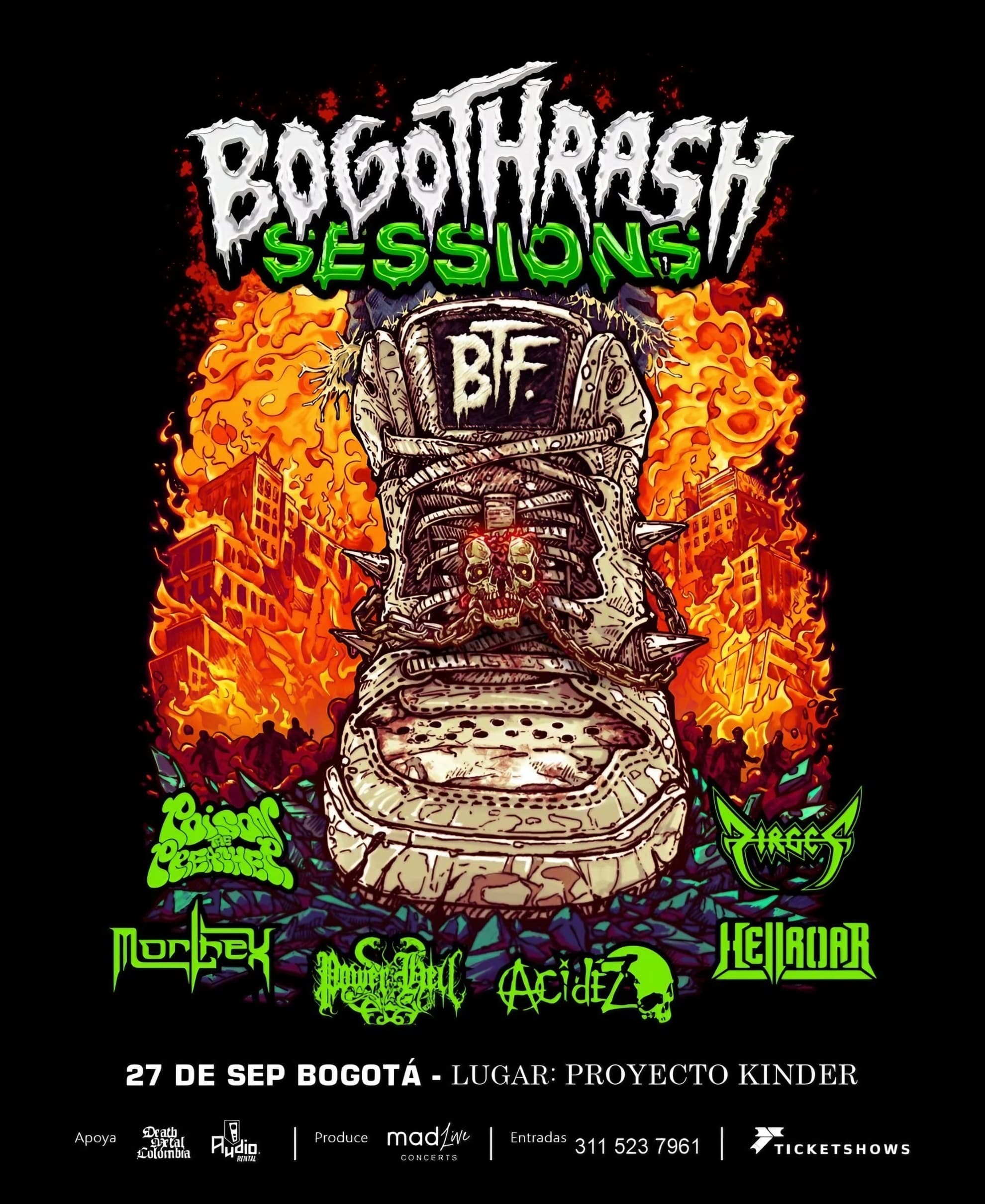
The elimination format is unglamorous by design: the crowd effectively votes by turning up and staying loud, and whichever of the six has demonstrably built a following advances toward the September final under the ticket tier billed as Proyecto Kinder. Scholars of local music scenes have argued that this kind of legitimacy is earned through repeated, unglamorous appearances rather than granted by outside institutions.3
Placing that structure beneath a band marking thirty-nine years of activity draws a direct line between two generations without collapsing the distance between them. Neurosis inherited a scene shaped by the country’s armed conflict decades; the six contenders inherit a scene shaped instead by the absence of label infrastructure and festival gatekeeping that never fully arrived even after the worst of that conflict passed.
A Door Price for the Displaced
Organizers built a charity mechanic directly into the door price. General admission runs 20,000 pesos (approximately $6 USD), but anyone bringing at least a kilo of non-perishable food, or pet food for dogs and cats, gets in for 10,000 pesos (approximately $3 USD). The stated cause is aid for communities in Colombia affected by recent flooding and displacement, covering both people and the animals stranded alongside them.
A raffle of band merchandise runs alongside the launch of official Bogothrash merchandise at a discounted rate. Entry is open to attendees fourteen and older, a deliberate choice by the promoters to widen the pipeline of who encounters the scene early. Tickets move through Nequi and are handled directly through the promotion’s WhatsApp line rather than through a commercial ticketing platform.
Nearly Forty Years of Refusal
What happens at Ozzy Company on August 23rd is a small, self-funded bill in a mid-sized rock bar in Engativá, and that scale is not incidental. It is close to the scale at which most of Colombian metal’s actual history has unfolded, including the version of it that produced ‘Verdun 1916’ in the first place, three decades before six unsigned bands started fighting over a spot to open for the record’s authors.
Mackenzie’s band never left that scale, even during the brief dissolution he announced in 2017, and its return to Bogotá’s bar circuit within months of that announcement said as much about the durability of the underground as any anniversary re-recording could. The six acts competing on August 23rd inherit a room, a format, and an audience built by exactly that kind of refusal to disappear.
Which matters more to you when a founding band shares a stage with an unsigned undercard: the record being reopened, or the six acts fighting to be heard beneath it?
References
- Deena Weinstein, ‘Heavy Metal: The Music and Its Culture,’ rev. ed. (New York: Da Capo Press, 2000), 98–103. ↩︎
- Alistair Horne, ‘The Price of Glory: Verdun 1916’ (New York: St. Martin’s Griffin, 1994), 327–332. ↩︎
- Andy Bennett and Richard A. Peterson, eds., ‘Music Scenes: Local, Translocal, and Virtual’ (Nashville: Vanderbilt University Press, 2004), 1–15. ↩︎

Leave a Reply