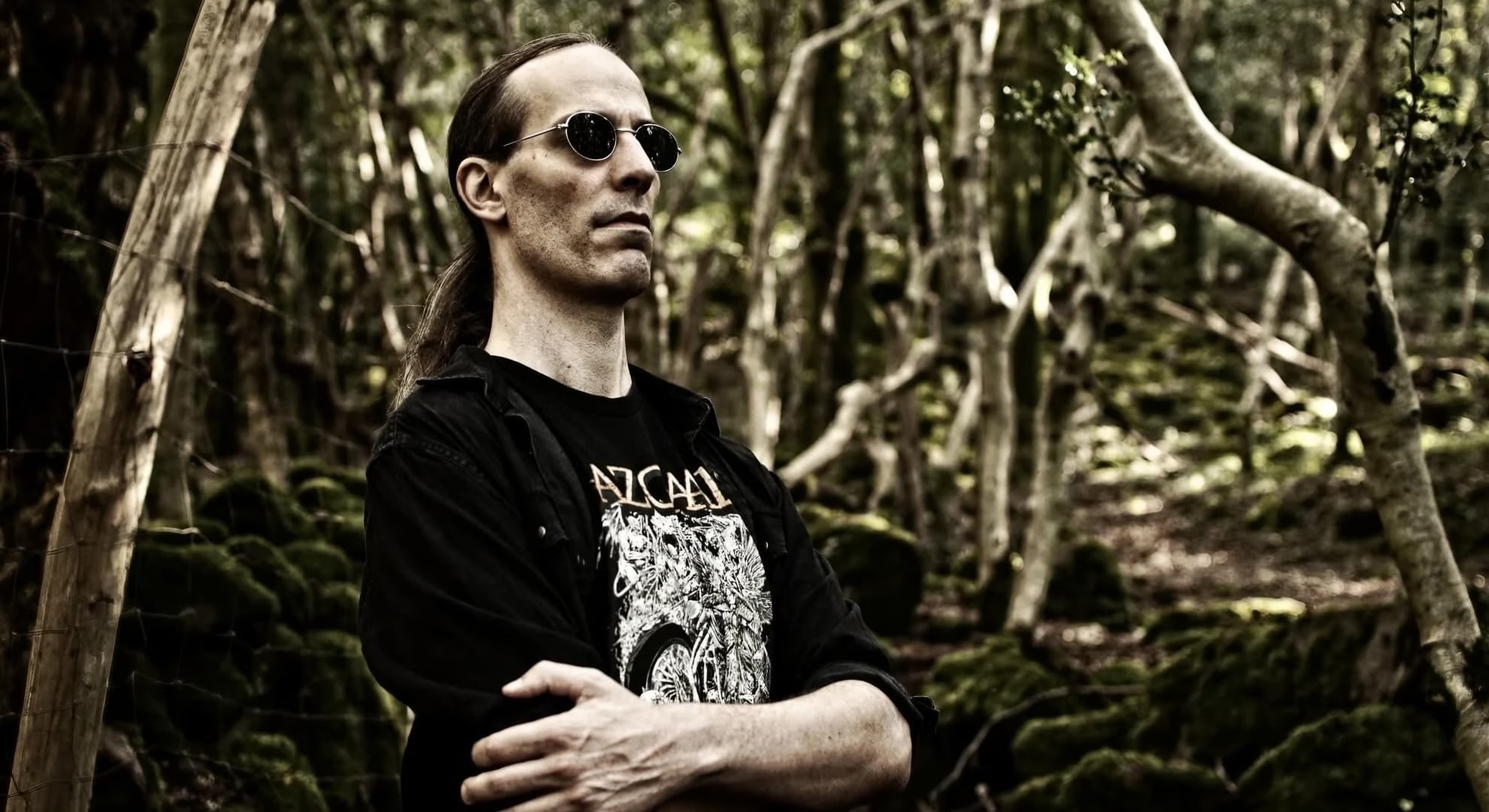


Centuries before anyone set a wrathful angel to blast beats and tremolo-picked guitar, a body of Jewish esoteric writing had already given shape to the idea that judgment is never abstract. It is carried out by a specific being, with a name, a rank, and an assignment. That inherited image now anchors the newest full-length released under the name Azgaal, the solitary French black metal project helmed since the early two-thousands by a musician known only as Naïwyn.
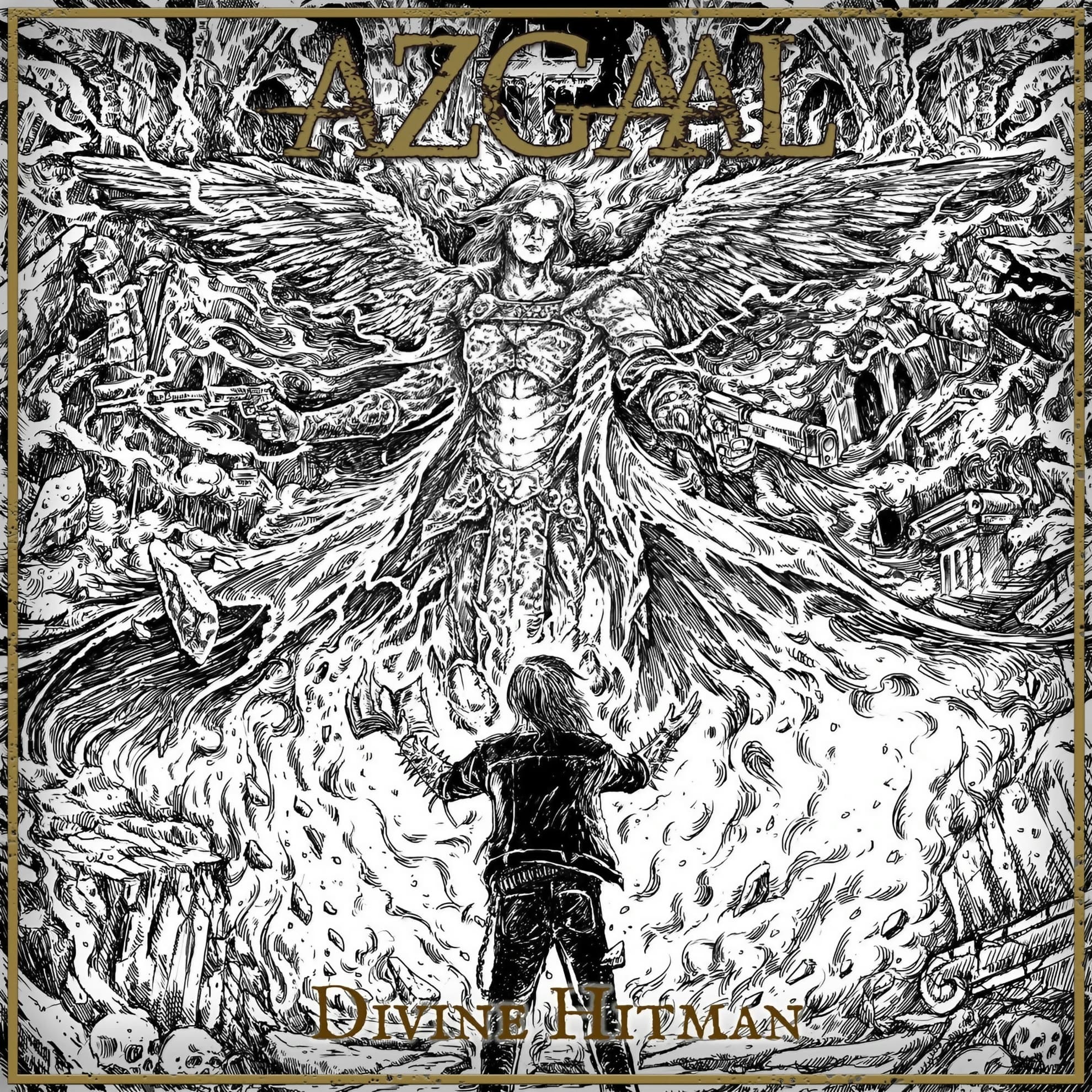
‘Divine Hitman’ comes out on August 28th, 2026 through the German label Fetzner Death Records, and it takes its title, and its organizing figure, from an angel named Daovith, identified by the project as the entity charged with punishing humanity for its transgressions. 10 songs organized around that single judgment carry the record, sung in a mixture of French and English, and running to just under fifty-five minutes.
Two Decades in a Single Voice
Azgaal began in the early two-thousands as a demo project, its earliest recordings never formally released but credited within the project’s own account as the foundation of everything that followed. Naïwyn’s first public statement came in 2011 with the EP ‘Solitude & Wisdom,’ issued through the Maltkross label.
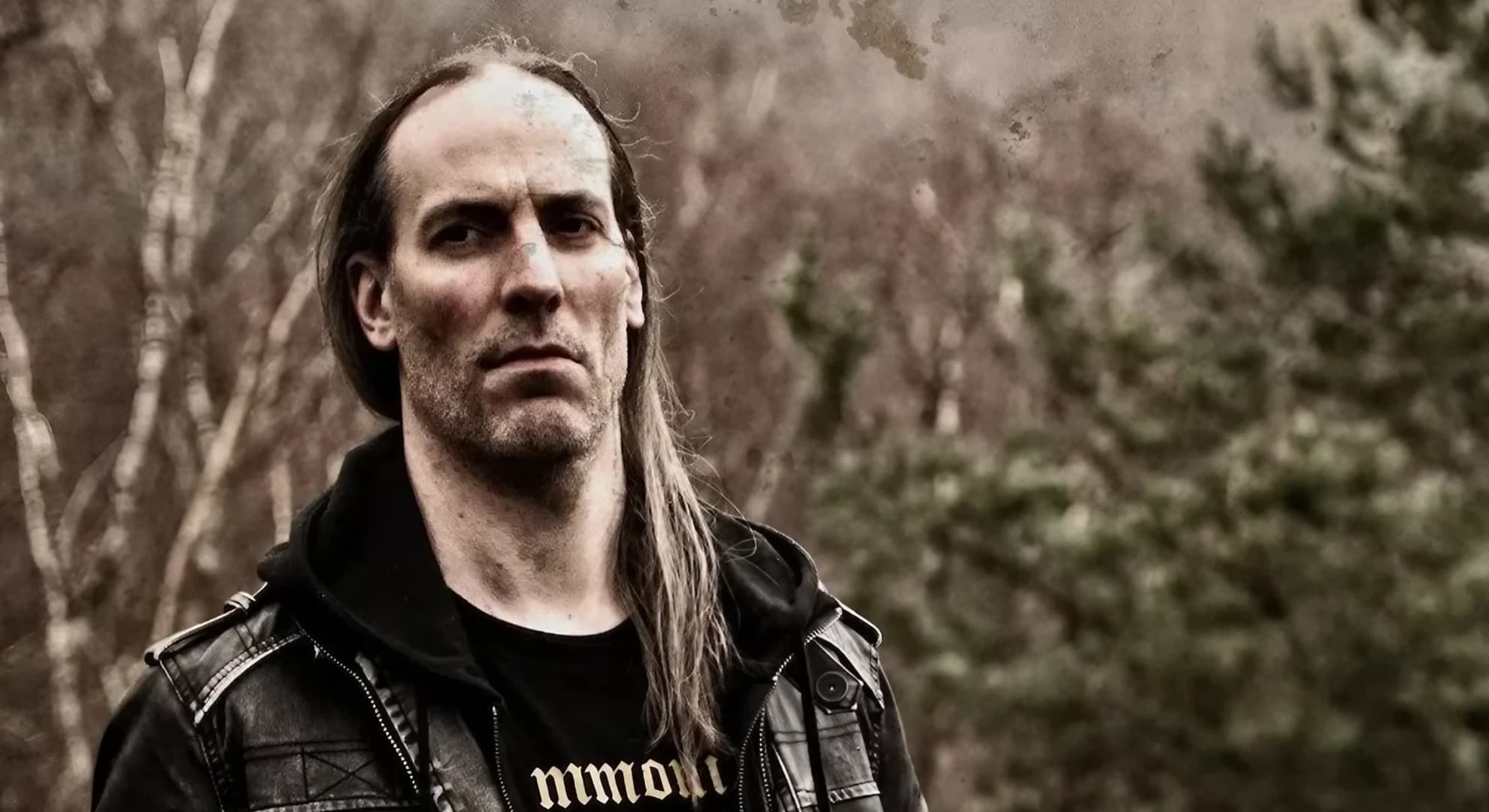
A run of further releases followed across that decade, including ‘A Matter of Death’ in 2013; the sophomore full-length ‘Vier’ followed in 2014, supported by Vrangsin, bassist of the Norwegian band Carpathian Forest, through his label Misantrof ANTIRecords. By the project’s own count, nine productions emerged during that first stretch of work, all of them still archived and available through Azgaal’s Bandcamp page.
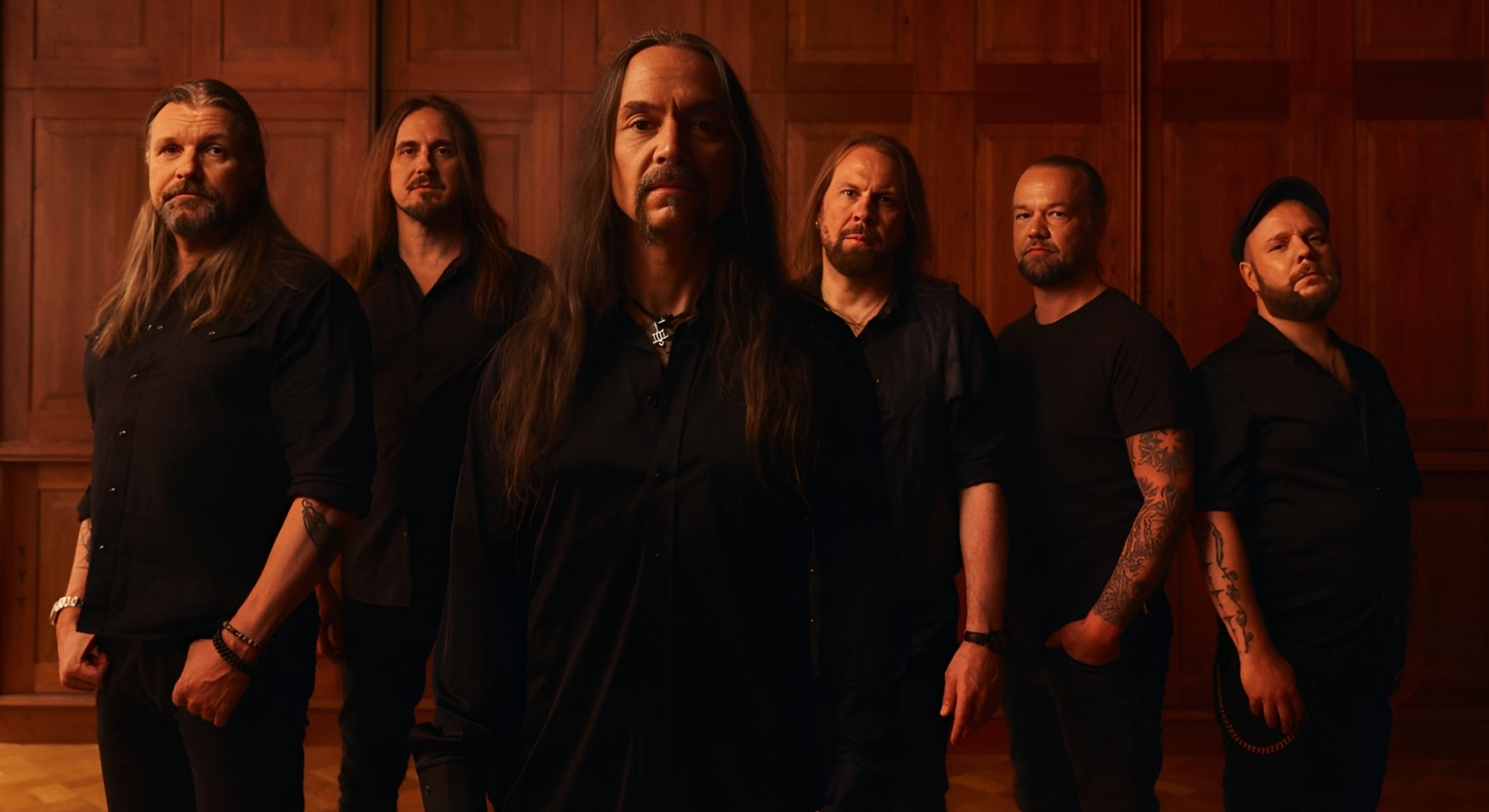
Throughout, Naïwyn has functioned as the sole architect of the material: writing, playing every instrument, and handling vocals without a permanent second member. This is a specific and well-documented mode of musical production.
Scholarship on the solo multi-instrumentalist performer has treated the arrangement less as a limitation than as its own discipline, one organized around a single author retaining full control over composition, performance, and, in Azgaal’s case, visual presentation.1
Extreme metal has produced a disproportionate number of such solitary projects, and Azgaal’s two decades of steady, self-directed output place it among the form’s more enduring examples.
That solitude also situates Azgaal at a distance from the tradition most commonly associated with French black metal internationally: Les Légions Noires, the loose Brest-centered collective whose members pursued a raw, deliberately unlistenable nihilism through the nineteen-nineties, prizing misanthropy and self-imposed obscurity over any systematic worldview.2
Azgaal shares that lineage’s appetite for extremity and self-direction but points it toward the opposite end of black metal’s range of concerns, working outward from named source texts and cosmological detail rather than inward toward raw despair.
A turning point came in 2022 with ‘Apotheosis,’ an album the project itself has described as carrying particular significance for Naïwyn. Where earlier releases moved between styles, ‘Apotheosis’ sharpened Azgaal’s occult and esoteric imagery into what has since become the project’s defining signature.
An EP, ‘Angel Of War,’ followed in July 2023, and the full-length ‘Barzaiel’ came two months later, continuing to develop that same magical and angelological vocabulary across nearly two years of near-continuous output.
From a Grail to a Judgment
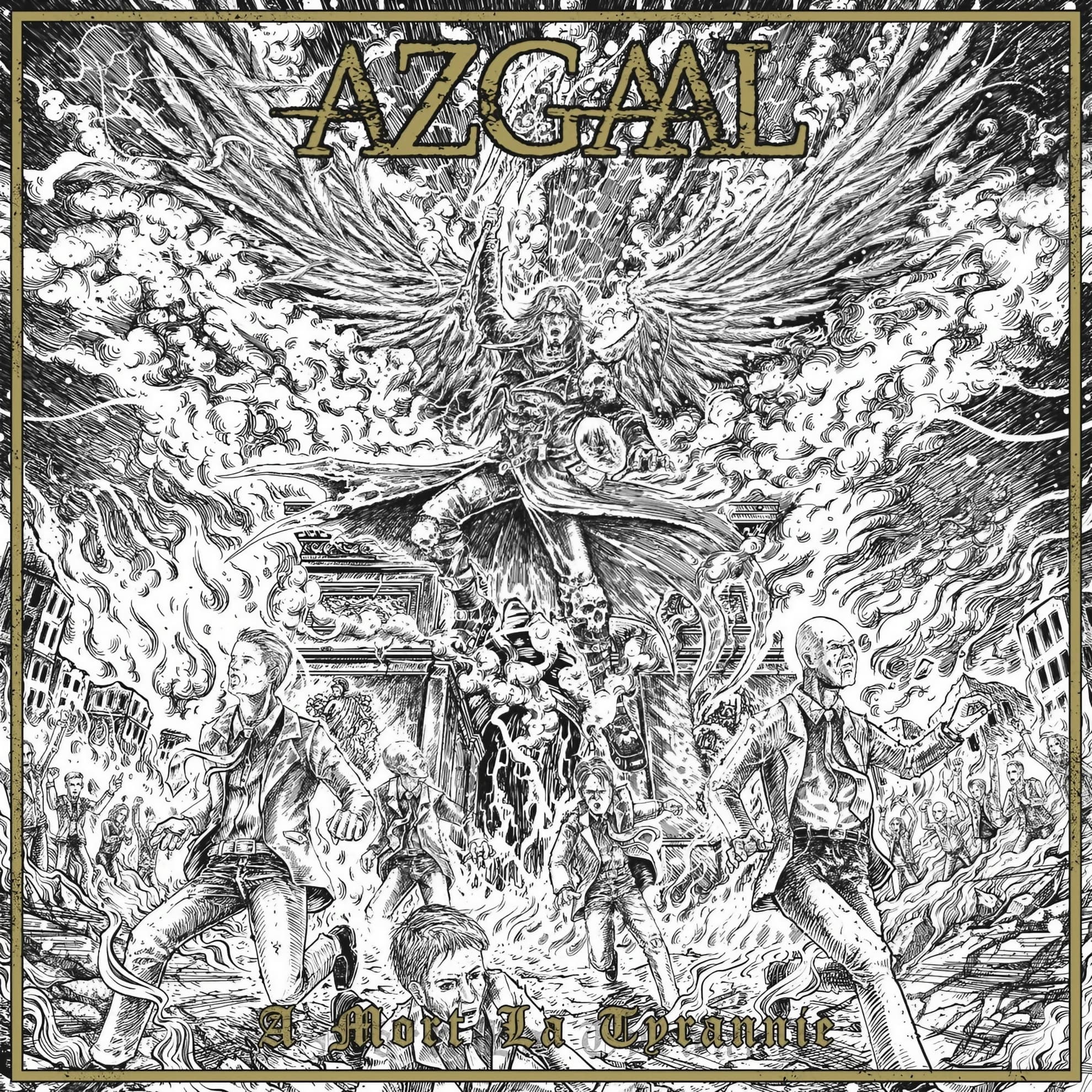
‘A Mort La Tyrannie,’ an EP released in December 2024, was Azgaal’s most recent release before the present record; the project’s most recent full-length remained ‘Barzaiel,’ issued in September 2023. Rather than issuing another full-length immediately afterward, Naïwyn spent 2025 on a different kind of collaboration.
Working with the French dungeon synth artist Werna Wolf, he co-produced the EP ‘Holy Grail,’ blending Azgaal’s black metal foundation with Werna Wolf’s synthesizer-based atmospheres. It was through the connections that followed, the project’s own account states, that Naïwyn met Fetzner Death Records, the label now issuing ‘Divine Hitman.’
That sequence gives the new album its clearest point of continuity. ‘Holy Grail’ pulled Azgaal’s established occult vocabulary into a more textured, synthesizer-inflected register; ‘Divine Hitman’ returns to a guitar-driven black metal frame while carrying that same cinematic, atmosphere-first instinct forward.
The label’s own description of the record frames it as a continuation of Azgaal’s occult universe rather than a departure from it, introducing new divine and infernal figures alongside Daovith and organizing the album’s 10 songs around the influence that judgment exerts over the record’s subjects.
The Angel Who Punishes
The angel at the center of ‘Divine Hitman’ belongs to a specific and well-studied text. ‘Sefer Ha-Razim, the Book of Mysteries,’ is a work of Jewish magical literature composed in Hebrew, most scholars agree, in the late third or early fourth century.
According to its own internal framing, the text was revealed to Noah by the angel Raziel and passed down through biblical history until it reached Solomon, whose reputed wisdom and command over spirits were said to derive from it. Structurally, the work divides the cosmos into seven heavens, cataloguing several hundred angels by name and assigning each a function: healing, warfare, divination, love, wealth, or the compelling of spirits, all governed through detailed ceremonies and invocations.3
The text’s standing among historians rests partly on how little else survives from the period in a comparable form: few other works give as systematic an account of angelic hierarchy and magical practice from Jewish sources of Late Antiquity, which is part of why it continues to draw scholarly attention across religious studies and the history of magic alike.
Daovith belongs to this catalogue of functionaries, one entry among hundreds of angels each assigned a discrete portfolio within a cosmic bureaucracy of mercy and punishment. Azgaal’s use of the figure follows a pattern common to occult black metal generally, in which grimoire material and esoteric texts are treated less as literal theology than as a working vocabulary, a set of names and hierarchies through which a record can organize its themes of judgment, transgression, and consequence.
Scholarship on this tendency within extreme metal has identified it as a distinct and increasingly systematic engagement with occult source material, rather than the looser, more atmospheric references to darkness and evil that characterized earlier decades of the genre.4
‘Divine Hitman’ sits squarely within that pattern: its track list, from ‘The Reaper Comes To You’ to ‘Finis Temporis,’ Latin for the end of time, reads as a sequence of judgment rendered, one stage at a time. A lyric video for ‘The Bewitched Souls,’ released as the album’s first advance track, confirms clean and harsh vocal registers within a single song, consistent with the range Naïwyn has used across the catalogue; no broader listen was available at the time of publication.
A New Label, an Old Practice
Fetzner Death Records operates out of Karlsruhe, Germany, with a catalogue spanning black, death, thrash, and speed metal drawn from across Continental Europe and beyond. ‘Divine Hitman’ carries the catalogue number FDR061 and is confirmed for release on compact disc, packaged as a four-panel digipak with a 12-page booklet and cover sticker, alongside a cassette edition.
Pre-order availability for both formats was confirmed through the label’s own shop at the time of publication; vinyl availability had not been confirmed.
The album’s credits confirm continuity rather than change in Azgaal’s recent working method. As with ‘Apotheosis,’ ‘Angel Of War,’ ‘Barzaiel,’ and ‘A Mort La Tyrannie’ before it, ‘Divine Hitman’ was mixed and mastered by the Polish engineer Michal Krol at KROL Studio, with cover artwork credited to Mohammed Khoirul Anam. The recording studio used for the sessions had not been confirmed through official sources at the time of publication.
An Audience Assembled by Catalogue
A French one-man black metal project signing to a small German specialist label is, on its own, a modest development. Its significance lies in what that label’s catalogue already demonstrates about where such a record travels.
Fetzner Death Records’ own release history includes Romania’s Chaos Insignia, Iranian old school death metal act Chaos Descent, and a run of German and American bands, distributed through the same compact disc and cassette channels that will carry ‘Divine Hitman.’ That existing network, documented through the label’s own Bandcamp catalogue and shop listings, is the concrete route through which a project like Azgaal reaches ears outside France, rather than any abstract notion of global reach.
Azgaal’s route to Fetzner Death Records, reached through a French dungeon synth collaboration and years of self-released output, fits a familiar shape within occult and ritual black metal specifically: a project assembled in isolation, reaching a wider readership one specialist relationship at a time, through labels and distributors rather than through festivals or radio.
The same pattern extends to how a listener outside France is most likely to encounter the record at all. Specialist mail-order shops and cassette-and-digipak collectors who already follow Fetzner Death Records’ Karlsruhe roster represent a far more concrete point of contact than any generalized notion of a global scene, and it is through exactly that channel, rather than radio play or festival billing, that ‘Divine Hitman’ stands to reach an audience beyond the borders of France.
Judgment Heard Beyond France
What ‘Divine Hitman’ offers before its release is not a verdict on how it sounds, since 10 new songs cannot yet be assessed in full, but a clear demonstration of how a record like this now travels. A text composed some sixteen centuries ago, cataloguing angels most listeners will never otherwise encounter, has been carried into contemporary black metal by one musician working alone, then passed to a small label whose own catalogue already spans several countries and genres.
The angel Daovith punishes within the confines of an ancient cosmology; the record assembled around him depends instead on a specialist distribution network, a physical pressing, and the patient accumulation of two decades of solitary work. Both, in their own registers, are systems of judgment: one theological, the other a working demonstration of how extreme metal actually moves music across borders.
What draws a listener to a record assembled from a name most of them will encounter for the first time, an angel from a text most will never read directly: the theology itself, or the discipline of one musician turning obscure source material into new songs?
References
- Julian Whittam, ‘Music, Multimedia and Spectacle: The One-Man Band and Audience Relationships in the Digital Age,’ Organised Sound 20, no. 3 (2015): 349–356. ↩︎
- Edia Connole, ‘Les Légions Noires: Labor, Language, Laughter,’ in ‘Sounds of Origin in Heavy Metal Music,’ ed. Toni-Matti Karjalainen (Newcastle upon Tyne: Cambridge Scholars Publishing, 2018), 71–93. ↩︎
- Peter Schäfer, ‘Jewish Magic Literature in Late Antiquity and Early Middle Ages,’ Journal of Jewish Studies 41, no. 1 (1990): 75–91. ↩︎
- Kennet Granholm, ‘Ritual Black Metal: Popular Music as Occult Mediation and Practice,’ Correspondences: Journal for the Study of Esotericism 1, no. 1 (2013): 5–33. ↩︎



Leave a Reply