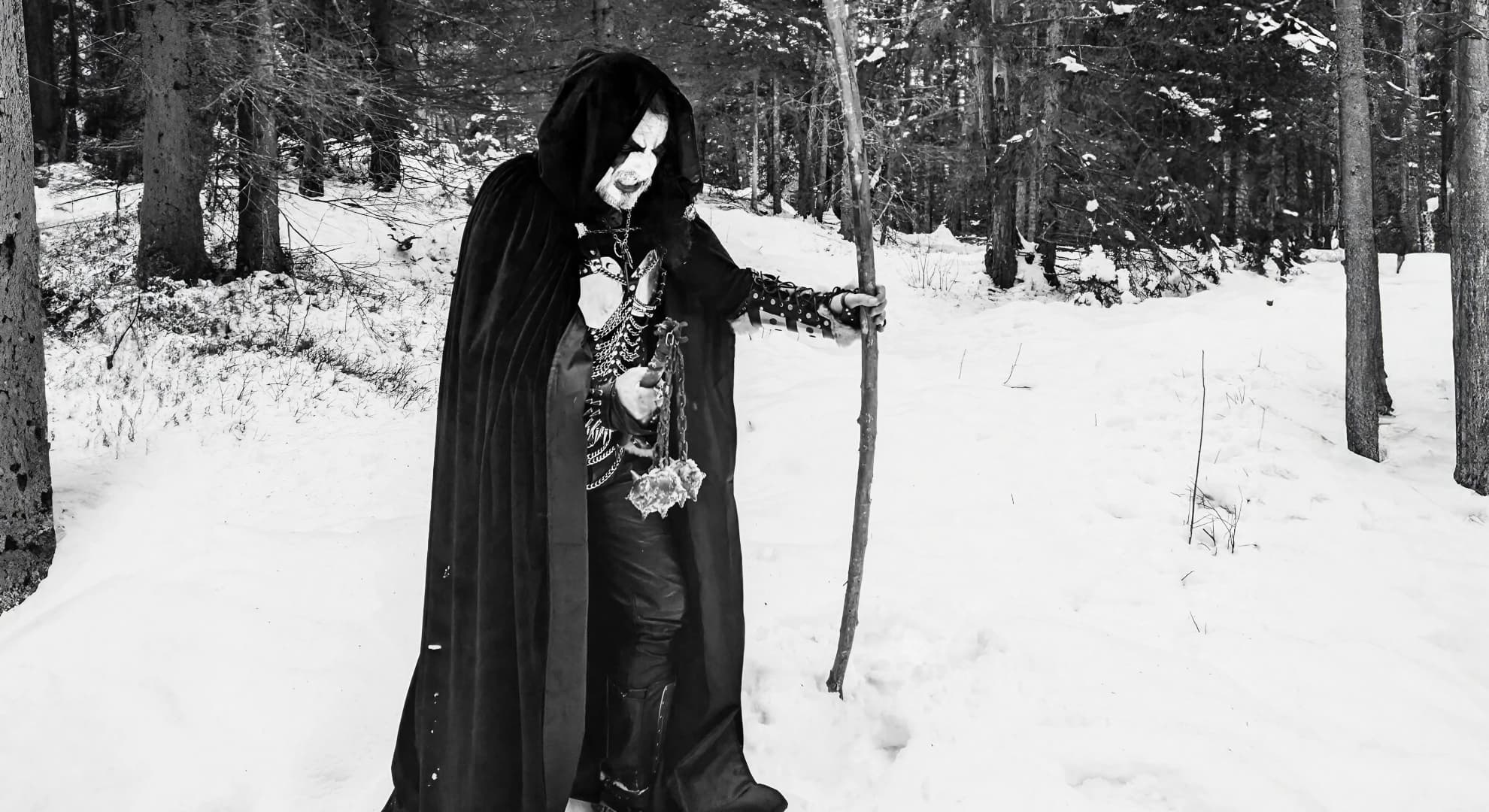


Deep within central Italy’s Sibylline Apennines during the 1400s, a French courtier made his way up to a cavern said to house the enchanted court of a mythical sorceress-queen. That visitor, Antoine de la Sale, documented the testimonies of local shepherds regarding mysterious night-time revelers haunting the mountainsides.
Six centuries after those writings, a new journey across the exact same terrain unfolds—rendered not through written prose but through black metal—proving that the Marche territory has continually birthed observers of its shadowy folklore.
Nine Albums Mapping One Region’s Legacy
Hesperus established Hesperia in Macerata, located within Italy’s Marche area, back in 1997 following his departure from the black metal band Rites Tenebrarum. Right from its inception, the project has operated as a solitary effort, with Hesperus composing, executing, and capturing every instrumental, vocal, and atmospheric component unassisted.
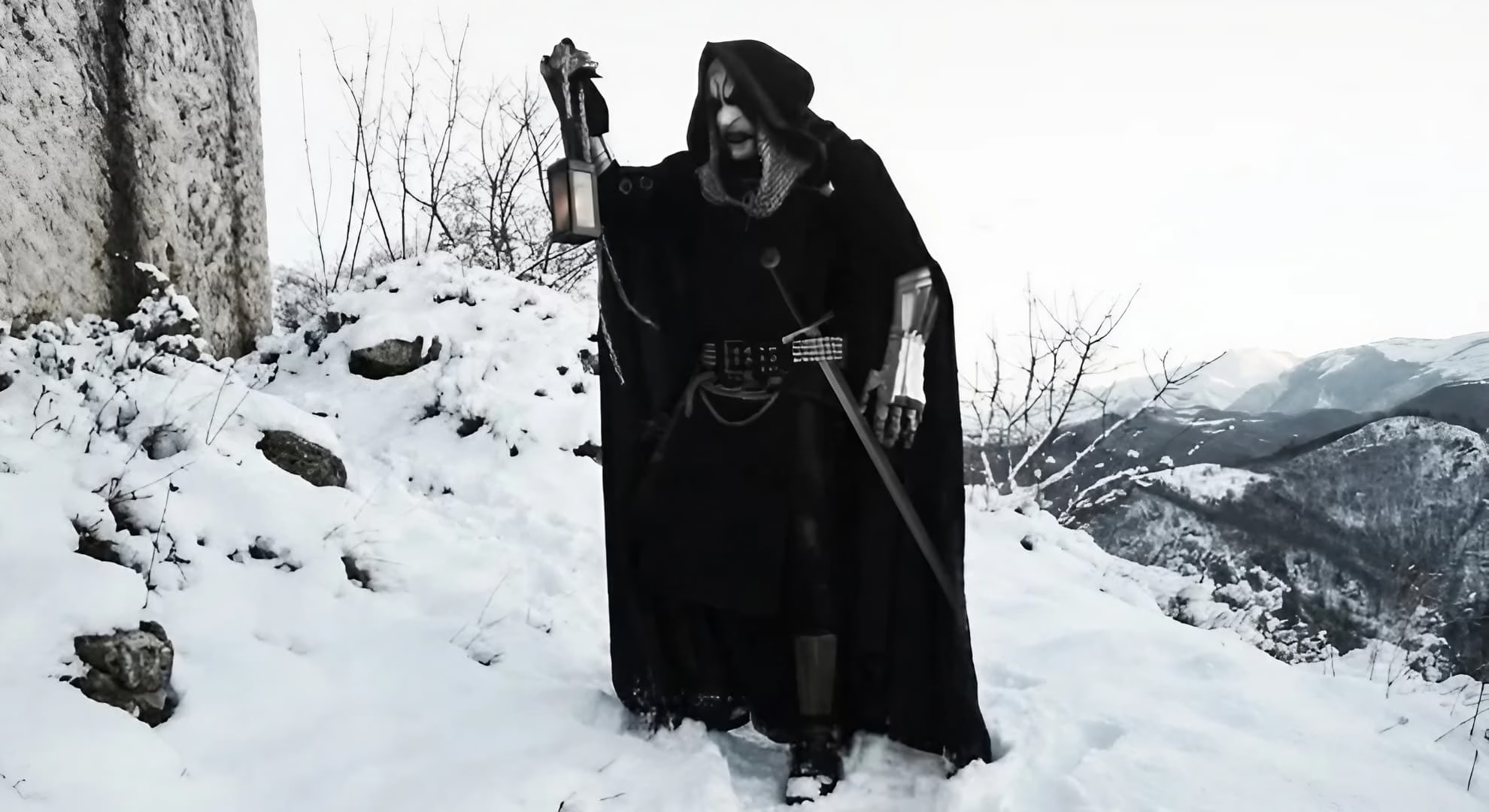
His initial four full-length records, issued from 2003 through 2015 under the overarching title ‘Aeneidos Metalli Apotheosis,’ set lines from Virgil’s Aeneid against the ancient Italic world prior to Roman dominance. The early Greeks referred to this western territory as Hesperia, a designation that provided both the artist’s moniker and his foundational artistic vision.
Two subsequent releases, 2017’s ‘Caesar (Roma Vol. I)’ and 2021’s ‘Roma Vol. II,’ extended this historical trajectory into the era of the Roman Republic and Empire, sung in Italian and archaic Latin.
In January 2025, Hesperia signed to the Dutch label Hammerheart Records and released ‘Fra Li Monti Sibillini (Black Medieval Winter Over The Sibylline Mounts),’ the project’s eighth full-length and its first sustained turn toward the Italian Middle Ages.
A Cold Prelude in the Sibylline Peaks
‘Fra Li Monti Sibillini’ ran to 14 tracks and 76 minutes, issued as a limited digipack CD and as an ice-marbled double-vinyl pressing of 300 copies. Structured as a winter pilgrimage through the Sibylline Mountains, the same range where medieval legend placed the court of a sorceress-queen, the record set frost-toned tremolo riffing indebted to Immortal and Satyricon against medieval instrumentation, spoken passages, and ambient interludes.
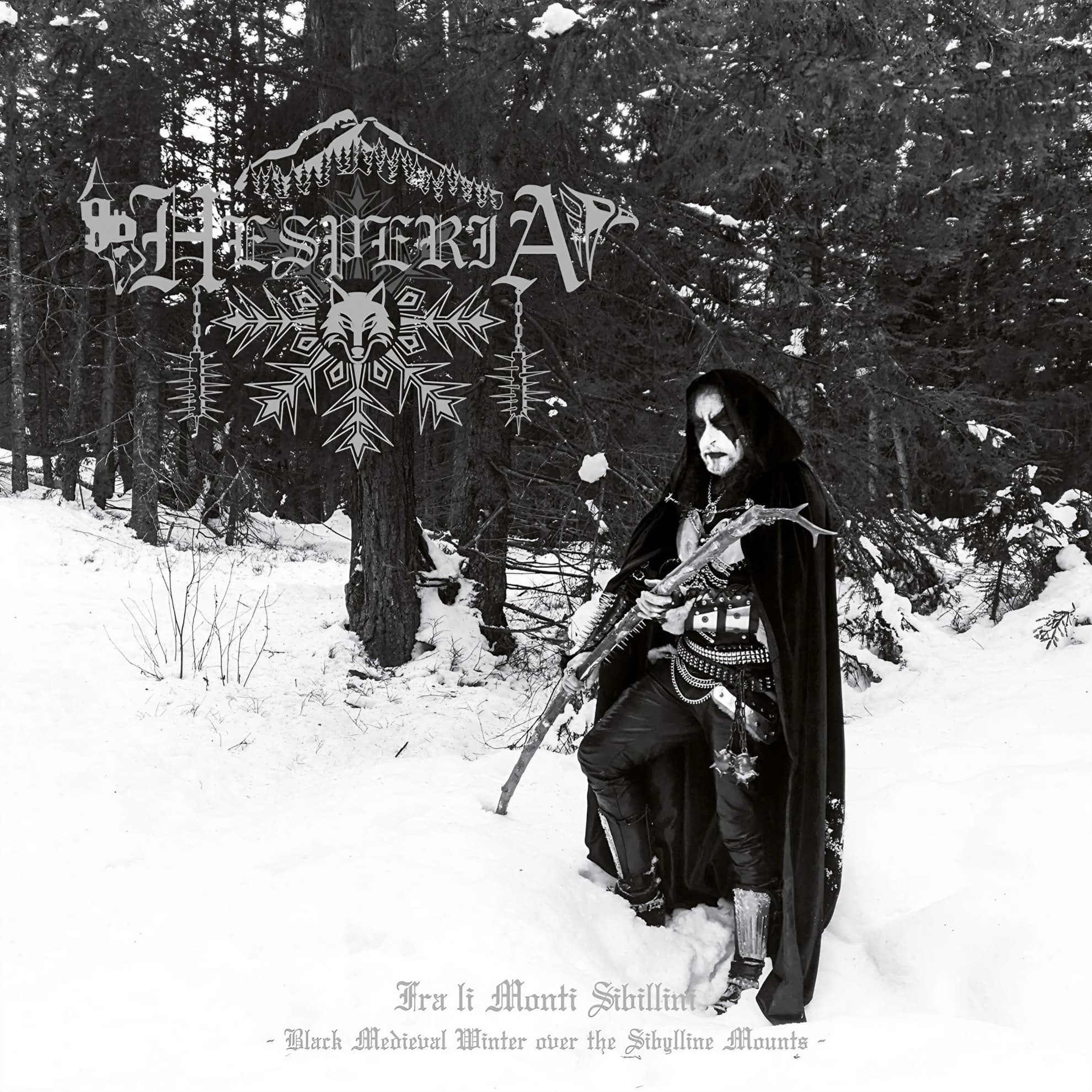
Heretics, witches, alchemists, and inquisitors moved through the album as a single unbroken winter narrative rather than as discrete songs, closing on the trial of the fourteenth-century Marche scholar Cecco d’Ascoli, condemned for heresy in Florence in 1327. ‘Picenum’ picks up a different thread of the same regional history, though its closing movement folds back into the ‘Sibylline’ material the earlier record established.
A Wider Map of the Same Ground
‘Picenum (True Marchigian Black Metal Renaissance)’ arrives August 28th through Hammerheart Records as Hesperia’s ninth full-length. Its title supplies the frame the earlier record lacked: Picenum was the Roman name for the territory of the Picentes, the Italic people whose lands stretched across the entire Marche, and Hesperus widens his focus from a single mountain range to that whole ancient geography.
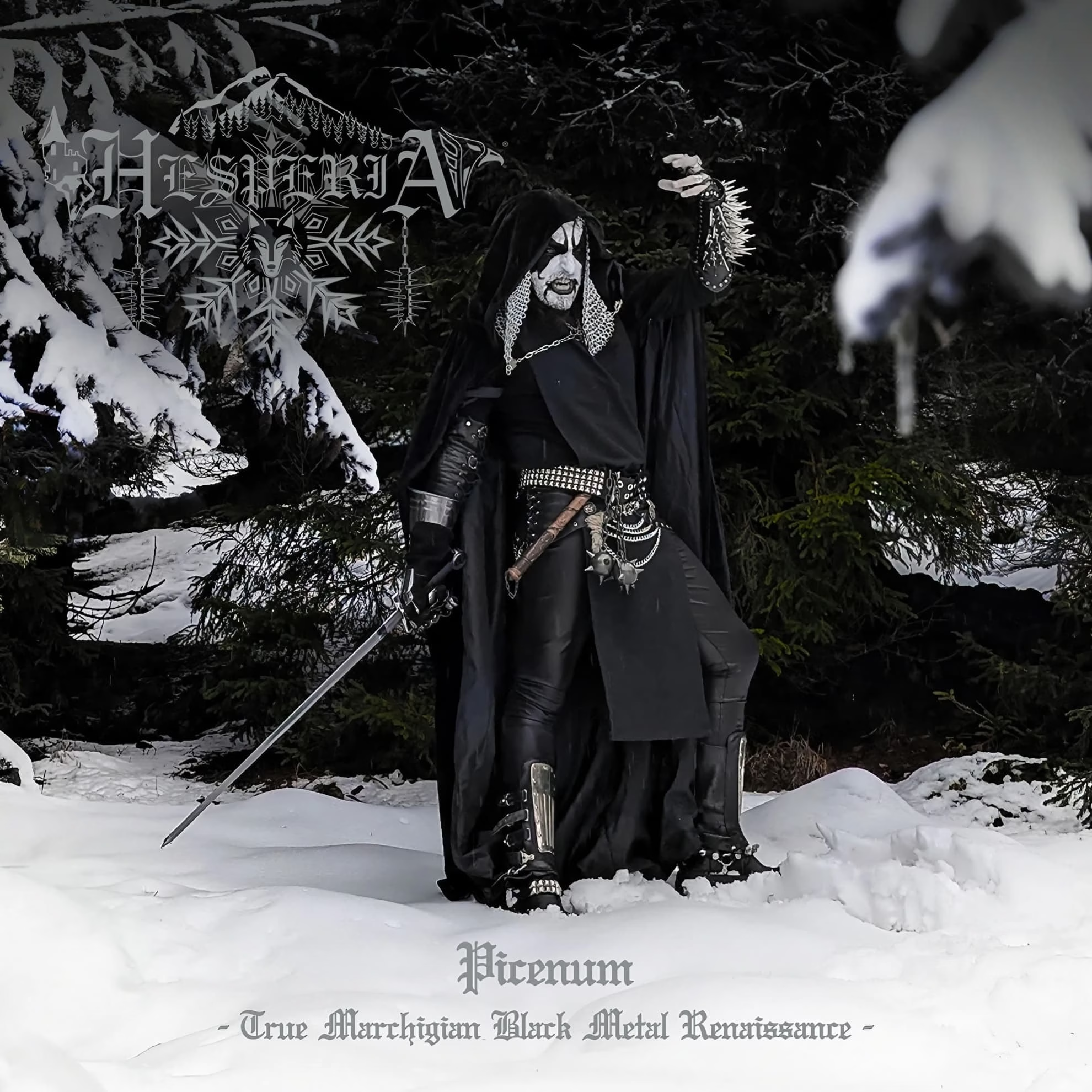
The record is available as a limited CD digipak and as two double-vinyl pressings, one on black wax and one on glacier-marble vinyl, all issued through Hammerheart Records, with pre-orders open ahead of the release date.
Hesperus continues to handle every instrument, vocal, and production task without a credited collaborator; no separate producer or recording studio could be confirmed via official sources, consistent with the project’s history of self-contained authorship.
Two Songs Ahead of the Record
The first advance single, ‘1375, La Lega Maledetta: I Signori Da Varano Si Ribellano Alla Chiesa,’ arrived alongside the album announcement in late June and previews the record’s opening historical arc: icy tremolo picking gives way to near-liturgical clean vocals before returning to blast-driven aggression, a structure that positions the song as narrative scene-setting rather than a standalone anthem.
A second single, ‘Il Paradiso Della Regina Sibilla, Atto I,’ followed weeks later with an accompanying video. Drawn from the album’s ninth track and its concluding section, the song’s slower, more spacious arrangement suggests that ‘Picenum’’s return to the ‘Sibylline’ material will lean further into the atmospheric and folk-inflected side of Hesperia’s writing than the record’s opening chapters do.
Lords, a Cursed League, and a Church
The album’s first movement is anchored in documented medieval history. In 1375, the ruling Da Varano family of Camerino, then lords of a signoria covering much of inland Marche, joined a wider revolt of Papal States communes against Pope Gregory XI, a conflict later remembered as the War of the Eight Saints.1
The uprising was provoked by the aggressive expansion of papal legates across central Italy and by the burden of clerical taxation, and it drew Camerino into alliance with Florence and Milan against Rome, serious enough that papal forces spent the following three years attempting to reclaim the territory by force.
Hesperia folds that documented rebellion into the fortress narratives that surround it: Castrum Pitini, built above a Picene necropolis and later home to a deconsecrated church and cemetery, and the Roccaccia, a stronghold local legend attaches to a warlord-turned-necromancer said to have served the devil.
Where the historical record establishes the political revolt, it is regional legend, transmitted orally rather than through chronicle, that supplies the darker second layer Hesperia builds his songs around.
A Grandmother’s Voice in the Mix
The album’s second movement turns from documented history to the oral folklore of the Marche, and here ‘Picenum’ makes an unusual choice: several passages are narrated in the voice of Hesperus’s own grandmother, recorded before her death, retelling legends she had carried from firsthand memory rather than from print. Among the figures she narrates are lu lupu mannà, the Marchigian werewolf, and la Sdrega, the regional witch.
Scholarship on European werewolf belief has traced how the lycanthrope figure moved between folk explanation, judicial prosecution, and later literary invention across different regions and centuries, of which lu lupu mannà is a regional variant rather than an isolated local invention.2
Carlo Ginzburg’s research into the Friulian benandanti, agrarian visionaries who described themselves as fighting witches in nocturnal spirit-battles, demonstrated that Italian folk-magic beliefs of exactly this kind were coherent, transmitted systems that inquisitors later reinterpreted through demonological categories imported from elsewhere in Europe.3
By recording his grandmother’s actual voice rather than restaging the legends secondhand, Hesperus turns ‘Picenum’ into something closer to a preservation act than a thematic device: the folklore on this record survives specifically because someone in his family remembered it and told it to him directly.
A French Knight Returns to the Mountain
‘Picenum’’s third and longest movement returns to the Sibylline Mountains, closing a narrative loop that began on ‘Fra Li Monti Sibillini.’ Its two extended tracks follow Antoine de la Sale, a French courtier and writer who in 1420 climbed toward the cave associated with the fabled Sibyl of the Apennines and later set down what he saw and heard from local shepherds in ‘Le Paradis de la Reine Sibylle,’ a manuscript written for the Duchess of Bourbon in the years that followed.
Recent scholarship on that text has treated it less as reportage than as a mental pilgrimage, a form normally reserved for religious devotion, redirected instead toward the folklore of a mountainous terrain.4
La Sale’s own account distinguishes between what he witnessed directly and what local people swore they had seen, a distinction Hesperia’s lyrics largely preserve: the record treats the Sibyl’s court as legend carried by a real historical traveler’s testimony, not as settled fact.
A Region That Keeps Its Own Records
‘Picenum’ works because its central gamble is unusual rather than because its influences are unfamiliar: a ninth indebted black metal record from an Italian one-man project is not, on paper, a novel proposition. What distinguishes this one is the choice, on a record about war, witchcraft, and a foreign knight’s search for a sorceress, to hand several of its darkest passages to a voice that is neither the songwriter’s nor an actor’s, but his late grandmother’s own.
That choice turns the album’s folklore from an assembled catalogue of regional curiosities into something closer to a family archive set to tremolo riffing, evidence that the legends Hesperia narrates were still being told, mouth to ear, within living memory.
Indeed, whether that distinction registers with an audience unfamiliar with the Marche is a separate question from whether the record earns it, and on the evidence of the two confirmed singles and eight albums of documented practice behind them, Hesperia has spent that particular kind of credibility a decade or more in the making.
Observers familiar with the translation of ancestral oral traditions into contemporary creative expressions—whether through soundscapes or other media—will find a resonant intent within Hesperia’s latest endeavor. The inclusion of an original narrator’s timbre fundamentally alters the mythic substance, posing a silent inquiry into how the physical presence of a specific, lived memory reshapes the legacy of the folklore itself.
References
- Gene Brucker, ‘Florentine Politics and Society, 1343-1378’ (Princeton, NJ: Princeton University Press, 1962), 297-335. ↩︎
- Willem de Blécourt, ed., ‘Werewolf Histories’ (Basingstoke: Palgrave Macmillan, 2015). ↩︎
- Carlo Ginzburg, ‘The Night Battles: Witchcraft and Agrarian Cults in the Sixteenth and Seventeenth Centuries,’ trans. John and Anne Tedeschi (Baltimore: Johns Hopkins University Press, 1983). ↩︎
- Miranda Griffin, ‘On the Trail of the Sibyl’s Mountain: Antoine de la Sale’s Le Paradis de la Reine Sibylle,’ Romanic Review 111, no. 1 (2020): 8-26. ↩︎
Leave a Reply