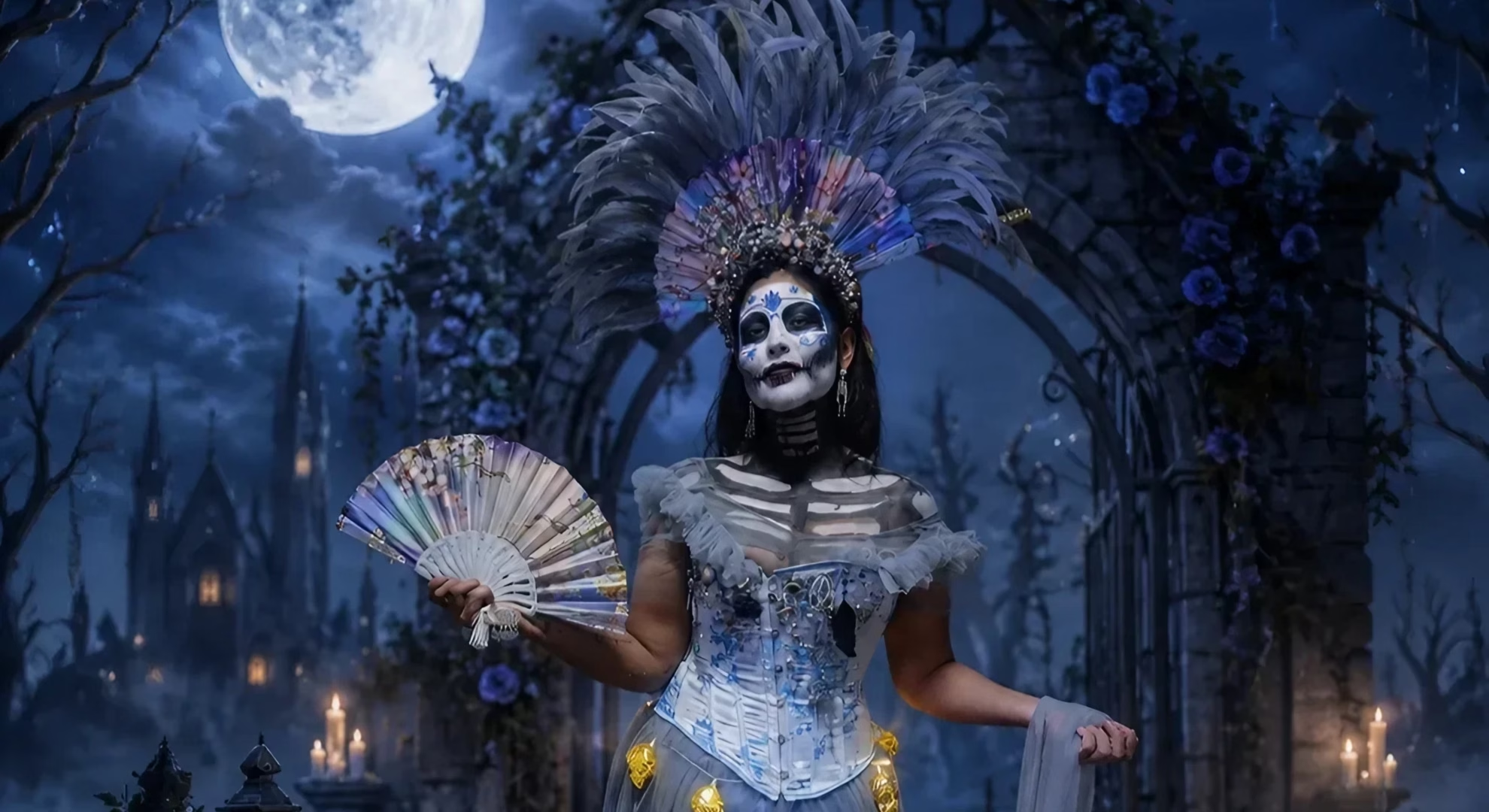


A costume built for one night of walking, dancing, and being seen close up asks something different of a room than the same costume asks once it is pinned upright behind glass and looked at from six feet away. Amarillo’s Día de Muertos community has produced, over three years and two venues, an answer to that difference without quite meaning to: a body of hand-sewn Catrina dresses and community altars now exists in two states at once, moving through a festival ground on October 24th and standing still in a gallery through October 9th.
The question is what changes when a garment stops being worn and starts being looked at instead.
The Costume Between Rite and Relic
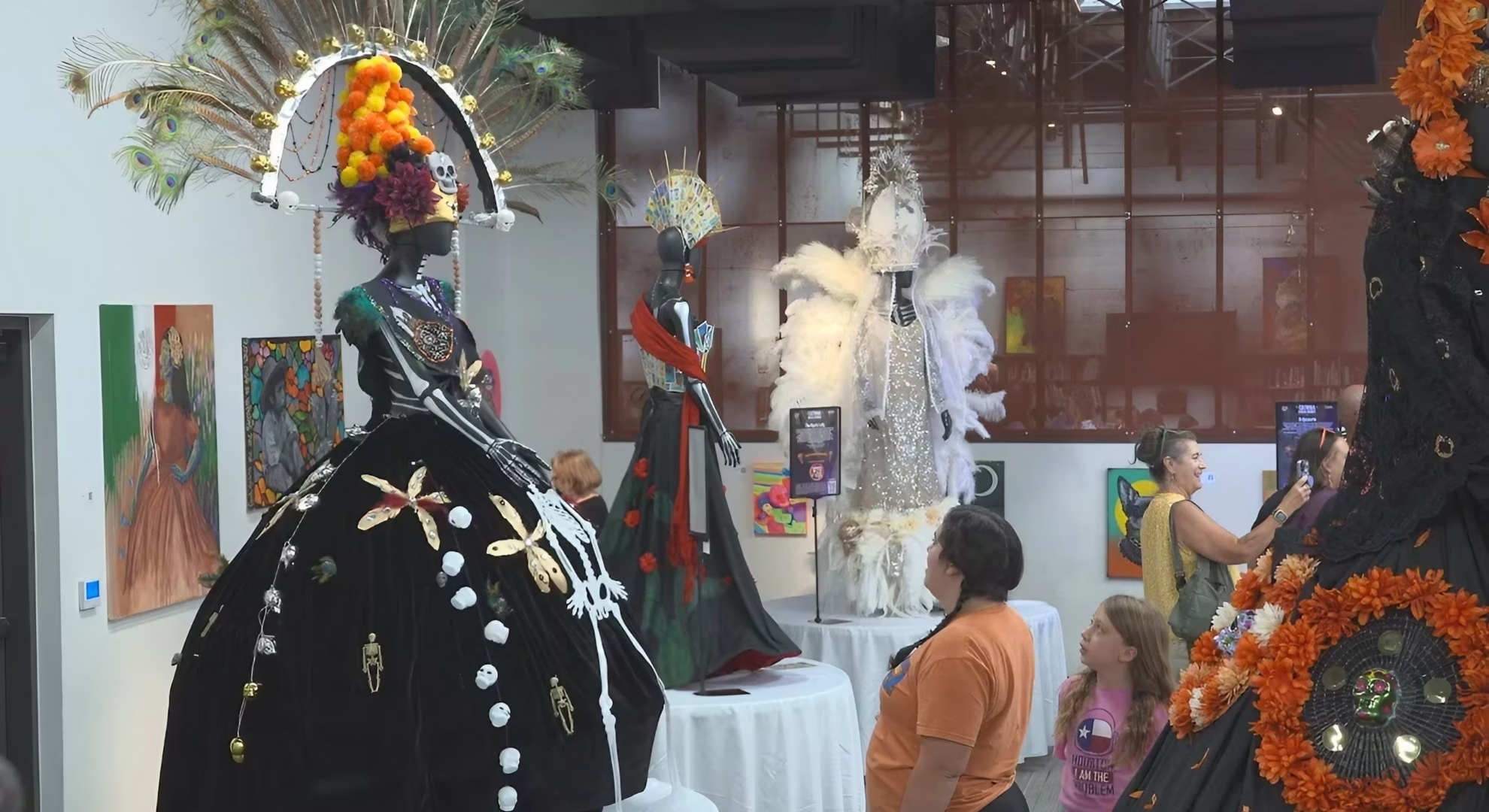
The ‘Catrina Dress Exhibit,’ on view at Arts in the Sunset in Amarillo, Texas, from September 4th through October 9th, 2026, gathers three years of hand-sewn Catrina gowns and costumes pulled directly from the Adult and Kids Catrina Costume Contests held at the city’s Día de Muertos Festival.
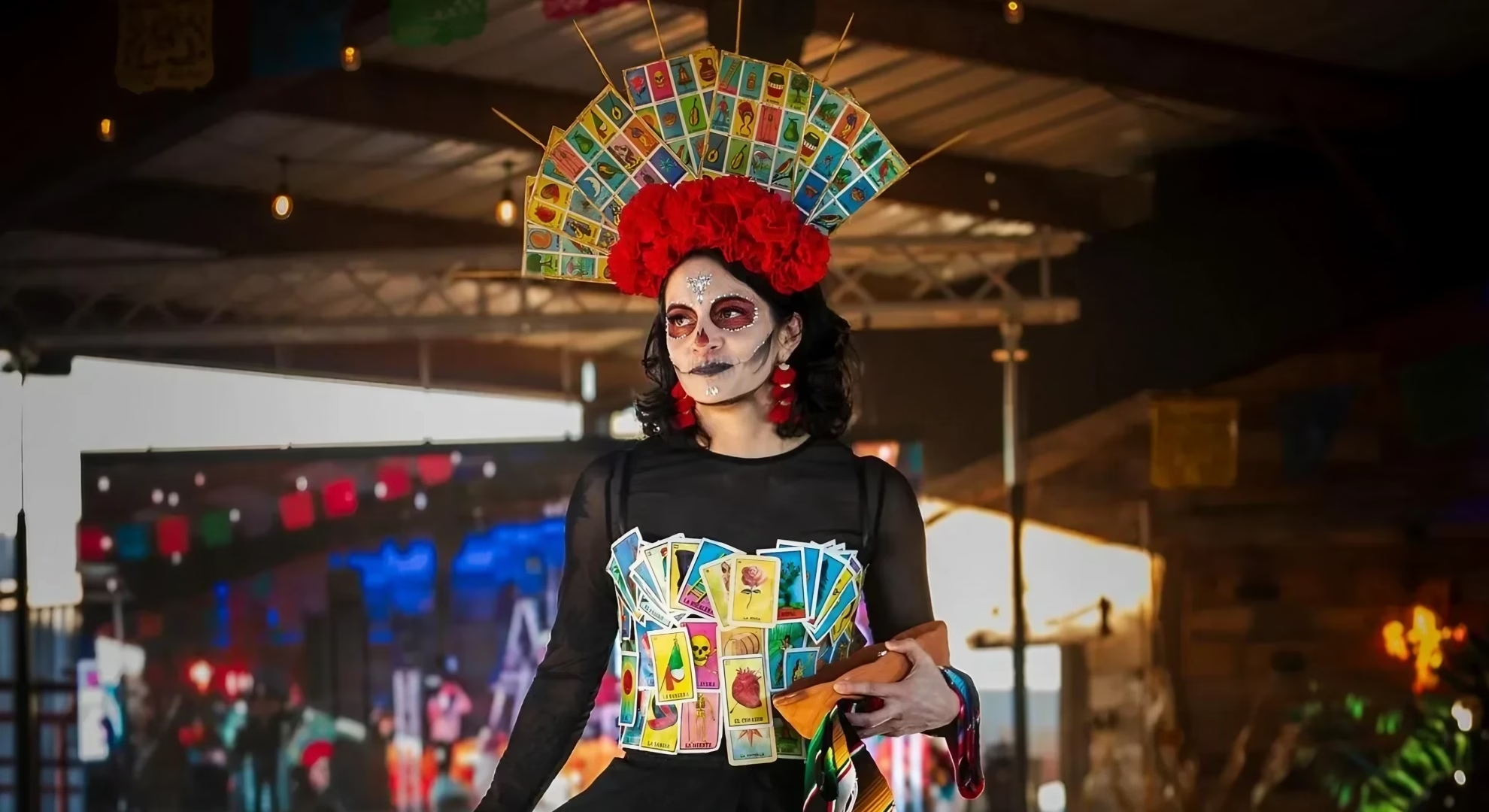
Three weeks after it closes, the Amarillo Council for the Latino Arts (ACLA) stages the fourth annual DODFest at Starlight Ranch on October 24th, 2026, where a new Catrina Costume Contest crowns this year’s dresses even as last year’s hang, retired, across town. The two events are not sequential installments of the same programming. They are the same material culture caught at two different speeds — one static and archival, the other live, judged, and consumed within a single evening.
The image both events work from has a settled history of its own. José Guadalupe Posada’s zinc etching, made between 1910 and 1913 and originally titled ‘La Calavera Garbancera,’ pictured a fashionably hatted female skeleton as a satire of Mexicans who imitated French aristocratic dress while denying their own indigenous ancestry.
The figure only became known as La Catrina after Diego Rivera placed a full-length, elegantly dressed version of her at the center of his 1947 mural ‘Sueño de una Tarde Dominical en la Alameda Central,’ where he positioned the historical Catrina walking arm in arm with his own boyhood likeness and Frida Kahlo, converting Posada’s class satire into a national emblem of mortality accepted rather than feared.
Every gown in the Amarillo exhibit descends from that specific reversal: a costume tradition rooted in turning class shame into a figure of dignity, then handed each October to contestants who redesign her within their own categories.
The Retrospective Without Names
The ‘Catrina Dress’ Exhibit is presented jointly by Arts in the Sunset, La Frontera Mexican Food Restaurant, Balú Productions, the Día de Muertos Festival of Amarillo, and ACLA, and hangs inside a public gallery in the city’s Cultural Arts District, with admission free throughout the run.
What the exhibit does not do, in any of its public materials, is attribute individual dresses to individual makers. The wall groupings follow the contest category — Adult and Kids — rather than name.
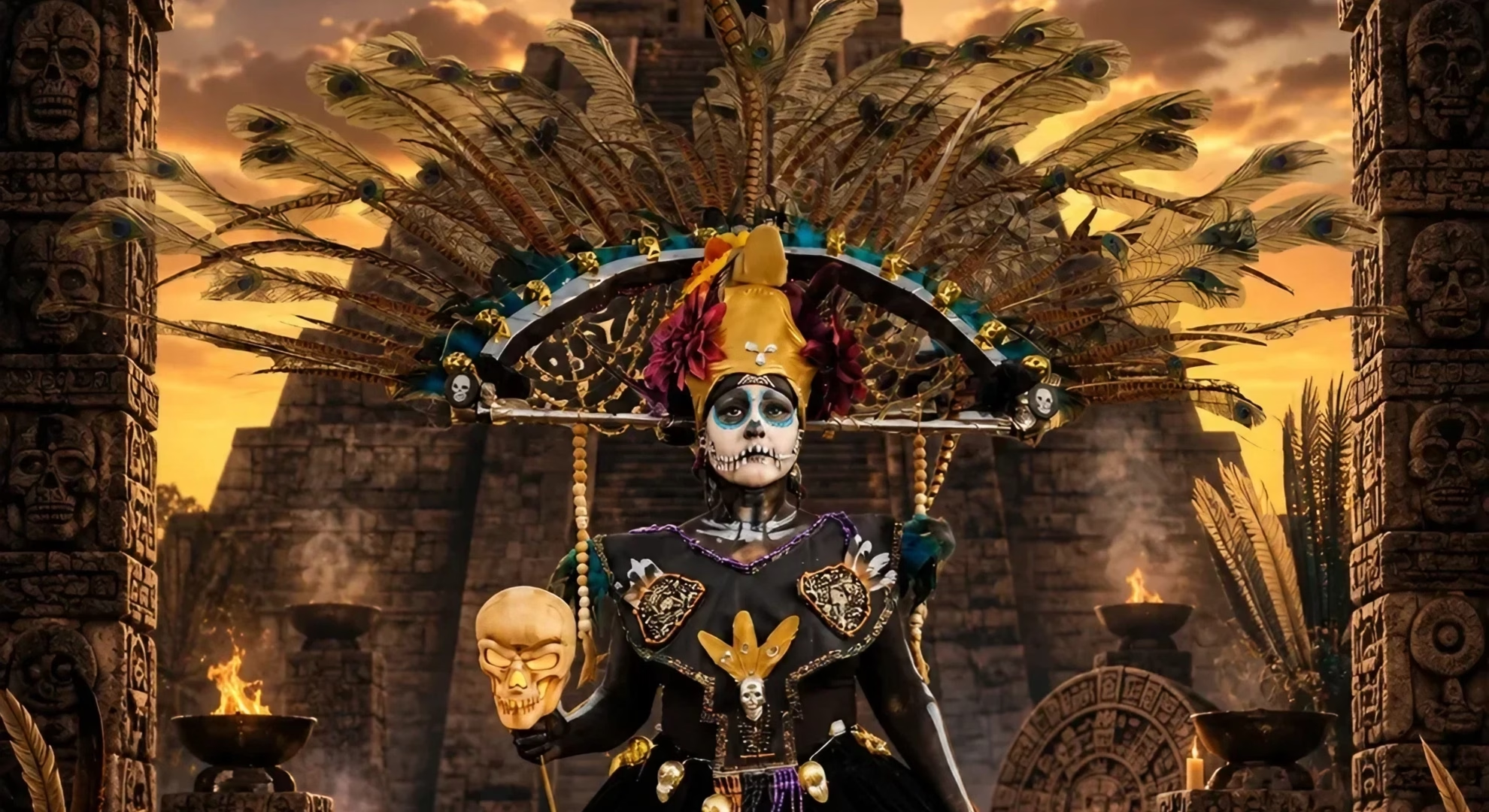
That omission reads less like a curatorial gap than an accurate carryover of how the costumes were made to function in the first place. A Catrina costume, inside a contest, exists to be judged against other Catrina costumes in the same category, not read in isolation; a maker’s skill becomes visible through comparison, not through a solo caption.
Moved into a gallery and set on a stand without a rival category beside it, a costume is asked to answer a different question than the one it was designed for — to hold up on its own construction, its floral crownwork, its beadwork, its color choices — a demand a contest garment was never made to meet alone.
The Altar That Cannot Be Archived
Where the gallery holds three years still, Starlight Ranch will hold one evening in motion. DODFest 2026, now in its fourth year and staged at Starlight Ranch for the second time — and, by ACLA’s own announcement, its last pairs a new Catrina Costume Contest with a community altar exhibition, in which attendees and a panel of judges vote on “ofrendas” assembled from candles, marigolds, and photographs of the dead. General admission is $10, with children under 12 admitted free.
When the festival first moved to the larger venue for its third staging in 2025, ACLA’s Diego Gutierrez Lopez described the shift as a matter of scale rather than ambition: “This is our Day of the Dead Festival. We’ve been hosting it for three years, but this is the first time at Starlight Ranch, which is a lot bigger.”
An “ofrenda” judged by a crowd on a single night cannot be preserved the way a costume can. Candles burn down; flowers wilt; the photographs go home with the families who brought them.
Across the festival’s four-year run, what DODFest carried from one year to the next was not the object but the format — the same categories, the same competitive structure, restaged with new material every October. ACLA has told the community that 2026 is that restaging’s final year, describing the choice as a deliberate return to a smaller, more intimate celebration rather than a cancellation.
The Catrina Dress Exhibit freezes three of those four years into something a visitor can walk past slowly; this October’s contest will complete the pattern the gallery has been holding still, not continue it.
The Motion a Symbol Keeps
Posada drew his ‘Calavera Garbancera’ to mock a specific kind of stillness — people who had frozen themselves into a borrowed, imitative idea of dignity rather than living their own inheritance. Rivera’s mural answered that stillness with motion, placing Catrina inside a crowd rather than isolating her on a single printed page.
Amarillo’s two events, read together, complicate that argument rather than simply repeating it. A costume held still behind a rope for five weeks was never, by itself, a full account of what the tradition meant; it depended on a festival that kept producing new material to hold still the following year.
ACLA’s announcement that the 2026 DODFest will be its last removes that dependency. What the gallery holds will not be replenished by a fifth year of contestants. The costumes now on the wall at Arts in the Sunset stop being a sample of an ongoing practice and become, instead, its complete record — the version of La Catrina that Amarillo’s Día de Muertos Festival leaves behind, still, after the crowd that kept her moving has gone home.



Leave a Reply