

Rökkr does not simply mean dusk. In the vocabulary ‘The Poetic and Prose Eddas’ assign to the end of the gods, it names a state of dimming that is neither day nor night, the exact condition that gives Ragnarök its first syllable and its argument: not annihilation so much as a fading toward what comes after. A metal record built to carry that word as its subtitle is making a statement about structure before a single note plays, promising a sequence rather than a mood board, an Act I that presumes an Act II.
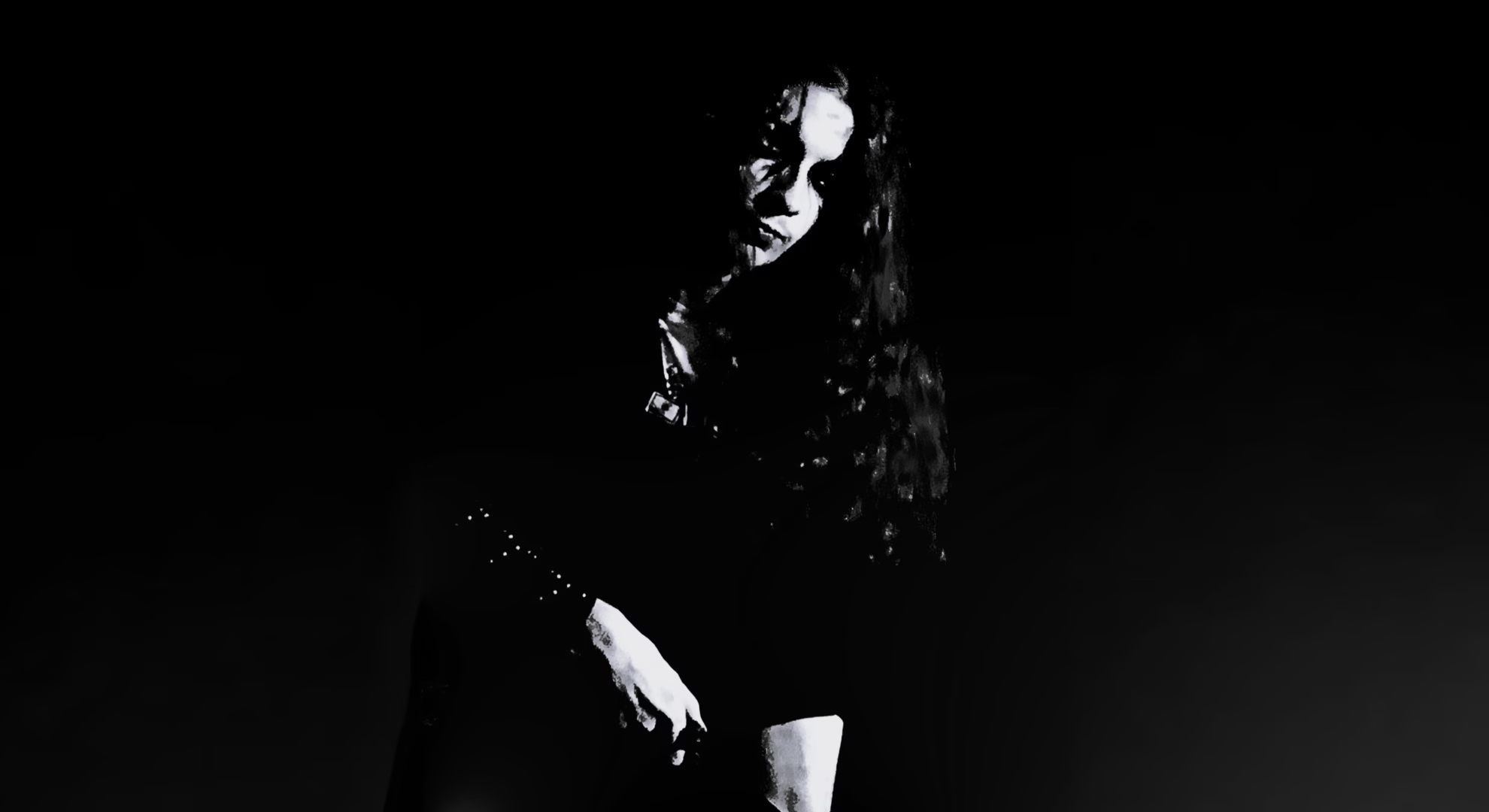
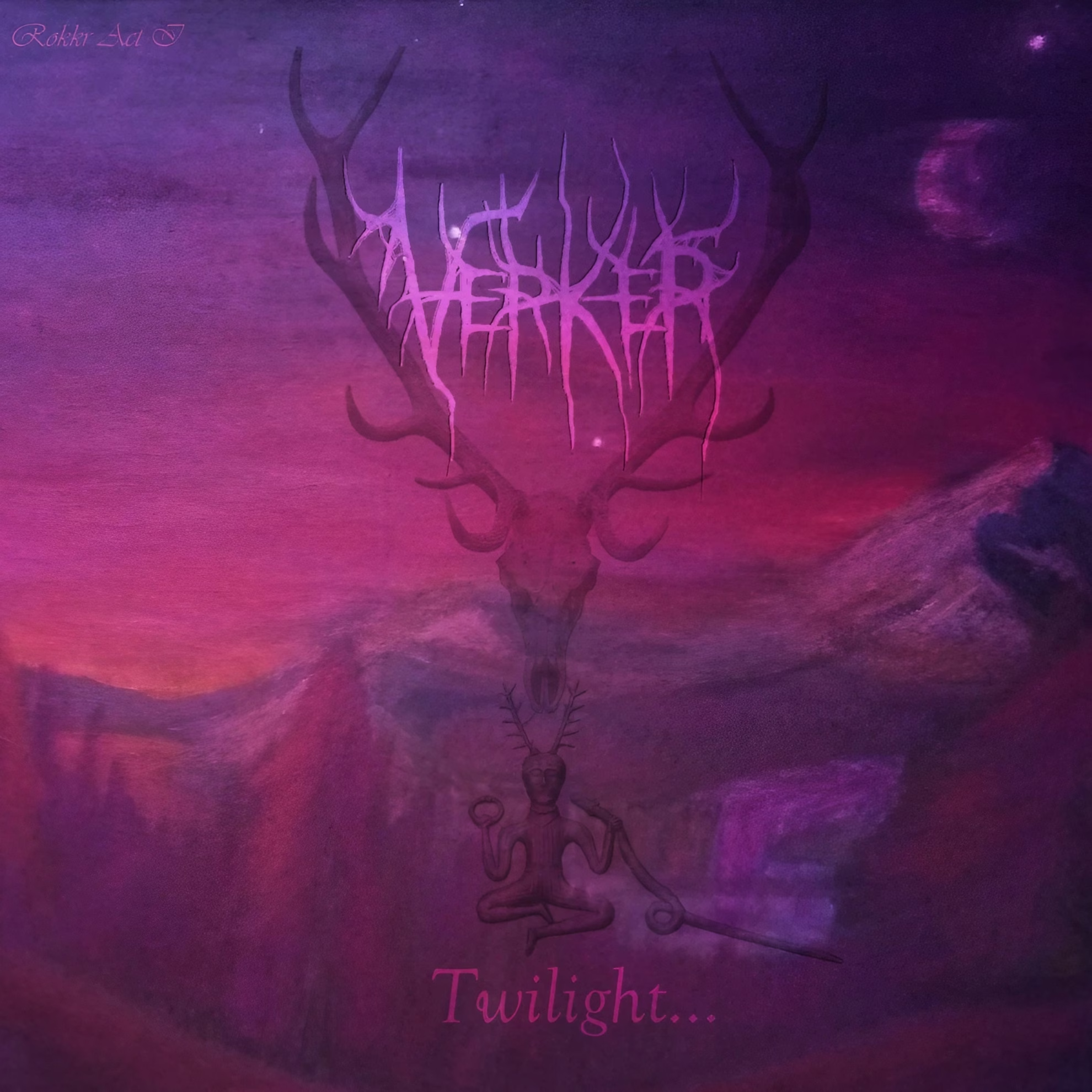
That kind of intent typically belongs to bands with label rosters, promotional budgets, and multi-year release cycles behind them. It belongs less often to a single guitarist recording alone in Greensboro, North Carolina, with no label attached to the release at all. Rune Richards, who has operated the one-man project Verker since 2017 under the working name Agathorn, releases the band’s debut full-length, ‘Twilight… (Røkkr, Act I),’ on September 22nd, 2026 — an album whose opening movement first surfaced, in fragments, seven years earlier.
Seven Years in the Telling
Verker began, in Richards’s own description on the project’s Bandcamp and Facebook, as a vessel of “what it means to work or to wonder,” built entirely around one musician playing every part: guitar, bass, drums, keyboards, violin, mandolin, and both clean and harsh vocals.
The project’s own genre label — experimental pagan black metal, with acknowledged reach into atmospheric, avant-garde, progressive, melodic, symphonic, and post-metal idiom — reads less like promotional shorthand than an accurate inventory of a catalogue built by one person testing every direction available within a folk-inflected black metal frame.
The rökkr concept itself predates the finished album by six years. ‘Prophecy of Chaos (Völva),’ released September 23rd, 2019, and ‘Cold Winds of Woven Reflection,’ released June 25th, 2020, were both billed on Bandcamp as advance tracks from Verker’s upcoming debut album, with the latter’s credits updated that same June to confirm ‘Twilight… (Røkkr, Act I)’ as the album’s working title.
A companion piece, ‘Prophecy of Doom (Shamanic Doom Version, Völva),’ followed on September 2nd, 2020, continuing the same Völva throughline at a slower, doom-inflected tempo. For the next several years, the only new Verker releases were alternate versions of existing material — acoustic, orchestral, and instrumental reworkings of ‘Cold Winds’ issued through 2021 — while the album itself remained unfinished.
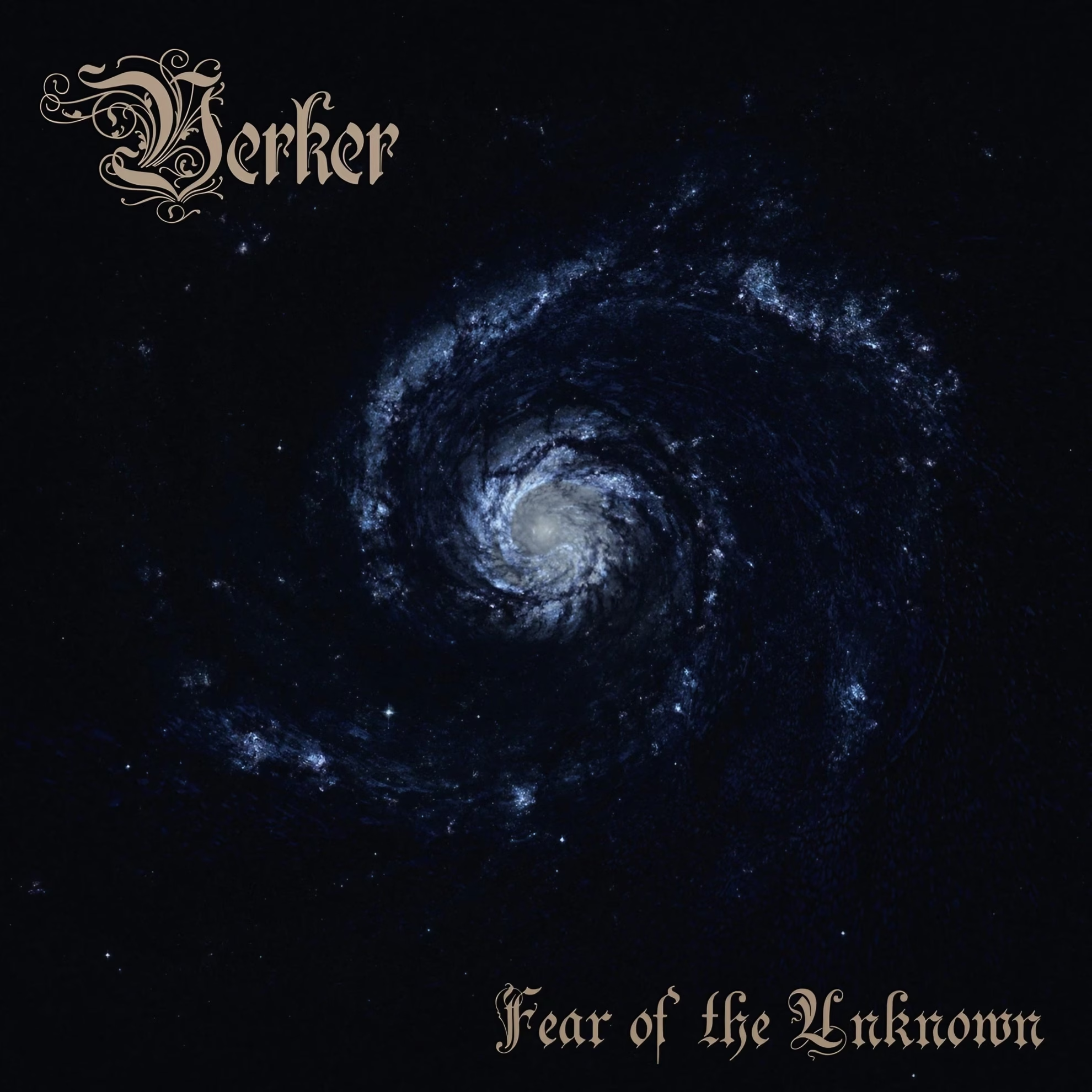
The clearest record of that gap sits in ‘Fear of the Unknown,’ a seven-track demo Richards released on November 15th, 2025, through the DIY tape imprint Dungeon Squid Productions. Its credits state plainly that the material was written and recorded between 2020 and 2025, then mixed and mastered only in its final year — a demo, functionally, assembled from leftover fragments of the same half-decade the debut album had gone quiet.
Paired studio and instrumental versions of songs including ‘Rogue Wave,’ the title track, and ‘Threat of the Others’ gave the release the character of a working notebook rather than a finished statement, the sound of a single musician testing arrangements in public while the larger project behind them stalled.
Set against the record that follows it, ‘Fear of the Unknown’ reads less as a proper second chapter in Verker’s catalogue than as the sound of Richards keeping the project’s momentum alive during the years the debut needed to reach completion.
Rökkr and the Roots of Ragnarök
The word carrying the album’s subtitle has a specific philological history. Rökkr, Old Norse for twilight or dimming, supplies the root beneath ragna rökkr — twilight of the gods — the compound that later editors and readers have folded into the more familiar Ragnarök, the sequence of battles, floods, and rebirths that closes the mythological cycle recorded in the ‘Poetic Edda’s ‘Völuspá’ and expanded in Snorri Sturluson’s ‘Prose Edda.’1
The distinction matters for a record built around the word: rökkr describes a state, not a single event, a threshold condition in which the old order has not yet fully ended and the new one has not yet fully begun. A serialized work organized around that threshold, with Act I implying at least one further installment, suggests a record more interested in the passage itself than in any single climactic destruction.
Reading Norse myth strictly on its own terms is one approach; reading it as the northern branch of a shared Indo-European inheritance is another, and it is the second approach that gives ‘Røkkr’ its stated intellectual reach.
The scholar most associated with that second reading, Georges Dumézil, argued across decades of comparative work that Indo-European societies from Rome to Scandinavia to Vedic India organized their mythologies around a recurring three-part structure of sovereignty, martial force, and fertility, and that Norse material, properly read, preserves that structure as clearly as any other branch of the family.2
A project subtitling its debut with a term specific to Norse cosmology while promising a serialized, multi-act sequence signals an ambition closer to that comparative tradition than to the single-culture imagery more common across pagan-themed metal.
Verker’s own catalogue supplies a case study in exactly that kind of structural thinking. The völva, the itinerant seeress of Old Norse tradition consulted for prophecy and credited in the Eddas with foretelling the gods’ own end, recurs across multiple Verker releases predating the album itself, including ‘Prophecy of Chaos (Völva)’ and its later doom-tempo reworking.
The völva is a documented figure of Old Norse religious practice rather than a folkloric invention, a professional seer whose ritual role Old Norse sources describe with unusual consistency across sagas and eddic poetry.3 Returning repeatedly to the völva’s prophetic voice while shaping a serialized concept around rökkr places the record’s design closer to a study of mythological structure than to atmosphere borrowed loosely from Norse sources for effect.
One Musician, Every Part
No producer sits between Richards and the finished record. Every confirmed Verker release to date, from 2019’s ‘Prophecy of Chaos’ through the 2025 demo, credits Richards alone for writing, performance, and production, a pattern consistent across the project’s entire documented history.
No external recording studio had been confirmed for ‘Twilight… (Røkkr, Act I)’ at the time of publication, consistent with a project whose prior releases show no credited outside facility on any occasion. The absence of a named producer or studio is not a gap in the reporting; it is the working condition under which the record was made.
That condition carries its own weight within a broader lineage of Norse-adjacent black metal, defined in part, according to scholarship on the genre, by its use of solitary, ritualized recording practice as a mode of quasi-religious mediation rather than simple production efficiency.4
Recording every instrument alone across a multi-year span is not incidental to a record organized around cosmological structure; it mirrors, in method, the kind of singular authorial control the völva figure exercises in the material Richards keeps returning to, one voice claiming to hold the whole shape of the story.
The Return of Riddle Weaver
The clearest publicly available evidence for the album’s direction surfaced in July 2026, when Richards released ‘Mov.t III, Riddle Weaver: (Interlude) …Of Life,’ an instrumental single reviving the title of his own 2018 release ‘Riddle Weaver, the Journey to Darkness and Fate.’
Stripped of vocals, the track foregrounds the mandolin and violin lines that have run through Verker’s catalogue since its earliest releases, set against the same blackened guitar tremolo that anchors the project’s harsher material.
The choice to reissue an eight-year-old title as an instrumental single, rather than debut new material outright, positions the forthcoming album as a project explicitly folding its own back catalogue into a single design — Act I gathering earlier fragments under one cosmological frame rather than discarding them for a clean start.
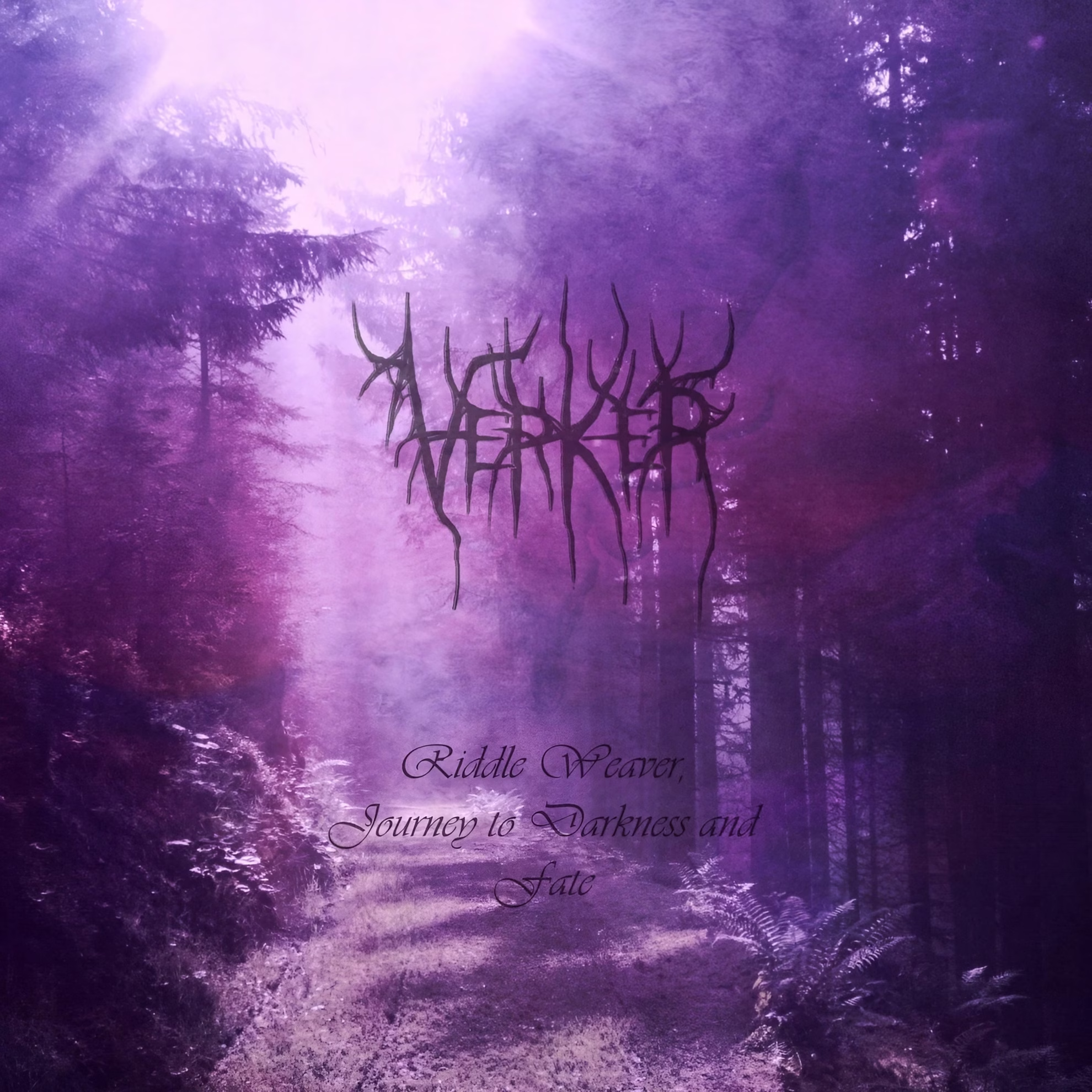
That gesture carries specific weight given the album’s stated concept. A serialized work built around rökkr’s threshold state benefits from exactly the kind of continuity the single stages: material written years before the album’s completion, reintroduced now as part of a larger design rather than left behind as juvenilia. The single suggests a record built by accretion, one musician’s decade of scattered material finally organized into sequence, rather than a single unified writing session.
An Act Still Awaiting Its Sequel
An eight-year gap between a debut’s first teased single and its finished release usually signals a project quietly abandoned, not one built by design. Richards’s continued output across that span — the ‘Völva’ material, the extended ‘Cold Winds’ versions, the 2025 demo, the ‘Riddle Weaver’ single — argues instead for a musician working toward a specific serialized structure at his own pace, unconstrained by a label’s release calendar because no label exists to set one.
‘Twilight… (Røkkr, Act I)’ stands, as of September 22nd, 2026, as the first documented proof that the structure Richards described in his own 2020 track notes was never abandoned, only delayed by the realities of recording an entire album alone.
The album’s own title promises an Act II, and its documented method — one musician, no studio, years of patient accumulation — gives no reason to expect that second installment on any conventional schedule. What the record does confirm, on the evidence available before release, is that rökkr’s threshold state has already described Verker’s own working method for the better part of a decade: neither finished nor abandoned, held instead in the space between the two until the moment demanded otherwise.
For those who followed Verker’s scattered catalogue across the six years between its first teased single and its completed record, does ‘Twilight… (Røkkr, Act I)’ resolve the fragments — the ‘Völva’ tracks, the alternate versions, the stopgap demo — into the shape they were always meant to take, or does hearing them gathered into a single completed design change what those years of dispersed work meant in the first place, now that the sequence they were forming is finally visible?
References
- John Lindow, ‘Norse Mythology: A Guide to the Gods, Heroes, Rituals, and Beliefs’ (Oxford: Oxford University Press, 2001), 254–256. ↩︎
- C. Scott Littleton, ‘The New Comparative Mythology: An Anthropological Assessment of the Theories of Georges Dumézil,’ 3rd ed. (Berkeley: University of California Press, 1982), 1–7. ↩︎
- Rudolf Simek, ‘Dictionary of Northern Mythology,’ trans. Angela Hall (Cambridge: D. S. Brewer, 1993), 291–293. ↩︎
- Kennet Granholm, ‘Ritual Black Metal: Popular Music as Occult Mediation and Practice,’ Correspondences 1, no. 1 (2013): 5–33. ↩︎


Leave a Reply