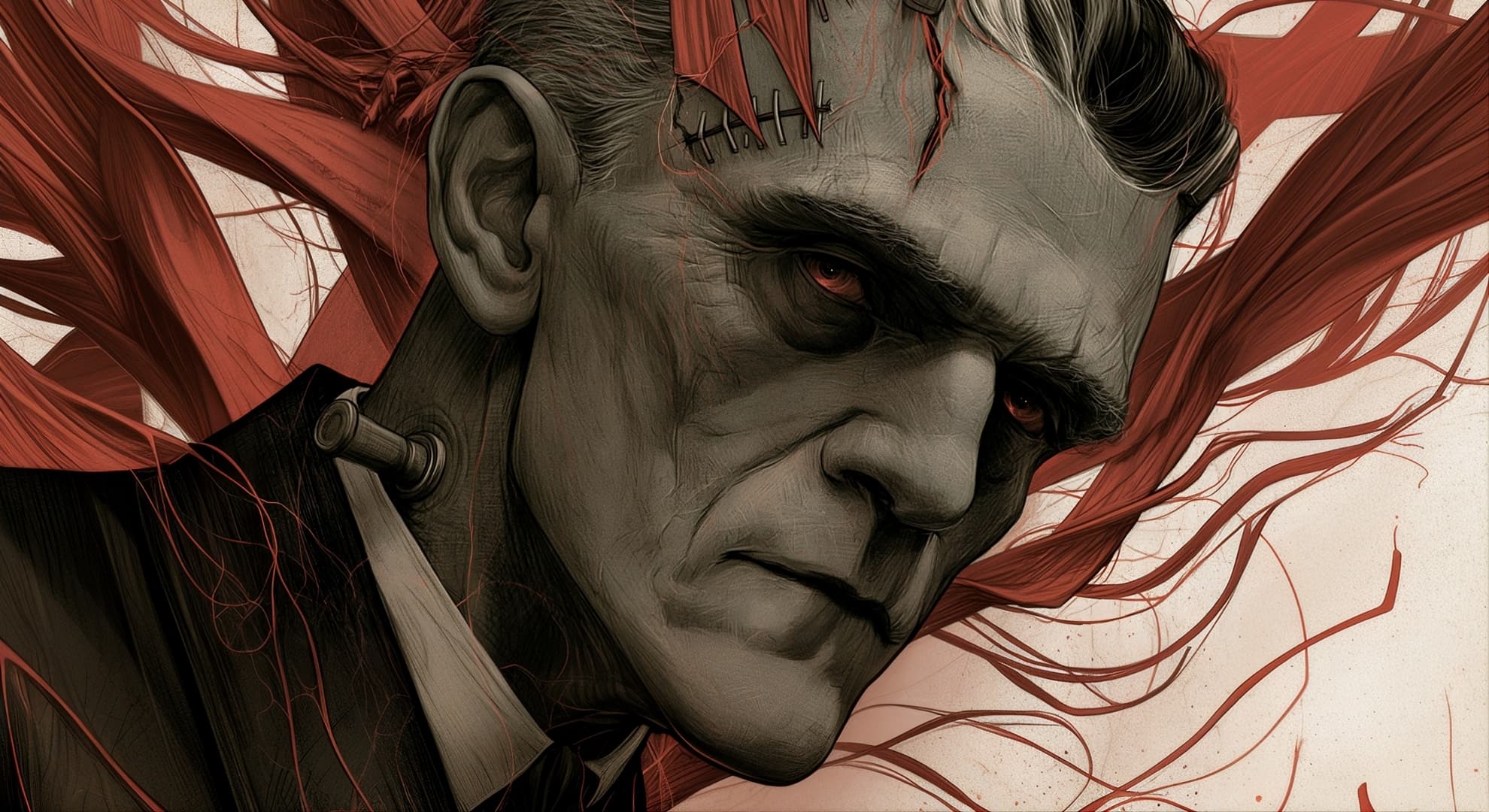


The gothic has always been an argument about what to withhold. Its eighteenth-century originators drew terror out of obscurity — out of the dreaded thing kept just past the edge of the candlelight — and treated suggestion as more powerful than disclosure. A run of institutional exhibitions opening across 2026 reverses that instinct.
Working in registers as far apart as an accredited literary museum, a commercial visitor attraction, and one of the world’s major film museums, they share a single method: each recreates the gothic’s moment of origin as a designed, sensory, walk-through environment, and in doing so makes visible, fixed, and fully lit the things the source material was careful never to show.
The Gothic Made Walkable
The tradition these exhibitions draw on is not the flattening category of a generic dark mood but a specific and documented one: the staging of terror as sensory spectacle. Edmund Burke had already, by 1757, recast terror as an aesthetic experience rather than a moral failing, arguing that obscurity and the prospect of pain could expand rather than diminish the mind.1
Four decades later Ann Radcliffe gave the principle its sharpest formulation, distinguishing terror, which “expands the soul,” from horror, which “contracts, freezes, and nearly annihilates” it — and locating the difference precisely in uncertainty and obscurity, in the dreaded thing suggested but never shown.2
That doctrine has a visual history as well as a literary one. In the seventeen-nineties the showman Étienne-Gaspard Robertson mounted his Fantasmagorie in a disused Paris convent, using concealed magic lanterns to throw ghosts, skeletons, and the recently dead across smoke and darkened walls.
The phantasmagoria was immersive entertainment before the word existed: a paying audience walked into a room to be frightened by projected apparitions it could not quite locate. Terry Castle has argued that the phantasmagoria did something lasting to the Western imagination — it internalized the ghost, moving the spectral from the external world into the mind, so that haunting became a metaphor for thought itself.3
The exhibitions of 2026 run that history in reverse. Where Robertson’s spectacle and Castle’s account move the ghost inward, the immersive show externalizes it again, returning the apparition from the mind to a room the visitor can enter, photograph, and leave. This is the hinge on which the whole argument turns.
Radcliffe’s terror depended on what the candlelight withheld; the walk-through environment is engineered to withhold nothing. The question each of these institutions raises, whether or not it means to, is what happens to an aesthetic founded on obscurity when it is rendered fully present — whether walk-through reconstruction converts Radcliffe’s expansive terror into her annihilating horror, or produces a third thing altogether, the themed environment, that is neither the book’s suggestion nor the reader’s dread.
The three shows are bound by more than one method. Each traces its lineage, directly or through the genre’s bloodline, to a single documented scene: the summer of 1816 on Lake Geneva, when a volcanic winter caused by the previous year’s eruption of Mount Tambora confined Mary Godwin, Percy Bysshe Shelley, Lord Byron, John Polidori, and Claire Clairmont indoors at the Villa Diodati, and Byron’s challenge to write a ghost story produced both ‘Frankenstein’ and, by way of Byron’s fragment, Polidori’s ‘The Vampyre.’
That week is the origin point the institutions keep returning to — and, increasingly, the room they recreate.
Remaking the Room at Diodati
No institution sits closer to that origin than Wordsworth Grasmere, the museum at Dove Cottage run by the Wordsworth Trust, whose ‘Ghost Story! Into the Gothic Imagination’ opens on July 7th, 2026 and runs through June 19th, 2027.
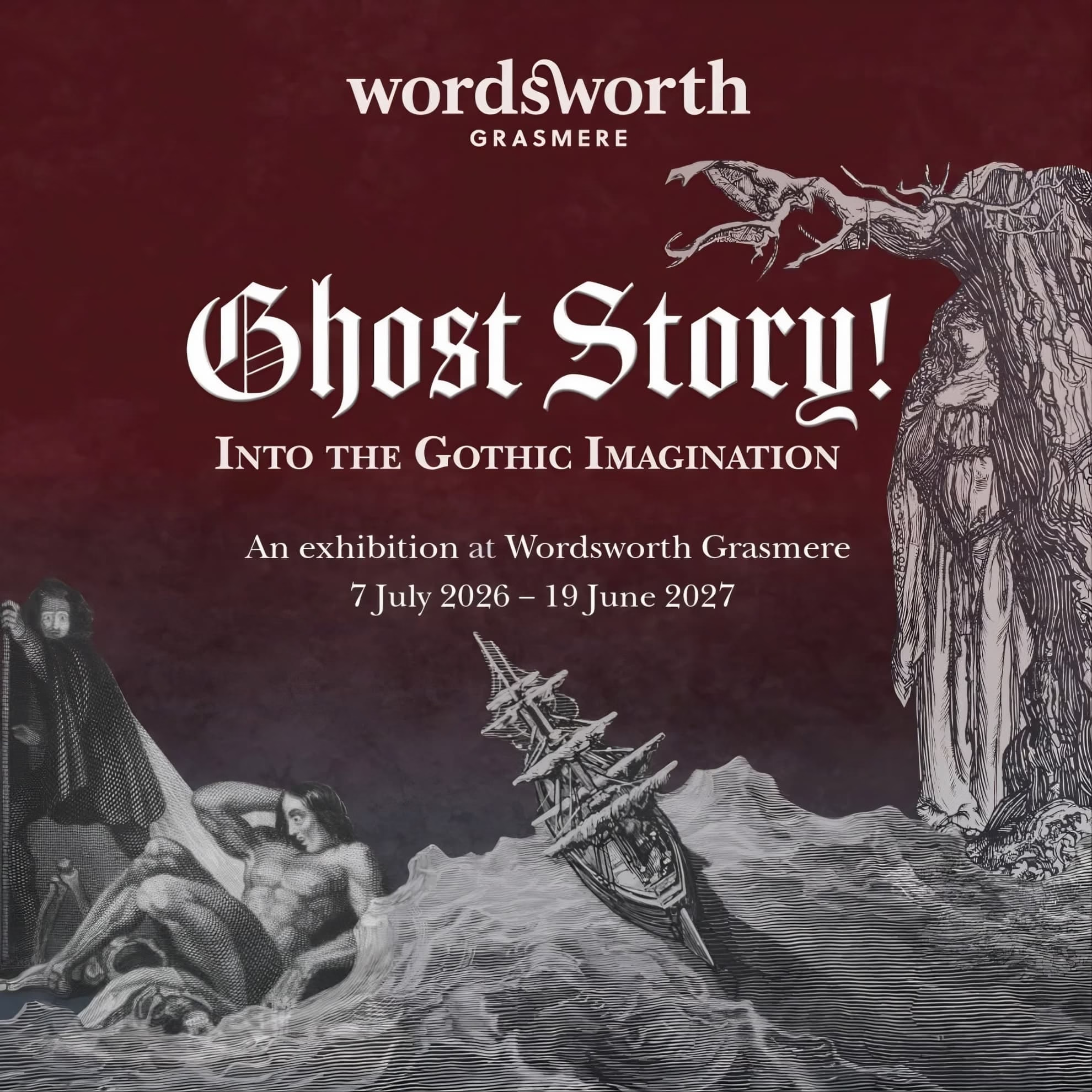
The Trust holds an internationally significant literary collection, and the exhibition’s claim is genealogical: that the haunting stories which laid the groundwork for modern horror and fantasy can be traced to a specific set of objects and a specific room, both of which it possesses or can recreate.
The objects are extraordinary, and chosen to argue the point. The show places on display a first edition of ‘Frankenstein’ from 1818, opened to the line in which the creature’s “dull yellow eye” first opens; a first edition of Polidori’s ‘The Vampyre’ from 1819, the novella that introduced the seductive aristocratic predator later refined into Stoker’s count; and the earliest surviving manuscript of Coleridge’s ‘Christabel,’ copied at Dove Cottage by Dorothy Wordsworth and Mary Hutchinson, whose serpentine antagonist Geraldine shaped a century of female vampires.
Alongside them sits Lord Byron’s snuff box, later owned by the actor Henry Irving, whose bearing is thought to have informed Stoker’s ‘Dracula’ — a chain of physical custody connecting the 1816 challenge to the Victorian stage.
The most telling object is an illustration. Among the works on view is Mervyn Peake’s depiction of the ‘Nightmare-Life-in-Death’ figure from Coleridge’s ‘The Rime of the Ancient Mariner,’ an image removed from the poem’s 1943 edition because the publisher judged it too frightening for readers. To exhibit it now, in a show designed to deliver fright as experience, is to stage the exact reversal this article is concerned with: the thing once withheld for being too much to look at is placed at eye level and lit.
The institutional gesture that defines the exhibition, though, is its choice to hire a screen designer rather than a curator alone to shape the visitor’s passage. The galleries were designed by the production designer May Davies, whose credits include ‘Black Mirror’ and the BAFTA-winning drama ‘Landscapers,’ and who has turned the museum’s rooms into an environment of moonlit woods, crumbling ruins, and haunting seas, opening in a recreated version of Mary Shelley’s bedroom at the Villa Diodati.
A literary museum that owns the actual 1818 book has chosen to place beside it a fabricated room — the authentic relic and the simulated origin standing in the same building, asking the visitor to move between them.
That doubling is the exhibition’s real subject, whether the wall texts say so or not. Admission, valid for 12 months, costs £16 for adults (approx. COP 72,600) and £8 for children (approx. COP 36,300). What the ticket buys is not only proximity to the manuscripts that started the genre but entry into a designed dream of their origin — the page and the walk-through scene of its writing offered as a single visit. The collection supplies the terror Radcliffe described; the immersive staging supplies the presence she warned against.
The Monster Made Literal in Bath
200 miles south, in Bath, the same origin is worked in a frankly commercial register. Mary Shelley’s House of Frankenstein, a for-profit visitor attraction occupying a Grade II listed Georgian townhouse on Gay Street, presents itself as the world’s first museum dedicated to Shelley, and it draws on the city’s documented claim to her: she lived in Bath in the early nineteenth century and wrote portions of ‘Frankenstein’ there.
Across four floors the attraction tells the same story Grasmere tells — the 1816 challenge, the sleepless night, the vision — but with none of the literary museum’s restraint about disclosure.
Where the novel delivers its creature through suggestion, recoil, and Victor Frankenstein’s refusal to look, the Bath attraction presents the whole of it. Its central object is an eight-foot animatronic creature, modeled on Mary Shelley’s own description rather than the flat-headed Hollywood silhouette, displayed among limbs, jars, and anatomical clutter; below it a phantasmagoria basement delivers darkness and jump-scares as a designed climax.
The rooms are multisensory by intent, layering recorded sound and circulated scent over the objects, so that the visitor’s body, not only the eye, is enlisted.
The attraction’s own promotional vocabulary — the language of the iconic and the unmissable — is institutional framing rather than critical description, and it is worth noting precisely because it marks the distance between the two Frankenstein shows. Grasmere holds the 1818 book under glass and recreates a room around it; Bath dispenses with the relic almost entirely and gives the visitor the monster’s body instead.
The word the attraction reaches for, phantasmagoria, is the exact one Robertson’s spectacle and Castle’s history supply — and it names the lineage honestly. This is the gothic as projected, externalized apparition, returned from the page to the darkened room two centuries on.
Museum entry begins at £12.50 for an adult (approx. COP 56,800), with combined experiences priced higher — a theatrical walking tour and entry at £24 (approx. COP 109,000), and a basement-inclusive ticket from £26.57 (approx. COP 120,600). What the convergence of the two English shows demonstrates is that the immersive method is not the property of any one kind of institution.
An accredited literary trust and a for-profit attraction, working independently, have arrived at the same instinct: to take the most withheld figure in the genre — the creature whose horror the novel guards — and present it whole.
Sorting the Gothic Into Galleries
The largest version of the method is mounted not in England but on Wilshire Boulevard. The Academy Museum of Motion Pictures, the museum of the organization that awards the Oscars, opens ‘The Horror Show’ on September 27th, 2026, running through July 25th, 2027, and organized by the senior exhibitions curator Jessica Niebel.
Where the English shows recreate a single originating room, the Academy Museum takes the whole genre as its subject and gives it a floor plan.
The exhibition’s structure is its argument. After an introductory sound installation, visitors pass through “The Hallway” — modeled on the horror trope of the corridor — into six named galleries: Gothic, Psychological, Science, Slasher, Religion, and Ghosts. The diffuse and suggestive material of the genre is sorted into a navigable taxonomy, each room dressed as the setting it names.
To divide horror into six legible categories and dress each as a walk-through set is itself an act of disclosure — the rendering of an aesthetic of uncertainty into a plan a visitor can follow from room to labeled room.
The genealogy back to the Villa Diodati is explicit in the objects. The Science gallery foregrounds the 1931 ‘Frankenstein,’ and the Gothic gallery the 1931 ‘Dracula’ and Hammer’s 1958 ‘The Horror of Dracula’ — the screen descendants of the 1816 challenge and of Polidori’s aristocratic predator, four screen generations downstream of the manuscripts Grasmere keeps under glass.
David J. Skal has traced how the gothic monster became, across the twentieth century, a creature of mass visual spectacle, its meanings reshaped each time it changed medium, from page to stage to celluloid to merchandise.4 The Academy Museum is the institution where that last transformation is housed and honored.
What distinguishes the show is that it states the thesis on its own behalf. Its organizers describe it as blurring the line between museum presentation and eerie spectacle — an accredited museum, the most prestigious in its field, openly trading the reticence of the vitrine for the immediacy of the designed environment.
Where Grasmere worries about the seam between relic and reconstruction, and Bath ignores the relic altogether, the Academy Museum simply absorbs spectacle into the museum’s own definition of its work.
General admission, which includes the exhibition, costs $25 for adults (approx. COP 85,800), with reduced rates of $19 for seniors (approx. COP 65,200) and $15 for students (approx. COP 51,500), and free entry for visitors 17 and under. The price admits the visitor to the genre’s afterlife arranged as a sequence of inhabitable settings — the end point of the same impulse visible at Dove Cottage and on Gay Street, scaled to a major museum and stated without apology.
The Cost of the Fully Lit Room
Set beside one another, the three exhibitions describe a single movement with unusual clarity. An accredited literary trust, a commercial attraction, and a national film museum — institutions that share neither scale nor purpose nor audience — have independently settled on the same way of presenting the gothic: not as text to be read or images to be studied at a distance, but as origin to be entered.
The genre that drew its force from obscurity is being turned, across every register of institution, into something fully lit and walk-through, and there is a cost to the conversion, and it is the cost the founding texts predicted. Burke and Radcliffe located the gothic’s power in the unseen; immersion trades the unseen for presence, and presence is precisely what terror cannot survive intact.
A creature you can photograph at eye level, a bedroom you can stand inside, a corridor dressed and labeled — each resolves an uncertainty the source material kept deliberately open, and each risks converting Radcliffe’s expansive terror into the safe, contained frisson of the themed attraction.
And yet the longer history complicates the verdict. The gothic was never only a literature of the page; from Robertson’s projected ghosts onward it was also a technology of staged spectacle, a thing shown to a paying audience in a darkened room. The immersive exhibition may be less a betrayal of the tradition than a return to one of its oldest forms.
What the shows at Grasmere, Bath, and the Academy Museum finally reveal is an institutional wager — that the dreaded thing can be made present without being made harmless, that the room you walk into can still hold what the sentence used to leave unsaid. Whether the wager pays is the one thing none of the three reconstructions can show in advance.
When Wordsworth Grasmere rebuilds the room where ‘Frankenstein’ was imagined, does it preserve the gothic’s origin or quietly replace it?
References
- Edmund Burke, ‘A Philosophical Enquiry into the Origin of Our Ideas of the Sublime and Beautiful’ (London: R. and J. Dodsley, 1757), 58–64. ↩︎
- Ann Radcliffe, ‘On the Supernatural in Poetry,’ New Monthly Magazine 16, no. 1 (1826): 145–152. ↩︎
- Terry Castle, ‘The Female Thermometer: Eighteenth-Century Culture and the Invention of the Uncanny’ (New York: Oxford University Press, 1995), 140–167. ↩︎
- David J. Skal, ‘The Monster Show: A Cultural History of Horror’ (New York: W. W. Norton, 1993), 18–24. ↩︎
Leave a Reply