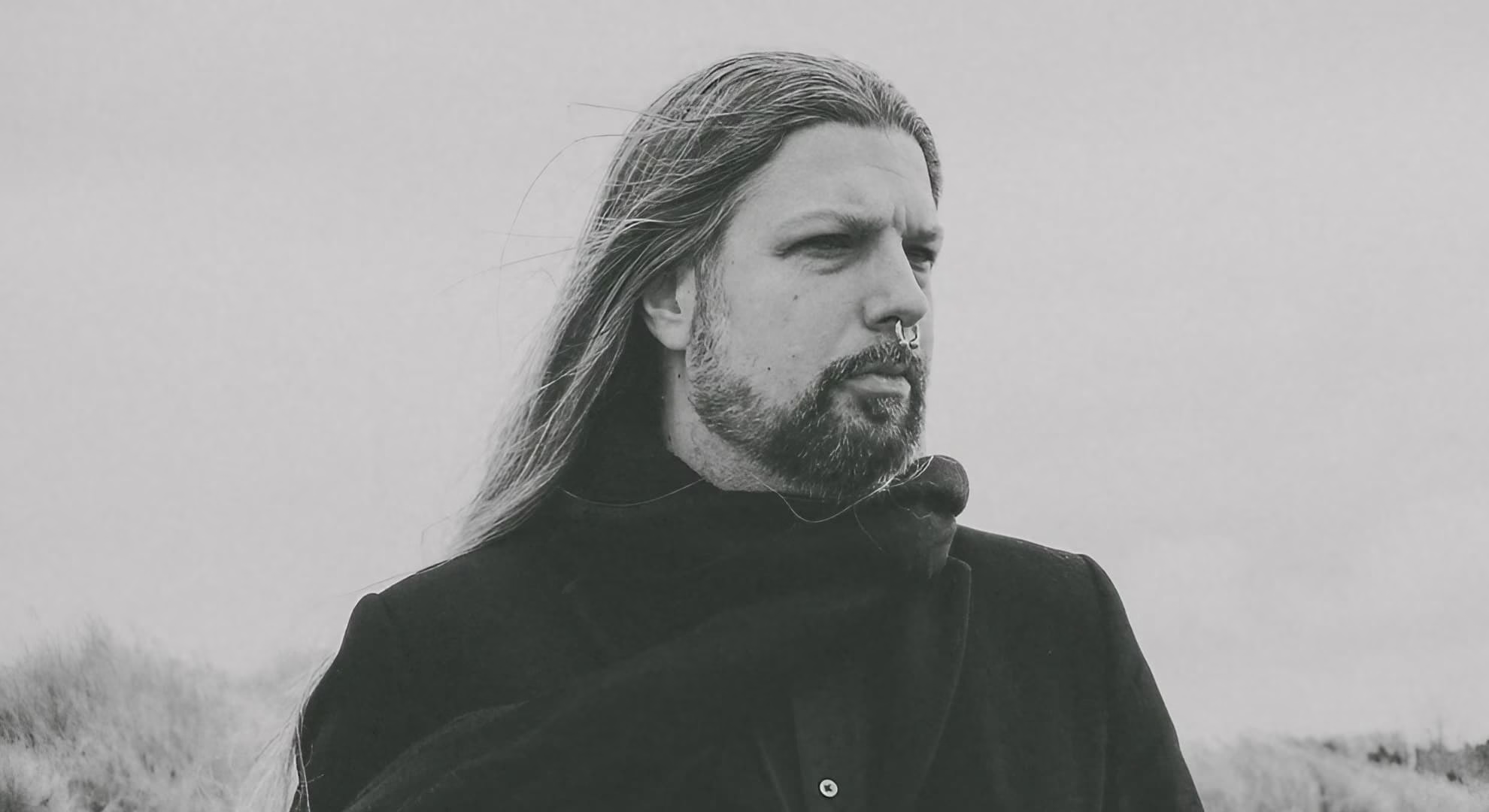


Swedish Beseech formed in Borås in 1992 and built its reputation on a particular tension: heavy, doom-inflected foundations pulled toward melody by two contrasting voices. That pairing, Erik Molarin’s low register set against Lotta Höglin’s warmer delivery, defined 2002’s ‘Souls Highway’ and 2005’s ‘Sunless Days’ before the band went silent for a decade, returned in a different configuration in 2016, and now arrives at a seventh album with Molarin and Höglin sharing a microphone again for the first time since ‘Sunless Days.’
‘Future. Present. Past.,’ released August 28, 2026 through the independent Swedish label Despotz Records, is the record that reassembles that partnership.
Molarin, who joined the band for ‘Souls Highway’ in 2002 and has remained a Beseech listener as much as a Beseech vocalist in the years between, spoke about the album title’s temporal framing, the studio dynamics of a lineup rebuilt around long-standing collaborators, and what continuity means for a band now operating without either of its founding members.
The Question of When
The album title sequences three tenses without ranking them, and Molarin treats that as the closest thing the record has to a thesis. “I would say that they are all the same thing, since the idea is about the concept of time, and how abstract that becomes the more you dive down into it,” he said. “And the question, ‘When are we?’”

That refusal to fix a single vantage point extends into the tracklist itself. ‘Álamos Sunset’ is the one English-language title to name a specific, non-English place, and Molarin traces it to time spent in Sonora, Mexico. “The title is very much in English. However Álamos is a town in Sonora, Mexico,” he said. “This is the place where the idea for the lyrics started, and where the story takes place. I have spent a lot of time in Sonora, Mexico and there are many beautiful places. But there is something with Álamos, and what happened there that really made it special to me.”
The album closes not on the more overtly conclusive ‘The Sweet Hello, the Sad Goodbye,’ a Roxette cover, but on ‘Between Worlds,’ which Molarin describes as carrying the album’s actual narrative weight.
“‘The sweet hello, the sad goodbye’ is a cover, and is originally performed by the Swedish band Roxette. And even though it touches the theme of the album, it is not part of the lyrical plot of the album per se,” he said. “‘Between worlds’ has a plot that suits the ending of the album. Without explaining the lyrics, which I no longer do, it is both an end and a beginning.” ‘You Bleed. You Dream. You Breathe.,’ with its three second-person declaratives, echoes the punctuation logic of the title track rather than standing apart from it.
For Molarin, that connection does not stop at the new record’s own tracklist. “I think it is rather easy to see that it follows the pattern of the title of the album,” he said. “And since all songs on the album are connected (they are also connected to many of our previous songs) I would say it’s rather easy to assume that it has a relationship with the title track.” The interconnection, by his account, runs backward through Beseech’s earlier catalog as much as it does across this single record.
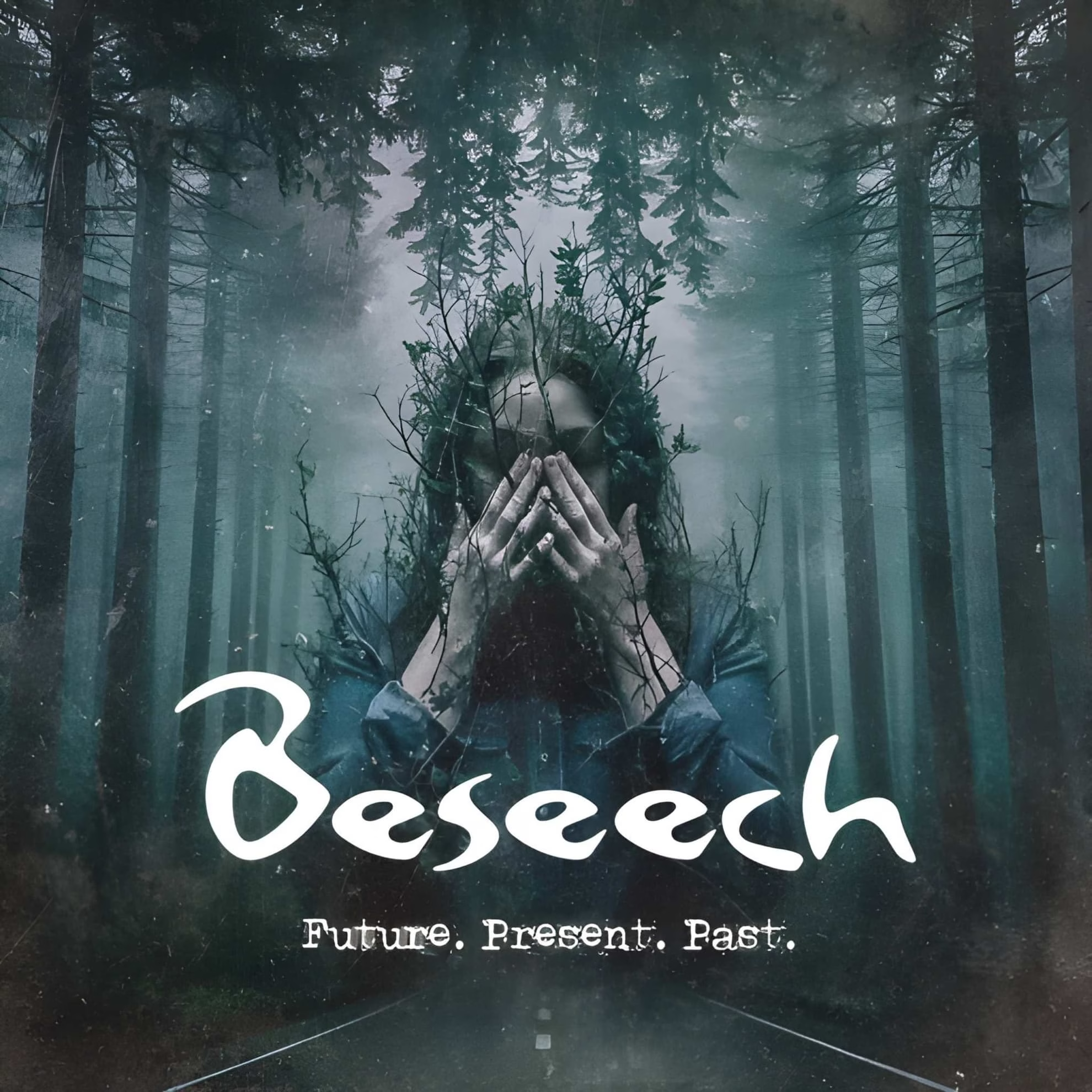
The visual identity follows the same brief. Fulton Hobbs designed the album cover from a set of concepts and required elements supplied by the band, while Rafael Sales handles cover art for the individual singles, working from the same visual language but tailored per song.
Ahead of the album, the band released ‘Boundless Space,’ ‘End This,’ and ‘Hesitation’ as singles, chosen, Molarin said, to signal continuity and range at once: something faster, something heartbreaking, something heavy, meant to show old fans that the band’s style holds while demonstrating a heavier investment in lyrics and vocal writing than before.
Two Voices, Two Eras
The gap between the Molarin-Höglin pairing’s last studio record and this one runs more than twenty years, though Molarin resists the idea that the two singers were ever fully apart. Between Beseech’s disbandment and this reunion, he and Höglin worked together in another project, Last Train to Venice, and Molarin credits that continuity with sharpening rather than resetting the working method.
“It has changed, but only to the better. We know our voices better than ever,” he said. “I can hear in my head what things will sound like, when I think about vocal melodies for me and Lotta. While back in the days it was more trial and error.”
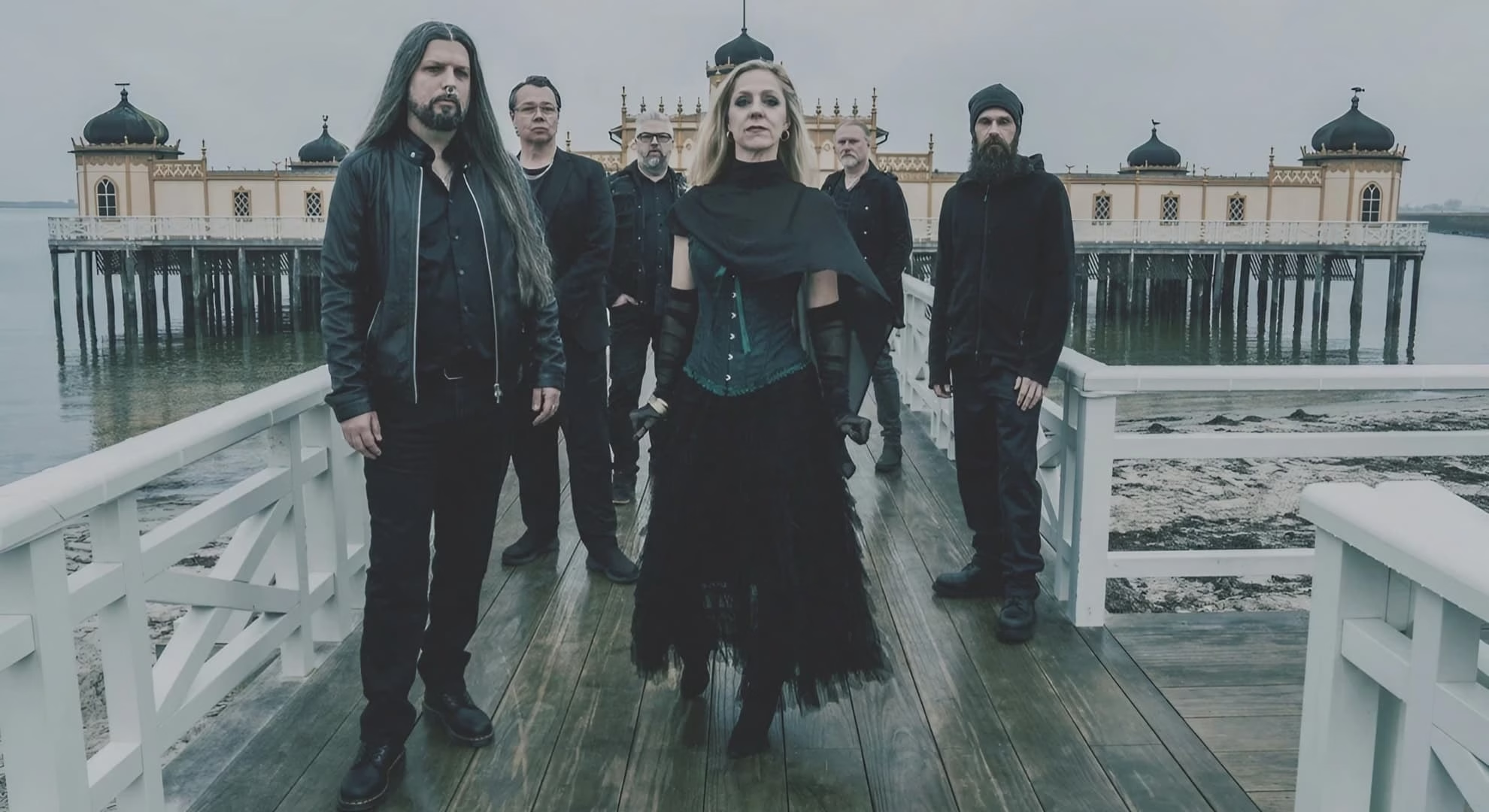
Both voices have shifted with age and experience rather than simply aging in place, in Molarin’s account: his own register has relaxed, while Höglin’s has grown more varied, a difference he hears most clearly set against her earliest recordings with the band.
“I would say that my voice has become more relaxed over the years, that might have to do with age but also of experience and keeping my voice active over the years,” he said. “Lottas voice has become more mature, and you can hear a big difference between ‘Black emotions’ and ‘Future. Present. Past.’ I think her voice is much more diverse nowadays.”
That contrasts with the band’s most recent prior configuration. ‘My Darkness, Darkness,’ released in 2016 with Klas Bohlin and Angelina Sahlgren Söder on vocals, was written primarily by Bohlin and guitarist Manne Engström, a structure Molarin does not dismiss on quality grounds but does distinguish from how the current lineup works.
“The song writing on ‘My Darkness, Darkness’ was mainly done by Klas Bohlin and Manne Engström,” he said. “However, I think it has some great songs, so we’re clear on that point. But the songwriting process the present line-up is more a team effort. Of course we have our roles, everyone has something they’re better at, but the songs are still made by Beseech as a whole, and not a single member.”
Engström is the sole member with continuous ties across both the 2016 record and the current one, and Molarin locates his contribution in both guitar writing and production, working alongside longtime producer Christian Silver on both albums.
The Producer Behind the Kit
Silver’s relationship with Beseech as a producer predates 1998’s ‘…From a Bleeding Heart,’ and on ‘Future. Present. Past.’ he holds a second role, playing drums in the current lineup. Molarin describes that overlap as a practical advantage in the studio rather than a source of friction between performing and producing roles.
“I would say that it has an impact in some decisions that we take as a band in the studio. He can hear how things will sound before we even try them,” he said. “So good thing is that we save a lot of time.” That efficiency does not make Silver’s word final, Molarin added, in a distinction he drew with some humor. “And even though he’s not always right, he makes a good point in the song making process,” he said.
Soundwise, Molarin places the new album closer to a continuation of ‘Sunless Days’ than to either the earlier Death and Doom Metal foundations of the band’s first records or the programming-driven approach of 2016. “It is both. But it leans more towards being a continuation of ‘Sunless days,’ which is perfectly logical since we’re almost the same line-up,” he said.
Part of that logic sits in the rhythm section: Jonas Strömberg, whose drumming on ‘Souls Highway’ and ‘Sunless Days’ Molarin describes as “mainly inspired by 70s bands,” now plays guitar, while Daniel Lindgren, bassist on both of those records, returns in the same role.
Molarin credits the pair’s long familiarity, dating back further still to ‘Black Emotions’ and ‘Drama,’ with giving the arrangements a texture built on trust rather than negotiation. “Daniel has a way of adding things to the songs that you might not hear directly, but after a couple of listenings you hear details in the bass that really gives the song something special,” he said. “Now when Christian is on the drums and Jonas is on the guitar you get a mix that is even more interesting, and Daniel keeps on doing his thing.”
The Weight of Borås
Beseech now operates without either of its founding members, Klas Bohlin and Robert Vintervind, both absent from the current lineup for reasons Molarin describes without elaboration or ill will. “For different reasons Klas and Robert could not be part of this line-up, which was the original intention. But life got in the way. We are still good friends though, so no bad blood,” he said.
Asked where continuity now resides, he points partly to Silver’s long production history with the band and partly to his own position as a fan before he became its singer. “I would say that Christian Silver has been a big part of the sound of Beseech, and he’s now in the band,” he said. “And I was a Beseech fan before I became the vocalist, so for me it’s very important that we keep the red thread that has been going through all the Beseech albums.”
The band’s label history runs from Metal Blade through Pavement Music and Napalm Records before settling with the independent Swedish label Despotz for both the 2016 record and this one, a relationship Molarin frames in terms of creative latitude. “Despotz lets us do what we want. And that’s the strength with an independent label,” he said. “They have good distribution channels and good production channels, so at the stage we’re in right now it’s great.”
Two members still live in Borås, the city where Beseech formed alongside contemporaries including Cemetary and Lake of Tears, and the album’s release party is scheduled there for September 5th. Molarin holds the city’s mixed reputation as a genuine source of material rather than a limitation. “We take the Borås heritage seriously. A town with a bad reputation, but that has given us a lot of inspiration over the years,” he said.
He has always sensed that the band’s audience skews more international than domestic, a fact he has weighed against a hypothetical he does not entirely dismiss. “We have always been more popular outside of Sweden, so maybe things would have been different if we all moved to Berlin, Mexico City or Sao Paulo,” he said. “But our soul might have been lost.”
On the question of whether the 2006 ‘Drama Ends’ DVD, released as a formal document of the band’s first era, shaped how the current lineup approached returning to that catalog, his answer was direct: “No. We have not thought about it at all.”
A Genre Without Irony
Molarin traces the most significant infrastructural shift in Gothic Metal since Beseech’s founding to the move from physical, cassette-based networks to instant online distribution. On how the audience itself has changed over the same three decades, he reserves judgment for now. “I don’t want to talk too much about how the audience has changed, since we’ve not been out playing too much,” he said. “But after the release of ‘Future. Present. Past’ I will probably have a good answer.”
On the frequent critical comparisons drawn to Paradise Lost, Katatonia, Type O Negative, and others from the same scene, Molarin locates the band’s actual source material elsewhere. “We don’t take too much inspiration from other bands, but more from separate ideas,” he said. “I have tremendous respect for all mentioned bands, but we have never tried to sound anything like them.”
‘Souls Highway’’s cover of ABBA’s ‘Gimme! Gimme! Gimme! (A Man After Midnight),’ reissued as a standalone single in 2025, sits inside that same logic for him: not an ironic detour but a recognition of the song’s latent darkness, pushed forward through heavier arrangement. “When we decided to make a cover of that song it was mainly because the lyrics has a melancholy dark vibe to them. And we wanted to make it heavier to put emphasis on the darkness,” he said. “We feel that we made it into our song somehow.”
Asked for a historical site suited to the genre’s long affinity with ruin and melancholy, Molarin did not reach for a European landmark but for a place near home. “Knallestenen, just outside of Borås,” he said. “A place where only your imagination can set the boundaries for what has happened there.”
‘Future. Present. Past.’ is released August 28th, 2026 through Despotz Records, available on CD, vinyl, and digital formats.
This publication covered the album’s campaign already, in a feature on the video for its third single, ‘Hesitation,’ which read the clip’s shared-frame staging of Molarin and Höglin as the visual completion of a two-voice argument suspended since 2006.
The record itself is worth approaching through its edges rather than its singles: ‘Álamos Sunset’ and the closing ‘Between Worlds’ carry more of what Molarin describes as the album’s actual argument than the pre-release tracks do, and that argument rewards a full, sequential listen rather than a shuffled one.
Have you spent time with ‘Future. Present. Past.’ yet, and does a band built on the tension between two voices still have something to say twenty years after those two voices last recorded together?
Leave a Reply