


The night auditor is the hotel employee whom guests never meet: the person who closes the day’s accounts after the last guest has gone upstairs and keeps the lobby lit until the morning shift takes over. In a Southern Appalachian novel set in 1993, that job belongs to a graduate student, and the mountain resort where he works stops keeping time at 3 a.m.
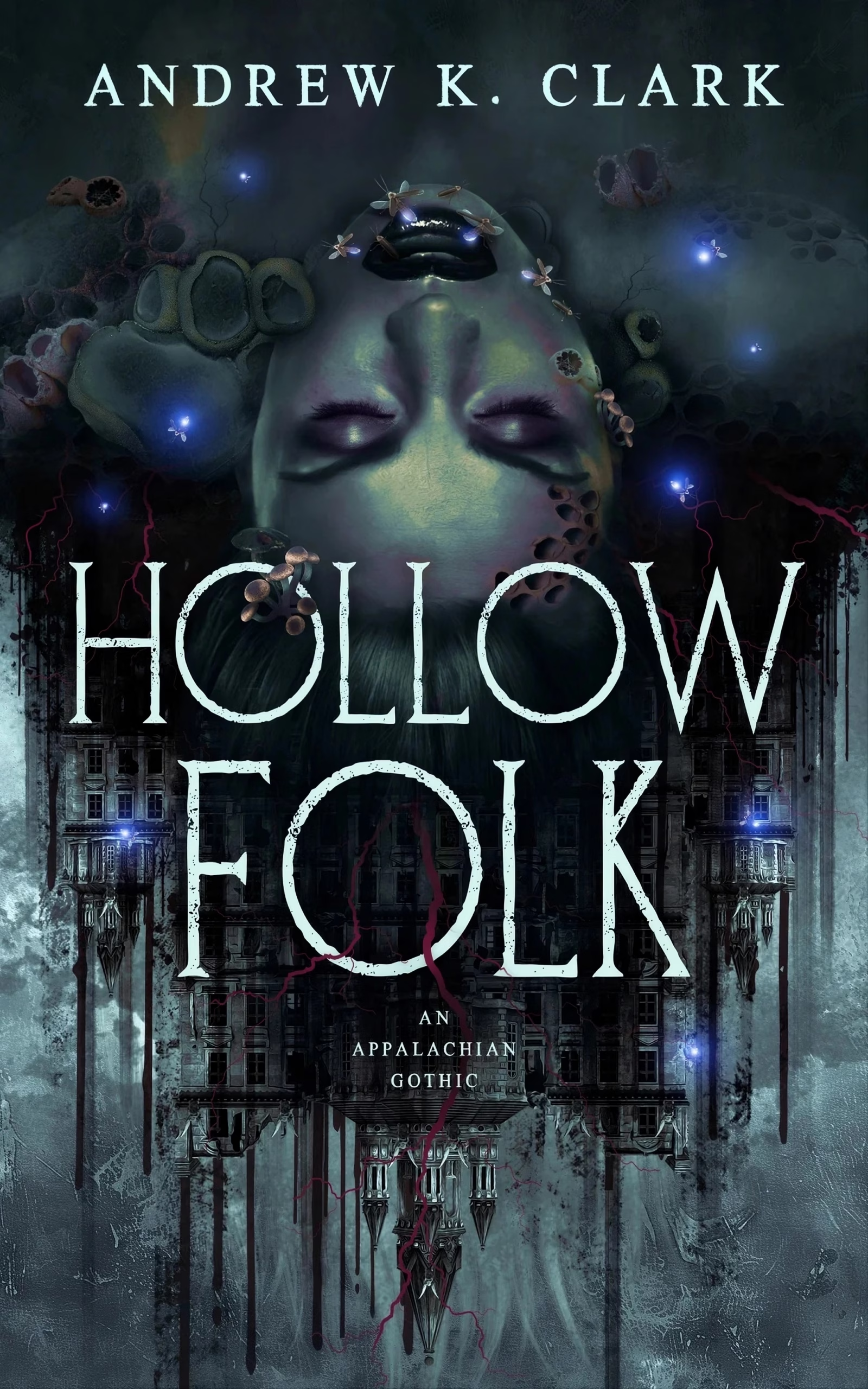
‘Hollow Folk,’ Andrew K. Clark’s third novel, publishes on September 29th, 2026, from Quill & Crow Publishing House in paperback and in a special-edition hardcover with sprayed edges, listed under ISBN 9781967911509. Clark’s own website labels it an Appalachian gothic horror romance, the publisher’s copy describes gothic romance meeting Appalachian folk horror, and the cover adds the line ‘An Appalachian Gothic,’ and runs 274 pages.
In the publisher’s synopsis, Ethan Ray takes the night-auditor shift at the aging Holloway Mountain Resort while working toward a graduate degree. Reddish-brown lights spread across the sky, hard winds move through the trees without a sound, and gargoyles in the shape of owls come to life. At 3 a.m. every clock stops, and Ethan is trapped inside with his co-workers, Kal and Teresa, who learn that the hotel functions as a boundary.
Each of the three is visited by visions that deliver the same warning, that someone in the hotel cannot be trusted, and a romance develops between Ethan and Teresa.
From Poetry to Three Novels
Clark is a writer from Western North Carolina, where, by his own account, his people settled before the Revolutionary War. He told the Asheville weekly Mountain Xpress, in an interview published February 5th, 2025, that his ancestors reached the Barnardsville area in 1739 and later moved to Woodfin and the country around Alexander.
Poetry came first: his collection ‘Jesus in the Trailer’ (Main Street Rag Press, 2019) was shortlisted for the Able Muse Book Award, and his work has appeared in ‘The American Journal of Poetry,’ ‘Appalachian Review,’ ‘Rappahannock Review,’ and ‘The Wrath Bearing Tree,’ among other journals.
He earned an MFA at Converse University and co-hosts the Dark Forms Podcast. Among the writers he named to the Southern Review of Books in October 2024 were Daniel Woodrell, whose ‘The Maid’s Version’ he called a model for opening a novel, and the Kentucky poet upfromsumdirt.
Fiction grew out of family talk. Clark said in the Mountain Xpress interview that ‘Where Dark Things Grow’ began as a short story about his grandparents’ years during the Great Depression, written so that his children would have a record of how their elders spoke, and that the story kept expanding until it became a novel. He described a line of storytellers who mixed scripture and folk warning in a single breath; his grandmother could move from a story about Jesus to a caution about how the dead are carried out of a house.
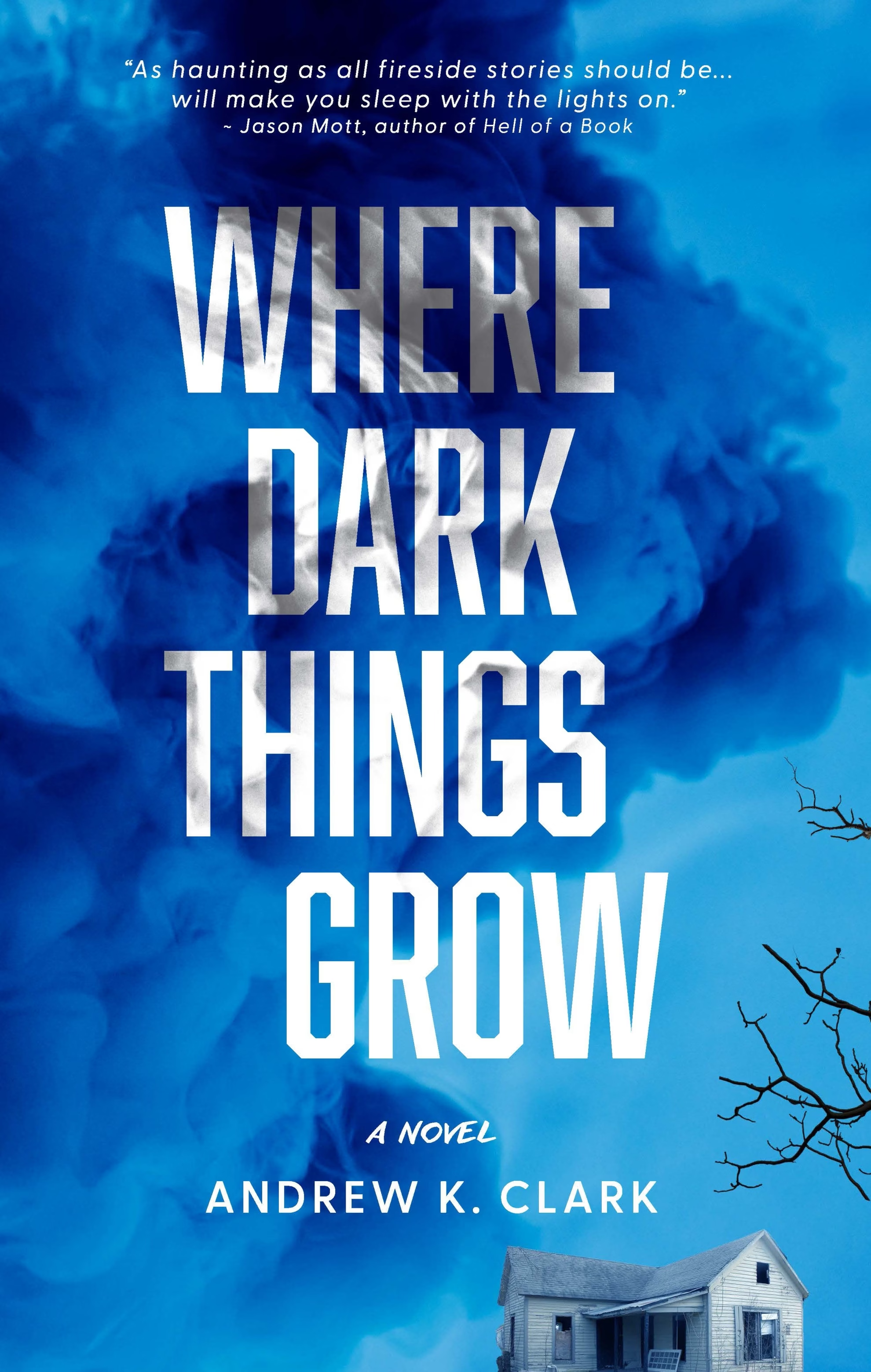
‘Where Dark Things Grow’ (Cowboy Jamboree Press, September 2024) follows 15-year-old Leo through a fictionalized Asheville countryside in the Depression years as he searches for his missing father, with the city itself renamed Altamont, the name Thomas Wolfe gave Asheville in his fiction.
Clark told Mountain Xpress that he took the horse-sized, upright-walking wolves of Scottish “Wulver” stories, benevolent helpers in their source folklore, and turned them toward horror. The paper also reported that he committed early to using only material from his own culture rather than borrowing from Indigenous traditions.
The novel was a finalist for the Manly Wade Wellman Award, was shortlisted for the Sir Walter Raleigh Fiction Award, and won an IPPY from the Independent Book Publishers Awards.
The Book Before ‘Hollow Folk’
‘Where Dark Things Rise’ (Quill & Crow, fall 2025) immediately precedes the new novel. Clark called it a loose sequel in an interview with the Southern Review of Books published October 10th, 2024: set in the 1980s, readable without the first book, with a few characters carried over who are now in their seventies.
Its protagonist is 16-year-old Mina, who is growing up poor in the Southern Appalachian Mountains with a father who drinks and a mother whose religious devotion is fanatical, and who can command supernatural creatures called the Shadow Faces. When a shapeshifting preacher stalks her classmate Gabe and abducts her best friend, Erin, Mina has to weigh saving Erin against her own chance at an ordinary life. The novel won an IndieReader Discovery Award and was a finalist for the Next Generation Indie Book Award.
Two changes separate that book from the next. In February 2025, Clark told Mountain Xpress that a third novel he had begun would feature a different set of characters and a different world, though it would still contain magical realism and horror.
Publisher materials for ‘Hollow Folk’ present it as his third novel rather than a continuation, and they name a cast, Ethan, Kal, and Teresa, that does not appear in the synopses of the earlier two. The frame also tightens: the first two novels range across families, schools, and the woods around them, while the new synopsis keeps three people inside a single hotel.
A Hotel Where Clocks Stop
The premise sets a task and a trap at once. An auditor’s work is reconciliation, confirming that the day’s figures agree with one another, and the synopsis places that worker in a hotel where the clocks have stopped and the one fixed measure of a shift has been withdrawn.
The synopsis keeps the cast small and makes the smallness the source of pressure: three co-workers, one shared warning, and a claim that someone among them cannot be trusted. Fear in that arrangement comes from the group itself rather than from an outsider, and the romance between Ethan and Teresa is placed inside the suspicion, so that tenderness and doubt occupy the same room.
How well the novel keeps those two currents apart, or lets them contaminate each other, is a matter for the finished pages, which had not been released at the time of publication.
Prose can be discussed only through Clark’s stated method. The Southern Review of Books interview of October 10th, 2024 took up how poetry influences Clark’s sentences, and his 2019 collection precedes all three novels. Judging how the poet’s discipline of compression carries into a novel of stopped clocks requires the finished text.
The cover carries the label ‘An Appalachian Gothic’ beneath the title. A woman’s face hangs inverted above a hotel facade that is inverted as well, its ornamental spires pointing down, while fungal growths, small winged insects, and scattered points of blue light gather around her head.
The reversal fits a synopsis in which the hotel is described as a boundary. The fungal motif belongs to the cover alone: the synopsis does not mention it, which leaves the novel’s relationship to that imagery open until the text can be read. The cover designer had not been confirmed at the time of publication.
The Folk Horror Chain
The publisher’s folk horror label invokes a named critical framework, and the framework has an origin worth stating. Adam Scovell’s 2017 study derived what he calls the Folk Horror Chain from the three British films he treats as the genre’s core, ‘Witchfinder General’ (1968), ‘The Blood on Satan’s Claw’ (1971), and ‘The Wicker Man’ (1973).
The chain has four links: a topography whose features damage the social and moral identity of the people who live within it; isolation from the progress of the wider world; a skewed belief system that grows in that isolation; and a climactic happening or summoning in which the belief system acts.1
Set beside the publisher-confirmed premise, the first two links are visible on the surface. The terrain is a mountain resort under an Appalachian sky, and the publisher’s own phrase for the book’s setting is that “the mountains are watching.” Isolation is literal: the workers are trapped, the clocks are stopped, and the hotel functions as a boundary.
The remaining links, a skewed belief system and a summoning, cannot be assessed without the text. The synopsis says only that something ancient has been waiting and is now awake, which names a presence without naming the belief that serves it.
The chain was drawn from British films made between 1968 and 1973, and its model community is a village. Clark’s synopsis substitutes a workplace for the parish: three employees on a night shift stand where villagers would stand, and a hotel takes the place of the settlement.
Carrying the framework to an American mountain resort is a move that the label invites and the novel will have to earn. The publisher’s pairing of folk horror with romance adds a register, desire between two of the three workers, that the chain as Scovell drew it does not address.
A Mountain Voice Deepening
Three novels now cover three points in twentieth-century life in Western North Carolina, the Depression years, the 1980s, and 1993, and they have passed between two independent presses.
The pattern is that of a regional writer extending a fictional record of one place rather than moving to a new premise each time, and ‘Hollow Folk’ tests that record under new conditions: after two books that range across families, schools, and woods, the synopsis confines its cast to one hotel and gives them a clock that no longer moves.
For readers following Appalachian dark fiction, the interest lies in what a poet writing novels does with confinement after working so freely in open country, and in how well a small press can carry that development from one book to the next. The title adds a further stake. Its phrase first circulated in a study written about mountain families by outsiders; it now heads a novel written from inside the region, whatever Clark intends by it.
Which novels or story collections set in the Appalachian mountains deserve this publication’s attention alongside Clark’s work, and what do they do with the region’s speech and places that keeps you returning to them?
References
- Adam Scovell, ‘Folk Horror: Hours Dreadful and Things Strange’ (Leighton Buzzard: Auteur Publishing, 2017), 17–18. ↩︎


Leave a Reply