


Twenty nautical miles off Boston lies an island absent from every chart, governed for four centuries by women of a single surname and long reputed to have opened its harbor to anyone the mainland meant to hang or return in chains. That invented shelter, Bell Island, is the ground of ‘Beyond the Graves Waits Mist and Sea,’ the new novel by Kathleen Kaufman, which Kensington publishes on September 29th, 2026, as a 384-page trade paperback carrying the ISBN 978-1-4967-5394-6.
The island’s founding story works twice. In the seventeenth century, its legend holds, Bell sheltered women fleeing the Salem witch trials; in the nineteenth, it served as a way station for people escaping slavery. American coastal gothic has returned to Salem for nearly two centuries because 1692 supplies the form with a founding wrong that has a street address.
Kaufman’s sharper move is to stack a second national reckoning on the same rock, and then to set both over something older than either: the sea lore of Iceland, the North Atlantic island tradition from which Bell Island was drawn.
An Island Founded on Flight
The novel’s present-day thread follows Harper Hafdóttir, a biologist who travels to Bell Island to lead a research team searching for evidence of Thalassa, a species of octopus that no one has yet described. The project was her parents’ before it was hers; she believes they died in a hurricane 15 years earlier, and she carries into the fieldwork both that loss and a set of vivid dreams that have recurred since childhood.
The island answers her equipment with disorder of its own: rising seismic activity, a rogue wave strong enough to capsize a boat, and creatures whose behavior no field protocol accounts for.
At the center of the island stands Bell Manor, the seat of Lady Loreana Bell, the island’s mayor and the latest heir of a matriarchal line that has governed Bell for 400 years, and a woman who appears to have been waiting for Harper. In the manor’s library Harper finds the 1690 journal of a young woman caught inside a religious cult, and as a tsunami gathers against the island, the journal, the dreams, and her own déjà vu begin to converge on the question of why she, specifically, has been drawn back.
The chronology Kaufman sets out is worth reading closely. A 400-year line reaches back to the sixteen twenties, past the 1630 founding of Boston itself, so the Salem women who reached Bell did not found a refuge; they entered a matriarchy already in place. The journal, meanwhile, is dated two years before the accusations began in Salem Village.
The novel’s one documentary anchor in the seventeenth century sits not inside the witch panic but just ahead of it, a placement that lets the book address religious coercion without borrowing the trial record itself.
The Salem Record
The trials that Bell Island’s legend answers are among the most thoroughly documented episodes of colonial New England. Accusations began in Salem Village, the farming settlement now called Danvers, in the winter of 1692, when a group of girls and young women fell into fits that the community’s minister and physicians attributed to witchcraft.
In May of that year Governor William Phips established a special Court of Oyer and Terminer, which admitted spectral evidence, testimony that the specter of an accused person had tormented the afflicted, and between June and September 1692 it sent 19 people to the gallows.
Giles Corey, who refused to enter a plea, was pressed to death under stones; others died in jail, and well over 100 more were imprisoned as the accusations spread across Essex County. Phips dissolved the court in October 1692 amid mounting doubt about spectral evidence, and the Superior Court that heard the remaining cases in 1693 convicted few and executed none. Paul Boyer and Stephen Nissenbaum located the pattern of the crisis in the long factional quarrel between Salem Village and the port of Salem Town, showing that accusers and accused clustered on opposite sides of the village’s divisions over its church and its independence.1
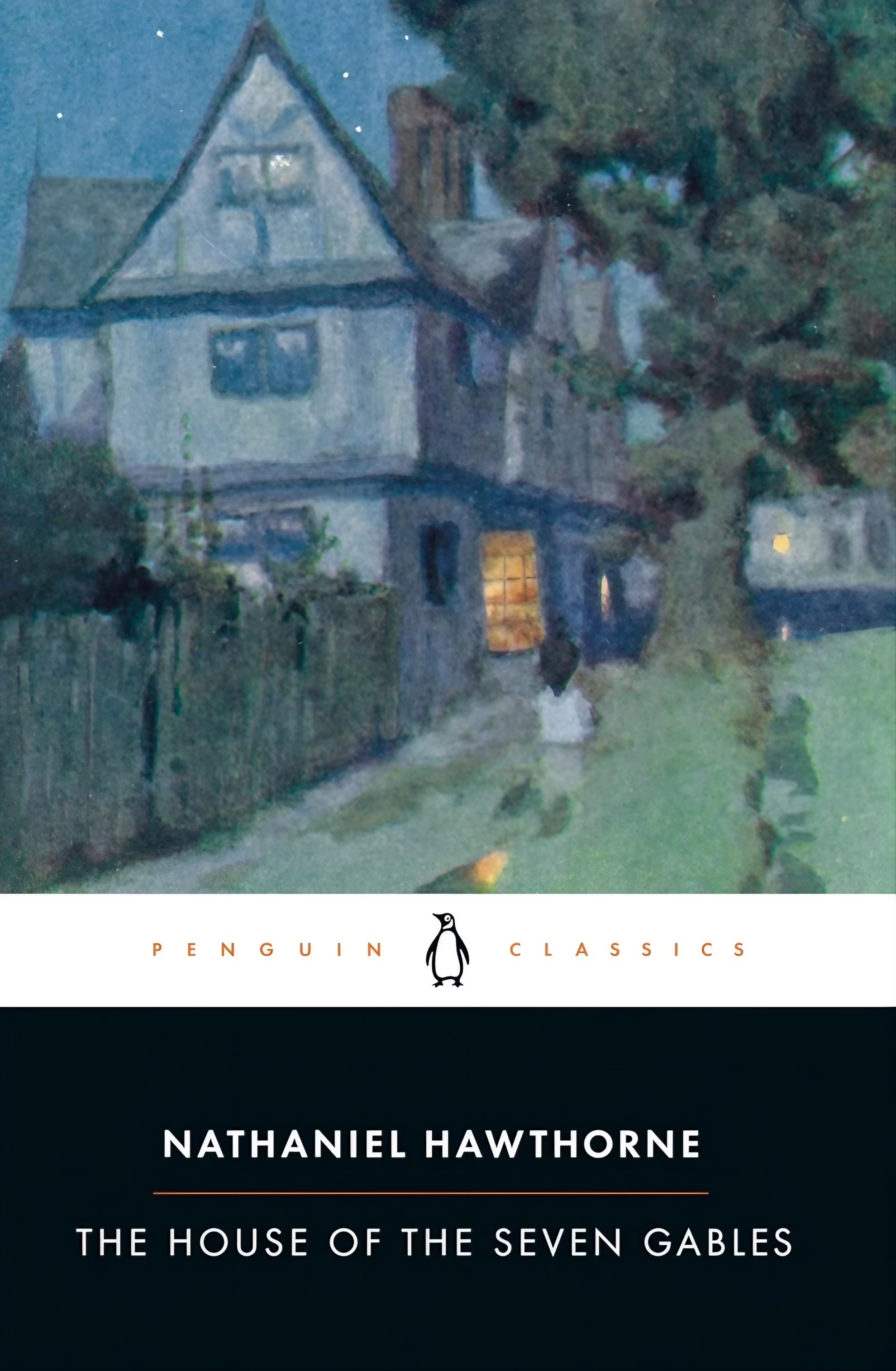
The American gothic took hold of that record early. Nathaniel Hawthorne, whose great-great-grandfather John Hathorne sat as a magistrate examining the accused, turned the inheritance of an old persecution into the curse of ‘The House of the Seven Gables’ (1851).
H. P. Lovecraft came closer to Kaufman’s premise in ‘The Dreams in the Witch House’ (1933), in which Keziah Mason escapes the Salem jail in 1692 and resurfaces in his invented Massachusetts town of Arkham. Kaufman keeps the invented Massachusetts geography and the escape but reverses their charge: Lovecraft’s fugitive witch carries the contamination with her, while Bell Island receives its refugees as the persecuted rather than the guilty, and whatever threatens the island is placed in the sea around it rather than in the women themselves.
A Harbor for Fugitives
The Underground Railroad, the second history grafted onto Bell, was never a single organization but a loose, largely improvised set of routes and households through which people escaping slavery moved north in the decades before the Civil War. Its danger sharpened after the Fugitive Slave Act of 1850, which obliged officials and citizens in the free states to assist in returning escapees and denied the accused a jury trial, pushing many toward Canada.
Coastal Massachusetts mattered to that movement in a specific way. Kathryn Grover has documented how the whaling port of New Bedford became a destination for fugitives who reached it aboard coastal vessels from Virginia and the Upper South, sheltered by a Black maritime community strong enough that the town gained a reputation as a place slave catchers could not easily enter; it was there that Frederick Douglass settled after his escape in 1838.2
The popular memory of the Railroad, however, grew larger than its documented record. Larry Gara showed that the legend of secret rooms, tunnels, and a disciplined network run chiefly by white conductors was largely a postwar creation of abolitionist reminiscence and local pride, one that obscured how often fugitives planned and carried out their own escapes.3
New England towns still attach that legend to old houses and coves on thin evidence. An island historically remembered as a refuge and rumored to be haunted belongs precisely to that mode of local tradition, in which a place adopts a hidden history as part of its identity. Kaufman does not present the double sanctuary of Bell as recovered fact; she writes the kind of story coastal New England has long told about itself, and then hands a scientist the task of testing it.
Icelandic Tides off Boston
The surface history of the island is American; its source is not. Kaufman drew Bell Island from Vestmannaeyjar, the volcanic archipelago off the southern coast of Iceland where she spent a month volunteering with the Icelandic Orca Project run by Earthwatch, and the novel’s lore follows that source rather than Massachusetts.
Bell Manor’s library ties Harper’s research to the Hidden People of Icelandic folk belief, to elves, and to Blódughadda, a sea spirit whose name means “bloody-haired.” In the mythology preserved by Snorri Sturluson in the thirteenth century, she is one of the nine daughters of the sea giant Ægir and his wife Rán, each named for an aspect of the waves, a sisterhood in which the violence of the sea takes the form of a family of women.4
The protagonist’s name belongs to the same design. Icelandic surnames are patronymics or matronymics formed with -son or -dóttir, and haf is the Icelandic word for the open sea, so Hafdóttir reads, on its face, as “daughter of the sea.” The octopus she hunts carries the Greek word for the sea, thalassa. A heroine named for the sea, pursuing an animal named for the sea, on an island whose ruling women seem to know her already: the novel states its central question in its nomenclature well before the plot poses it.
The seismic tremors and the gathering tsunami likewise belong more naturally to a volcanic North Atlantic archipelago than to the shelf off Boston, a sign that Kaufman has moved an Icelandic island, with its geology and its folklore, into Massachusetts Bay, and let the American legends settle on top.
A Biologist and a Journal
Formally, the novel pairs two kinds of investigation that the gothic has long kept apart. Harper’s fieldwork is empirical, a matter of sampling, observation, and the attempt to prove that an undescribed animal exists, while the manor offers the older gothic method of discovery, the found document and the room that should not feel familiar.
Bell Manor’s library first appears in Harper’s memory of childhood, its shelves running into darkness, and reappears when she walks into the same room as an adult, so that the house functions less as setting than as ancestral memory made physical. The 1690 journal adds a third register, a first-person seventeenth-century voice set against the scientist’s present, and the recurring dreams bind the two.
That structure makes suspense a matter of alignment rather than discovery alone. Harper’s dreams, the journal, and Lady Bell’s expectation point early toward the same buried fact; the tension lies in how long Kaufman can hold the empirical thread and the inherited one apart before the island forces them together, with the tsunami setting a hard limit on the delay.
The Title and Its Cover
The title works through inversion. ‘Beyond the Graves Waits Mist and Sea’ places its verb before a compound subject and holds the singular “waits” against two nouns, a syntax closer to the epitaph or the hymn than to ordinary speech.
The graves come first and the elements wait past them, which is the novel’s wager in miniature: the Salem dead and the hurricane dead are the visible history, and what lies beyond them is weather and water. Kaufman has not given a documented account of the title’s origin, so its meaning rests on the grammar alone.
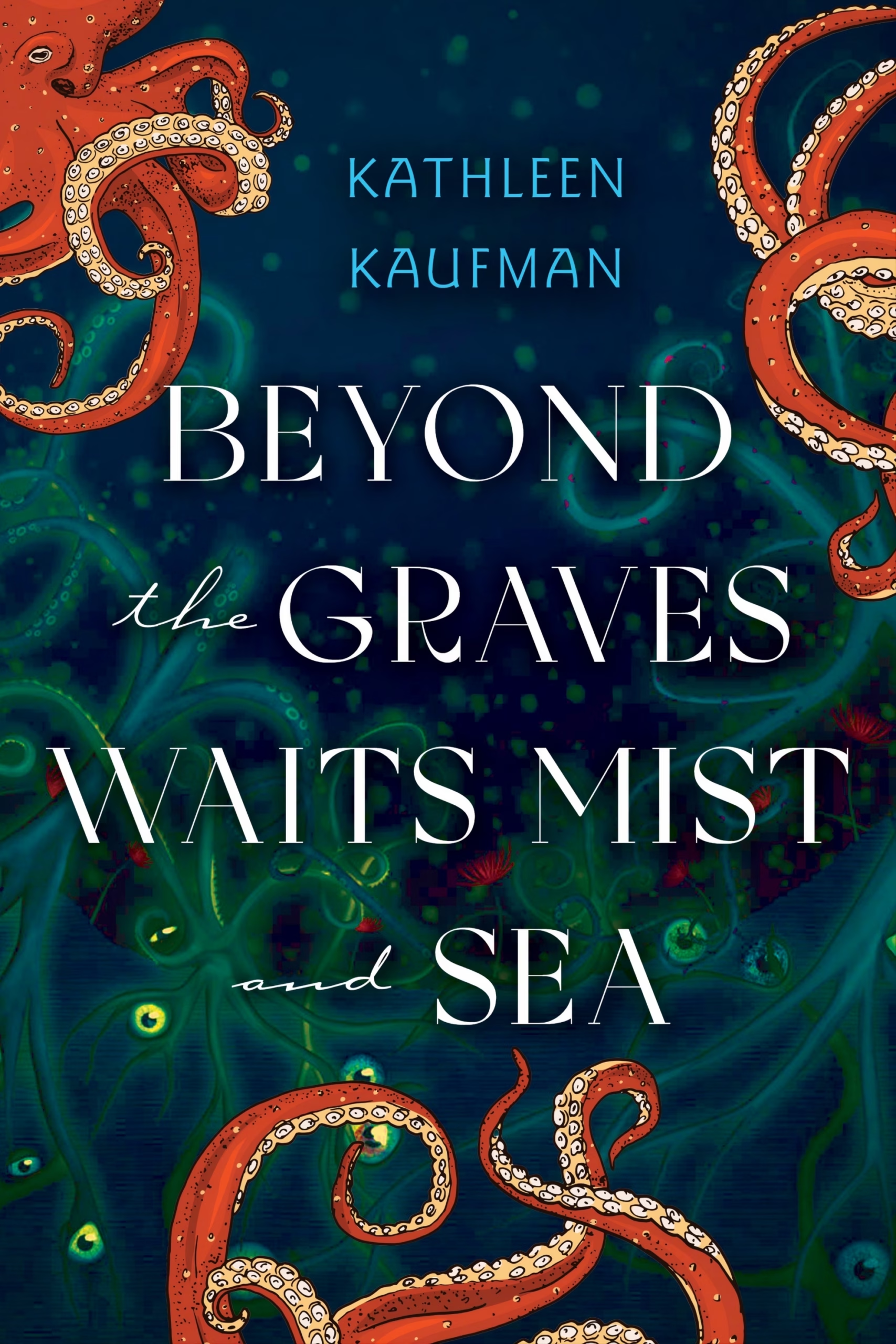
The cover stages that ordering without people. Orange-red octopus arms curl in from all four corners over deep blue-green water, their suckers rendered in pale detail, while small green eyes and faint shapes glint in the depths between them, and the title stands in white capitals with its two small connecting words set in script.
There is no manor, no woman at a window, and no lighthouse, none of the stock furniture of the coastal gothic. The arms frame the title as if holding it, and the watching eyes below place the viewer where Harper’s research team works, at the surface, looking down. The cover designer had not been confirmed at the time of publication.
From Mesmerists to Octopuses
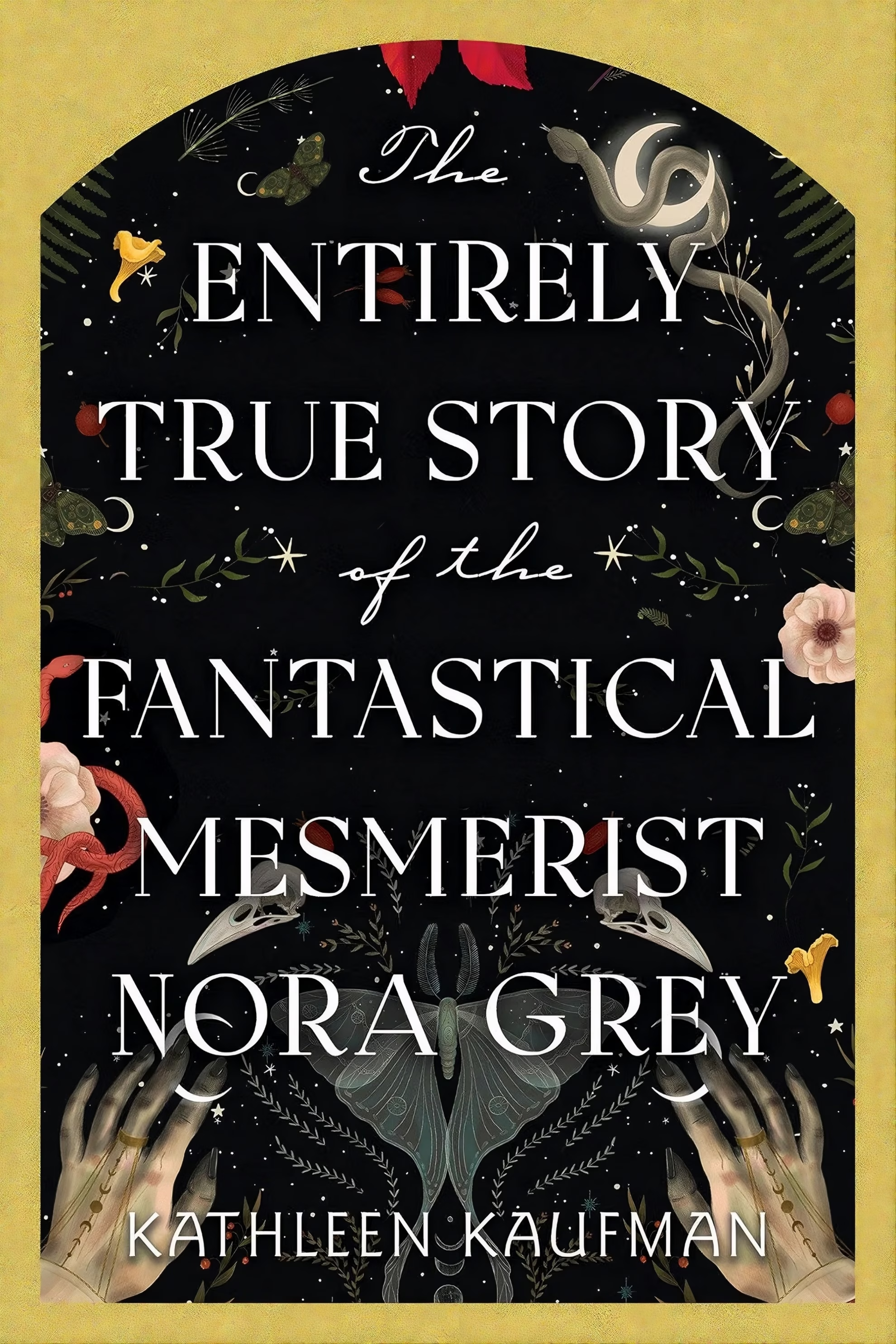
The new book follows ‘The Entirely True Story of the Fantastical Mesmerist Nora Grey,’ published by Kensington on July 29th, 2025, as a 448-page hardcover.
That novel opens in 1900 with Nairna Liath, a 16-year-old Scottish girl traveling the countryside with Tavish, her charlatan father, who stages encounters with the dead while she reads tarot cards. Nairna’s gift turns out to be real, inherited from her grandmother Lottie Liath, the widow of a Welsh coal miner whose confinement in an asylum in the eighteen sixties calls to Nairna across four decades.
Taken into the spiritualist circle of Edinburgh and then disgraced by a séance that ends in blood, Nairna flees to a secluded community near Boston and becomes Nora Grey, until a public séance at the Old South Meeting House brings her face to face with Lottie as her spirit guide.
Kaufman based the novel in part on the life of her own great-grandfather, a nineteenth-century charlatan, drawing on family records of which she became the keeper.
The line from that book to this one is direct. Both novels end their flight on the Massachusetts coast, both run a present heroine against a woman from an earlier century who speaks to her across the gap, and both treat an inherited gift as a burden before it becomes a power.
‘Beyond the Graves Waits Mist and Sea’ keeps the Boston shore and the channel between generations, but trades séance for field research and Scotland for Iceland, and replaces a single ancestor with an entire island of women who seem to have kept Harper’s place for her.
A Career in Feminist Gothic
Kaufman describes her own work as magical realism and feminist gothic horror, and the description holds across a bibliography that now spans nearly two decades. A Colorado native and a graduate of the University of Southern California, she lives in Los Angeles, where she has long taught literature and composition.
Her first novel, ‘The Tree Museum’ (2009), was a science-fiction thriller issued by The Way Things Are Publications; she turned to folk horror with ‘The Lairdbalor’ (2017), since optioned by Screen Australia for a feature adaptation directed by Nicholas Verso. ‘Hag’ (2018), a historical horror novel, drew by Kaufman’s own account largely on her mother’s life and stories.
The ‘Diabhal’ trilogy, published by Keylight Books, followed: ‘Diabhal’ (2019), ‘Sinder’ (2020), and ‘The Son of Abraham’ (2021). Its title is the Scottish Gaelic word for the devil, and the first book sets that figure loose in nineteen-eighties Los Angeles, where 10-year-old Ceit Robertson, heir to a matriarchal society living in a Venice Beach cul-de-sac, is sent after a failed exorcism into MacLaren Hall, the real county children’s institution in El Monte.
Kaufman has described her subject as “the other” seen from “the other’s” point of view, and the pattern across these books is consistent: matriarchal lineages that the surrounding world treats as monstrous, institutions that confine women and girls, and a past that returns through blood. Bell Island’s line of ruling women carries the Society of ‘Diabhal’ to its furthest extent, a matriarchy that governs not a street but an entire island.
Fog Over an Invented Harbor
The fictional Massachusetts shore has a long pedigree, from Hawthorne’s inherited guilt to Lovecraft’s invented towns, and nearly all of it treats Salem as the bottom layer, the original wrong beneath which nothing older lies. ‘Beyond the Graves Waits Mist and Sea’ disputes that floor. It accepts both of the region’s most durable sanctuary stories, the witch refuge and the fugitive harbor, and then places beneath them a body of North Atlantic sea lore that predates the Puritan settlement and owes it nothing.
For readers of coastal gothic, the book’s interest lies in that reordering: the American histories become tenants of the island rather than its foundation, and the sea, not the scaffold, holds the last claim on the dead.
Which novels set on invented islands or coastal towns along the North Atlantic, in New England, the Hebrides, or Iceland, would you place beside Bell Island as deserving this publication’s attention, and what in their handling of inherited sea lore earns them that place?
References
- Paul Boyer and Stephen Nissenbaum, ‘Salem Possessed: The Social Origins of Witchcraft’ (Cambridge: Harvard University Press, 1974), 1–21. ↩︎
- Kathryn Grover, ‘The Fugitive’s Gibraltar: Escaping Slaves and Abolitionism in New Bedford, Massachusetts’ (Amherst: University of Massachusetts Press, 2001), 1–12. ↩︎
- Larry Gara, ‘The Liberty Line: The Legend of the Underground Railroad’ (Lexington: University of Kentucky Press, 1961), 1–18. ↩︎
- John Lindow, ‘Norse Mythology: A Guide to the Gods, Heroes, Rituals, and Beliefs’ (Oxford: Oxford University Press, 2001), 47–49. ↩︎



Leave a Reply