

A photograph left beneath a napkin at an abandoned first date shows a child in his bedroom, a body in the shadows, and a masked man standing over the scene. The adult who finds it has no memory of that night. More images follow, some placing him beside murder victims with blood on his hands, and one carries a line written beneath it in old black ink: “Does the nightjar remember the night?”
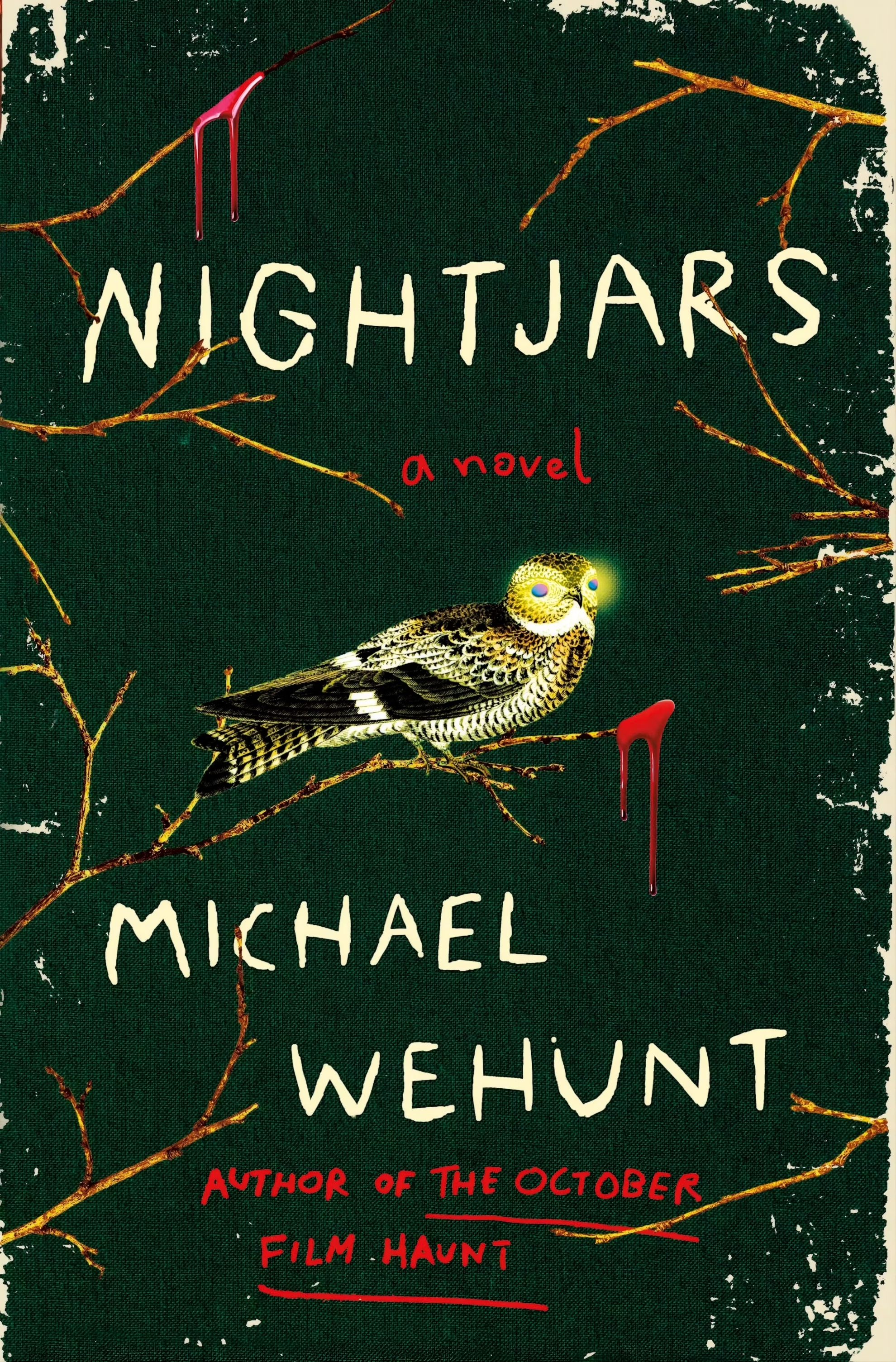
The question belongs to ‘Nightjars,’ the second novel by Michael Wehunt, which St. Martin’s Press publishes on September 29th, 2026, as a 352-page hardcover carrying the ISBN 978-1-250-33372-8. Its narrator, Luke Oshel, has spent years turning drugs, alcohol, therapy, and hypnosis against a single fear: that he did not escape the hidden inheritance of his late father, a killer who drained his victims of blood.
When a new series of killings points toward Luke, the search for the truth leads into the North Georgia Appalachians and a secret held for centuries, while his ex-wife and their young daughter come within reach of the threat. The novel’s editor and cover designer had not been confirmed at the time of publication.
The book sets two forms the horror tradition usually keeps apart inside the same body. Serial-killer fiction draws its dread from human agency and the forensic trail a person leaves behind; the vampire novel draws its dread from something older than any single life. ‘Nightjars’ gives both to a father who killed by exsanguination, and then asks which of the two his son received.
The Bird That Names the Book
Nightjars are the nocturnal birds of the family Caprimulgidae, insect hunters with wide mouths and mottled plumage that lets them vanish against the leaf litter where they nest.
Their North American members include the eastern whip-poor-will and the chuck-will’s-widow, both breeding birds of Georgia. The family’s older English name is goatsucker, and Carl Linnaeus fixed the same belief in Latin when he named the genus Caprimulgus, the goat-milker, after the old rural conviction that these birds drank from livestock in the dark.
The title therefore carries a bloodless ancestor of the vampire inside ordinary bird lore: a creature of dusk accused of feeding on the living body while its owners slept. The novel converts that folk accusation into a family name.
In a remembered scene, Luke’s father crouches at the edge of a failing lantern’s light, his mouth red, and tells the boy, “We’re nightjars.” The word stops describing a species and starts describing a lineage.
The bird’s defining trait matters as much as its folklore. A nightjar survives by being indistinguishable from the ground beneath it, and the question written under the photograph turns that camouflage inward. A son who cannot remember what he witnessed, or what he did, is a creature hidden even from himself, and the title frames memory, not the killings, as the novel’s central problem.
A Decade of Short Fiction
Wehunt grew up in North Georgia and has described the Appalachians of his childhood as close enough to feel and to live in the shadow of; he moved roughly 60 miles south to Atlanta, where he still lives.
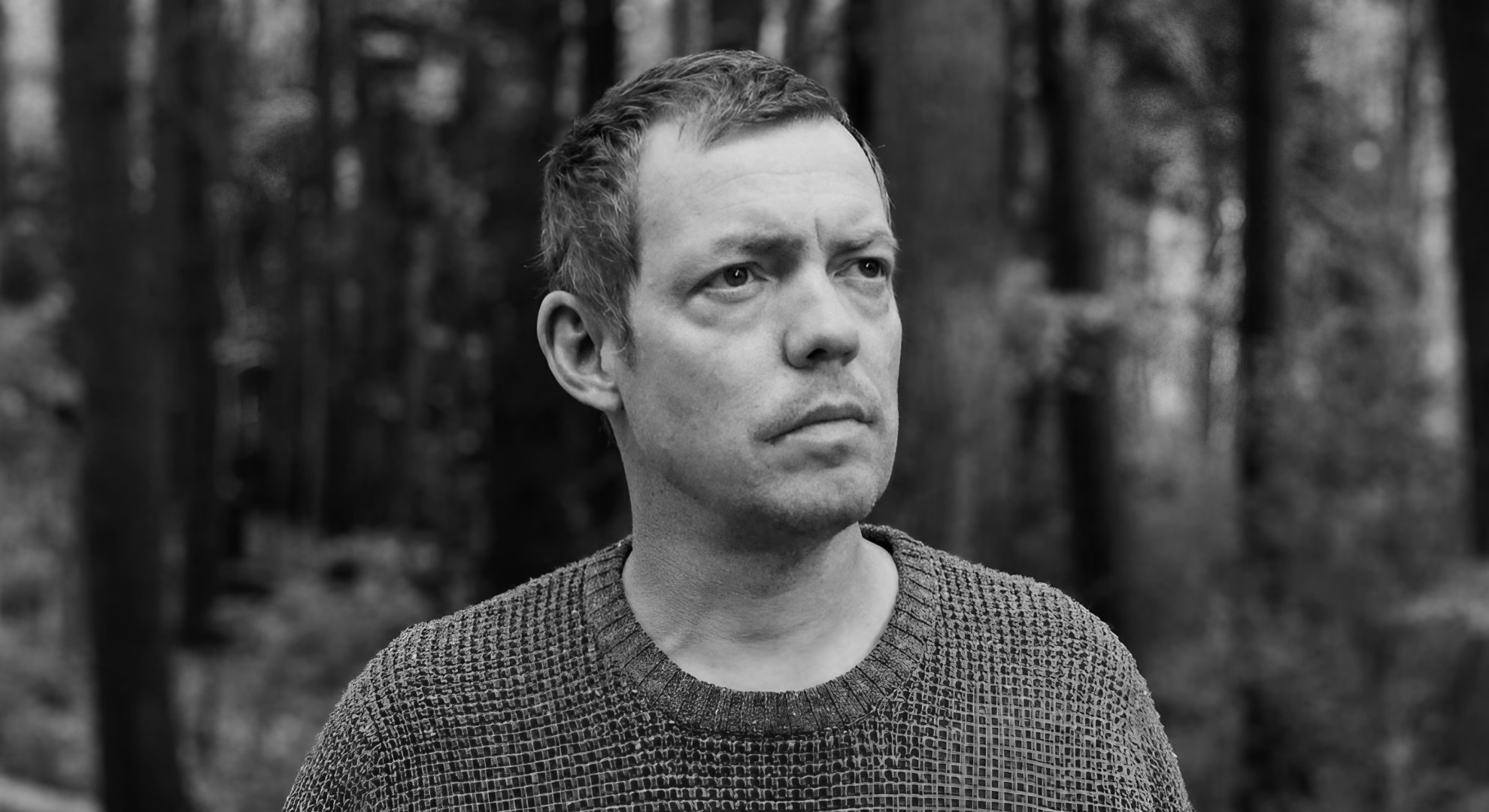
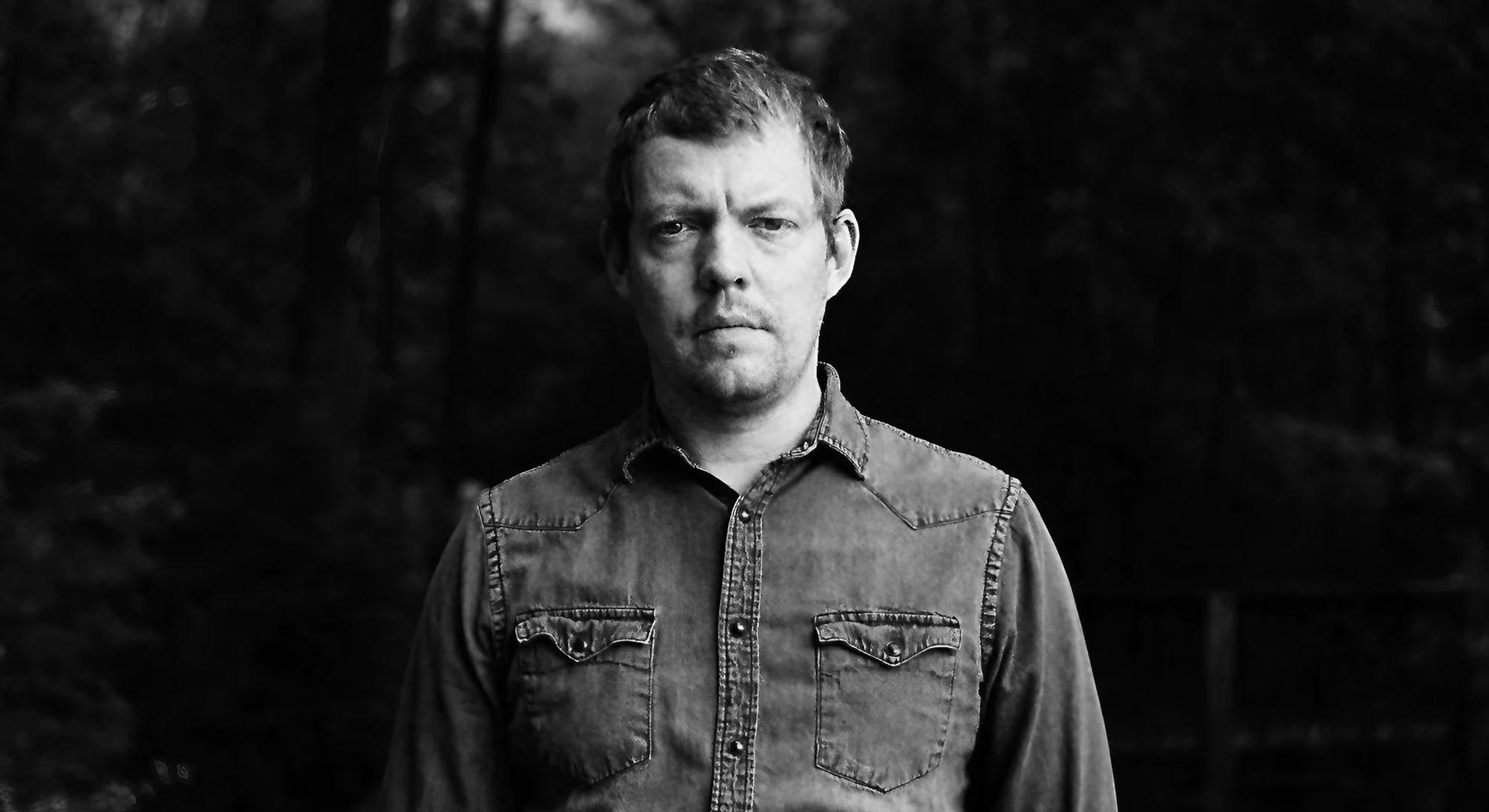
His short fiction appeared in small-press venues, among them Shock Totem, Innsmouth Magazine, and the ‘Shadows & Tall Trees’ anthology series, and that apprenticeship in the short form produced his first collection, ‘Greener Pastures’ (Shock Totem Publications, 2016).
The collection was a finalist for the Shirley Jackson Award and was shortlisted for the Crawford Award, the International Association for the Fantastic in the Arts’ prize for a first book of fantasy. The novelist Brian Evenson singled out its “almost pastoral sense of calm,” a quiet surface against which its disturbances land harder.
A charity chapbook novella, ‘Everything Is Beautiful and Nothing Bad Can Ever Happen Here,’ followed, and in 2023 Bad Hand Books published his second collection, ‘The Inconsolables,’ with artwork by Trevor Henderson accompanying each story. That book drew a further Shirley Jackson Award nomination.
Both collections have appeared in Spanish from Dilatando Mentes Editorial, as ‘Un lugar mejor’ and ‘Los Inconsolables,’ and his translated stories have been nominated for the Premio Ignotus and have won the Premio Amaltea.
One story in ‘The Inconsolables’ now reads as a direct forerunner of the new novel. In “Vampire Fiction,” a man returns to a game of pretend from his childhood, and the vampire appears first as something rehearsed by a boy before it becomes anything real. ‘Nightjars’ reverses the order, placing an actual killing inside a childhood bedroom and leaving the adult to wonder whether what he has always called imagination was testimony.
The Cult Film Before It
Wehunt’s first novel, ‘The October Film Haunt’ (St. Martin’s Press, 2025), won the Bram Stoker Award for Superior Achievement in a First Novel, announced on June 6th, 2026, at StokerCon in Pittsburgh, and later took the horror category of the Georgia Author of the Year Awards.
The Horror Writers Association has presented the first-novel category since its inaugural awards for 1987, when Lisa W. Cantrell’s ‘The Manse’ won over a field that included Clive Barker’s ‘The Damnation Game.’ Barker came to that ballot with the ‘Books of Blood’ behind him, and Wehunt’s win completes a comparable route in reverse: a writer whose reputation rested almost entirely on short fiction taking the prize that the most celebrated short-fiction debut of the 1980s did not.
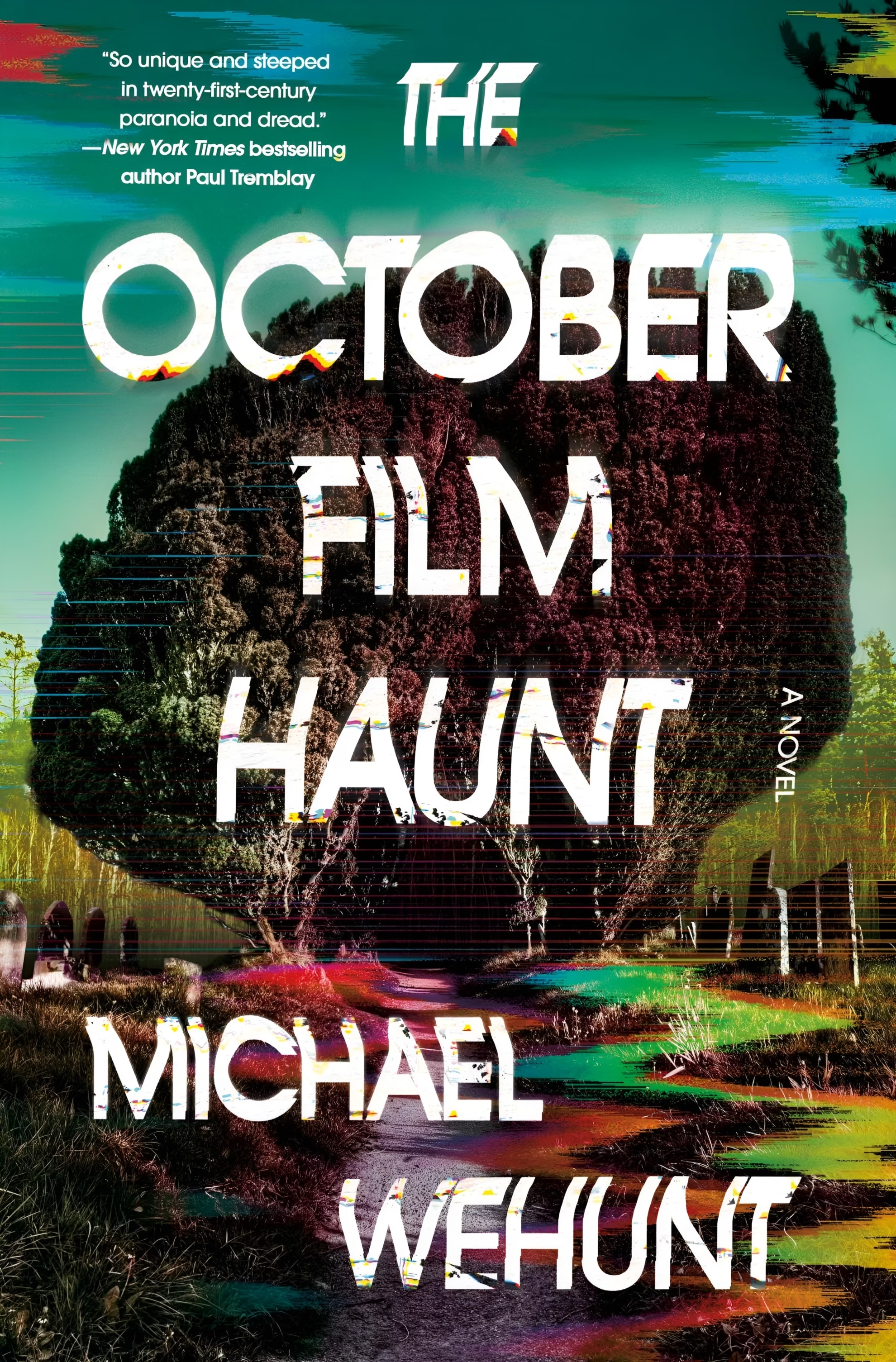
The novel follows Jorie Stroud, who a decade earlier belonged to a trio of horror devotees who camped at the filming locations of favorite horror films and chronicled the trips online.
A night in the graveyard from ‘Proof of Demons,’ an underground film by the enigmatic director Hélène Enriquez, produced a viral post, a devoted fan following convinced the film held instructions for a summoning, and the death of a teenage girl. Ten years on, living quietly in Vermont with her son, Jorie finds a videotape in her mailbox that appears to be a new version of the film.
The book is divided into three sections titled as tapes, and it folds in, without simply expanding, Wehunt’s earlier story “October Film Haunt: Under the House” from ‘Greener Pastures,’ while “The Pine Arch Collection” in ‘The Inconsolables’ belongs to the same invented archive of cursed footage.
The two novels open with the same gesture. A recorded image reaches a protagonist who has withdrawn from the past, a tape in a mailbox in the first book and a photograph under a napkin in the second. The distance between them is where the new novel’s argument lies. Jorie’s guilt concerned what she published about a film; Luke’s may concern what he did, and the recording now documents the protagonist himself rather than a movie he loved.
Wehunt, announcing the book in January 2026, called it “leaner, bloodier, darker, and full of my grim heart.” The shift from horror about watching horror to horror about being the thing watched gives that description its substance.
A Narrator Without Memory
Luke tells the story in the first person, and the confirmed shape of the novel makes that voice its principal instrument of dread. Two movements run against each other. The new killings push the plot forward with the logic of a criminal investigation, each fresh photograph tightening the case against him; the recovered memories pull backward into the childhood house and the father’s work. The reader is placed in the position of a juror hearing a defendant who does not know his own record.
Early pages of the novel show how Wehunt handles the returning past. Memory reaches Luke in his father’s voice before it reaches him as an image, and the father appears only at the edge of a dying lantern’s glow, a large shape bent over work the prose will not light.
Sound comes first, the wet noises of that work rising out of a grave, and only then the red mouth. The sentences withhold the act and keep the details at its perimeter, so that the horror lies in what the narrator’s own memory declines to illuminate.
That technique has a precise ancestor in American noir. Jim Thompson’s ‘The Killer Inside Me’ (1952) gave its genre a first-person narrator whose composure hides the killer within, and the reader learns to distrust every placid sentence. ‘Nightjars’ inverts the arrangement: its narrator is not concealing the truth from the reader but may be concealing it from himself, and the photographs act as a second witness whose testimony his memory cannot answer.
Blood Kept in the Family
The vampire has always been a creature of lineage. Bram Stoker’s Count boasts to Jonathan Harker that “in our veins flows the blood of many brave races,” treating inheritance as a claim to rank. Stephen King’s ‘Salem’s Lot’ (1975) moved the European aristocrat into a small American town, and Anne Rice’s ‘Interview with the Vampire’ (1976) settled the figure in the Southern city of New Orleans.
The mountains had their own precursor in Manly Wade Wellman, whose ballad-singing wanderer John confronted Appalachian witches and night creatures in stories gathered as ‘Who Fears the Devil?’ (1963).
‘Nightjars’ turns Stoker’s boast into a dread. Where the Count displays his blood as pedigree, Luke fears his as contamination, and the secret the novel traces across centuries promises an answer to a question the serial-killer tradition usually leaves to psychology: is the capacity to kill learned in a house or carried in a body. Fusing the two forms lets the novel pose that question in literal terms without settling it in advance.
The Mountains as Record
Appalachian gothic has long had to write against an outside image of its region. From the late nineteenth century onward, local-color fiction, journalism, cartoons, and later film and television fixed the mountaineer as isolated, feuding, and violent, a figure Anthony Harkins has traced across more than a century of American popular culture.1
Fiction that sets inherited violence in the mountains risks repeating that caricature, in which bloodshed becomes a regional trait rather than a family’s or a person’s act, and North Georgia also produced one of the most documented efforts to record the region in its own voices.
In 1966, the teacher Eliot Wigginton and his students at the Rabun Gap-Nacoochee School in Rabun County began Foxfire, a magazine in which teenagers interviewed their elders about crafts, remedies, beliefs, and stories, and the collected material appeared as ‘The Foxfire Book’ in 1972. The project’s method was generational transmission, knowledge passed from the old to the young across a kitchen table.
‘Nightjars’ takes that same mechanism, a father handing something down to a son in the North Georgia mountains, and makes the inheritance the source of terror. The horror belongs to one bloodline and one secret, not to the mountains as a type, and that specificity is the novel’s answer to the caricature.
A comparable structure runs through Juan Rulfo’s ‘Pedro Páramo’ (1955), in which Juan Preciado travels to Comala to find the father he never knew and hears, from the murmurs of the dead, the record of that father’s violence. Rulfo’s son learns that his father was a landowner whose power emptied a town. Wehunt’s son faces the harder possibility that the father’s nature did not stay in the ground where the family buried it.
A Son Beneath the Lantern
Across two collections and a first novel, Wehunt wrote about people undone by what they watched: cursed films, found footage, and the fans who follow them into graveyards. ‘Nightjars’ moves the camera around to face the viewer.
That turn gives Appalachian gothic a sharper version of its oldest question, whether violence in the mountains is character or caricature, by lodging it inside one man’s blood and one man’s unreliable memory, and it tests the vampire, a figure defined by transmission, as an instrument for thinking about inherited guilt rather than a device for excusing it.
A novel that asks its narrator to account for a night he cannot recall asks its readers to weigh evidence against the self, which is the form’s most exacting demand.
Which novels have handled a child’s inheritance of a parent’s violence most convincingly, and does the vampire, a creature defined by what it passes on, sharpen that subject or offer its characters a way out of it?
Reference
- Anthony Harkins, ‘Hillbilly: A Cultural History of an American Icon’ (New York: Oxford University Press, 2004), 3–12. ↩︎

Leave a Reply