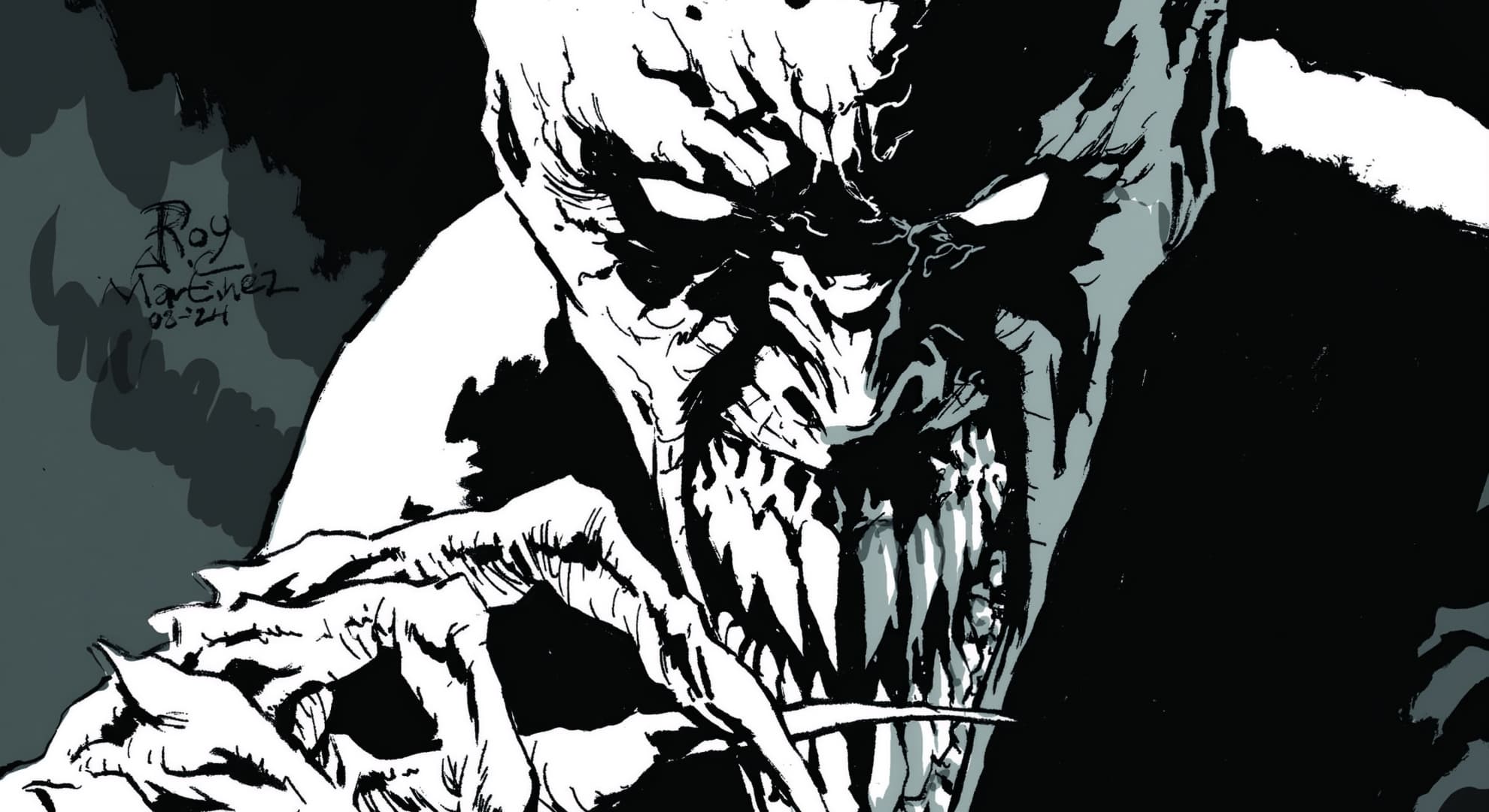


Bram Stoker’s Count is a predator of consent, drawing his victims toward him with cultivated charm before he feeds. Count Orlok, the creature F.W. Murnau and screenwriter Henrik Galeen built for the 1922 film ‘Nosferatu, a Symphony of Horror,’ offers no such courtship. His elongated fingers, his rigid gait, and the rats that travel in his wake root him in disease rather than desire, a visual grammar that treats vampirism as an infection carried into the ordinary world rather than a seduction staged within it.1
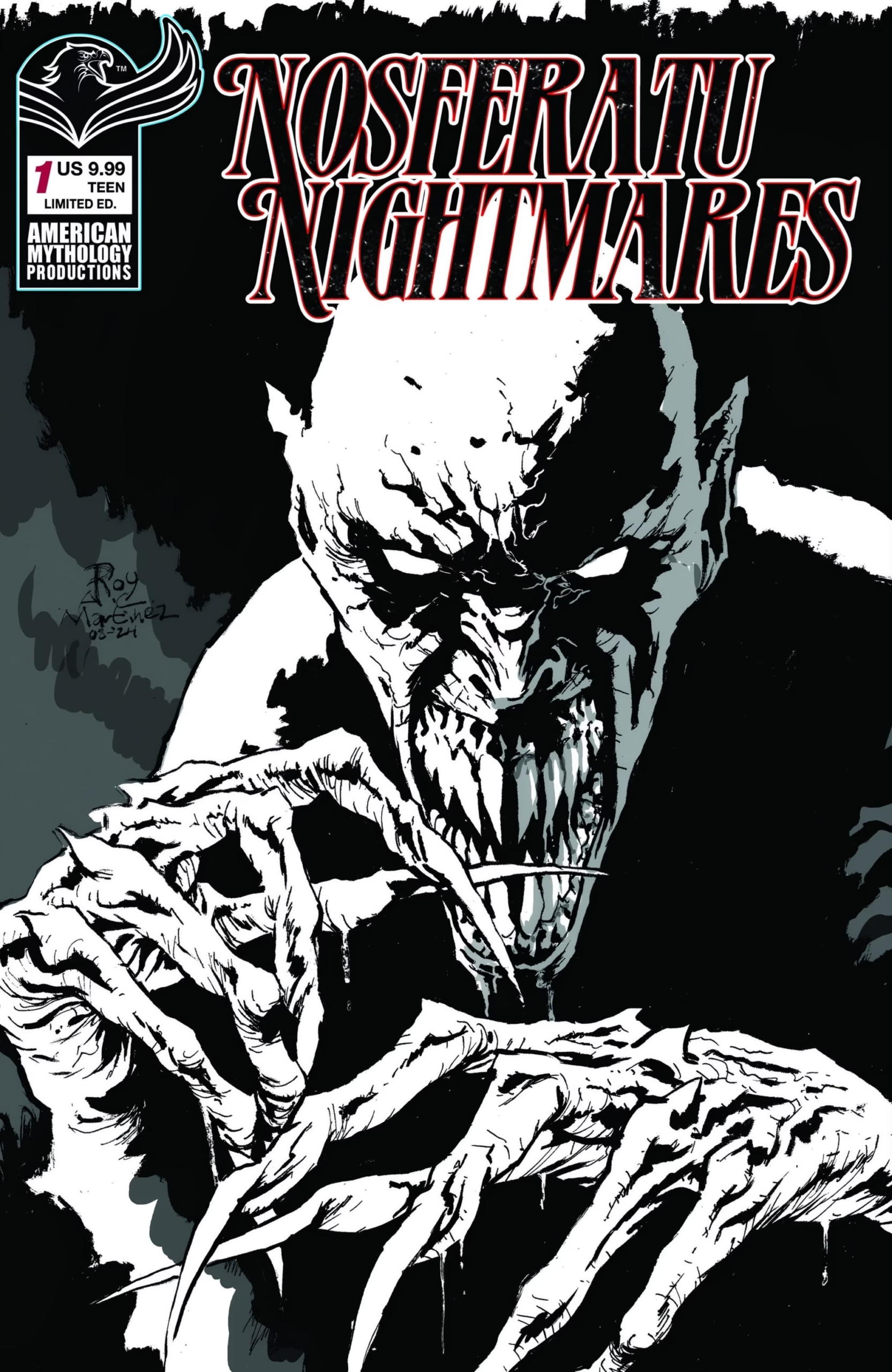
That distinction is what ‘Nosferatu Nightmares’ #1 returns to when it reaches comic shops on July 29th, 2026, from American Mythology Productions, priced at $4.99 USD, approximately COP 16,280, across 32 black-and-white pages, in four cover editions.
The word “nosferatu” carries less certainty than the film’s imagery suggests. Popular sources trace it to the Romanian “necuratul,” the unclean one, but the philological record does not confirm that path, and at least one documented linguistic study finds no verified Romanian source for the term as Stoker and later Murnau used it. The name may be closer to an invented word than a folkloric inheritance, which makes the monster’s terror a matter of image rather than etymology.2
An Anthology Without A Lead
Writers G.O. Parsons and James Kuhoric contribute stories to the anthology, joined by artist Emanuele Tommarelli. Kuhoric is also the publisher’s president, giving the lineup a rare instance of a company head writing inside his own horror line rather than only signing off on it.
Four artists supply the covers: Roy Allan Martinez on Cover A, Buz Hasson on Cover B, Neil Vokes on Cover C, and Andrew Mangum on Cover D, each staging Orlok in the sharp black-and-white contrast the anthology’s format is designed around.
A letterer had not been confirmed in the announced materials at the time of publication, nor had an editor. The anthology carries no colorist credit, the black-and-white presentation operating as the design choice itself rather than an omission, matching the monster-magazine format the solicitation names directly as its model.
Black And White By Design
The black-and-white monster magazine that the solicitation invokes has its own documented lineage in American comics. Forrest J Ackerman’s ‘Famous Monsters of Filmland’ established the format in 1958, and James Warren’s ‘Creepy’ and ‘Eerie’ carried it into narrative horror through the 1960s and 1970s specifically because black-and-white pages let Warren Publishing sidestep the Comics Code Authority, which regulated color comic books sold on newsstands but had no jurisdiction over black-and-white magazines.3
‘Nosferatu Nightmares’ borrows that same visual register decades after the Code’s authority collapsed, which makes the choice an aesthetic homage rather than the regulatory workaround it once was.
A Court Order That Failed
The 1922 film exists today only because a legal order meant to erase it did not succeed. Florence Stoker, widow of Bram Stoker and controller of his literary estate, sued the German studio Prana-Film over the unlicensed adaptation, and a court ruled in her favor in 1925, ordering every surviving print destroyed.4
Prana-Film had already gone bankrupt before the ruling, and by the time the destruction order reached enforcement, copies had already circulated to film societies and distributors outside German jurisdiction. Those unauthorized copies are the reason ‘Nosferatu’ survives at all, which makes the film’s current public-domain status a direct legal consequence of the same unlicensed circulation the court had tried to punish.
‘Nosferatu Nightmares’ inherits a character whose survival is itself a story of underground transmission, and the anthology’s cheap black-and-white pages, styled after the monster magazines that followed the film’s postwar rediscovery, extend that history of scrappy circulation rather than glossy studio polish.
American Mythology at Ten
Founded in 2016, American Mythology Productions carved a niche in licensed horror before expanding into family-oriented licenses and Edgar Rice Burroughs pulp adventures, a catalog that already included ‘Fright Night,’ ‘Return of the Living Dead,’ ‘Hatchet,’ and ‘Silent Night, Deadly Night.’
The 2025 bankruptcy of Diamond Comic Distributors disrupted the publisher’s direct-market presence along with much of the industry it served, and American Mythology returned to comic shop shelves in June 2026 through Prana Publishers and Lunar Distribution, timed to its tenth anniversary under Kuhoric, a former Bleeding Cool editor-in-chief and former Diamond director of purchasing.
‘Nosferatu Nightmares’ #1 lands in the publisher’s second month back within that restored distribution relationship, a horror anthology entering shelves just as the company itself works to reestablish its own place there.
Cheap Paper, Old Fears
What ‘Nosferatu Nightmares’ #1 argues, without needing to say so directly, is that the plague-vampire tradition survives best in cheap, disposable pages rather than prestige hardcovers. A publisher restoring its own distribution after an industry collapse, working within the same underground, bootleg-adjacent history that kept Murnau’s film alive, gives the anthology a symmetry its solicitation copy does not claim for itself.
Whether two writers working through a single artist’s line can sustain narrative unity across a single thirty-two-page anthology issue is the open question the book has yet to answer.
Does returning Nosferatu to cheap black-and-white pages recover the dread of Murnau’s plague-vampire, or does a two-writer script risk diluting the single vision that made Count Orlok frightening in the first place?
References
- Lotte H. Eisner, ‘The Haunted Screen: Expressionism in the German Cinema and the Influence of Max Reinhardt,’ trans. Roger Greaves (Berkeley: University of California Press, 1969), 96–103. ↩︎
- Katharina M. Wilson, ‘The History of the Word Vampire,’ Journal of the History of Ideas 46, no. 4 (1985): 577–583. ↩︎
- Amy Kiste Nyberg, ‘Seal of Approval: The History of the Comics Code’ (Jackson: University Press of Mississippi, 1998), 118–124. ↩︎
- David J. Skal, ‘Hollywood Gothic: The Tangled Web of Dracula from Novel to Stage to Screen’ (New York: Faber and Faber, 1990), 45–52. ↩︎


Leave a Reply