

Long before any doctrine offered comfort about what follows death, communities scattered across the northern forests pictured the departing soul as a bird: small, mortal, and shaped precisely for the crossing a human body could not survive. The image required no explanation. It only required the shape.
Finnish rune-singers carried that shape into the oral poetry later gathered into the Kalevala, where the traveler crosses into a realm the epic calls Tuonela and returns, if fortune allows, only with what the dead are willing to release. The crossing itself, in every version of the story, is the danger.
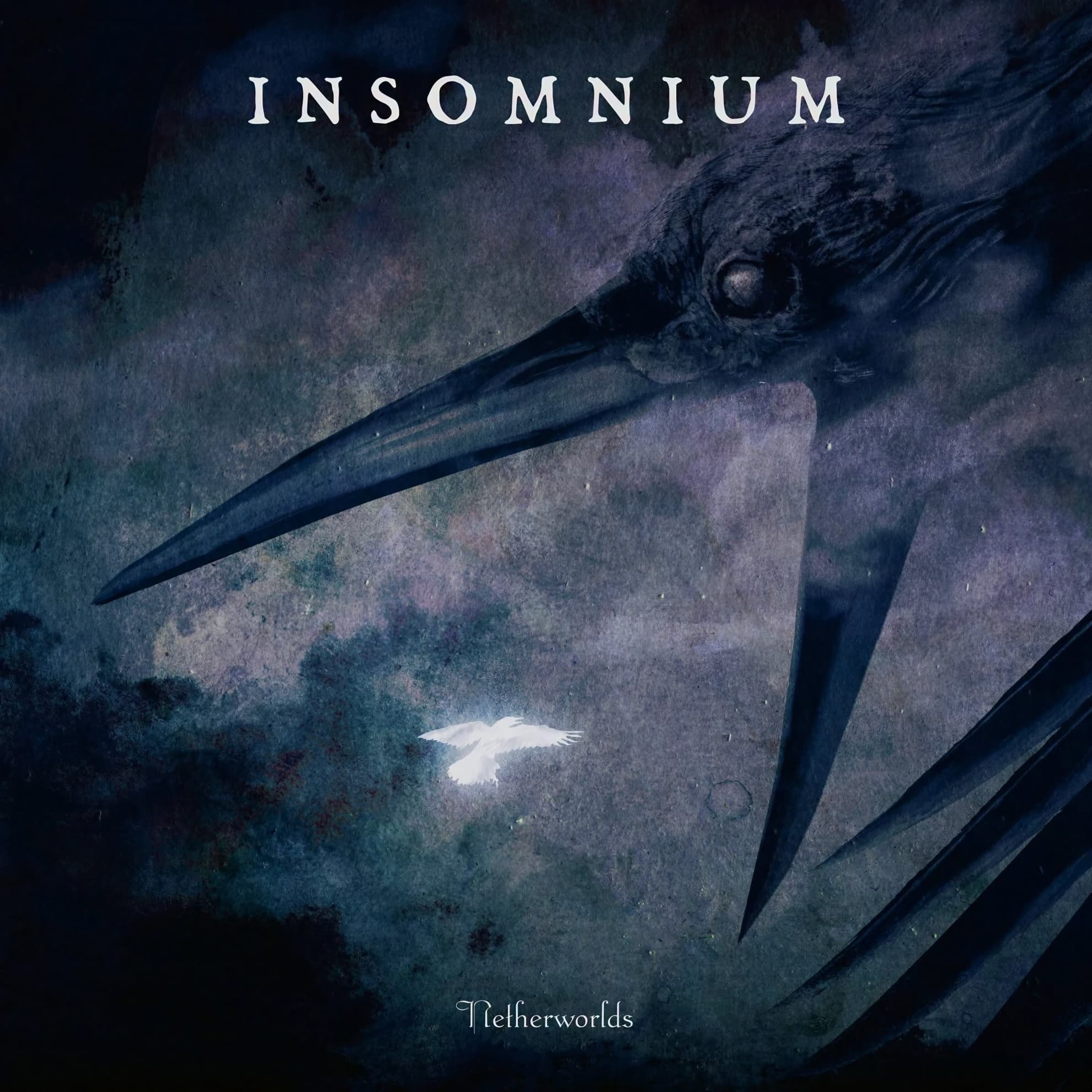
That same image, a solitary pale bird set against an enormous dark shape, now sits on the cover of a record from Joensuu, the Karelian town that has anchored the melodic death metal band Insomnium since 1997.
‘Netherworlds,’ the tenth full-length the band will release through Century Media Records in October 2026, is produced by Miiro Varjus and Insomnium and mixed and mastered by Jens Bogren, the Swedish engineer whose Fascination Street Studios has shaped two decades of Scandinavian extreme metal. Physical formats and the exact release date within October had not been confirmed at the time of publication.
The album follows ‘Anno 1696’ (2023), the witch-trial concept record that closed the chapter of Insomnium’s history built around guitarist Jani Liimatainen, and opens a different one: the first full-length to carry the credit of Tomy Laisto, the Turku guitarist who joined the band’s touring lineup after Liimatainen’s abrupt 2024 departure and was named a permanent member in January of 2026.
Two Doors in the Same House
‘Shadowlife,’ released June 17th, 2026, offers the only publicly available evidence of what ‘Netherworlds’ sounds like, and it earns close attention on those terms. Niilo Sevänen frames the opening image directly: “For I have only two doors left in this house. One leading to soothing sleep. The other to death.”
The two-door image is not a metaphor Sevänen introduces once and abandons. He described the song as an elegy not only for a lost beloved but for the fading belief that anything beautiful can remain untouched by time, framing the record’s opening statement as a suspension between longing and acceptance rather than a resolution of either.
Markus Vanhala, who wrote the track, described it in blunter terms as a deliberate attempt at an obvious hit, built to open the record with catchiness before what he called the deeper cuts follow. He noted that the tenth album marks a milestone for a band honoring its history while introducing new nuances, positioning ‘Shadowlife’ as the accessible threshold to a record that promises less immediate material behind it.
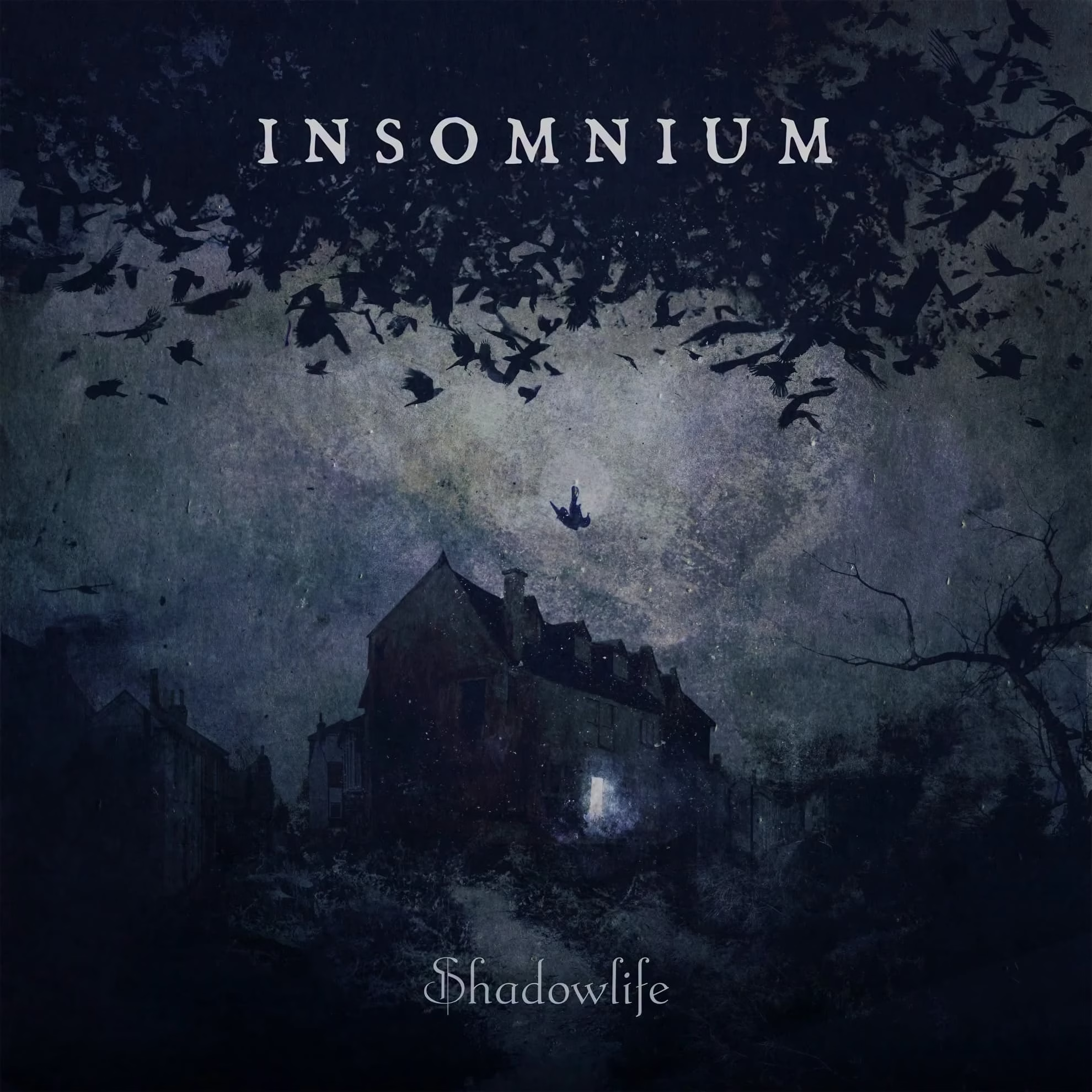
The published artwork for the single, credited to Travis Smith’s Seempieces studio, extends the same tension into image: a figure falls from the peaked roof of a house toward a small point of light while a mass of crows spills across the top of the frame. The image belongs to a recognizable convention within extreme metal cover art, in which mortality is rendered not through violence but through scale, the tiny figure dwarfed by an engulfing dark mass.1
A Circle from Turku
Tomy Laisto’s arrival completes a circle that predates his membership by two decades. His earlier band, Hateform, shared a rehearsal space with Insomnium in Joensuu in 2005, and Laisto has recalled the members of Insomnium borrowing his band’s bass equipment for the recording of ‘Above the Weeping World’ (2006).
Insomnium’s original guitarist, Ville Vänni, played alongside Laisto in that same Hateform lineup before Vänni’s own departure from Insomnium in 2011, a coincidence Laisto noted when he described joining the band as coming home after twenty-five years of friendship.
The immediate circumstances of his arrival were less settled. Jani Liimatainen, who had joined for ‘Heart Like a Grave’ (2019) and remained through ‘Anno 1696,’ became unreachable to the band in late 2023, and Laisto filled in for a single Zurich show on short notice before an extended run of touring commitments turned into a formal offer.
The band confirmed him as a full, official member and third guitarist on January 16th, 2026, returning Insomnium to a five-piece lineup for the first time since Liimatainen’s exit.
‘Netherworlds’ is therefore the first Insomnium album to carry Laisto’s writing and playing from the ground up rather than his presence as a touring stand-in, and the timing gives the record a specific kind of evidentiary weight: whatever direction the album takes, it takes with a lineup only recently stabilized after nearly two years of uncertainty.
Bogren Takes the Board
The production credit marks a genuine shift from the record immediately before it. ‘Anno 1696’ was mixed by Jaime Gomez Arellano at Orgone Studios in England and mastered separately by Tony Lindgren at Fascination Street Studios in Örebro, Sweden. ‘Netherworlds’ collapses that division: Jens Bogren, the studio’s founder, now handles both roles himself, working alongside Miiro Varjus and the band on production. The studio or studios where ‘Netherworlds’ was tracked had not been named in the material available at the time of publication.
Bogren’s documented body of work gives that credit specific weight. He mixed and mastered Opeth’s ‘Ghost Reveries’ (2005) and produced Amon Amarth’s ‘With Oden on Our Side’ (2006), records that helped define how melodic extremity could be recorded with clarity rather than murk.
Most directly relevant is Bogren’s relationship with Amorphis, the Finnish band whose own blend of melody and death metal aggression runs parallel to Insomnium’s across three decades of shared festival bills and touring circuits. Bogren produced, mixed, and mastered Amorphis’s ‘Under the Red Cloud’ (2015) and returned for ‘Queen of Time’ (2018), giving him a working familiarity with the tension between clean melody and extremity that a Finnish melodic death metal record will need to resolve.
Miiro Varjus brings a complementary, more local credential. A veteran of Amorphis’s own touring crew and a mixing engineer on the band’s live album ‘Queen of Time – Live at Tavastia’ (2023), Varjus also served as a recording and engineering technician on ‘Torn Away,’ the debut single from Cemetery Skyline, the gothic supergroup fronted by Dark Tranquillity’s Mikael Stanne that features Insomnium’s own Markus Vanhala on guitar, working alongside fellow engineers Alexander Backlund, Juho Räihä, and Santeri Kallio; the track’s production credit belongs to Cemetery Skyline collectively, with Backlund handling the mix. His presence places a second set of hands on the record who already understand the internal logic of Vanhala’s playing.
The Crow and the White Bird
The title ‘Netherworlds’ and the imagery surrounding its lead single point toward a specific, documented strand of Finnish belief rather than a generic gothic atmosphere.
In the mythology preserved through Kalevala-metre oral poetry, the land of the dead is called Tuonela, a realm bounded by a black river and ruled by Tuoni and his daughter Tuonetar. The epic’s central hero, Väinämöinen, travels there not as a conqueror but as a supplicant, seeking words and knowledge that only the dead possess. A swan patrols the river separating Tuonela from the living, and the poetry treats the boundary itself, not the realm beyond it, as the site of greatest danger.2
Underlying that transit is a belief documented across Finno-Ugric shamanic practice, in which the soul, or a shadow-portion of it, is imagined leaving the body in the form of a bird to make a journey a full human self cannot survive intact.
Scholars of Kalevala-metre poetry have traced the bird-soul image through the incantations of the tietäjä, the ritual specialists whose formulas guided such crossings, distinguishing the free-soul that travels from the sleeping or living body it leaves behind.3
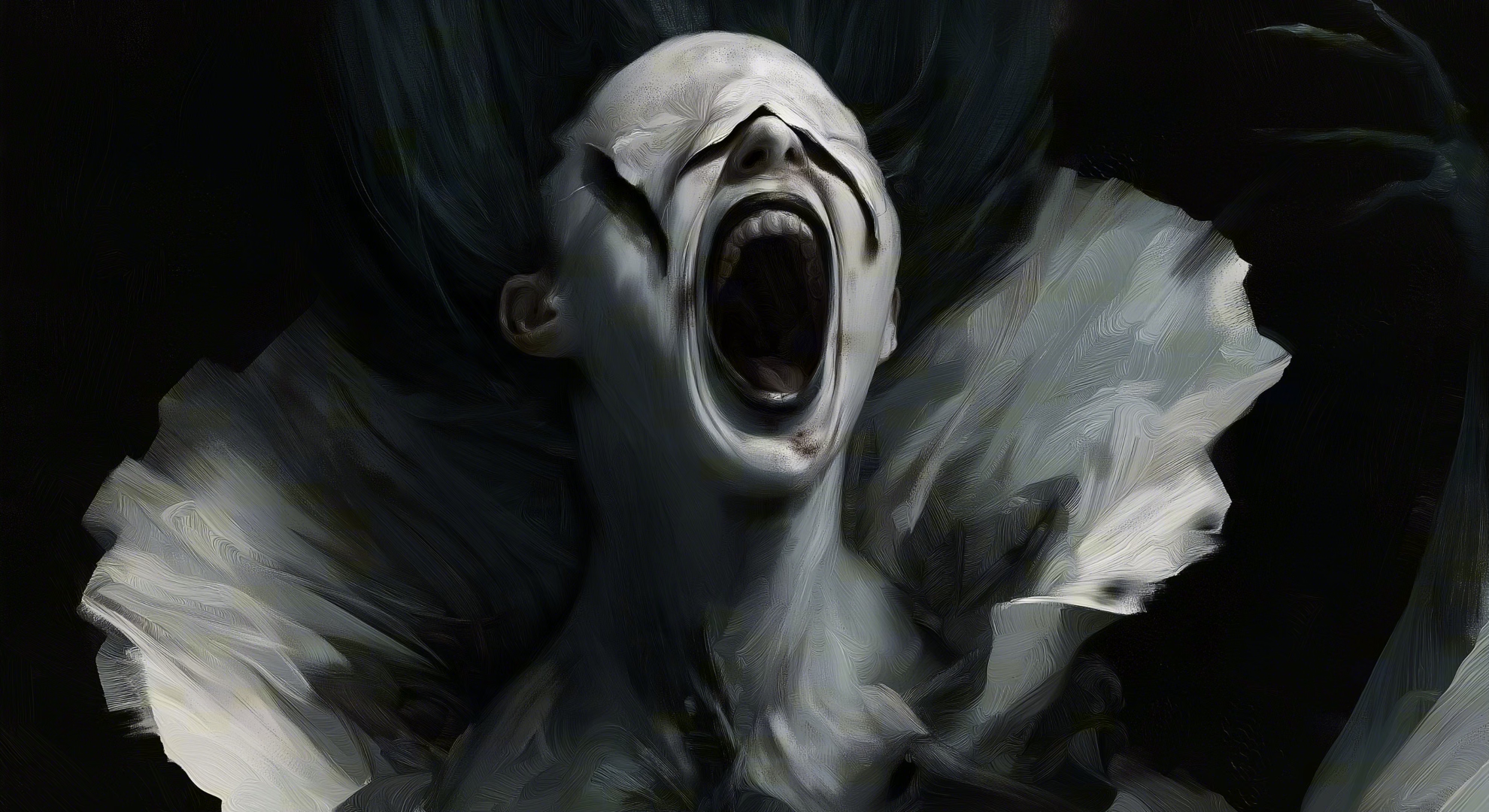
Set against that documented tradition, the published cover art for ‘Netherworlds,’ showing a single pale bird set against the vast dark shape of a crow, reads less as decoration than as a compressed illustration of the crossing itself. Whether the band has stated that connection directly had not been confirmed via official sources at the time of publication, though the visual vocabulary and the album’s plural title sit unmistakably inside this specific inherited image rather than a borrowed one.
Melancholy Beyond Karelia
Insomnium’s particular register, melody carried inside aggression rather than opposed to it, belongs to a documented lineage distinct from the harsher Norwegian black metal tradition or the theatrical excess of symphonic metal. Finnish melodic death metal built its identity in the 1990s and 2000s around bands willing to let despair sound beautiful, a formal choice legible to listeners with no direct tie to Finland’s winters or its internal debates.
That legibility carried the genre outward well before streaming made global circulation effortless. Scholarship on the internationalization of Finnish heavy metal has traced how the domestic music press narrated the export of bands like Insomnium’s own contemporaries as evidence of a national sound distinct enough to travel, a framing that shaped how international audiences received Finnish melodic death metal as a coherent tradition rather than a scattering of individual acts.4
For extreme metal audiences outside Scandinavia and Finland, the genre’s appeal has rarely rested on any claimed access to a specifically Finnish experience. It rests instead on the transferable shape of the emotional argument: grief rendered with craft rather than shock, melody used to carry weight rather than to soften it. A record that stages its title as a crossing into multiple netherworlds, rather than a single named place, extends that transferability rather than narrowing it.
The Cost of Crossing Over
None of what ‘Netherworlds’ will sound like across its full length can be assessed from a single confirmed track. What can be assessed is the shape of the evidence Insomnium has placed in public view: a title drawn from a documented mythological plurality, a production credit that shifts creative authority toward an engineer whose Finnish and Scandinavian body of work sits directly beside the band’s own, and a lineup only recently returned to full strength after an unsettled two years.
Whatever the record does across its full run of tracks, still unconfirmed at the time of publication, it does so as the first complete statement from a five-piece Insomnium, and as a record whose governing image, a lone bird measured against an engulfing dark shape, belongs to a specific inherited tradition of thinking about the passage out of life rather than to interchangeable gothic imagery borrowed without context.
October 2026 will settle what the deeper cuts Vanhala promised actually contain. Until then, the evidence already in circulation, one song, one lineup change, one shift in whose hands shape the final mix, argues for a record built with deliberate weight around the documented act of crossing over.
Insomnium have spent three decades setting grief inside melody rather than against it. Does a title built from a documented Finnish image of the soul’s crossing change how that melody lands for listeners who reach the record with no prior attachment to Kalevala tradition, or does the shape of loss it stages need no inherited myth to be understood?
References
- Natalie J. Purcell, ‘Death Metal Music: The Passion and Politics of a Subculture’ (Jefferson, NC: McFarland, 2003), 45–49. ↩︎
- Juha Pentikäinen, ‘Kalevala Mythology, trans. Ritva Poom,’ expanded ed. (Bloomington: Indiana University Press, 1999), 66–72. ↩︎
- Anna-Leena Siikala, ‘Mythic Images and Shamanism: A Perspective on Kalevala Poetry,’ FF Communications 280 (Helsinki: Suomalainen Tiedeakatemia, 2002), 210–216. ↩︎
- Toni-Matti Karjalainen and Eero Sipälä, ‘Tunes from the Land of the Thousand Lakes: Early Years of Internationalization in Finnish Heavy Metal,’ in ‘Global Metal Music and Culture,’ ed. Andy R. Brown et al. (London: Routledge, 2016), 210–218. ↩︎

Leave a Reply