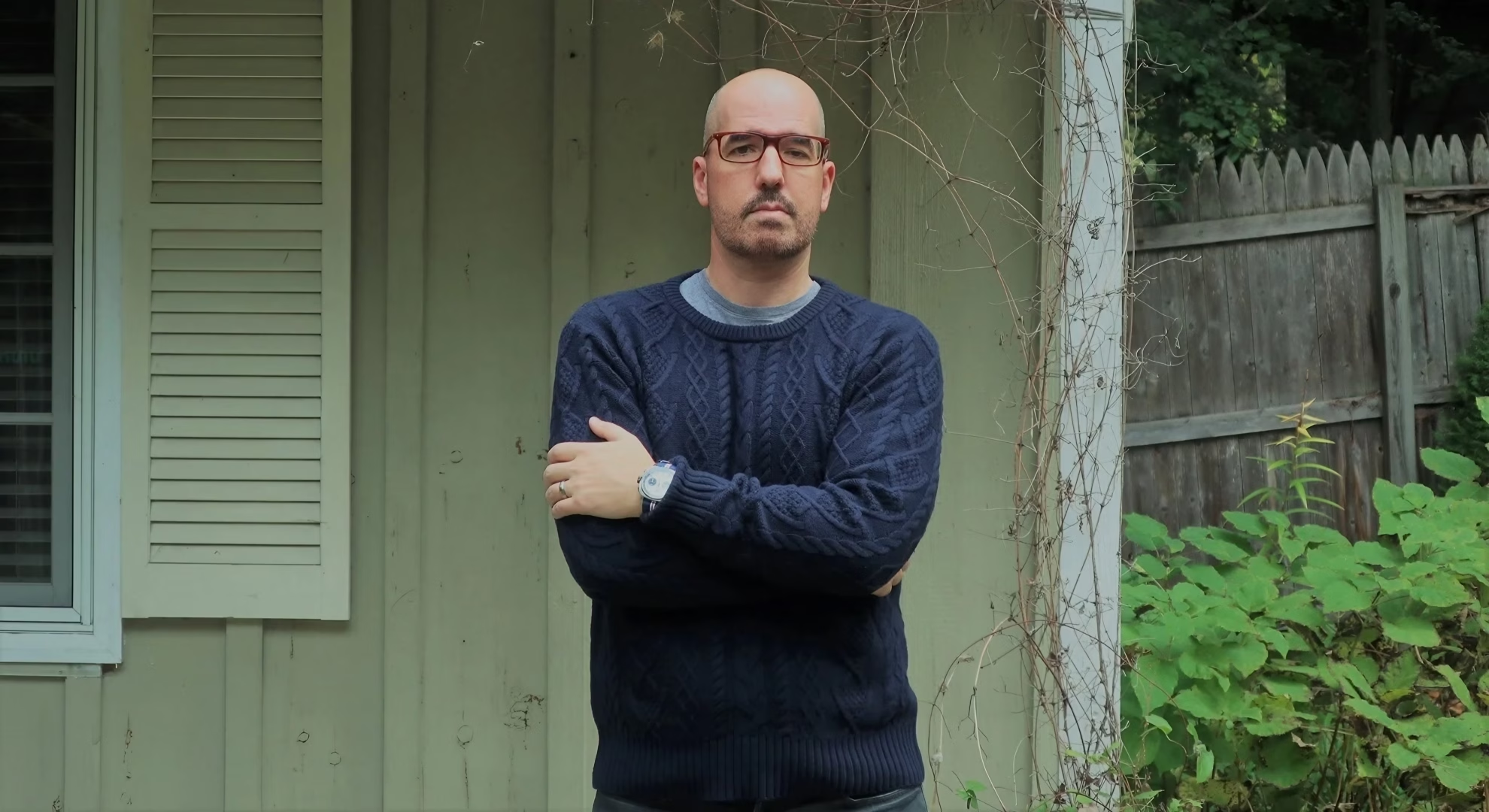


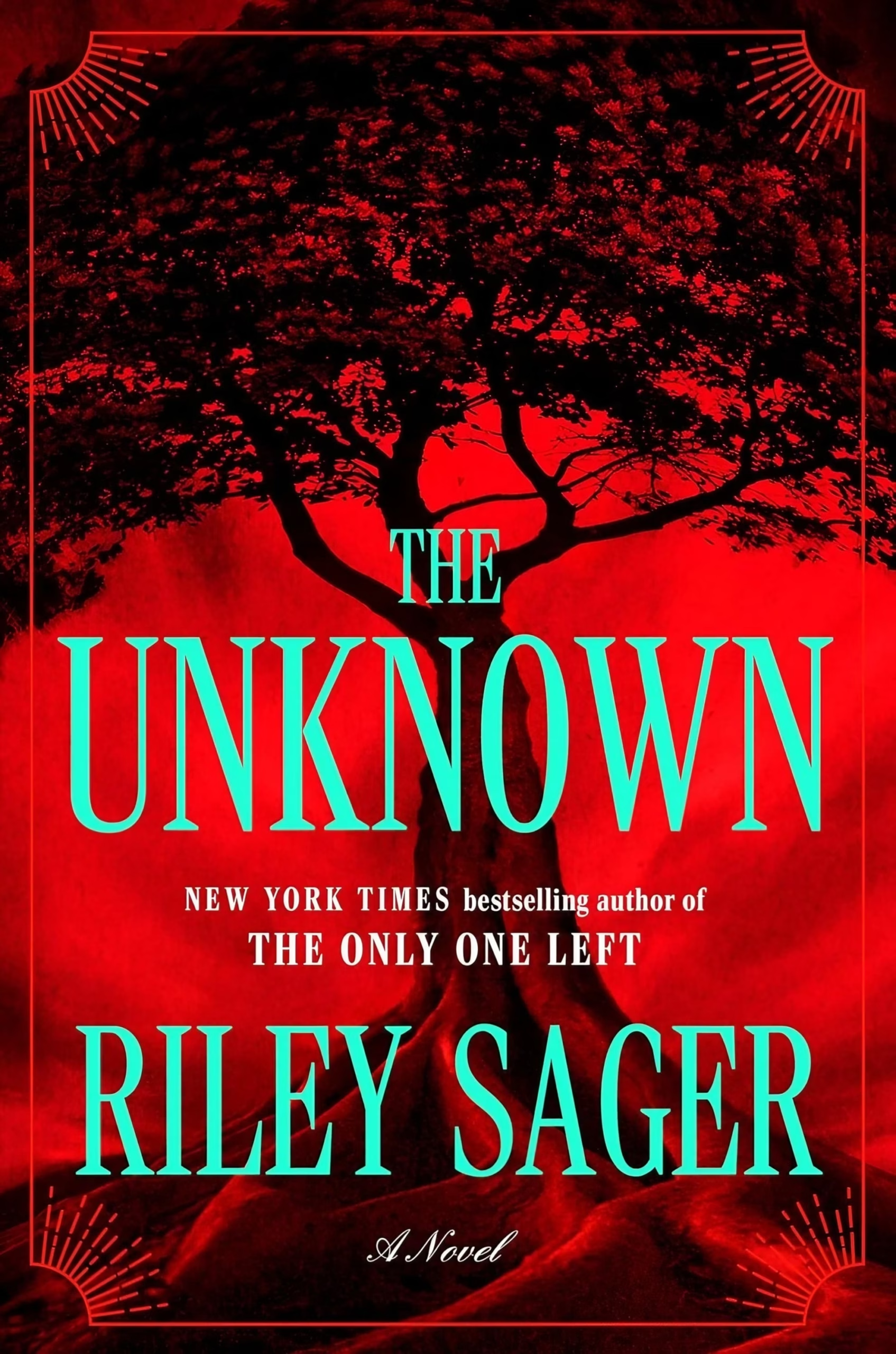
A crew of five actresses, a director chasing his first genuine hit, and an island that has kept a century-old secret — that is the configuration Dutton sends into print on August 4th, 2026, when ‘The Unknown’ becomes the tenth novel Todd Ritter has published under his pen name, Riley Sager.
The hardcover runs 368 pages under ISBN 979-8-217-04409-2, standing apart from any series — a further entry in a body of work that has, since ‘Final Girls’ introduced Sager to readers in 2017, returned again and again to women who survive what others did not.
New Avalon, the island at the center of ‘The Unknown,’ gives that pattern a specifically occult frame. A century before the novel opens, the island served as a commune for spiritual mediums; in 1926, all five of its residents disappeared during a séance that, by the account the book’s own synopsis gives, went wrong.
Only five dresses, hung from an old oak tree, remained. That premise — vanished women, an occult ritual, a legend the surviving record cannot settle — places ‘The Unknown’ inside supernatural thriller territory the horror tradition has always claimed as its own, alongside séance fiction, missing-persons folklore, and the found-document ghost story.
A Cast Sent to New Avalon
Struggling actress Marin Keane is the character through whom the present-day half of the novel runs. She lands the lead role in a film that dramatizes the New Avalon disappearance, cast opposite an established star, Violet Wright, and under the direction of Ronan Peters, whose approach to the project involves more than ordinary rehearsal.
The production requires its cast to spend a week on New Avalon itself, living and dressing as the five vanished women did, an immersion method that collapses the distance between reenactment and repetition before a single scene is filmed.
That collapse is the novel’s engine. Strange noises reach the cast at night; symbols the previous occupants left behind turn up around the island; a medical emergency strands the production on New Avalon with its means of communication gone. What the publisher’s own synopsis withholds — deliberately, as a forthcoming title — is whether the danger is a person working to sabotage the production or the island’s occult history reasserting itself.
‘The Unknown’ declines to answer that question before publication, and any assessment of how it resolves waits for readers who can turn every page.
The Vanishing of 1926
The historical strand belongs to Daisy Rue, one of the five women who disappeared from New Avalon in 1926 and the role Marin is cast to play. Rue left behind a diary, and the novel’s marketing has made that document central to its structure: Marin turns to Daisy’s own words in an attempt to establish what happened to her before the production repeats it.
Some islanders, according to the book’s official description, believed the five women left New Avalon by choice. Others believed they were killed. Neither theory found the kind of evidence that would settle the matter, and the five dresses on the oak tree remain the disappearance’s only physical trace.
The choice to make a spiritual commune’s fate turn on a botched ritual gives ‘The Unknown’ access to a specific vein of American occult fiction, one where the failure of a ceremony designed to contact the dead becomes the mechanism of the story’s harm rather than its resolution. The séance, in this tradition, is not staged for atmosphere alone; it is the hinge on which the plot’s disappearance and reappearance both turn.
Sager’s Recurring Method
Sage’s catalog has established a formal pattern this novel extends rather than departs from. ‘The Only One Left,’ his 2023 novel built around a Lizzie Borden-adjacent case of accused matricide, and ‘Middle of the Night,’ his 2024 return to a childhood disappearance decades removed from its present-day narration, both work through a documented past that the living characters must reconstruct using fragments the record left behind.
‘The Unknown’ follows that same design: a 1926 disappearance, recovered in the present through a diary rather than an interview or an archive, with the reconstructive work assigned to a character who did not live through the original event.
What distinguishes the new novel’s use of that design is the specific role assigned to its investigator. Marin does not simply read Daisy Rue’s diary; she performs Daisy Rue on camera, a doubling that puts a living woman inside a dead one’s identity for the length of a film shoot. That arrangement gives ‘The Unknown’ a structural relationship to a lineage older than Sager’s own bibliography.
Diaries, Documents, Dread
Charlotte Brontë’s ‘Jane Eyre,’ published in 1847, first gave English fiction the shape of a woman measured against a predecessor she can never fully see: Bertha Mason, confined and unnamed for most of the novel, shadows Jane’s engagement without ever speaking for herself.
Daphne du Maurier’s ‘Rebecca,’ in 1938, made that comparison the entire novel, following a nameless second wife who cannot escape the presence of the woman who came before her at Manderley. ‘The Unknown’ inherits that same structure and gives it a literal frame: Marin is cast, quite deliberately, to become Daisy Rue for a production and a public that both prefer the dead woman’s story over the living one telling it.
The diary itself belongs to a separate but related device — the recovered document that carries a truth the present cannot otherwise access. That device runs through Gothic fiction wherever a manuscript, letter, or journal survives its author to indict the living.
Sager’s choice to give the device to a woman who disappeared under an occult ritual rather than a domestic crime places ‘The Unknown’ closer to supernatural horror’s found-document tradition than to the straightforward psychological suspense of his earlier work.
Vermont’s Real Disappearances
New Avalon is invented, but the state around it is not, and Vermont carries its own documented history of disappearances that resist explanation.
Southwestern Vermont, centered on Glastenbury Mountain, saw a string of unsolved vanishings between 1945 and 1950 — Middie Rivers, Paula Welden, James Tedford, Paul Jepson, and Frieda Langer among them — that the writer Joseph A. Citro named the Bennington Triangle in 1992. Citro’s ‘Green Mountain Ghosts, Ghouls & Unsolved Mysteries’ collected the case alongside the rest of the state’s documented folklore two years later, and the term has outlasted every theory advanced to explain the disappearances themselves.1
Sager, whose earlier novels have drawn on a Lizzie Borden-era case and other documented American crime, works in territory Citro’s book already occupies: real regional folklore treated as a foundation sturdy enough to support invented plot. New Avalon did not disappear anyone in 1926, but the county that surrounds it has a genuine record of vanishings the state’s own investigators never closed.
Spiritualism’s American Ground
The commune of spiritual mediums that ‘The Unknown’ places on New Avalon is not an invention without precedent. The modern Spiritualist movement in the United States is conventionally dated to 1848, when the Fox sisters of Hydesville, New York, reported communicating through rapped code with the spirit of a murdered peddler, a claim that spread within a year into an organized movement of mediums, séance circles, and permanent communities built around contact with the dead.2
Lily Dale, in western New York, and Cassadaga, in Florida, both trace their founding to that same nineteenth-century movement and remain active Spiritualist communities today, evidence that the commune structure ‘The Unknown’ assigns to New Avalon reflects a documented American religious practice rather than an invention built purely for the plot.
Locating a fictional commune’s failure inside that real tradition gives ‘The Unknown’ a historical floor the disappearance can stand on. A séance that goes wrong is not, in the context of documented Spiritualist history, an arbitrary genre device; it is the failure mode of a practice millions of Americans took seriously for the better part of a century.
An Island That Keeps Returning
‘The Unknown’ asks a version of the question every disappearance narrative eventually poses: whether the living can recover what happened to the dead without repeating it.
Sager builds that question on ground two traditions already occupy — American Spiritualism’s documented history and Vermont’s own unresolved vanishings — and adds to it the specific modern discomfort of a film production that turns a real tragedy, however fictionalized, into content for an audience.
New Avalon’s five women disappeared without an audience watching. Marin Keane’s disappearance, should the novel allow one, would happen with cameras already rolling.
Given how closely ‘The Unknown’ ties its invented commune to the documented history of American Spiritualism and Vermont’s own unsolved disappearances, does grounding an occult premise in real regional folklore deepen a supernatural thriller’s effect, or does it risk borrowing more credibility from the historical record than an invented ritual can earn back?
References
- Joseph A. Citro, ‘Green Mountain Ghosts, Ghouls & Unsolved Mysteries’ (Boston: Houghton Mifflin, 1994), 112–119. ↩︎
- Ann Braude, ‘Radical Spirits: Spiritualism and Women’s Rights in Nineteenth-Century America,’ 2nd ed. (Bloomington: Indiana University Press, 2001), 10–14. ↩︎


Leave a Reply