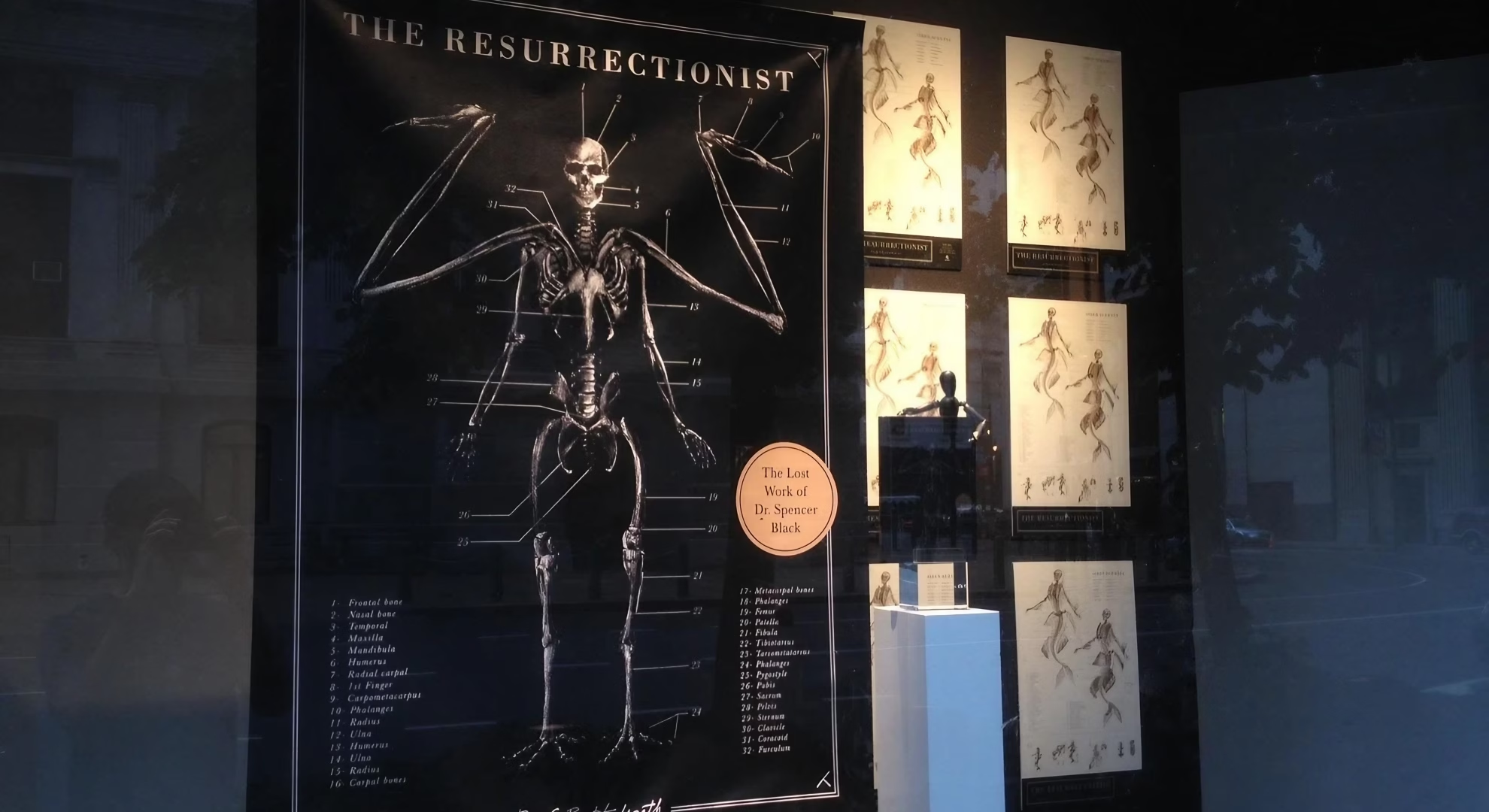


An anatomical atlas carries its own claim to authority before a reader reaches a single sentence of argument. The plate, the labeled cross-section, the clinical caption — these were the visual instruments the nineteenth century used to render a body legible, and in the hands of the period’s teratologists, they were also the instruments used to render a body monstrous.
E. B. Hudspeth’s fiction has always worked by inhabiting that visual language rather than describing it from outside, and his second novel asks the same instruments to answer a different question: who gets to decide, once a body has been catalogued as an anomaly, whether it has found a sanctuary or a spectacle.
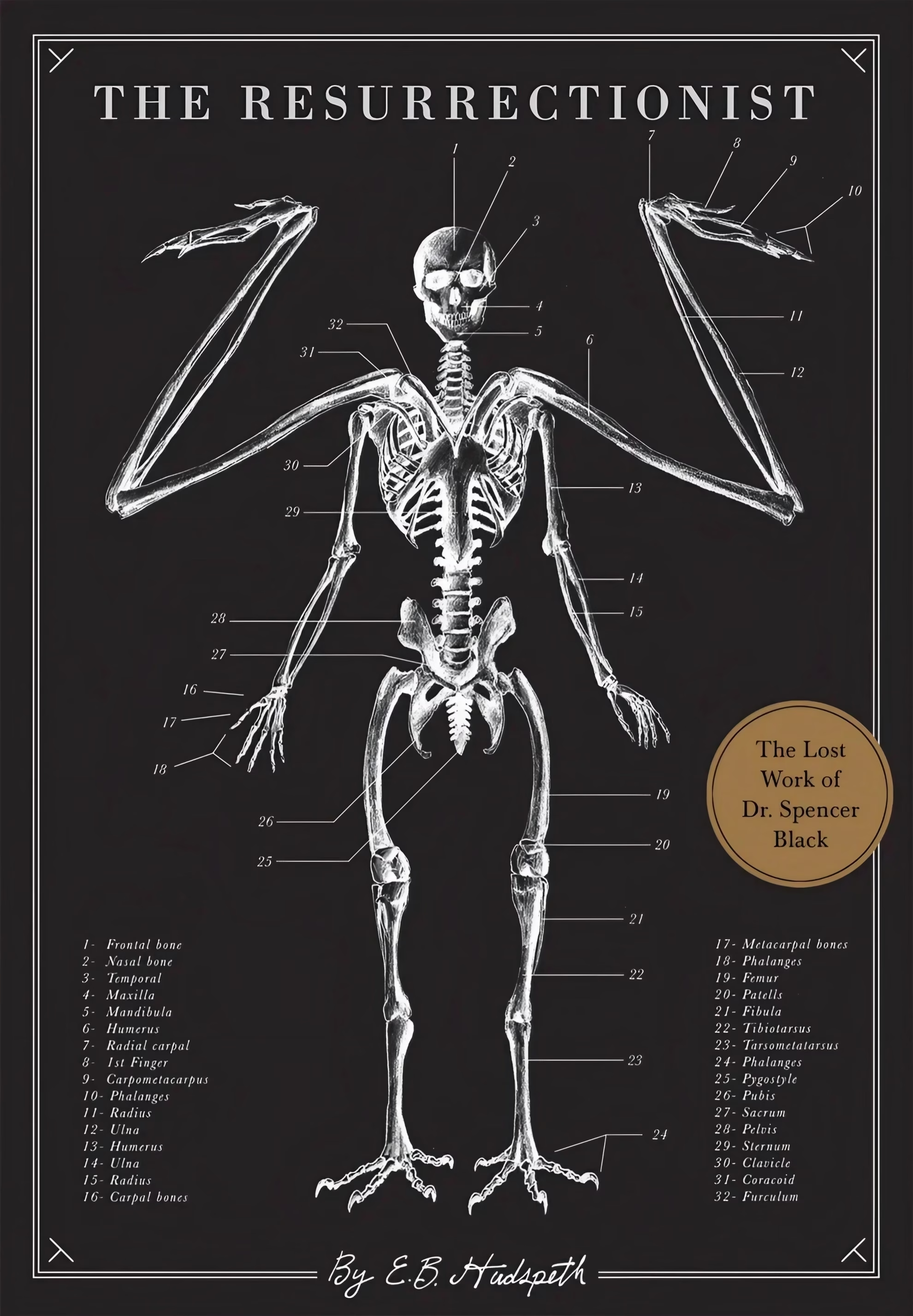
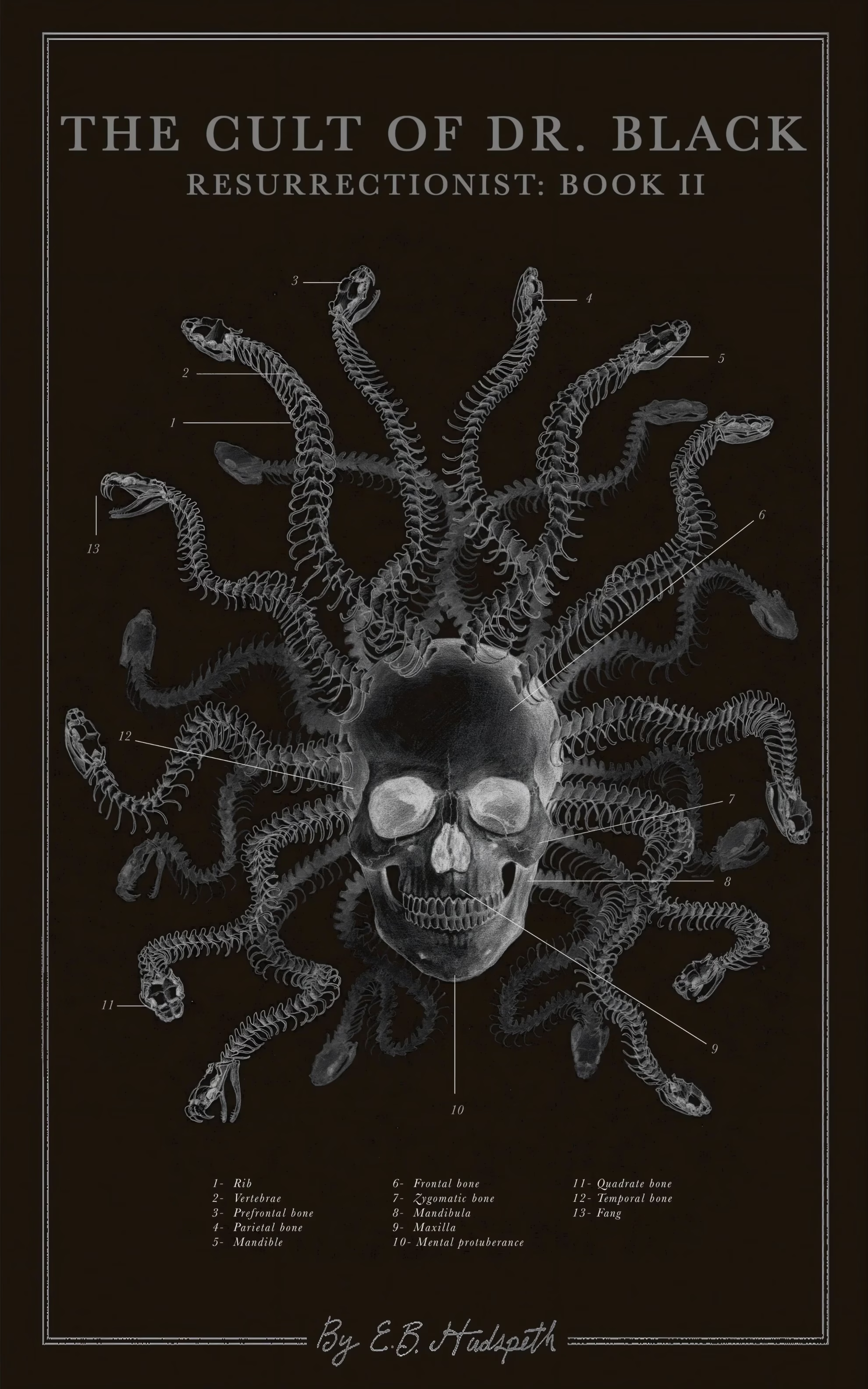
Blackstone Publishing releases ‘The Cult of Dr. Black’ on September 8th, 2026, in a 302-page hardcover carrying the ISBN 9798228364455. The novel is the long-delayed sequel to Hudspeth’s 2013 debut, ‘The Resurrectionist: The Lost Work of Dr. Spencer Black,’ published by Quirk Books in a 192-page hardcover under ISBN 9781594746161, and it continues the illustrated codex format that made the earlier book a documented object of interest within contemporary dark fantasy and horror publishing.
A Codex Left Unfinished
‘The Resurrectionist’ presented itself as a recovered archive: a fictional biography of Dr. Spencer Black, a Philadelphia surgeon and the son of a grave robber, paired with Black’s own supposed magnum opus, ‘The Codex Extinct Animalia’ — an illustrated atlas arguing that mermaids, satyrs, minotaurs, and other mythological hybrids were not invention but evolutionary throwbacks, and that human deformity was the body’s attempt to revert to those earlier hybrid forms.
The biography closed with Black’s disappearance after his theories, his surgeries, and his public exhibitions of the results cost him his career, his family, and eventually his son Alphonse.
‘The Cult of Dr. Black’ resumes that unfinished account. According to Blackstone’s confirmed synopsis, the sequel follows Black past the disappearance that closed the first volume, into a period in which he abandons pure anatomical practice for a fusion of machinery and medicine, attempting to engineer new bodies capable of leading humanity into what the publisher’s copy calls a golden age of immortality and perfection.
The word spread by that project becomes the Noumenon, a community Blackstone describes as open to acolytes “regardless of faith, ethnicity, creed, or state of health,” and it draws followers from across the United States into Black’s continuing experiment.
A Discipline Named for Monsters
Hudspeth’s fiction borrows its authority from a genuine nineteenth-century science, and the sequel’s title places that borrowing in sharper focus than the first book’s did. Teratology, the formal study of congenital anomaly, took its name and its disciplinary shape from French naturalist Isidore Geoffroy Saint-Hilaire, who coined the term in his 1832 treatise on structural anomalies in humans and animals, extending comparative work his father, Étienne Geoffroy Saint-Hilaire, had begun decades earlier.
The distinction matters to any account of Hudspeth’s source material: it was the son, not the father, who converted centuries of “monstrous birth” superstition into a taxonomy — malformation as classifiable variation rather than divine punishment or supernatural omen.
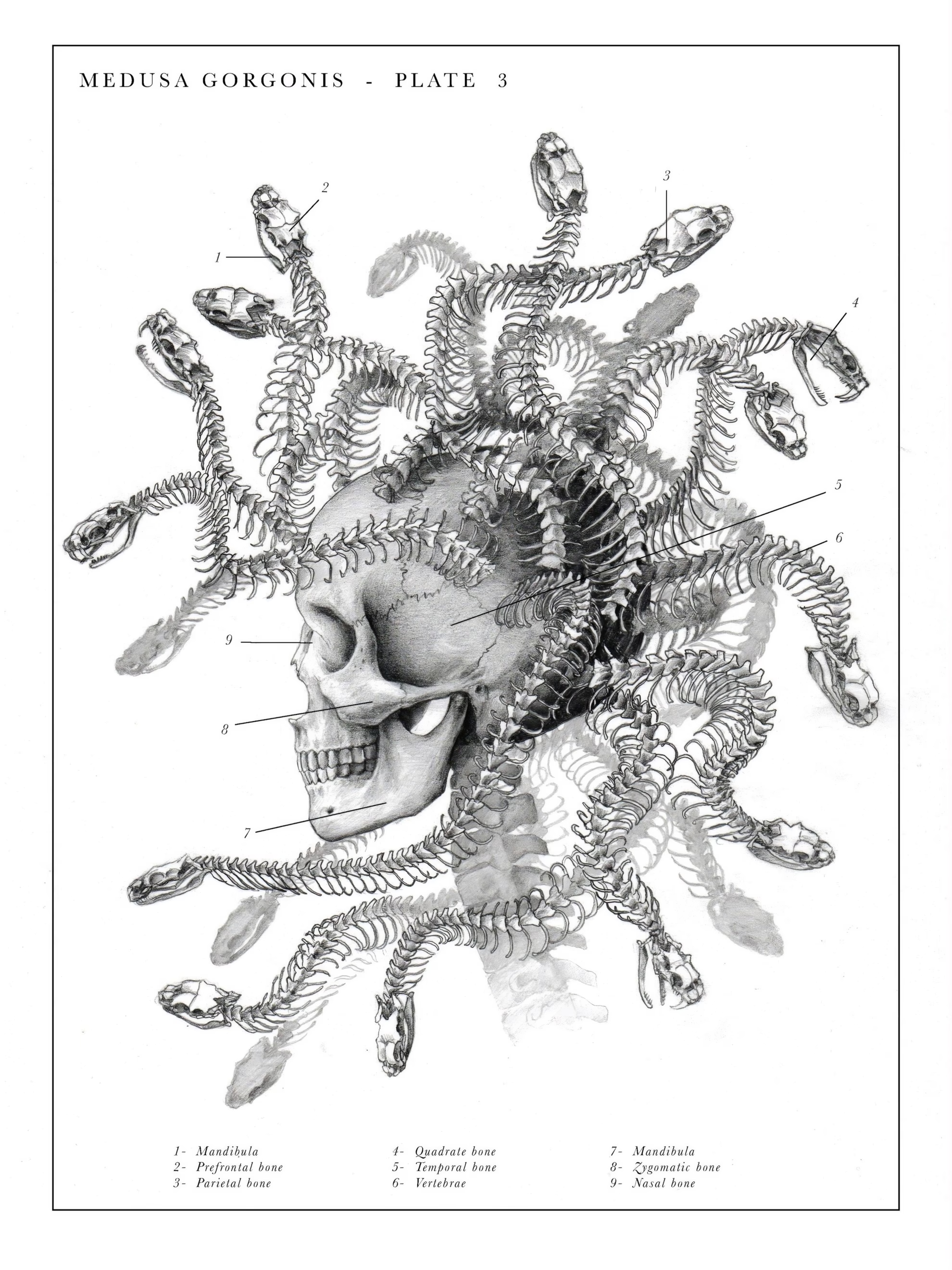
That reclassification is the historical hinge Hudspeth’s fiction turns on twice now. Dr. Spencer Black’s insistence, across both books, that deformity records an evolutionary memory rather than a defect is a fictional extension of the same nineteenth-century impulse that produced teratology as a discipline: the conviction that the anomalous body could be studied, mapped by category, and understood on its own terms rather than dismissed as an aberration.
The Trade Behind the Atlas
The other documented history ‘The Cult of Dr. Black’ inherits from its predecessor is less scientific and considerably more criminal. Before Britain’s Anatomy Act of 1832, the only cadavers legally available to surgeons and anatomical schools were those of executed criminals, a supply that never matched demand; the resulting trade in illegally exhumed corpses, carried out by so-called resurrection men, supplied the dissection tables on which much of the century’s anatomical knowledge, however illicitly, took shape.1
Hudspeth’s Black is explicitly the son of a grave robber, and the first book’s account of his medical training treats that inheritance as formative rather than incidental — the anatomist’s craft descending directly from the trade the Anatomy Act was written to replace.
The sequel’s turn toward machinery does not abandon that inheritance so much as modernize it. Where the resurrection men supplied raw material for an anatomist working with a scalpel, Black’s fictional project in the new book supplies raw material — Alphonse’s notebooks, the guiding texts of the Noumenon, newspaper clippings documenting the community’s growth — for an anatomist working with engineering. The trade in bodies becomes, in the sequel’s confirmed premise, a trade in the promise of bodies remade.
Sanctuary Instead of the Sideshow
The clearest argument ‘The Cult of Dr. Black’ appears positioned to make, on the evidence of its confirmed synopsis, is an inversion of how the nineteenth century actually treated anomalous bodies in public. Real teratological subjects were displayed in cabinets of curiosity and traveling exhibitions as objects of both fascination and moral instruction, framed for audiences as warnings about the fragility of normal form rather than as people with an ordinary claim on welcome.2
A community that Blackstone’s own copy describes as open “regardless of faith, ethnicity, creed, or state of health” reads, against that documented history, as a direct reversal of the sideshow logic Black’s world would otherwise seem to invite: not a stage on which deformity is displayed for a paying crowd, but a settlement that admits the deformed as its founding population.
Whether the finished novel sustains that inversion as a critique of the sideshow tradition, or lets Black’s messianic machinery curdle the sanctuary back into a version of the spectacle it claims to reject, is a question the confirmed synopsis raises without answering.
The publisher’s account is explicit that the golden age Black promises the Noumenon comes at “great cost,” which suggests the novel intends to interrogate rather than simply inhabit the premise of a community organized around a cure for deformity.
A Book Assembled From Fragments
Structurally, Blackstone’s description places ‘The Cult of Dr. Black’ within the same documentary form that distinguished ‘The Resurrectionist’: the publisher confirms the book is assembled from anatomical drawings, notebook fragments attributed to Alphonse, newspaper clippings, and the Noumenon’s own guiding texts, continuing the archival-fiction method rather than shifting to a conventional first-person or omniscient narrative.
Hudspeth remains both author and illustrator across the two-book project, a dual role documented since his years as a sculptor in Pietrasanta, Italy, where the anatomical drawings that became the seed of ‘The Resurrectionist’ originated.
Formal assessment of how the sequel’s prose and pacing execute that documentary structure awaits the book’s September publication; the fragmentary, multi-document form itself is confirmed by the publisher and consistent with the method the first book established.
The cover artist for the sequel had not been separately confirmed at the time of writing, though Hudspeth’s own account of the book credits its full-color illustrations and artwork to himself, consistent with his role as the sole credited artist across both volumes.
The Codex Still Being Written
What ‘The Cult of Dr. Black’ proposes, before a single reader outside its publisher has assessed the finished prose, is that the documentary horror Hudspeth assembled from a genuine nineteenth-century science has not exhausted what that science can argue.
Teratology gave the anomalous body a taxonomy; the resurrection trade gave anatomists their raw material; the cabinet of curiosities gave both a public stage. Hudspeth’s fiction has spent 13 years assembling a world in which all three inheritances converge on one family, and the sequel’s confirmed premise suggests it intends to ask whether a community formed to shelter the anomalous body can avoid becoming another version of the stage that once displayed it.
Given how directly ‘The Cult of Dr. Black’ inherits its historical material from documented teratology, resurrection-era anatomical science, and the exhibition culture that displayed both, does a fictional community formed explicitly as a refuge for deformity read as a genuine departure from that exhibition tradition, or as a more sympathetic staging of the same impulse to put the anomalous body on display?
References
- Ruth Richardson, ‘Death, Dissection and the Destitute’ (Chicago: University of Chicago Press, 2000), 34–58. ↩︎
- Rosemarie Garland-Thomson, ‘Extraordinary Bodies: Figuring Physical Disability in American Culture and Literature’ (New York: Columbia University Press, 1997), 55–80. ↩︎


Leave a Reply